WOW. Isn’t this the truth? Hasn’t the truth of this been smeared all over Facebook and Twitter the last, well, a long time, but especially the last four to five years?
The context of this quote (which actually comes from one of Pope Francis’ homilies) is how the global economy has been trying to remove “human costs,” and to rely on free market to keep everything “secure.” The pandemic, he says, makes it clear that we have to worry about people again. At the end of the paragraph he talks about rethinking lifestyle and relationships–which is something we all experienced this past spring–and also societal organization, ending with a call to rethink the meaning of life.
On days when I ride out to the Missouri River, I often take the book The Ignatian Adventure (Kevin O’Brien, S.J.) to guide reflection and prayer. Yesterday, the Scripture verse was Jesus asking, “What are you looking for?”
Instantly, I thought: “Peace.”
Then I thought: “No, it can’t be that easy.”
As previously established on this blog, my Enneagram personality type is #1, The Crusader. I am hyper-aware of everything in the world that is NOT AS IT SHOULD BE, and I feel if I do not expand my last drop of energy attempting to fix it, I am derelict in my duty. I am very hard on others, but I’m harder on myself. Integrity tops the list of traits I value most.
None of this facilitates a peaceful spirit.
Further complicating the acquisition of a peaceful spirit is the sheer intensity of family life in a time of division and pandemic. Peace, for me, is achieved in solitude and quiet. These days, solitude is hard to come by. I walk around my house all day turning off things people turned on, closing doors they opened, yelling at them to put away things they got out and left (food, dishes, dirty socks, electronics, you name it), and to quit annoying each other out of sheer boredom… and (let’s call a spade a spade) boy mischief.
And all of you who are out there feeling smug right now about “well, if you’d just teach them,” just remember how resistant your own kids are/were to the lessons you tried to teach. And imagine being stuck in a house for seven-plus months trying to correct such patterns with people whose mental health is as precarious as your own, during one of the most blisteringly, ugly, divisive times our country has ever experienced.
So yes. When Jesus asks, “What are you looking for in following me?” the honest answer is: “peace.” The peace that comes from assurance that everything is going to be okay, and not just someday on the far side of death, but here, in this world. This beautiful, fragile, fractured world given to us as practice for Heaven.
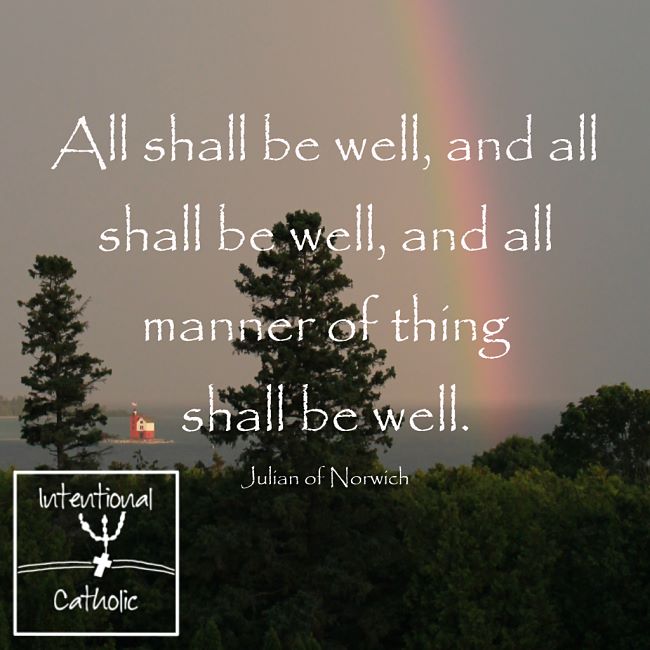
I love this quote from Julian of Norwich. It is so comforting–except when people use the quote to suggest that we shouldn’t be worrying about solving real world problems because the only thing that matters is what comes later. As if you’re ever going to be allowed INTO the world beyond without working for its realization on this side of the great divide.
And yet, also, I have been slowly waking to a new insight, these past weeks. Sometimes situations are so messed up, there IS no human solution. The division in America, for instance. No matter who wins this election, the problem at the foundation isn’t going away. We don’t have a solution for the ugliness and bitterness and extremism of our politics. We’ve chained ourselves to them.
There must be away out—a way toward unity and cooperation—but I can’t see it, and I don’t have much faith that anyone else can, either.
So my prayers, of late, have been asking God to show us the path we can’t find on our own. And recognizing that the path TO that path may be so steep, tick-and-poison-ivy-infested, and rugged, we may just have to take it on total faith that we’re heading the right direction at all. That regardless of what I can see or comprehend–no matter what it looks like right now–all will, eventually, be well.
The problem with being the center of world culture is that we tend to be really myopic–so focused on ourselves, we tune out the rest of the world. Every time I’m out and about at 2p.m., I butt up against this reality in myself. While I really enjoy listening to NPR news programs, to dig deeper into big questions, it’s excruciating to listen to the BBC News Hour. Unless, of course, they’re talking about the USA.
Three quarters of what is talked about on that program is talking about situations that are so off my radar, I can’t summon any desire to pay attention.
This is what comes to mind while reading today’s section of Fratelli Tutti (#22-28). Pope Francis points out in reality, all human rights are NOT given equal time. Some of us live in opulence and others’ rights are totally discarded. We pay lip service to women having equal dignity to men, but reality paints a different picture. Human trafficking, organ harvesting, etc. further illustrate the divide.
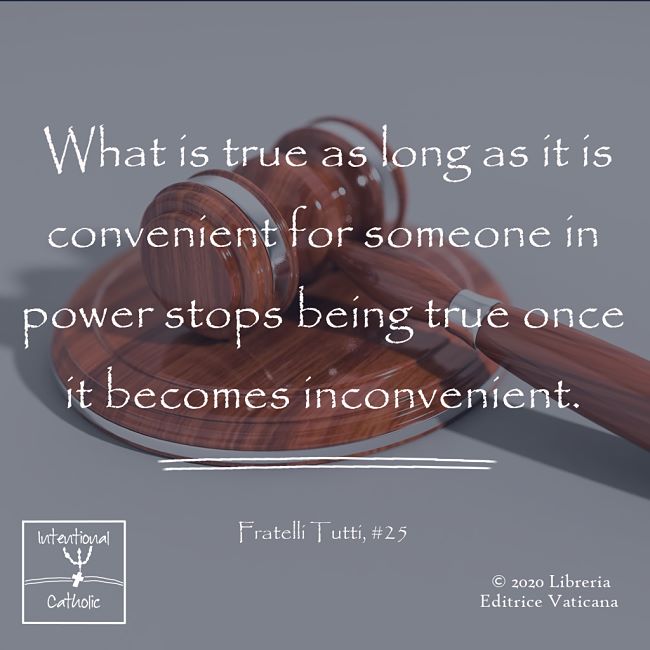
Where he really hits his stride, though, is in #25, where he skewers the habit of defending or dismissing assaults on human dignity, “depending on how convenient it proves.”
This feels very, very familiar. The difference in how we perceive the dignity of the unborn versus that of the refugee fleeing Central America (with or without going through “proper channels”) springs instantly to mind. If it doesn’t cost ME anything, of course I’m going to uphold human dignity. But if it has the potential, however remote, to inconvenience ME, well, then I can find all kinds of reasons why it’s not my problem, it’s theirs.
Next, he points out the tendency to build walls, both figurative and literal, separating humanity into “us” and “them.” It’s so beautiful, it’s nearly poetry. Just go read #27. And he rounds out this section by pointing out that the disenfranchisement caused by these sinful behaviors is precisely what leads to “mafias,” which I would suggest is a blanket term that includes terrorism.
So many Christian teachings have an incredibly practical element. Yes, we should treat each other as “brothers” (in the non-gender-specific meaning of the word) just because that’s God’s will. But the reality is that the failure to follow that teaching has all kinds of real-world ripple effects.
The way those ripple effects bang into each other and intensify is what made me start Intentional Catholic in the first place. Because I think an awful lot of us spend our lives totally unaware of them. That certainly was true of me until the arrival of my daughter set me on a small boat in the middle of all those ripples, and I had no choice but to recognize them because of the bumpiness of the ride.
Until then, I had compartmentalized life, thinking, “Sure, THESE issues are connected to my faith, but all THESE have nothing to do with it.” I was totally wrong. All issues are connected to faith.
Reflecting the other day on Pope Francis’ blistering critique of American politics got me pretty riled up. I keep thinking about the lack of honesty and integrity in the political process. We seem to have different standards for politics than we do in real life, and that’s just bizarre. Especially for Christians.
Judging by the way we conduct our politics, truth and integrity no longer matter. We can stretch the truth of any narrative so much, it’s no longer recognizable as truth–and as long as we think it will help us achieve our end goal, that’s A-OK.
I avoid the air waves as much as possible in the pre-election weeks, but you can’t escape it all. A political ad comes up, and I think, “What the actual heck? You have a family. You put your tiny kids on all your direct mail pieces to show what a great, upstanding, moral Christian you are. And then you say things like THAT? You take your opponent’s words out of context so you can change what they mean. You exaggerate their beliefs so profoundly that there’s more falsehood than truth in your statement! How in the world do you do this and then expect your kids to grow up valuing honesty and integrity and respect for others? What example are you giving them?”
How did we reach the point where we think it’s OK to pick and choose what facts to share so that we can pretend the more inconvenient truths don’t exist at all? (”La la la, I can’t hear you!” How childish. How unworthy of Christ.)
I think the problem is, we’ve allowed politics to get so extreme that people actually think the hyperbole is reality. They have stopped seeing the difference. Stopped recognizing that context matters. Stopped recognizing nuance. Why paint with a detail brush when we can use a fire hose?
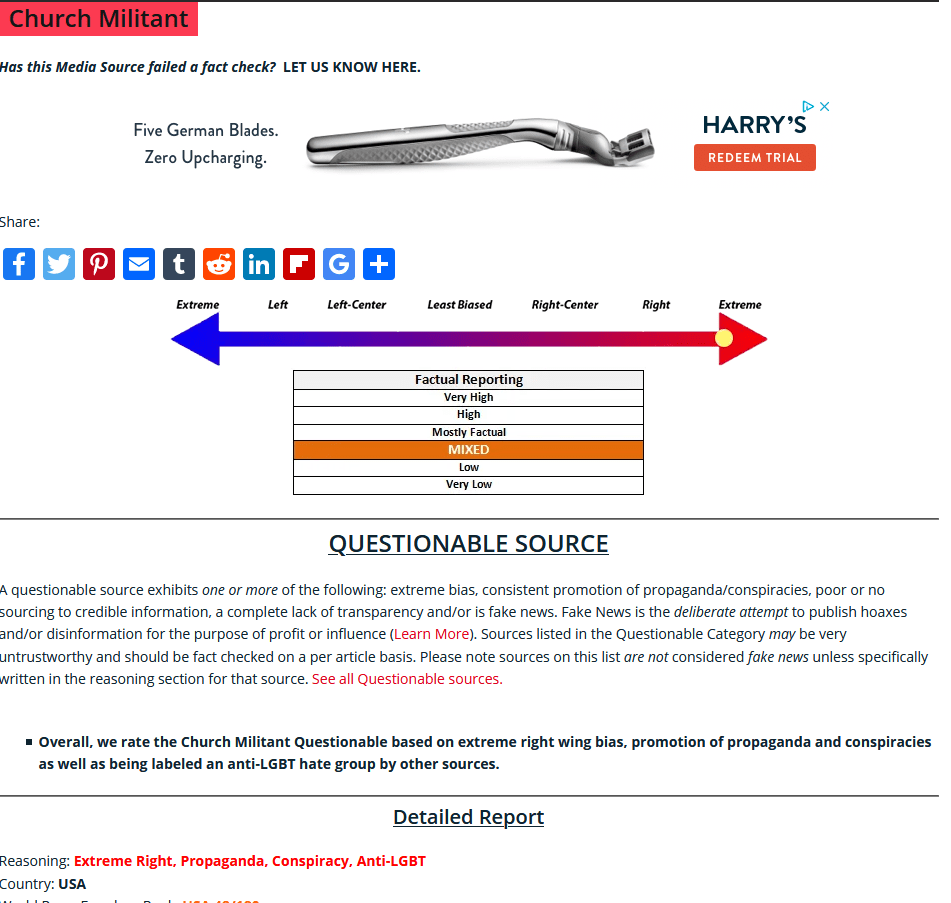
Once we do that, it’s inevitable that we’ll start swallowing extreme narratives whole, without even bothering to think critically, without bothering to do a 30-second bias check on a place like mediabiasfactcheck.com. (I mean, it’s such a low bar. It takes no time at all.)
For instance, here are a couple sites that conservative Catholics like to share.
And lest you think I only bias-check the right, here’s a site that gets shared a lot by social justice Catholics:
The unintended consequence of all this is that no one trusts anyone to tell the truth anymore. Leaders (unless they’re MY political color), media (unless it’s MY media). People are picking and choosing their own facts, their own realities. Which gives them blanket permission to ignore and dismiss anything that would cause them to question said facts and realities. If you don’t like it, call it fake news.
(All those years we spent bemoaning relativism, and now the entire culture, including the right, has not only embraced it but is rabidly, passionately devoted to it!)
What’s become excruciatingly clear, in all this, is that religious teachings—like, oh, let’s say honesty & integrity–are not given just to slap us with strictures to chafe and annoy us. They are necessary for the functioning of society. If no one can trust anyone else to tell the truth, well, you’ve got a problem, folks. Your society is going to be a mess.
If we would just take a deep breath and turn back to honesty and integrity, and condemn hyperbole, America would be a much better place. We all know it. We all believe it. Why don’t we demand it? Why won’t we do what’s necessary to make it happen?
So there’s an election next week. Let’s talk politics? (Yippee!)
Because I feel pretty certain that the timing of the release of the encyclical “Fratelli Tutti” was not accidental. Pope Francis released it right before the US elections for a reason.
Over the course of my life, papal documents have generally been pointed at someone else. At least, that’s how it felt. Like America was the good guy–not that we were perfect, but generally we were on the right side of the Gospel–and all those other countries were the ones getting their body parts handed to them by popes.
Fratelli Tutti doesn’t feel that way. In fact, it feels the opposite.
#15 begins a section subtitled “lacking a plan for everyone,” and ouch! does it ever capture modern American life. He calls out politics that make use of hyperbole, extremism and polarization. He talks about strategies of ridicule, suspicion and criticism. About political life being focused on marketing techniques rather than long-term efforts to better the plight of humanity. I mean, that’s a mirror for all of us, whatever our political persuasion, if I ever saw one!
In #18-21 he returns to a familiar topic of the “throwaway culture,” naming the unborn and elderly, and expanding the circle to recognize that wastefulness (like food waste) is also a symptom of the throwaway culture, one that harms the most vulnerable. Discarding people also comes in forms like corporate cost-cutting and racism, and even the declining birth rate.
This is the part where I pivot from “Here’s what the pope says” to “here’s my reflection on it.”
This list of modern problems echoes the questions that preoccupy me, the ones I gnaw over, day in and day out. Trying to understand how good people can fail to recognize bad things, and end up embracing them instead. The frustration that people will always point these kinds of examens at others, refusing to examine our own consciences for times when we, too, participate in or enable evil.
This concept of universal brotherhood is the central problem of our time. Well. Of all human history, but it seems particularly apt in this day and age.
We deal with problems in our families in a far different way than we do in matters of policy. In a family, we have our own concerns, but we also recognize the rights and needs of others, and we know we must look for solutions that serve everyone’s interest.
If we truly regarded everyone in America as members of our family, how would that change the way we look for national solutions? I think we’d have to move beyond “how does this affect ME and MY rights” and add, “How can I balance my needs against the valid needs ofthis other person with a conflicting interest?”
We need both right and left in order to keep us in balance. What we don’t need is the villifying, the mocking, the “contrast ads” and editorials and memes whose “truths” are stretched so far, they’re actually falsehoods. We wouldn’t treat our families this way. How can we, as Christians, think it’s justified in politics?
I have four kids, and each of them is in a different school this year. (Long story.) Two of them are in seat (one because parochial school, one because special ed), the other two are all online so far.
Today is the first day I have to have one of my in-seat kids at home for learning, and since I’m groaning internally about it, I want to stop to acknowledge the great blessing that my two highest-maintenance kids have, in fact, been able to have relatively normal schooling all the way to October 21st. I have been on fire in my writing–laser focused and accomplishing a lot.
At the same time, some really beautiful things have come out of having two kids at home for school. I’ve gone running with my 6th grader a few times. Taken afternoon walks with him at other times. Eaten lunch with my high schooler, who, in an ordinary year, we’d barely see because he’d transition between school and marching band and be gone for ten hours and do homework the rest.
Also, I have a lot better picture of what my kids are doing at school this year. I’m puttering around the kitchen during middle school zooms and for that reason I know all the teachers by voice and name and I know that one teacher has a chirping smoke detector in her house, and I can hear the banter in the class. I can ask intelligent questions about the things the kids are studying, because I have some clue what they are.
It’s a give and take. There are plenty of things that feel constraining about this mode of education, and keeping spirits high… or, well, in the neutral range or better… requires constant vigilance. I feel much more guilty for going to take my hike/bike/sit/pray times when there are kids at home. But there are things to love about it, too.
I’ve been trying for several days to find the entry point to reflect on the first section of Fratelli Tutti’s Chapter One. Like many papal encyclicals, FT begins by laying out the problem. It seemed, Pope Francis says, that for a few decades the world was heading in a positive direction–greater peace and international cooperation; an understanding of where we’d been and why we didn’t want to go there again. But it’s been shifting in recent years. He calls out “myopic, extremist, resentful and aggressive nationalism” and individualist ideologies that shred the idea of “social sense.”
This whole section is rich with resonance to me: consumerism, corporations that succeed by feeding individualistic priorities, leading to a loss of the sense of human interconnectivity and even an understanding of history. (This is my best attempt to sum it up. Really, you just need to read it.) In such an environment, high ideals such as democracy, freedom, justice, unity, etc., become meaningless catchwords that can be abused by anyone. Hence, the quote above.
Pope Francis catches a lot of flak in some quarters for being “liberal;” as far as I’m concerned, passages like this disprove that. To me, this sounds like the same conservative rallying cry that permeated my childhood. For decades, popes have been warning that when big conglomerates control the narrative of the world, it’s bad for us. Certainly, in my conservative Catholic upbringing, Hollywood and the music industry were the focus of this criticism.
I think we’re getting ready to hear that those targets aren’t the only ones–just the easiest to call out.
This past summer, I was honored to be invited to speak at the National Association of Pastoral Musicians national convention. Among the presentations I gave was this one, “Being Catholic in a Messy World.” I was asked to give a fifteen-minute reflection on what I mean by “Intentional Catholic.”
I have so many thoughts, I never imagined it would be a difficult talk to write, but it was–because the topic is so huge. The through-line that eventually emerged was how I wrestled with being “pro-life” in the wake of giving birth to a child with Down syndrome. I’ve often said that my daughter’s birth was the earthquake that changed everything for me, though I didn’t know it at the time. This is that story. It encapsulates many of the difficult issues we’re wrestling as a nation (badly). I hope you’ll set aside a quarter hour to listen!
(Thanks to GIA Publications, my music publisher, for making this available.)
Today’s reflection is (slightly) adapted from a post originally written seven years ago on my personal blog.
Having wrestled anxiety for most of my young adult life, I don’t often plumb the depths of my psyche too much anymore. I may be emotionally and psychologically healthy these days, but I’m far from immune to doubt. Doubt is an inevitable part of the human experience. We doubt God, we doubt our leaders, those we love, and of course, ourselves. The decisions we’ve made, especially the big ones, sometimes lead us to places that don’t look like what we envisioned, and we start thinkingif we’d chosen another path, things might be easier.
This happens to me most often when I’m ticked off at the world, i.e. husband and kids. They are my vocation, so when family life seems really hard, a niggling thought will sometimes come to mind: could I have heard the call wrong? I have always been drawn to silence and stillness. Why didn’t I ever seriously consider religious life? A life of prayer, of contemplation, without the familial demands that wear me down, the unceasing noise that shreds my inner peace, the constant busyness that makes it almost impossible to dip into the well of the Spirit. Wouldn’t I be a better disciple if my life were devoted to solitude and prayer?
The end of Thomas Merton’s Seven Storey Mountain surprised me when I read it:
“You have got me walking up and down all day under those trees, saying to me over and over again: ‘Solitude, solitude.’ And you have turned around and thrown the whole world in my lap. You have told me, ‘Leave all things and follow me,’ and then You have tied half of New York to my foot like a ball and chain. You have got me kneeling behind that pillar with my mind making a noise like a bank. Is that contemplation?”
Look at that: a contemplative monk, questioning his vocation because–gasp–it’s not contemplative enough. Because he’s got distractions. Because his mind is rattling like a piggy bank. (Oh, that is so me.)
That made me rethink another quote I’d read years earlier:
“Usually, in refusing such a gift from God, a person finds his or her path to heaven more difficult. … it seems that God calls us to the best possible vocation suited to our personalities and talents…”
When I first read it, I interpreted it to mean that I will be a better disciple if I am in a situation that challenges my weaknesses least. But in light of Merton’s quote, I realized: what if the very soul stretching that comes from struggling with my vocation is what makes me a better disciple? After all, if we’re never challenged, how in the world can we grow?
If patience, pride and self-centeredness are my weaknesses (and believe me, they are), then family life, in which patience is tried every moment of every day and self-centeredness is forced by virtue of necessity to give way to self-emptying–family life seems ideally suited to make me a better disciple.
In other words, the grass is always greener on the other side of the fence…until you get there and realize what you’ve left behind.
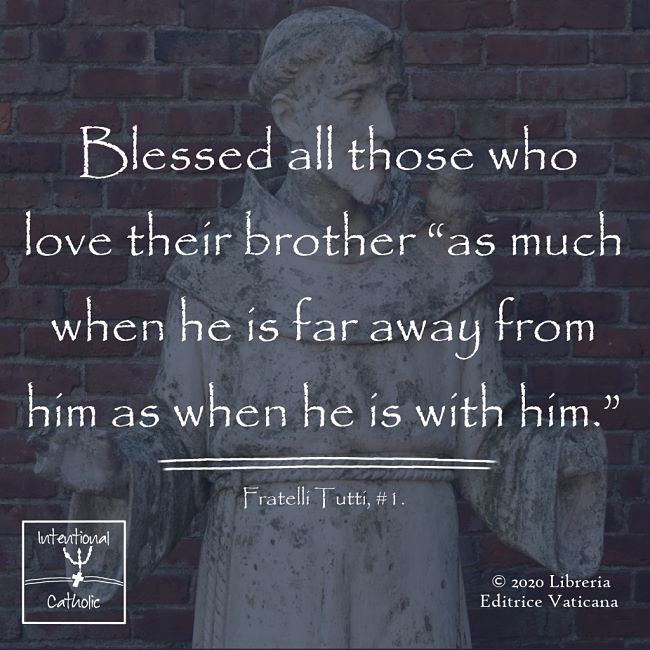
I have begun reading Pope Francis’ new encyclical, “Fratelli Tutti,” and thought it might be worth simply sharing as I read, since it’s new to all of us.
The topic seems like a timely reminder, given the state of the world right now. I can’t quote it all, but Pope Francis sets the tone in the introduction by pointing to St. Francis of Assisi’s trip to visit the Sultan Malik-el-Kamil. He went during the Crusades–a time when the goal of Christianity was to conquer and convert the Muslims–and instead modeled peaceful conversation with no agenda at all.
Two things strike me here: one is that with this trip, St. Francis, quietly and without making a production of it, issued a sharp rebuke to the entire goal of the Crusades. A rebuke that, with the benefit of hindsight, was well deserved.
The other is that Pope Francis is setting the stage to remind us that our worldwide politics of division (because it’s not just an American thing) is directly counter to holy living.
And I suppose there’s a third thing, which is that there’s more than one way to interpret “far away” and “near.” In St. Francis’ case, it was both physical and philosophical difference. My guess is that Pope Francis is gearing up to admonish us to be “brothers” in both those spheres in modern life, as well.







 Intentional Catholic