It’s interesting to hear this argument, given the conversations/arguments we are having as a nation about gun violence. I’ve never heard anyone talk about this factor. Of course, violence goes way beyond mass shootings:
– Domestic violence is made possible by unequal relationships between life partners.
– War is quite often a symptom of one group imposing its greater power upon another weaker (i.e., unequal) population.
– Violent protests are quite often a symptom of a weaker, poorer, or oppressed group rising up against the institutions of power that hold them down. (Race protests in the wake of police shootings come to mind right away. And what happened in Puerto Rico.)
And so on. I find this statement really striking because we bemoan violence, we come up with all these ideas for what will stop it, and we miss this obvious reality, which means we can’t talk about violence without also talking about race, poverty, discrimination, and so on. It’s the spaghetti bowl principle all over again.
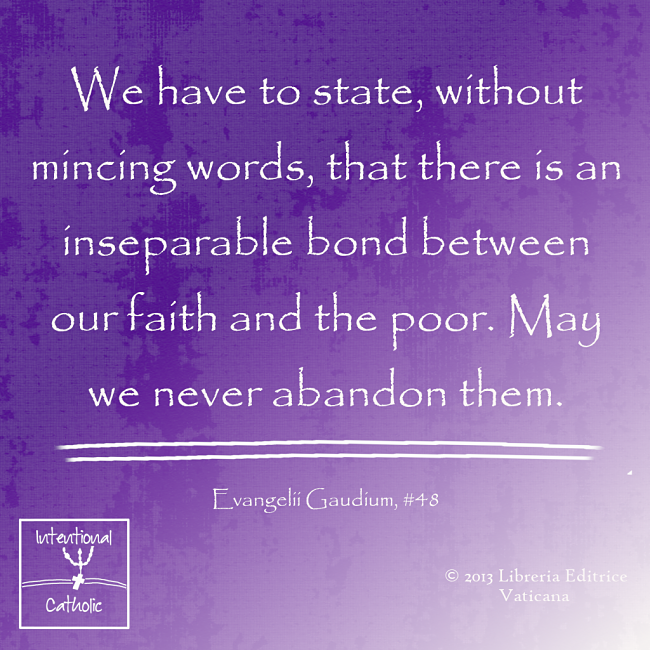
I have to be honest: it’s terrifying to share this excerpt from Evangelii Gaudium. The idea of free market and trickle-down economics is foundational to the world view of so many Americans who hold the Christian faith, it’s often viewed as fundamental to being a Christian. Heck, I grew up that way. I know how defensive a reaction this quote is likely to provoke in many faithful Catholic readers.
So I guess we have to start by acknowledging that we can’t examine this question solely from the perspective of faith, because there is a very concrete, practical reality underlying it. The fundamental practical question we have to answer before we can address the faith component is this: does trickle-down economics work? Does it actually bring prosperity (and, far more important, greater human dignity) to all? Because if so, more power to it. But this weigh-in from the Church indicates otherwise.
Back to the topic at hand. If Pope Francis is right, then what does this mean for us as Christians?
I’ve spent an hour trying to formulate an answer to that question that doesn’t trip political land mines. Maybe the answer is that we all, regardless of where we stand politically, need to pray for the grace and wisdom to be able to self-reflect more honestly. We’ve always embraced it when our leadership has called out the failures and injustices in the Communist systems. And with good reason. But we’ve often turned a blind eye when the popes and bishops have called out the same offenses within capitalism. It’s easy to assume we know God’s will and not even recognize when what we’re actually worshiping is our own.
This is probably one of the best illustrations a girl could hope for in trying to explain what I mean when I talk about being “intentional” about the faith. We’ve all heard about food waste, but how often do we actually connect it to our Christian faith? Plus, it’s such a general, “out there” kind of concept. Places like this, that put it in concrete terms we can wrap our heads around, paint the issue in big, global terms, which means we don’t always connect it with our individual habits. For instance:
We don’t make our kids finish eating whatever they don’t want, because it might teach them an unhealthy relationship to food… but we don’t wrap it up and save it for the kid’s next meal, either; we throw it away.
Restaurant portions are gargantuan and sometimes we take home the leftovers, sometimes we don’t; it gets thrown away.
And all the while we’re enjoying the bounty of our own privileged existence, people are starving.
What if we were more intentional about how we eat and how we deal with food waste? (This link from the EPA gives some great tips.) What savings might we be able to achieve, and thus redirect toward providing food for those not as blessed as ourselves?
These are the piddly little habits we don’t always recognize as being connected to our faith. Being intentional means we have to stop think instead of doing what we’ve always done on autopilot.
I know. This means devoting time and mental energy none of us feel like we have. Believe me, I get it!
But having been on this journey for several years, I can promise this: Whatever you invest in living your faith intentionally–in these real, concrete, practical ways–will come back to you many times over.
We all have our preconceived ideas about what elements of modern life run counter to God’s plan. I could list mine, and no doubt some of them would be quite different from yours. Contradictory, even. We’d probably get into an argument about it. Isn’t that what happens every time we talk about guns, immigration, health care, poverty initiatives, race, or climate change? Half of us think the kingdom points in one direction; the other half sees that direction as heresy.
When God works in our lives, we are challenged to grow. Growth
requires change, and change is threatening to our equilibrium. So we
resist. We come up with a hundred ways to dismiss what we recognize as a
threat to our own comfort.
How, then, do we truly discern when God is at work, challenging our preset assumptions, as opposed to when something is truly counter to God’s plan?
I would argue that we have to start by subordinating our preconceived opinions long enough to think around divisive issues and see them from another side. We might not change our minds. In some cases, we shouldn’t. But we’ll recognize the nuance and complexity of the issues, and that would allow us to enter into conversations in a productive, rather than toxic, way. It would go a long way toward bringing us, collectively, out of the place of acrimony and extremism in which we, as a nation, have become imprisoned. And that, in turn, would bring us closer to God’s kingdom.
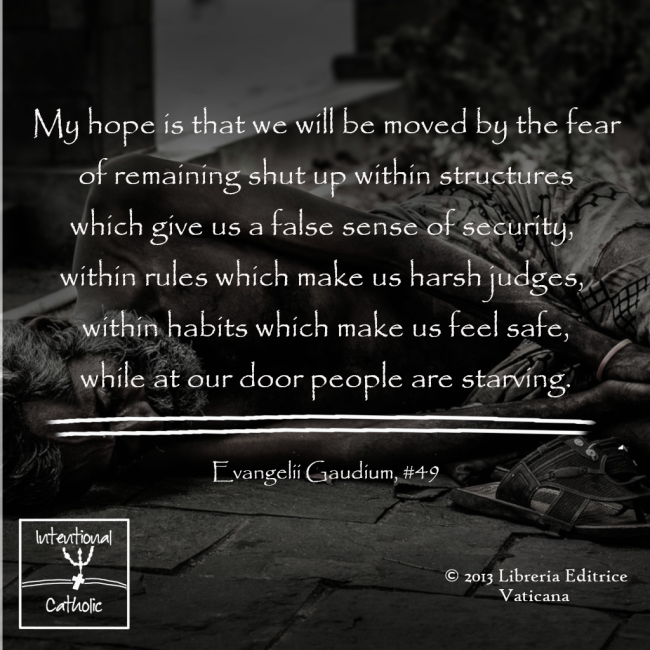
People are starving, not just for food, but for being treated with dignity and for acknowledgment of their wounds. Earlier in #49, Pope Francis talks about preferring a Church bruised and hurting from being out there with people to one that is “unhealthy from being confined and from clinging to its own security.” That description seems uncomfortably apt.
He also names a fear that I think drives a lot of religious people: the fear of “going astray,” which I interpret as the fear that if we go out into a sinful world, we’ll be corrupted by it. (We put our kids in bubbles for this reason, too.)
It occurs to me that if our faith is so weak it can’t survive the challenge of being around temptation, then the solution isn’t to hide from temptation, but to do some good work strengthening our faith.
I freely admit that I am no model for going out into the world and getting my feet dirty. In my case, it’s a result of an introvert’s paralyzing dread of interacting with strangers. But it’s something I’m thinking about a lot these days, and feeling called to address in that intersection of my own faith and the real world I inhabit.
I said before, on a different graphic: Dorothy Day struggled with joining the Church because of the contradiction between Catholic social teaching and the reality of communities whose focus was Bingo and card games. What about us?
If you reacted to this with, “well, duh,” I hear you. This is the kind of religious platitude that we usually skim right over: so general and familiar, we can nod our heads and move on, totally failing to see how it applies in concrete ways in real life.
What if, in place of the word “others,” we substituted the actual people we struggle to love, i.e. will the best for? For example:
“to see God in and seek the good of…
…. that political figure I think is possessed by the devil. (And people have thought that about more than one recent figure, so be honest and don’t write this one off. It applies to both sides of the political spectrum.)
…those people who hold beliefs contrary to my own on important issues.
… that person who likes the OTHER kind of liturgical music.
…. that person who told lies to me or about me and deeply harmed my emotional well-being.
…. that school administrator/boss/coworker who is combative and uncooperative and makes my life miserable.
…that refugee on the southern border whose desire to come here feels threatening to me on some level.
If you didn’t squirm at this recitation, then you probably didn’t dig deep enough, because I definitely squirmed writing it.
This is the problem with religious platitudes: we can all, whatever our opinions on divisive matters within the Church and outside it, applaud and feel affirmed by such statements as long as we don’t dig down to what they actually mean in real life.
That’s why I’m here, doing this work at Intentional Catholic: because we don’t grow in holiness until we dig deep enough to get uncomfortable with the status quo.
Since the Church considers this quote important enough to be underscored in the Catechism, I thought it deserved a graphic of its own, even if I did already write a whole post on the topic. Sometimes a picture is worth a thousand words, right?
Tell me if this sounds familiar: you tell a kid to put away a piece of clothing, and ten minutes later you look and discover it hasn’t been done. You tell them to do it again, and this time it makes it up the stairs and gets dumped on the floor. By the third time, you’ve pretty well lost your temper, and it’s all downhill from there.
This is my life right now: dishonesty, serial disobedience, and difficulty discerning how much is developmental and how much is spacey personality versus testing behavior. My husband reminds me we’ve been through it before and we’ll get through it this time, but it’s wearying.
Why does this warrant a blog post on a site about living the faith?
Because I’m starting to recognize that this parenting issue has a lot to teach us about love—real, self-giving, sacrificial love. How can we teach such a big concept to our children without starting with small, intimate relationships and small—maybe even petty—examples?
Little kids experience the world in concrete ways, after all. I need my child to learn that love doesn’t just mean cuddles and kisses and being tucked into bed at night and giving me a hug on the way out the door. That’s a tiny child’s version of love, but as they grow, they need to learn that a bare minimum, love means you don’t do things that harm the other.
And since Jesus Christ was never in the business of bare minimum, I’d go a step further and say, as the Catechism says: love means willing the good of the other.
So your actions show your love—or the lack of it.
To wit: if you cause your favorite parent to LOSE HER EVER LOVING MIND because you just don’t feel like doing what she asked you to do, then you’re causing harm and you’re definitely not willing the good of said parent.
In other words: NOT. LOVE.
Okay, it’s petty, I know. But really, if you start spinning out the implications, this is a big deal, and not just for the kiddos, but for us as adult Catholics.






 Intentional Catholic