Should We Quit Having Kids Because Of Climate Change?

Recently I learned that there are people who are struggling with the decision to have children, because of climate change. They’re questioning if the morality of bringing children into what is virtually certain to be a hellscape in the not-too-distant future.

Now, I can hear hackles rising and derisive snorts being uttered all over the place right now, but I would ask you to take a deep breath, say a prayer for discernment, and actually take a moment to consider this. And remember that the person speaking here is a mother of 4 who’s been using NFP for nearly a quarter century.

Consider this:

We in the west are fundamentally and unshakably committed to our own convenience and comfort at the expense of everything else.

In the summertime we make our churches, schools, and hotels so cold, we have to wear coats inside. People write Facebook posts telling us we’re psychotic if we set our thermostat anywhere above 72 in the summer.

Our culture glorifies gluttony—how else can you interpret the clear parallel between “bigger portion size = better” at restaurants?—and then throw away shameful amounts of food while huge swaths of the world are starving.

People leave cars running while they stand at the door talking, or while kids are at soccer, or while waiting for half an hour in school pickup line, or while scrolling phones. (That one baffles me. You’re literally burning money!)

These and a thousand other things we do thoughtlessly, habitually, without intention and without examination. Even after it’s pointed out that our habits of consumption and comfort are damaging God’s creation. Even when we see daily the proof of climate change, and that it’s the poor who suffer first and most. Even when the scientific community is begging us to fix it, and telling us how. Even when the world is literally burning around us—even in places where fires aren’t supposed to be a part of our climate.

As Catholics, we believe children are always and unequivocally a blessing, the crowning of marriage.

But honestly, when I heard that some are choosing not to have children because of the world they will have to survive, I thought, “There’s some sound moral reasoning going on there.” I can’t embrace it, but I understand it.

As Catholics, we can and should advocate for the goodness and dignity of human life, and the worth of having children, even though they will suffer in this world. Because of course, life will always involve suffering.

But if we are flippant, derisive, or dismissive about climate change—if we, collectively, act as if our selfish commitment to comfort and convenience has no long-term ramifications—then we have no business judging people who discern against having children. We’ve created the situation they’re responding to. And God will call us on our sins as much as he will call them on theirs.

Background Image by Kevin Ellis from Pixabay

A little less talk, a little more action

You know that saying: whenever you point a finger at someone else, four fingers are pointing back at you? (Well, it’s really three, as you can see, but…)

I think about that a lot in the context of Intentional Catholic. Anything I write, integrity forces me to turn back on myself, mirror-like.

I’ve been struggling through the Bible in a Year podcast… valuing it for the sake of hearing Scripture in a way that helps me grasp the historical context, but struggling because sometimes the commentaries really set me off. The one on Matthew 25—which is sort of the whole foundation of Intentional Catholic–pretty much gave permission for people to say “I’m clothing my naked children and feeding my hungry family. I’m covered.” In fairness, I do not believe that’s what he intended to convey, but it certainly does give tacit permission to ignore the plight of ACTUAL poverty and suffering.

Which is not to belittle feeding and clothing a family. I am up to the tips of my frizzy curls in caring for kids. It’s a real thing.

But it doesn’t negate our responsibility to the poor, marginalized, and vulnerable. First of all because keeping our kids fed and clothed is only a sliver of what keeps us so busy. The vast majority of what keeps us hopping is not essential. We could ALL cut back on some of our luxury and busy-ness and refocus some of that energy on the poor, marginalized, and vulnerable.

But as I sat there stewing and fuming over this, it occurred to me that me sitting in my house writing blogs and social media posts is not clothing the naked and feeding the hungry, either.

Here’s the thing. The conventional wisdom is that not everyone is called to everything. We are supposed to find what we, individually, are called to.

But I am an Enneagram 1, which means I’m very concerned with Getting It Right. For myself AND for the larger world. Enneagram 1s are deeply susceptible to scrupulousness. (Scrupulosity?)

The trouble is, when I, as an Enneagram 1, try to parse out what I feel most passionate about, I can’t do it. It all matters!

I have a child with a disability. Our health care system of access & payment is deeply dysfunctional and a burden on families.

My conscience stings every time I see a homeless person at an exit ramp. How dare we drive by, avoiding eye contact to preserve our own comfort? How dare people on my “Nextdoor” app call them “zombies,” as if these are not human beings with the same innate dignity as themselves?

I see the chaos and suffering that causes people in Central America to flee for the U.S.—and the way some people here villainize those who are desperate for the same security we treat as a divine right. How can I not be passionate about refugee and immigration?

I have godchildren and family members whose skin color will make them a target when they grow up. How can I not rail against those who deny systemic racism?

I had infertility that the medical community wanted to treat by slapping bandaids on it (birth control, artificial procedures) while ignoring the problems that caused it. We have a family because an NFP doctor took the time to find the root cause (PCO + agricultural chemicals in the water—how can I not be passionate about the environment?). So when I see how abortion is the symptom of a host of other problems that are systemic in our culture, how can I fail to rage at those who want to address the symptom while ignoring the causes?

I don’t know what my “one” issue is, because dang it, they’re all equally important. Thank you very much, Enneagram 1. But I can’t do everything. For years, I’ve been trying to learn to respect my limits, to create healthy boundaries.

But sooner or later you have to say “yes,” too.

So for now, I am working a shift at the Food Bank into my schedule, and exploring volunteer possibilities with Refugee and Immigration Services. Because at least there’s a known entry point there.

I am not going to stop talking. But I’m going to start mixing more action in with it.

Being Intentional About Care of Creation

Fires in the west. The slow and inevitable draining of the Colorado River. Floods in Mississippi and in Pakistan.

These are just a few of the effects of climate change in very recent history.

By now I think most of us recognize that human-caused climate change is not some made up thing. The frequency and severity of natural disasters are becoming so much worse, it’s hard to cling to denial anymore.

But the question is, what do we do about it?

Environmental stewardship has been a passion of my Christian life since my husband and I discovered that half of our long battle with infertility was caused by poor male fertility numbers stemming from diazanon, alachlor, and atrazine in the water supply. In case there are doubters here, we discovered this in backwards order. My husband encountered the study about the connection between low fertility numbers and these chemicals through his work as a science writer; then he went through testing and found he was the classic case; then we got a water filter and conceived within three months.

So I’m really tuned in to how we interact with creation. To be intentional about an area of faith means you have to examine how your actions do (or don’t) reflect what you think you believe. We wash and reuse plastic Ziploc bags. Watch the weather so we can pull the house temperature down to 65 on cool mornings and then close it up, thus minimizing the need for the air conditioner. Etc.

What makes me want to pull my hair out is the thoughtlessness surrounding creation that I see around me.

Every time I pull into Jazzercise, or Ace Hardware, or Target, or church, I see someone sitting in their car with the car running while they’re scrolling their phone. Every time. Sometimes I have even seen people get INTO their car, turn it on, and THEN pull their phones out. Why? It has nothing to do with the weather, because it happens in perfect weather as well as bad.

School pickup is even worse. People queue up beginning 25 minutes before school dismissal, and they will sit there running their cars the entire time. Not everyone—it’s improved over the years, thank God—but it’s still pretty bad. I used to go over to school after noon Jazzercise and wait until school let out—a deliberate choice, made to combine trips and reduce gas consumption. I’d bring my laptop and work remotely.

But every afternoon, when I pulled into a shady spot at 1:30 p.m., there was a guy in a huge white pickup truck who LEFT IT RUNNING FOR HOUR AND A HALF. This is a person who is ostensibly Catholic,  a religion that values stewardship of creation.

None of these people are horrible human beings who care nothing for the earth and the life and health of future generations. Chances are, it’s just never occurred to people to examine what they’re doing. We are creatures of habit.

And yet the wellness and dignity of future generations—not to mention ourselves—is compromised by such ongoing and habitual abuse of the earth. How much carbon could we cut if we just turned off the cars when they don’t need to be running?

So this is my invitation for today. First, turn your car off! At long stoplights (you know where they are), while you’re at soccer practices or piano lessons, and above all when all you’re doing is checking your phone.

And second, to examine your days and routines for small but concrete ways you can show more reverence for creation through the way you use and interact with the things of the earth.

And feel free to share any of those here. I always like to get new ideas.

* All the photos in this post are pictures I took on my nature rambles in the last 6 weeks. This is the earth we are trying to protect, because it is how we live, and because look at the gift it is to us!

Being Catholic in a Messy World

This past summer, I was honored to be invited to speak at the National Association of Pastoral Musicians national convention. Among the presentations I gave was this one, “Being Catholic in a Messy World.” I was asked to give a fifteen-minute reflection on what I mean by “Intentional Catholic.”

I have so many thoughts, I never imagined it would be a difficult talk to write, but it was–because the topic is so huge. The through-line that eventually emerged was how I wrestled with being “pro-life” in the wake of giving birth to a child with Down syndrome. I’ve often said that my daughter’s birth was the earthquake that changed everything for me, though I didn’t know it at the time. This is that story. It encapsulates many of the difficult issues we’re wrestling as a nation (badly). I hope you’ll set aside a quarter hour to listen!

(Thanks to GIA Publications, my music publisher, for making this available.)

A Trip Down Memory Lane

Last night, I cuddled up with my youngest to do First Communion homework. In the Dynamic Catholic sacramental prep book, there’s a page of cartoon character saints, and I started telling him the stories—what we know and what are legends about them. One of the saints was John Paul II.

I had to leap up and go get this:

When I was five years old, my parents packed me, my big sister, my little sister, and both my grandmothers into an RV and drove to Iowa to attend the Pope’s Mass.

Here’s what I remember: it was a really, really, really long walk to the bathrooms. And they were porta potties.

Yup, that’s all I remember.

But I’ve always treasured this book. I love pulling it out to show the kids the snapshots my mom glued into the front cover, and the letter I got when, evidently, I wrote a letter to Pope John Paul II afterward. (I don’t remember that, either.)

I don’t think about that Mass very often, because we were far, far away and I was short and I probably saw none of it. But in the years since, I made a really good friend who lives in Des Moines, and the first time I visited, I recognized their diocesan symbol as the one from the cover of my book. I got unreasonably excited.

And last night, when for the first time I actually started reading the book (rather than just the handwritten note on the inside cover), I realized I now know something about the place where the Mass was held. We haven’t made it to Des Moines’ Living History Farm yet, but I know right where it is from past trips.

I was also startled to read the words “rural life” in the invitation sent to the Pope. (“Possibly one of the most young and enthusiastic groups of representatives in the Church in America today is our own rural life people.”)

I only encountered Catholic Rural Life five years ago, when it was spoken well of in conversations with NFP contacts living in Ohio. I learned that this organization espouses a beautiful and very Catholic view of the relationship between us and the earth. Unfortunately, no one in my highly agricultural state has started a chapter. Being a farm kid myself, this makes me sad.

It’s striking to me, as an adult reading this book about an event I have only the haziest memory of, how strongly the vision of Catholic Rural Life was woven into that Mass. Repurposing wood from a corn crib to make the altar, building an “asymmetrical” platform for the altar so as to work with the contour of the land, and so on.

I suppose the reason I’m sharing these thoughts today is that it was really affirming to see that John Paul II, the darling of traditional Catholics, tied himself so closely in this event to a movement that prioritized stewardship of the earth. The false dichotomy between “traditional” or “conservative” Catholicism and care of the earth is a source of great grief to me; I can’t fathom why people deny climate change and resist the Church’s consistent teaching about societal responsibility to ensure environmental stewardship. But it’s especially baffling in the rural community, who would (one would think) be more in tune with the land. Yet it seems like rural areas are the center of resistance to climate action.

It was lovely to see that at least in the pope’s Iowa visit, there was no false dichotomy between “traditional” Catholicism and stewardship of the earth.

A world in peril

Context is important…Gaudium et Spes was published in 1965, during the cold war, and no doubt the bishops who wrote it, as well as Pope Paul VI, were thinking about the threat of nuclear war. But it’s interesting how much these words resonate today, isn’t it?

What Do Faith, Infertility, and Environmental Stewardship Have To Do With Each Other?

My passion for environmental stewardship was born because of infertility.

For three years, we tried to start our family and couldn’t. It was excruciating. I started metformin to treat PCO; I had surgery for endometriosis. But in the end, what allowed us to conceive was a water filter.

Yes—a water filter.

The water where we live contains alachlor, diazinon, and atrazine—herbicides and insecticides used in lawn care and agriculture. These three chemicals also suppress male fertility. We don’t drink much soda; water is our staple. We installed a PUR water filter, and four or five months later—time enough for the change to impact the male reproductive system—we were expecting.

Were there other ways we could have overcome our infertility? IVF? Most likely. But even if it weren’t against what we believed as Catholics, IVF isn’t the answer to infertility caused by lawn and agricultural chemicals in the water supply. The fix is not to have those chemicals in the water supply in the first place.

My husband and I are big believers in NFP, because we have experienced firsthand what the use of chemicals by human beings can do to the natural environment. To us, Church teaching on birth control simply makes sense. Working in conjunction with the way God made us is a best practice for living. It puts us more in harmony with God’s creation. With how God made us. Self-knowledge, better marital communication—all these are real benefits, but the basic truth is that planning our family through NFP allows us to live as God made us, without harming ourselves or the world around us.

For me, it’s no leap to generalize the lesson to a million other questions of environmental stewardship. Nothing exists in a vacuum. Ecosystems work because all the pieces are in place. God designed them to work in a particular way. If one species goes extinct, it upsets the balance; the ripples go out from there. I was mocked a few months ago by a supporter of the border wall for sharing a link outlining the negative impact on migrating species. It was a reminder that we have an unfortunate tendency as human beings to compartmentalize rather than recognize how all things exert a push and pull on each other.

Here’s my favorite example of this ripple effect:

Just one species, long absent because humans had tried to eliminate them, made all that difference.

How can anyone cling to the belief that human beings couldn’t possibly be causing climate change?

We often try to separate issues into “these issues are faith issues, and the rest are not.” It simplifies life, for sure—makes it easier to process a complex world. But it’s not accurate.

What I find so beautiful about Laudato Si’ is that it makes the connections. In fact, if we live in a world created by God in a certain way–with intention, in other words–then all issues are faith issues.

Power and Responsibility

As a mom of boys and accordingly well-steeped in superhero lore, I read these words and they automatically translate to those of Uncle Ben, in Spiderman: “With great power comes great responsibility.” Responsibility to discern, to self-reflect, to make sure my actions beliefs –and when they don’t (as is true far more often than I’d like), to confess and vow to do better.

And again: although this is in the context of stewardship of the earth that keeps us alive, it applies across the spectrum of a lived faith.

Care of creation is up to us

When we (and by “we” I mean American culture–media, social media, etc.) talk about climate change, environmental stewardship, etc., we focus pretty much exclusively on policy: the Paris climate accord, rollbacks of protection initiatives, opening up preserves for drilling, etc. I remember when Trump first decided to pull us out of the Paris Climate Accord, I posted my “ways to be a good steward of the environment,” suggesting that if all of us examined our lives, we could still make a big difference ourselves. Someone I know poo-poohed the idea that we as individual people could have an impact.

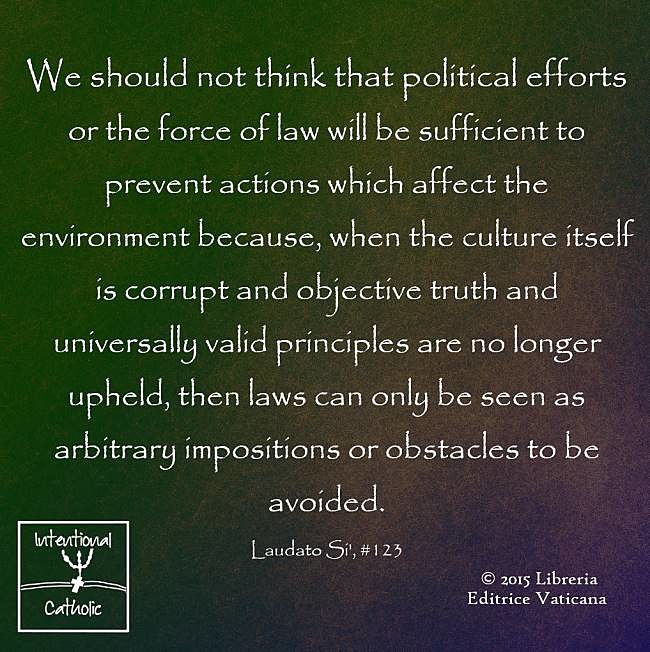
But this clip from Laudato Si’ points out an uncomfortable truth: that it’s human nature (especially when profit is involved) to look for loopholes, to figure out how to be the exception so as not to have to do what is difficult, costly, or uncomfortable. Law, in other words, isn’t going to fix the problem of poor stewardship of the earth by itself. We as individuals have to step up and do our part.

Which doesn’t necessarily mean big, earth-shattering things. My family is saving for solar, but in the meantime, a big part of how we form our kids is a focus on reducing waste and initial consumption. Things as simple as those stupid party bags full of useless, disposable junk that you tend to get at birthday parties. Why? Every bit of that is going to end up in the landfill sooner rather than later.

Things like (and those who know me will say “oh here she goes again”) turning off the car when you’re waiting on kids, sitting in the grocery store parking lot, or checking your phone. There’s almost always an option–sitting under a shady tree when it’s hot; going inside when it’s cold. The vast majority of the time, the only reason to leave the car running is one’s own comfort/convenience. Comfort/convenience is one of the most insidious, invisible idols of modern life.

The increasing number and severity of natural disasters hasn’t yet touched *most* of the First World (though even here, we’ve had fires and superstorms and hurricanes). Acting like our daily choices are divorced from the greater good of the earth and those who shelter on this tiny oasis of blue in a vast universe is not a mark of true discipleship. Being a Christian means examining our daily choices–in other words, our habits–and being more intentional about them.

Good from evil

The news about the Amazon has had me very troubled lately; perhaps that’s why Laudato Si’ has been on my mind again lately. I went back to see what quotes I hadn’t used, and this seemed so universal, not just in relation to stewardship of the earth, it practically leaped off the screen.