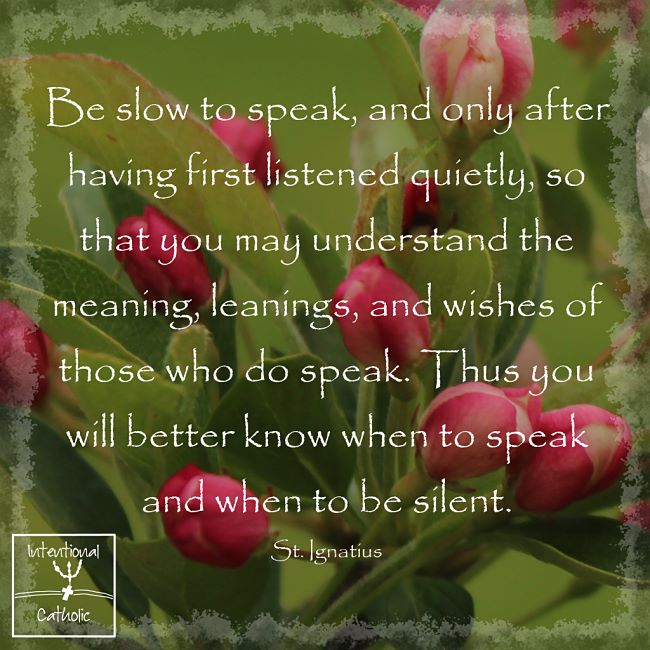
This is something I’m working on a lot.
A LOT.
I think this quote should be a pop-up “are you sure?” prompt on every social media post. For every one of us.
Real Faith for a Real World
This is something I’m working on a lot.
A LOT.
I think this quote should be a pop-up “are you sure?” prompt on every social media post. For every one of us.

It’s been a hard slog, the last couple of months. Although Memeland USA has tried to lighten the mood by joking about it (my personal favorite was a picture of Doc and Marty, with the words “First Rule of Time Travel: Never go to 2020!”), the humor is only an attempt to bleed off some of the stress. Some among us are struggling financially because of lost income. Some because of the stress of illness or death–coronavirus-related or not–in a time when families can’t even gather to grieve. Some because mental health is hard to maintain in a time of anxiety and isolation.
That last was the struggle for me and my household. It took us a full month to get our equilibrium–which I achieved partly by counseling, partly by a 100% withdrawal from all news sources. And prayer, of course, but prayer guided me to those real-world solutions. Prayer is rarely a fix-all on its own. In prayer, God guides you to what *else* you need. God is the creator of science and psychology, after all.
I still have to be vigilant about mental health in certain quarters in my family, but I know we had it pretty easy compared to others. My Facebook feed is filled, top to bottom every day, with evidence that more people are still struggling than not.
I’ve started dipping a toe back in the news now, and the vehemence and acrimony of the protests against stay-at-home orders and masks are really striking. I heard a report this morning that in Stillwater, Oklahoma, a man threatened a business owner with a gun because he didn’t like the citywide requirement to wear a mask inside businesses. I mean, really? REALLY??
Full disclosure: I’m a flute player. Wearing a mask makes me feel like I’m suffocating. But I’m wearing them anyway, not when I’m outside, but when when I go to the grocery store or the hardware store. Why? Because I trust the medical authorities who say this is one small sacrifice we can make for the greater good.
That news story this morning just blew my mind. I don’t know what that man’s beliefs are. What I can say for certain is that his actions show a lack of respect for life and the Gospel. The Christian call is about self-emptying, about placing others’ needs ahead of our preferences.
And that’s my point for today. The whole point of being “intentional” about the faith is to take it out of the realm of the vague generalizations. It’s easy to talk in general about self-emptying, but the real test is what happens when you’re asked to make a sacrifice for others. Especially when you’re already struggling with loss of income or freedom of movement or mental health or loved ones.
For years, we in the religious community have criticized American culture for being hedonistic, for the idolization of instant gratification and “me, me, me.”
Those are totally just criticisms.
But the response to this pandemic shows that hedonism, instant gratification, and “me, me, me” is just as much a problem among religious people. (How many of those signs demanding an end to stay-at-home orders invoke God?)
This pandemic is nothing if not a series of opportunities to make sacrifices. When I think of people in Italy and Spain, who weren’t even allowed outside (because where would they go without encountering others?), it is abundantly clear to me that my stay-at-home order, which allows for biking and hiking and playing outside and taking walks in the neighborhood and going to the grocery store and on and on and on, is really a *very* small ask for the health of the community.
And now, as my community begins to open up–today, in fact–the discernments are going to get more complex. With schools and businesses closed, there wasn’t really anywhere to go, anyway. We had no choice but to honor the greater good by staying home.
Now, we have to start learning a new balance, because as important as “flattening the curve” was, economic motion is vital to the community, too.
But we can’t be cavalier about it. To be a Christian in this new reality means we have to think, rethink, and rethink again. All the rules and rituals we take for granted have to be re-examined. How do we best balance the safety of the community and the need to slowly expand exposure to this new virus, against the need to get the economy moving again so that everyone can regain the dignity inherent in work?
It’s inevitable that for the foreseeable future, we’re all going to have to give up things we’d like and deny ourselves things we’d like to do on our own schedule, but which now have to be planned around the greater good. It’s not going to be fun.
But we can view this as an invitation to grow in faith and holiness–by self-emptying, by doing the things we don’t like for the greater good.


More inspiration for living under a stay-at-home order, for the discernments and sufferings and joys that rest so very close together these days.

I’ve been thinking lately, as I watch the skyrocketing numbers of people watching daily Masses (895 people watched my parish’s Saturday Mass, in whole or in part–a Mass that *might* get 75 ordinarily) and other religious formation events online, that we as Church have a once-in-a-lifetime opportunity when the bans are lifted and we are together again.
People will be back, and they will be spiritually hungry; for the first time in years, they will have been forced–collectively–to examine their lives. Not that individuals among us haven’t had this experience before, but now we’ve done it as a Church. This means that we, collectively, as Church will be aware of the gift that is the parish, the Sunday Eucharistic Liturgy, and our communities.
We need to be ready for this. We’re going to have a window that we have not had in my lifetime, for sure, and maybe for many generations. We don’t want to squander this. People who recognize the gift they’ve been given are people who are more open to giving back. We have to be ready to give what’s needed and to ask for help.
And if we take advantage of this window, we could revitalize our weary, beaten-down Church.
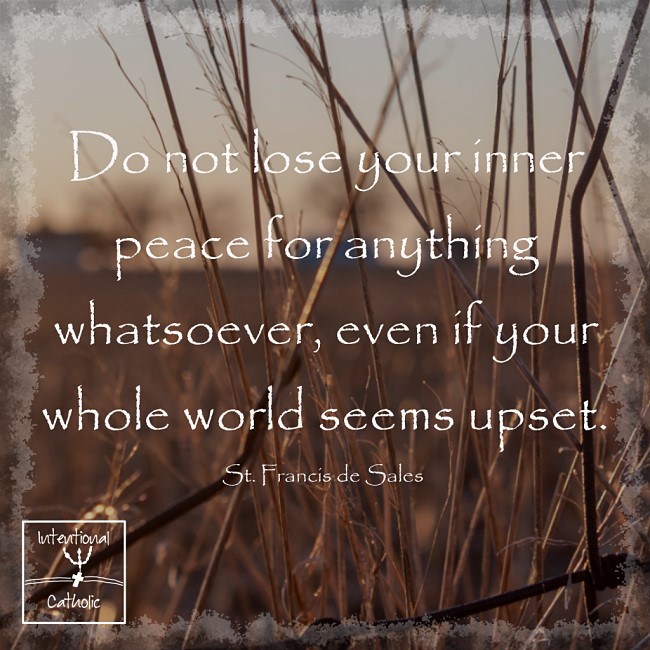
When I went through my files looking for words of comfort the other day, I wasn’t sure whether to share this or not. There’s a lot to be anxious about right now, and I doubt any of us feels real inner peace. Yesterday we took a break from the Lenten sweets fast. I said, “You know, sometimes life hands you Lent, and when it does, you don’t need need to make it for yourself.”
Of course, we have no chocolate in the house to speak of, so we can’t just make cookies. But we pulled out the cake pops that have been in the freezer for a year or more, and they decimated the candy jar. All the Valentine’s candy is gone. (Before Easter!)
But that’s not really the point. The point I’m aiming for today is that a quote like this *can* do more harm than good, making us feel that if we aren’t able to live up to it, we are deep failures. I spoke to a counselor yesterday for the first time in my life. Once I cleared the anxiety that dogged me for years in young adulthood, I vowed that never again would I be too ashamed to seek help. And yet every time anxiety has reared its head in the past two decades, I’ve managed to work through it on my own in a few days or a couple weeks.
When it hit last week, I knew I’d outrun my ability to cope on my own. And with a stay-at-home order in place, I am well aware that I have to have my own emotional health if I hope to support that of my children.
So I stopped reading articles on the pandemic, and asked to be removed from an impassioned family email thread; I’m not watching the news; and most importantly, I called a counseling service available through my husband’s work.
One of the things he told me is that our emotions respond to the narrative we give them. Right now I’m focused on the deprivation–concerts, freedom, unfettered grocery store runs. But the reality is that what I still have far outweighs what has been taken from me. That’s why this quote speaks to me this morning. The whole world SEEMS upset, but it isn’t as upset as it feels. However imperfectly, however often I fail, I will work to refocus on what I have, rather than what I’ve (temporarily) lost.

I’m going to switch focus for a while to words of comfort and hope… for my own sake as well as, I would imagine, everyone else’s Only one comment to go with this quote, which felt like balm on my own soul this morning: when I went online to doublecheck the spelling of St. Francis de Sales’ name, this was in the Wikipedia preview biography about him: that he was “noted for his deep faith and his gentle approach to the religious divisions in his land resulting from the Protestant Reformation.”
We have religious divisions of our own. St. Francis de Sales might be a great model for us all.
I haven’t posted here in a week. I just couldn’t. What can I say?
In the past week, death by coronavirus came to my community. My kids came home from school for a four-week online learning plan that I have already told them to expect to last until the end of the year. That way if we do get to go back to school, we’ll all be pleasantly surprised.
My family is wrestling with the loss of events we had our hearts set on. The loss of freedom. The panicky sense of lack of external structure, which you can handle for a week or two, but the idea of it stretching from now until late August is enough to invoke panic attacks. (Every blessed day exactly the same, nothing, not even going to church to break the monotony.) The gut-hollowing recognition that no matter what I do, I can never provide as much structure as my daughter with Down syndrome needs in order to learn successfully.
There’s the discernment of what things outside the home need to be done, and the reality of judgment when others think we’re discerning too loosely. The terror of a person whose anxiety molds itself on scrupulousness, thus making me think I’m not doing enough to “flatten the curve” unless I lock the doors and keep us totally isolated. The discernment of trying to weigh mental health against the reality that if the kids go outside, they’re going to encounter other kids.
The recognition that way too much of my anxiety has to do with other people’s opinions.
To say nothing of the fear of what happens if the virus does land in my household.
Only a few weeks ago I was looking at my life with great contentment. And, truthfully, waiting for the other shoe to drop. Things were going too well.
I didn’t expect what we’re dealing with now.
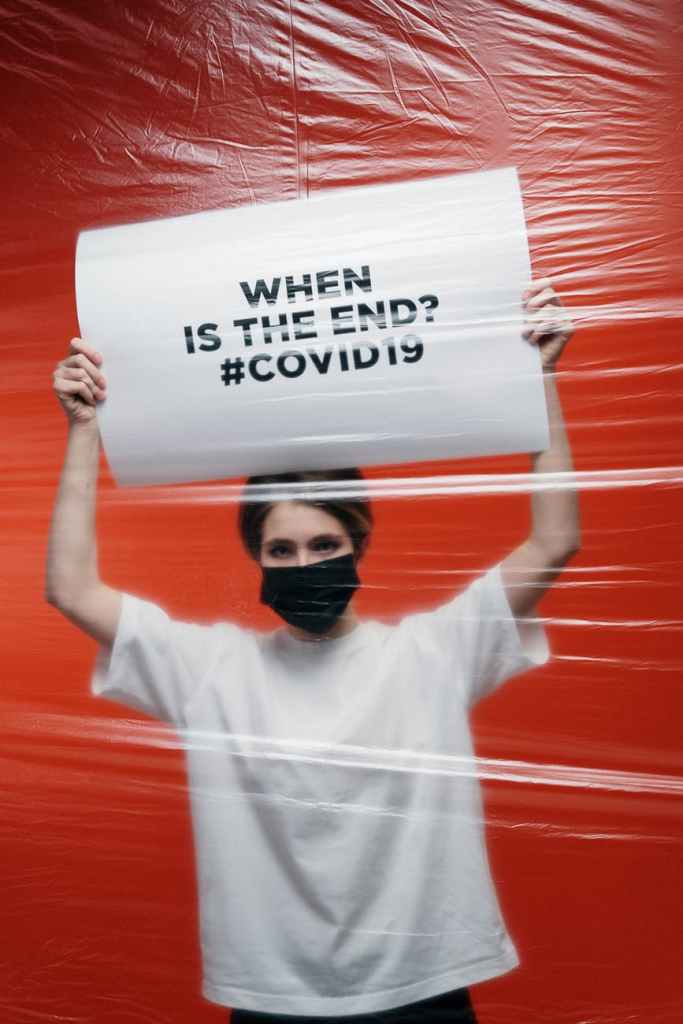
I also didn’t expect the anxiety to hit. Because hit it did, roaring back into my life the middle of last week along with the arrival of my kids at home for Coronavirus Break. And unlike other flare-ups in recent years, this one has no expiration date.
I’ve spent a lot of hours lying awake lately with heart pounding, praying and praying and praying.
The one moment of hope coming out of all this is that, in the middle of one of my white-night prayer sessions, begging for clarity and discernment and peace, I remembered my spiritual director asking me, “Has there ever been a time when you were certain that what you were hearing was God?”
Well, of course there was.
“What did that feel like?” she asked.
Well, I answered, it felt like quiet, cool breezes by a creek. It felt like calm.
It did not feel like a maelstrom of lava pits and pounding hearts.
That recognition was so profound. And I am clinging to that reminder in the midst of these days full of anxiety I could never have anticipated.

Ever since “it’s the economy, stupid,” this has been how every issue is approached, both personal and societal. Who am I kidding? If the Vatican II bishops were talking about this, clearly it’s been this way since before the 1990s. But it’s impossible to escape the message these days. No matter what crisis is happening (coronavirus is one, but there have been plenty of other instances), the go-to response is always “how is it going to impact the economy?” As if that were the only–or even the most–important factor.
As a Catholic striving to put my faith above all else–far, far above money, which is supposed to be how we survive and do good in the world, not the defining factor of existence–I find this fixation problematic. We say we want to be a Christian nation, but that only holds as long as the topic is some moral issue that costs me nothing, because it doesn’t impact me personally. As soon as it’s a Gospel directive that affects *my* pocketbook, it’s a whole different story.
God vs. mammon, indeed.
I’ve never succumbed to communal panic about crises. The closest I came was my senior year of high school, when some dude who’d “never been wrong” in predicting an earthquake predicted the biggest one ever on the New Madrid Fault, and it happened to line up with the day I was out of town auditioning for all-state band. I think my response was to pack a blanket in the car.
So it felt very… wrong… somehow, yesterday, to go to the grocery store a day early and spend more than twice what I normally spend on a week’s worth of groceries to freeze–vegetables, snack packs with nuts & cheese, milk & pizza makings. It felt like abandoning a long-held principle.
But if things do follow recent patterns, we could find ourselves quarantined in our home for two weeks, and if that happens, well, I have six people to feed. Extra groceries seems like a reasonable precaution.
Here’s what I’m realizing this week: in the coronavirus era, more than ever, living the faith intentionally requires humility and self-checking one’s biases.
I, for instance, have been very resistant to the limitations on worship that have come down. But I remind myself that devotion to purity of worship is a golden calf just as deadly as idols of political philosophy or money. There are immuno-compromised people to consider, and their dignity is more important than the externals of worship.
We all have some hangup to get over. Some people are so certain that “on the tongue” is the only proper way to receive the Eucharist, they are unwilling to bend in the interest of public health. Others insist we shouldn’t ban the Cup or stop the sign of peace because obviously God will protect us.
For all of us, the coronavirus outbreak is a wakeup call. For years, we’ve been warned that something like this was inevitable, but we all shrugged it off.
And now that it’s here, we’re reaping the fruit of our collective failure to listen and compromise. While Americans up and down the political food chain have been busy screaming at each other about a handful of hot button issues, a bunch of critical things have been ignored. We’re not prepared for a health crisis like the one China and Italy have been facing. This morning, a family member sent the text of an article from the Economist (a British magazine which is rated “least biased” by Media Bias/Fact Check, a rare distinction), which stated that “In 2010 the CDC budget was $12.7 billion in current dollars; today it is $8 billion.”
Meanwhile, the talk in some quarters is more tax cuts. Tax cuts *might* stimulate some minor economic movement (although with everything closed/canceled, what are we going to spend it on?), but the nation is already deeply in debt. You can’t keep cutting government’s funding and expect it to be able to carry out its proper function–i.e. the protection of the population.
Our basic vocation as Christians is to care for each other. Sometimes that’s on an individual basis, person to person. But if we want to be a “Christian” nation, then we should view that as a collective, societal vocation. To accomplish that is going to require taxes. Taxes are not evil; the pandemic illustrates that some functions simply *cannot* be carried out on an individual basis. They *require*, by definition, centralized intervention. We can’t hold any philosophy, whether it’s Communion under both species, Communion on the tongue, or low taxes, so tightly that we give up the thing that’s most important–the Christian call to care for each other.
 Intentional Catholic