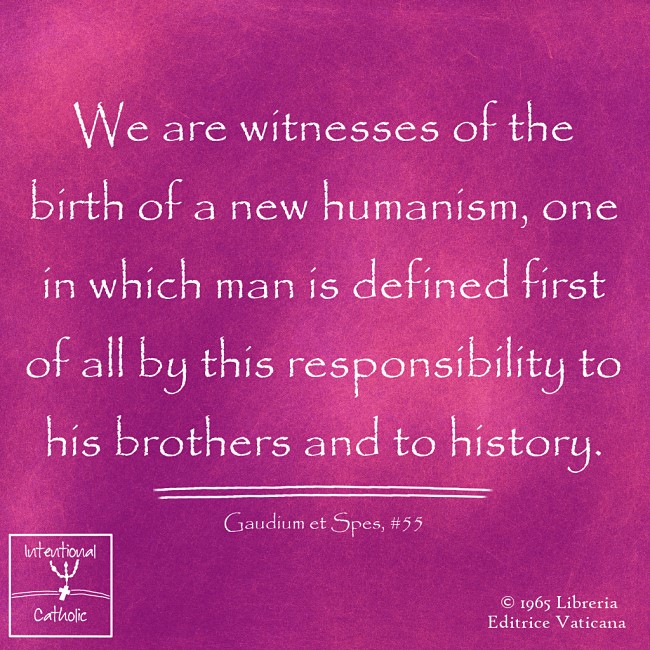
This seems like such a simple quote. I was going to let it stand without commentary, but I realized that this is really the essence of the convictions of all Christians who are passionate about social justice. To be a Christian is to care, in a self-emptying, physical, sacrificial way, for others. And to recognize that the things we do now have ripples down through history, on generations not yet born.
This quote expresses why we have a responsibility to act on environmental issues, on racial issues, on issues of poverty and inequality–the whole range of questions that are the most uncomfortable to address, because they challenge cherished ideals of self-reliance and rugged individualism.
I absolutely love this quote. WE are the creators of our culture. Holding ourselves apart from it, putting ourselves in a bubble to protect ourselves from the evils of the world, is actually an abdication of our job. We’re supposed to leaven the world by being part of it. By influencing it. Not by hiding from it.
That also doesn’t mean we take a combative stand to everything in the culture. By being part of it, we can shape it. If all we do is criticize it and not participate, we give over our chance to make it better.
Disclaimer: I’m a big believer that faith is never easy, and if it is, it almost certainly means you’re not digging deep enough. If you think you have it all figured out, you’re probably more pharisee than seeker.
When I started Intentional Catholic, I knew I couldn’t just ignore the bits of the documents that are hard for me to swallow. So I admit it: this is one of them.
Certainly the most “traditional” among us believe very strongly that moms should be in the home, always and forever. But that second half of the quote, about not underrating legitimate social progress, seems to indicate that even the bishops had to wrestle with how rigidly to hold that principle.
Because if a woman’s rightful place is in the home as long as she has children, the reality is she will ONLY have a place in the home. The reality of the world is that one cannot have children, raise them in isolation from a professional career, and then blithely step into the workplace at age 45 or 50.
As crazy as my life is—as stretched-thin as I am by the various irons I have in the fire—I recognize how incredibly blessed I am that my gifts & passions lend themselves to working from home. But my situation is the exception, not the norm. God gives women gifts just as he gives men; surely He means for them all to be used? Surely they were all given for a purpose in the divine plan. Yes, mothers have something irreplaceable to give to their children, but does it necessarily follow that that gift can ONLY be expressed by staying home?
Also, the male-dominated professional world really suffers from the lack of the feminine gifts—peacemaking, teamwork, empathy come to mind; I’m sure there are others. Those, too, are gifts given by God for a purpose.
I know families in which the father is the one with the gift for homemaking, and it works beautifully. I also know families who move Heaven and Earth to work opposing schedules so they share the tasks of breadwinning and child care.
I’ve heard it said many times that stay-at-home-mom is a pretty new invention, one enjoyed only by the wealthy. I’m not able to confirm this quickly, but it tracks with knowledge of women working in clothing factories and washing houses in earlier times. If you think of moms at home pre-industrial revolution, they were growing vegetables and preserving, baking bread and sewing clothes for the family.
And if you are tempted to say, “Well, duh, that’s what you do when you stay home,” I’d remind you that at the same time the husbands were working fields and raising livestock, also at home. Home and work were the same thing for EVERYONE in the agricultural era.
And in the industrial age, how many of those wealthy at-home moms employed other women as wet nurse, nanny, and tutor? So they were home, but they still weren’t really raising their own kids. Plus, that picture reveals even more women working outside the home in an era we tend to idealize as the era of SAHMs.
So all in all, I think we have a tendency to oversimplify this whole picture of what a mother’s domestic role is, and what it means to safely preserve it. A mother does have a unique place in her children’s heart and in their upbringing. But it doesn’t follow that if she goes to work outside the house, that role is being discarded.
I have a family member who works full-time and points out that being a working mom does NOT mean work is more important. When kids are off school or sick, they frequently camp out in her office all day. When she can’t work it another way, she sacrifices work time. “I am always a mom first,” she says.
A lot of this reflection is not strictly faith-related, but many times general expressions of faith—i.e. “we are all given unique gifts by God for a specific purpose”—require us to get down in the weeds on practical things to see how that principle can or should be lived out in the real world.
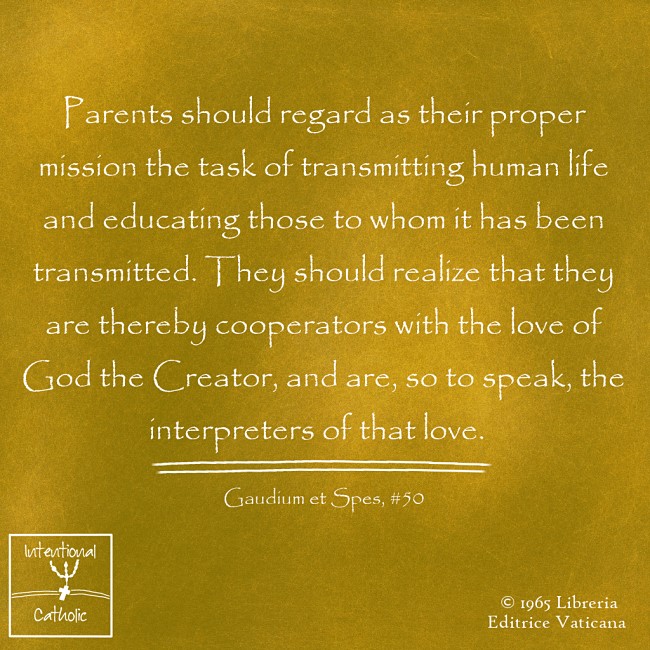
There’s a sequence in Gaudium et Spes that addresses marriage and family, and is often quoted for its guidance on discerning family size. Children are the supreme good of marriage; marriage is ordained for children (though not solely so); educating the next generation; discernment of family size.
This is from the middle of that sequence, but it isn’t among the most well-known extracts. (Well anyway, they’re well-known to me from years in the natural family planning community. In any case, see #s 48 and the rest of 50 for that.) But I pick this bit because it’s a smaller, more-easily processed excerpt, and because I think it really crystallizes the big picture: we are cooperators with God when we bring children into the world, and we interpret that love through the way we raise our children. That’s big stuff!
There’s been an uptick recently in the expression of a point of view that suggests that since we are citizens of Heaven, not earth, we should not pay attention to earthly suffering or strive to alleviate it. The Church says otherwise.
Posted on
As Catholics, I think we’re often in danger of putting ourselves in a bubble. The thing that strikes me most in Gaudium et Spes is the implicit idea that we’re supposed to be in the world, not isolated from it. It seems so obvious. Of course–how can we leaven the world if we don’t interact with it?
But another danger of the bubble is that we develop a combative, competitive view of ourselves vs. the world. THE WORLD is bad, nothing good can possibly come of it, all secular movements are inherently contrary to the Gospel, etc. We do this all the time.
Here, the bishops and Pope Paul VI urge the faithful to remember that even when the world doesn’t get it all right, the heart is often in the right place. To me, the lesson is: Rather than battling everything that comes out of the secular realm, we should look for what is of value, and find how to work in cooperation for the betterment of all. To me, that seems the best chance for true evangelization.
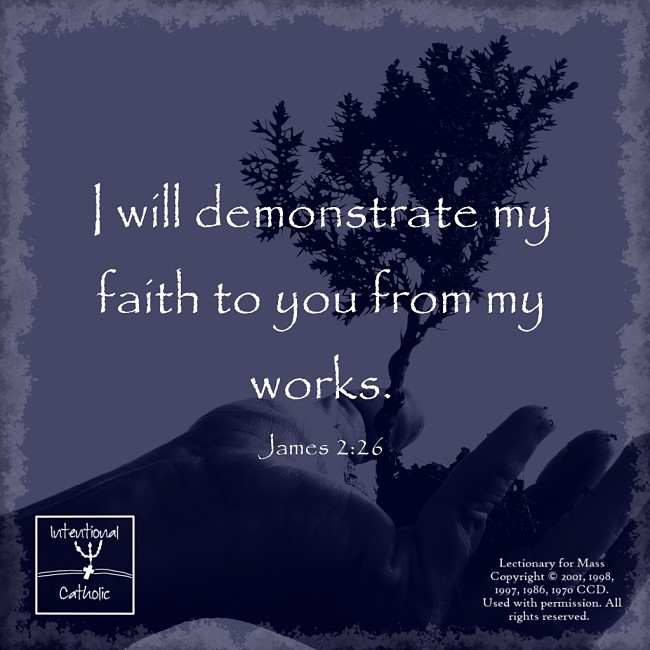
Listening to today’s daily reading caused me to perk up. What an image James uses to remind his community that simply talking about being a disciple isn’t really being a disciple! Farther down in the reading, he clarifies what he means by “doing something”: to care for orphans and widows in their affliction and to keep oneself unstained by the world. What struck me is the both/and of it–social justice AND personal piety. No false binaries here.
My husband and I have been natural family planning users since day one of our marriage. NFP saw us through infertility (the data from the charts facilitated treatment), four babies conceived without medical intervention, and another eight years of charting.
I bring this up because Church teaching on birth control probably represents the biggest sticking point for many people in the modern world–the biggest perceived encroachment on “personal rights.”
I used to be a lot judgier on this issue than I am now. NFP is hard for some people, and often the reasons are not as easily dismissed as many NFP devotees would like them to be. Sometimes it’s physical (tough charts, long abstinence), and sometimes it’s emotional–when practicing NFP causes people to excavate deep, long-standing wounds, wounds with ripple effects that make marital intimacy a point of contention rather than an opportunity for intimacy.
Also, none of us are perfect at the way we use our sexuality. None of us. So I’m less, well, judgy these days.
Nonetheless, I still believe passionately that NFP is a great thing. The self-knowledge that comes from charting has been liberating and empowering to me as a woman, and I see the practice of NFP as a source of healing for a world where relationships between men and women are suffering the wounds caused by dominance. Where sex is used as a bludgeon, mostly by men against women. To use NFP successfully requires two people to respect each other in all their God-given dignity, to hold in honor and awe the total gift of the way the other is made. Not to try to turn off an entire healthy, functioning system of the body.
It’s also a no-brainer for environmental stewardship. Pharmaceuticals go back into the water, and not all chemicals are filtered out. Lawn & agricultural chemicals in the water supply were half of our infertility issues.
And I see the fruits of NFP in my relationship with my husband. The openness, honesty, and mutuality of communication surrounding this most sensitive topic has helped me understand what total security in a relationship means. What true intimacy means.
Which is not to say we’re a happy-happy couple. Those who know us know we pick at each other all.the.time. And sometimes the conversations are hard–it’s not just “do we try for a child or do we try to avoid?” It’s “I don’t feel close to you” and “I don’t want to be close to you when you do X or Y.” It’s “I feel resentful because of Z.”
But we always grow in love because of them.
So this quote strikes great resonance for me. NFP is a big limit, but it’s also freeing–in many ways, but I’ll focus on one: it’s a limit forces the issue of dignity and mutual respect. It’s not that you can’t have mutual respect and treat each other with dignity if you don’t use NFP, because clearly you can. But being successful with NFP–by which I mean “We are equal members of the team,” not just “we didn’t get pregnant”–REQUIRES us to pay attention to issues of dignity and mutual respect.
I haven’t entirely sussed out a satisfactory meaning to this quote, except that the word “wrestle” really resonates. The past several years, my spiritual life has consisted of a great deal of wrestling. When so much darkness is around, how do I make any headway against it? What things must I say publicly, even if they will cause (at a minimum) conflict, and possibly even relationship damage? How often am I clinging to my own opinions and calling them God’s? When are the things I’m so angry about in other people the same offense I’m committing, right in the moment of my anger? Am I complicit in the evils I abhor? How would I know?
These two sentences from Gaudium et Spes reflect a clear-eyed recognition of the reality of the world. Until we pass beyond the veil and can actually see through the eyes of God, we’re all guessing at an awful lot of things, and I think I can safely say this one absolute: NO spiritual life is genuine unless it involves a lot of wrestling and turmoil.






 Intentional Catholic