It’s been six years since I read Thomas Merton’s “New Seeds of Contemplation,” but the experience remains with me. It resonated so deeply with my experience of finding God in the silence of nature, beyond cell signals and wifi, beyond human noise. So many things stood out to me, but this quote in particular seemed noteworthy, because we think of “freedom” as “I get to do whatever I want to do.” We fail to recognize that self-gratification makes us prisoner within a set of chains far more inescapable than the strictures we rail against.
Here’s the larger quote:
It should be accepted as a most elementary human and moral truth that no man can live a fully sane and decent life unless he is able to say “no” on occasion to his natural bodily appetites. No man who simply eats and drinks whenever he feels like eating and drinking, who smokes whenever he feels the urge to light a cigarette, who gratifies his curiosity and sensuality whenever they are stimulated, can consider himself a free person. He has renounced his spiritual freedom and become the servant of bodily impulse. Therefore his mind and will are not fully his own. They are under the power of his appetites.
Love is one of those words we throw around a lot. I often get frustrated when homilies focus on love, not because it’s wrong to do so, but because so much of the time, it stays in the realm of the theoretical. We can all nod our heads sagely and agree that to be a disciple is to love, but it’s awfully hard to recognize the concrete ways in which we don’t love at all.
It’s easiest to spot in the kids. One kid comes home stressed by lack of time and homework. He has a veritable comic strip cloud hanging over his head, with lightning bolts coming out of it. He bites off the heads of his brothers, who aren’t actually doing anything wrong, and they react by being predictably hateful. I may or may not, recently, have shouted, “All the religious formation in the world is useless if you can’t figure out how to live it in real life!”
Every parent reading this post probably chuckled and nodded sagely just now. We’ve all dealt with it.
But it happens to us, too. We’re just a lot more sophisticated with our stresses, and far more skilled at justifying ourselves for not acting in love.
The interesting thing is that the section of Evangelii Gaudium from which I drew both yesterday’s and today’s posts is addressed to preachers. Yet both days resonate really strongly with me as a lay person. I’m guilty of this… are you?
My passion for environmental stewardship was born because of infertility.
For three years, we tried to start our family and couldn’t.
It was excruciating. I started metformin to treat PCO; I had surgery for
endometriosis. But in the end, what allowed us to conceive was a water filter.
Yes—a water filter.
The water where we live contains alachlor, diazinon, and
atrazine—herbicides and insecticides used in lawn care and agriculture. These
three chemicals also suppress male fertility. We don’t drink much soda; water
is our staple. We installed a PUR water filter, and four or five months
later—time enough for the change to impact the male reproductive system—we were
expecting.
Were there other ways we could have overcome our
infertility? IVF? Most likely. But even if it weren’t against what we believed
as Catholics, IVF isn’t the answer to infertility caused by lawn and agricultural
chemicals in the water supply. The fix is not to have those chemicals in the water supply in the first place.
My husband and I are big believers in NFP, because we have
experienced firsthand what the use of chemicals by human beings can do to the
natural environment. To us, Church teaching on birth control simply makes
sense. Working in conjunction with the way God made us is a best practice for
living. It puts us more in harmony with God’s creation. With how God made us.
Self-knowledge, better marital communication—all these are real benefits, but
the basic truth is that planning our family through NFP allows us to live as
God made us, without harming ourselves or the world around us.
For me, it’s no leap to generalize the lesson to a million other questions of environmental stewardship. Nothing exists in a vacuum. Ecosystems work because all the pieces are in place. God designed them to work in a particular way. If one species goes extinct, it upsets the balance; the ripples go out from there. I was mocked a few months ago by a supporter of the border wall for sharing a link outlining the negative impact on migrating species. It was a reminder that we have an unfortunate tendency as human beings to compartmentalize rather than recognize how all things exert a push and pull on each other.
Here’s my favorite example of this ripple effect:
Just one species, long absent because humans had tried to
eliminate them, made all that difference.
How can anyone cling to the belief that human beings couldn’t
possibly be causing climate change?
We often try to separate issues into “these issues are faith
issues, and the rest are not.” It simplifies life, for sure—makes it easier to
process a complex world. But it’s not accurate.
What I find so beautiful about Laudato Si’ is that it makes the connections. In fact, if we live in a world created by God in a certain way–with intention, in other words–then all issues are faith issues.
The readings this weekend were all about money. Amos was talking about the dishonesty of those with money–how they were so focused on their own profits that they didn’t really care what happened to the “have not”s of the world. And Jesus said, “Guess what? How you use your money matters.”
Listening yesterday at Mass, it really struck me how those readings should skewer America. The obvious application is the question of income inequality: how many of the huge profits made by companies are held by those at the top of the food chain, how little is actually shared with those down the ranks.
But you know, so much of what we talk about in America centers on money. Many would like to believe we’re a Christian nation, but money–capitalism–is the primary thing that preoccupies our social and political discourse, even among Christians. So many things come back to money: health care and social programs would require more taxes, and we can’t possibly suggest raising taxes. Immigrants are perceived as a threat to American jobs, so again–it comes back to money. The question of whether a president deserves re-election is always about the economy. We’re having all these discussions about China and intellectual property and trade fairness, but nowhere on anyone’s radar is the question of just wages for labor, which is–let’s face it–the only reason manufacturing went overseas in the first place. It went overseas because we, the rank and file Americans, aren’t willing to pay what it would cost to make a product while paying a just wage to the laborer who made it.
We have a lot to answer for, and I don’t pretend to have a pat solution. I personally try to take a step back from the consumer culture by starting with secondhand clothing purchases as much as possible. But those clothes, too, were made by cheap labor overseas, and I order from Amazon just like every other red-blooded American. What do I think God will say to me when it comes time for me to answer for my choices? I don’t like pondering that question any more than anyone else.
In any case, when I was looking through the possibilities for things to share today, this quote from my Beatitudes book seemed to dovetail with what we heard at church yesterday. Because what if? What if, instead of money, we made God’s will, God’s kingdom, God’s priorities, the central principle that guided every other choice?
While I was preparing a talk called “Who is my neighbor?” recently, I learned that the Jewish law was laid out as a set of concrete guidelines to explain how it looks, in real world terms, to “love the Lord your God with all your heart, with all your heart, your soul, and your mind, and your neighbor as yourself.”
Isn’t that interesting? Jesus is all over people in the Gospels for being too rigid and scrupulous about the Law, and Paul takes it to a whole new level. From that, modern Christians sort of naturally assume the Law was intrinsically flawed. But this made me realize the purpose of the Law was the same as what I’m doing here: to try to connect airy-fairy concepts of the faith to a concrete world.
The problem came when scrupulousness and rigidity about the precepts of the law caused people to judge others rather than love them.
I have two thoughts on this, and they’re kind of contradictory. On the one hand, I think the modern Church suffers from the same scrupulosity as ancient Jews. I know I have. Frankly, I think it’s more common among Catholics than we might think. What is Catholic guilt, if not an overwhelming anxiety to make sure we’re doing things RIGHT? And we judge everyone else for not doing the “right” thing. (Cough-cough-liturgy wars-cough-cough)
On the other hand, we tend not to recognize what the precepts of the faith actually mean in real life. All the big political issues of the day–abortion, guns, health care, immigration, race, etc.–looking at these through the radical call to love unconditionally should make all of us squirm, wherever we fall on the political spectrum. The love of money taking precedence over care of neighbor or creation. And so on. It’s like I said to my boys yesterday morning before school, when they were being nasty to each other: “All the religious formation in the world will do you no good if you can’t figure out what it looks like in real life!”
This is the question I leave us all with for the weekend: if showing love is how people will know I am a follower of Christ, HOW do I show love in this moment, this time, to this person I am encountering?
I can’t stand conflict. But there’s something I loathe even more: when people who are upset with each other talk past each other instead of to each other. I’ve been harping on this for years in politics, but recently it’s come home to me that it happens an awful lot in places much closer to home.
There’s a relationship in my family’s life that is riddled with this dysfunction: you see a problem, you ask for an answer, and there’s either a complete lack of response, or the entity on the other side of the line issues its “message points” instead of answering the question. Is it any wonder that a person who approaches communication in good faith and gets message points in return ends up feeling, well, enraged?
Unfortunately, it’s a common dysfunction. I’ve come to believe it is the source of tremendous unnecessary angst and lack of peace in the modern world. As I ponder this, weighed down by the frustration and bewilderment that comes from beating your head on a brick wall you can’t avoid, I realize something else: we live in a world defined by fear and lack of trust. People use their message points because they’re afraid if they address the questions on the other side of a conflict openly and honestly, it’ll come back to bite them. They’ll get sued, they’ll get in trouble with their superiors, or whatever.
My whole life, I’ve been conditioned to look at the big picture, and so for years, when I ponder questions like this, I’ve gone straight to its impact on issues of global or at least national import. But everything big starts small. If protectionist passive-aggressiveness is what we as individuals face in interacting with individuals or local entities (and how often are we the guilty party?), then of course the larger world looks this way, too. It’s like those mosaics made up of hundreds of tiny thumbnails. One individual incident doesn’t change the world—but all together, they form a global pattern.
“Let your yes mean yes and your no mean no,” Jesus says. His context is different, but it applies all the same: Just lay it out straight. Don’t dance around. Be authentic and communicate in good faith.
What if changing the world could really be that simple?
**(Note: I did not say “easy.” I said “simple.”)**
As a mom of boys and accordingly well-steeped in superhero lore, I read these words and they automatically translate to those of Uncle Ben, in Spiderman: “With great power comes great responsibility.” Responsibility to discern, to self-reflect, to make sure my actions beliefs –and when they don’t (as is true far more often than I’d like), to confess and vow to do better.
And again: although this is in the context of stewardship of the earth that keeps us alive, it applies across the spectrum of a lived faith.
I’ve written about the Beatitudes twice now –one book for families with young children, and now the new book, aimed at helping adult Catholics examine our lives in concrete ways, using the Beatitudes as a guide. Both times, it’s required me to rethink how I look at certain words. “Meek,” for instance, is not a quality any of us particularly prizes. As a woman, striving to find my voice in this world in a both/and rather than an either/or way (professional AND mother-wife), I’m acutely conscious of my own tendency to avoid asserting myself–to give way to others. And then to be bitter and resentful about how others’ voices are amplified above my own.
It’s something women talk about a lot when we discuss how difficult it is to make a dent in the world: how we feel a need to subordinate our own priorities and skills and voices in favor of others. Men don’t feel this compulsion nearly as much as we do. My husband often wants me to be more assertive in professional situations. It is a constant struggle.
And so, as a woman, my first reaction to the word “meek” is to put up my claws and hiss. I don’t need any more of that, thank you very much.
But in praying about how to write this section of The Beatitudes, The Spirit whispered the bit of wisdom contained above. That nugget shaped the section of the book on meekness, framing it in a whole new way, free of the baggage I attach to it naturally.
I realize now that meekness–real meekness, not some pale, distorted earthly version–is a trait I will spend the rest of my life trying to master.
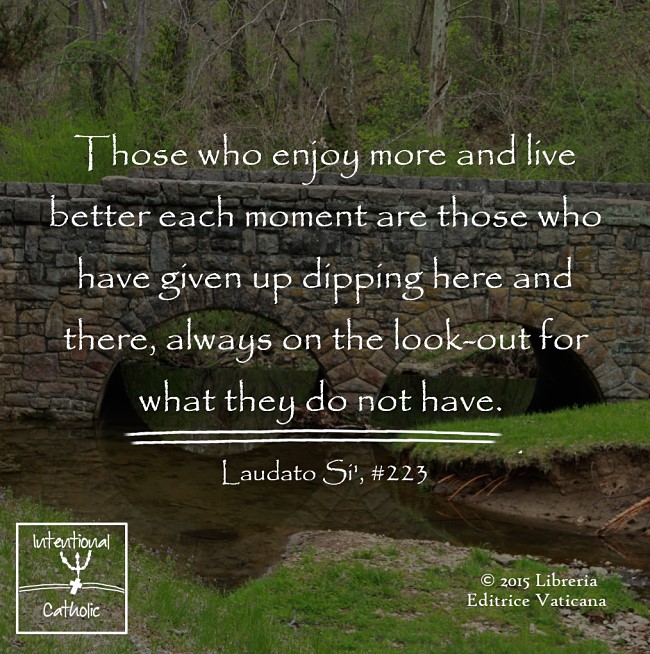
One of the things I love about Laudato Si’–and all the documents I am mining, in fact–is how lessons about the primary topic apply in so many other, seemingly unrelated, areas of life. Take this one. It’s about living more sustainably, but his point is that the chasing after the wind that is the consumption culture (new phone! Better streaming service! New clothes!) leads to being unsatisfied with life–skipping along the surface without ever really sinking into the moment. This resonates with me so deeply. It applies to the pursuit of physical goods as well as one’s reach and influence. You can imagine how much that topic preoccupies someone with an online ministry. Stats! Followers! Shares! Engagements! SEO!
But it also applies to being too busy, trying to gorge on everything on the buffet table of life instead of choosing and savoring. We all recognize this as a perennial problem we face in modern life.


 Intentional Catholic