There’s a sequence in Gaudium et Spes that addresses marriage and family, and is often quoted for its guidance on discerning family size. Children are the supreme good of marriage; marriage is ordained for children (though not solely so); educating the next generation; discernment of family size.
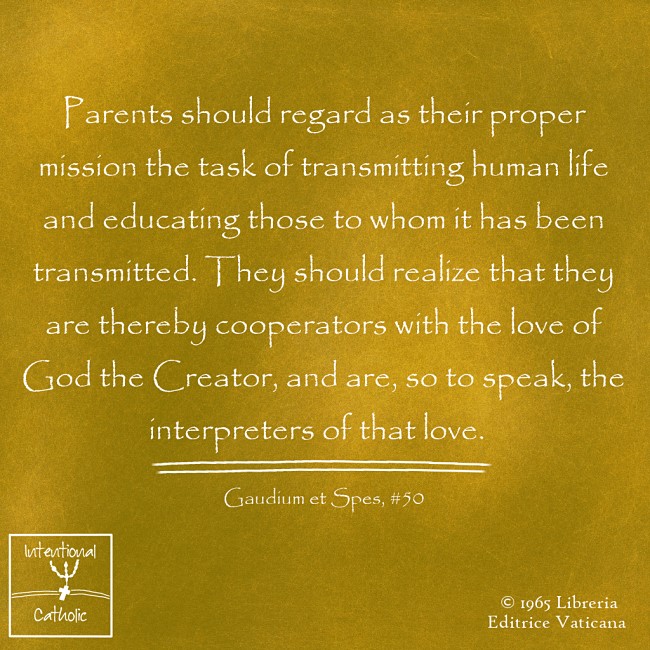
This is from the middle of that sequence, but it isn’t among the most well-known extracts. (Well anyway, they’re well-known to me from years in the natural family planning community. In any case, see #s 48 and the rest of 50 for that.) But I pick this bit because it’s a smaller, more-easily processed excerpt, and because I think it really crystallizes the big picture: we are cooperators with God when we bring children into the world, and we interpret that love through the way we raise our children. That’s big stuff!
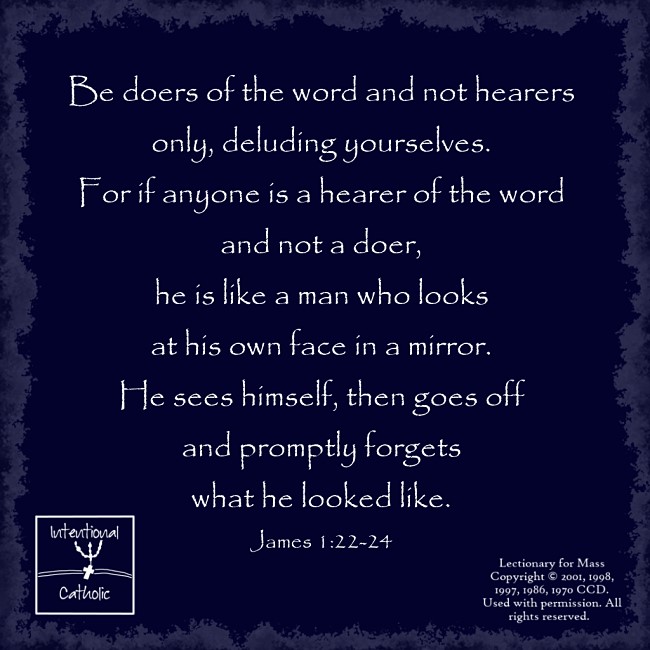
Listening to today’s daily reading caused me to perk up. What an image James uses to remind his community that simply talking about being a disciple isn’t really being a disciple! Farther down in the reading, he clarifies what he means by “doing something”: to care for orphans and widows in their affliction and to keep oneself unstained by the world. What struck me is the both/and of it–social justice AND personal piety. No false binaries here.
“Another self.” It’s hard enough to view others this way in family life. Half of Godly parenting–maybe three-quarters of it–is trying to get kids, who are supremely selfish beings, to recognize the other as not only equal to themselves, but “another self.”
But take this beyond the confines of those we already love, and it’s downright superhuman.
-the three people you most dislike in the world, you should view as “another self.”
–the people who are a continual thorn in our sides are “another self.”
–the people living in the woods and holding signs at intersections, whether they’re drug addicts or lazy or criminals or whatever assumptions we might be tempted to make about them, are “another self.”
–the refugee, asylum seeker, and yes, even the genuine “illegal alien” is “another self.”
And as a Christian it is my *job* to enable all these “other selves” to live with dignity. This is a conciliar document saying this, not one priest or one bishop. This is the Church speaking as clearly as the Church can speak.
Now, we can argue about what is the best way to enable human dignity. That’s a totally valid argument.
But those aren’t the discussions we’re having.
Instead, almost all our arguments are focused on whether we *should* help people–whether they *deserve* it and whether “there’s money” to do it. But let’s be honest: in America, there’s plenty of money to do what needs to be done. The argument is between those who think it can’t be done piecemeal, and should therefore be done at the level of society, i.e. through higher taxes and governmental administration, and those who think government is intrinsically evil and taxes are to be avoided at all costs–that charity should be entirely a private matter, even if that means many people will get missed.
This is the fundamental logjam in America today, and the trouble is that people on both sides view their own position on that question as universally-accepted truth–a settled reality. And so instead of figuring out how to strike a balance between personal rights and societal responsibility, we end up bickering about who does and who doesn’t deserve help. We start labeling asylum seekers as criminals, and conservatives as racists, and it all falls to pieces.
Our opponents, too, are “another self.”
The following quote is too long to put in a graphic, but it’s well worth putting at the center of our minds in an election year:
…there must be made available to all men everything necessary for leading a life truly human, such as food, clothing, and shelter; the right to choose a state of life freely and to found a family, the right to education, to employment, to a good reputation, to respect, to appropriate information, to activity in accord with the upright norm of one’s own conscience, to protection of privacy and rightful freedom even in matters religious.
This social order requires constant improvement. It must be founded on truth, built on justice and animated by love; in freedom it should grow every day toward a more humane balance. An improvement in attitudes and abundant changes in society will have to take place if these objectives are to be gained.
The more time I spend with Gaudium et Spes, the more I love it. It’s just so beautiful!
You could look at this quote as a throwaway comment, but if you take the time to dig into it… wow! I can’t find myself until I don’t matter anymore. My opinions, my priorities, my philosophies, my vision of the way the world should work–all these are irrelevant, and I will be more spiritually free, more like God, the more independent of them I am. The less tightly I hold onto me, the more I will know who I actually am.
The thing is, what does it mean to make a “sincere gift of self”? The NFP community uses self-gift as a catch-phrase, to the point where for years, I only saw it in relation to questions surrounding sexuality.
But that’s only one tiny slice of self-gift. What does it mean in my family? In my marriage? What does it mean in a work or school community situation where I feel threatened or I passionately disagree with choices being made? Does emptying myself mean I should never stand up and protest injustices I’ve suffered? Never call out poor choices or un-Christlike behaviors or policies?
What about emptying myself of my own self-importance? We all know it’s God’s opinions, not ours, that matter. The trouble is, we are all 100% convinced that God agrees with us. We don’t recognize the possibility that we might have opinions we need to give up, because obviously, we’re already in the right. We never even stop to question what human priorities we have slapped with the “God’s on my side” label.
This quote from the Second Vatican Council offers a heck of a lot of food for thought in the year 2020, as we stare down the barrel of a presidential election guaranteed to be ugly–and more to the point, guaranteed to be full of the temptation to assume that my worldly philosophies, my desires, my opinions, are God’s opinions, rather than mine.
This is such a striking and beautiful statement, I want to let the document stand on its own today–a good reflection as we launch into this second week of Advent. Here is some of the context surrounding it.
In the depths of his conscience, man detects a law which he does not impose upon himself, but which holds him to obedience. … Conscience is the most secret core and sanctuary of a man. There he is alone with God…
Conscience frequently errs from invincible ignorance without losing its dignity. The same cannot be said for a man who cares but little for truth and goodness, or for a conscience which by degrees grows practically sightless as a result of habitual sin.
It’s been six years since I read Thomas Merton’s “New Seeds of Contemplation,” but the experience remains with me. It resonated so deeply with my experience of finding God in the silence of nature, beyond cell signals and wifi, beyond human noise. So many things stood out to me, but this quote in particular seemed noteworthy, because we think of “freedom” as “I get to do whatever I want to do.” We fail to recognize that self-gratification makes us prisoner within a set of chains far more inescapable than the strictures we rail against.
Here’s the larger quote:
It should be accepted as a most elementary human and moral truth that no man can live a fully sane and decent life unless he is able to say “no” on occasion to his natural bodily appetites. No man who simply eats and drinks whenever he feels like eating and drinking, who smokes whenever he feels the urge to light a cigarette, who gratifies his curiosity and sensuality whenever they are stimulated, can consider himself a free person. He has renounced his spiritual freedom and become the servant of bodily impulse. Therefore his mind and will are not fully his own. They are under the power of his appetites.
I spent some time yesterday morning–the first full day of school for all my kids–thinking about faith formation for my oldest child, who has now transitioned to public schools. Not all forms of religious formation are going to serve every kid.
And what does good formation look like? One of the things I talked about in my books for families with young kids is that it’s not just about knowing the what. Is it more important to be able to name the commandments in order, or to know what they are and how they apply in real life?
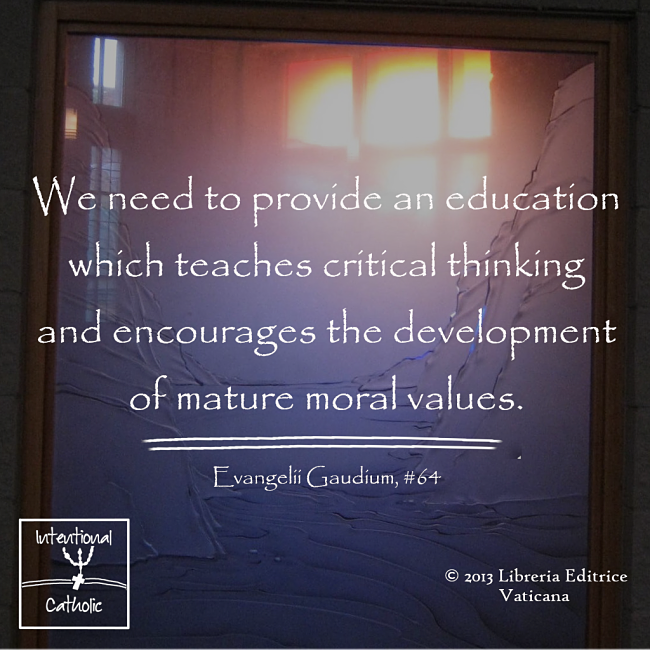
I don’t know what we’ll end up deciding, but I love the idea set forth in this quote: critical thinking formed by mature moral values. What a fabulous vision to set at the center of one’s educational goals! Critical thinking, to inoculate them from the worst of the manipulation practiced by modern life; mature moral values–not oversimplified ones that can’t stand up to the complexities of real life. I love it.



 Intentional Catholic