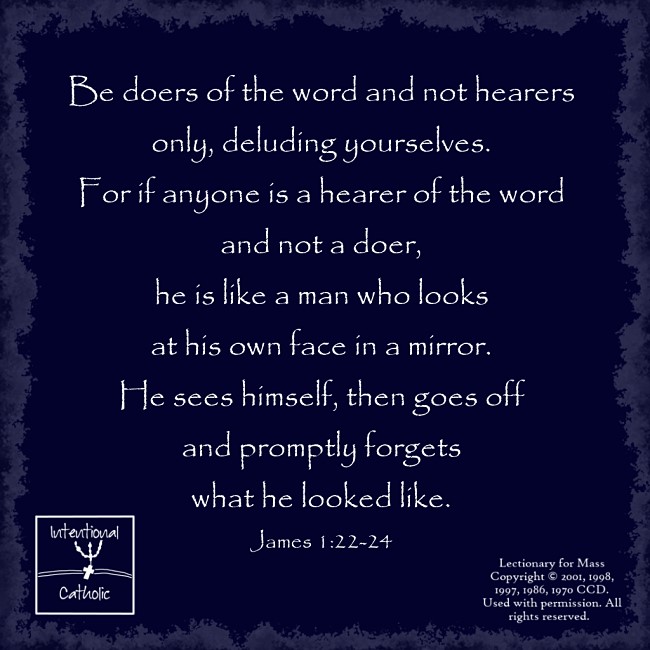
Listening to today’s daily reading caused me to perk up. What an image James uses to remind his community that simply talking about being a disciple isn’t really being a disciple! Farther down in the reading, he clarifies what he means by “doing something”: to care for orphans and widows in their affliction and to keep oneself unstained by the world. What struck me is the both/and of it–social justice AND personal piety. No false binaries here.
Very few of us are good at extending respect and love to those who think differently than ourselves. It seems all issues today are all-or-nothing.
I’ve never been able to watch so-called reality TV, because so much of it consists of people shredding each other’s dignity. People come to fitness classes and laugh about the hateful things said by one contestant about another, and I just feel revulsion. I don’t understand how good people can fail to recognize how awful it is that we’re laughing at other people’s dignity being shredded.
And if that’s how we get our entertainment, then it’s no wonder we can’t even have civil discourse on the issues that matter most. The sentence following this quote in Gaudium et Spes talks about how, the more we respect and learn to understand the person who thinks or believes differently, the better we are able to enter into dialogue with them.
Doesn’t that sound like exactly what we need right now? This whole impeachment trial is a great example: the two sides aren’t even having the same conversation, let alone dialoguing. Those who support Trump won’t address the specifics of the case at hand, they just keep saying “Democrats have been looking for a reason to impeach since day one.” And those who loathe Trump won’t address that accusation. So it’s like we have two separate realities, because people will not treat each other with the respect and love called for in this excerpt from Vatican II. (And this is not just in Washington, but on our social media feeds.)
It’s worth reading all of Gaudium et Spes #28, because the context around this quote addresses the balance between respect and love and caring passionately about truth and goodness. It talks about the difference between error and the person in error. Lots of us say, “I love everyone, I just hate the sin,” but the actions and tone of voice and words used don’t show the love; they only show the hate. I’m well aware of my own struggles in this area, and I think the people who most vehemently insist on “love the sinner, hate the sin” are often those whose words and actions feel the most hate-filled.
A few years ago, I’d never heard the term “scrupulousness.” My mother introduced me to it when I wrote a series on my personal blog about my struggles with anxiety. Now I think of it all the time–though simply recognizing it is a big step toward battling it.
I tend to view it as a sin, although a web search this morning seems to indicate that it’s more a cross to be borne. But I think Catholics in general are particularly susceptible. I would argue that scrupulousness is a big part of “Catholic guilt.”
Once I was sensitized to this tendency in myself, I saw it cropping up all over the place. It may not be a sin, but the inevitable fallout of scrupulousness is a rush to judge anyone who doesn’t share whatever I think is the right way to look at the world, and to place rigid expectations on others that constitute a heavy burden on people prone to scrupulousness–which, as I said, I think is many of us.
I would argue that scrupulousness plays a big part in a lot of the no-compromise fights we have within the Church–the political ones, yes, but also the liturgical ones (and many others). Most recently it’s struck me in the arguments about texts of liturgical songs–an assumption that because I read a particular text fragment in a certain way, a song is inarguably heretical, even though thousands of other people may find great spiritual benefit in it, and great potential for growth in holiness, because they don’t interpret that text fragment the same way I do.
For a long time, because I myself was very conservative and all my scrupulousness was about doing the right things (which were always conservative values), I thought scrupulousness was only a problem conservatives have. As I got better at combating my own scrupulousness, I began to move to the center, and that seemed to confirm my assumption.
But I was wrong. These days I am more likely to suffer from scrupulousness about environmental issues. It’s never enough. And I am VERY judgy about other people’s lack of environmental stewardship.
But the example that sparked this post was this: In the midst of my great world view shift, a quote kept cropping up over the course of months–I can’t find it anymore, but it was something like, “Your money doesn’t belong to you, it belongs to the poor.” It was attributed to a pope. No arguing with that!
The obvious conclusion to draw from this quote is: anything I do to save money is a sin. I have no right to enjoy the things of the world as long as poverty exists. I should never go out to a nice dinner, I should never take a trip to see the wonder of the world, I should never own jewelry–because as long as people are suffering, “my” money doesn’t belong to me. Also, I pointed it at conservatives who don’t like taxes.
It was a big struggle. I told myself that religious figures exaggerate to shock their listeners into doing something for the poor. But that didn’t help, because of who we hold up as the ideal of Christianity: Francis of Assisi and Katherine Drexel, rich people who did give away everything they had; Mother Teresa, who lived in abject poverty for decades; the fact that to this day, a lot of religious orders take a vow of poverty. A papal quote + the body of evidence of what the Church holds up for honor made it hard to draw any other conclusion than the Church intends us to be poor rather than rich.
Even Robert Barron used that quote once.
I tried for a long time to find the exact verbiage, but couldn’t find it anywhere. Then one day, someone attributed it to Rerum Novarum #22. Finally! I went to look it up.
Guess what? Rerum Novarum 22 does NOT say I am obligated to give every single penny I don’t absolutely need for my bare survival to the poor. Here’s what it actually says:
(Note the date: eighteen ninety-one. This is not some uber-modern corruption of the Gospel. Note 2: the footnotes refer to the Summa theologiaeand to Luke 11:14.)
It’s also worth noting that St. Basil the Great is a little more blunt on the topic of our responsibility to the poor:
(Note: I have not checked that quote, for what it’s worth.)
In the end, we all have to wrestle, to try to find a balance between enjoying with gratitude the good things of the earth (which are, after all, made by God), and hoarding the wealth that allows us to do so, thereby sinning by not helping those who suffer.
My freshman year in college, I landed (quite unintentionally) in an honors writing intensive class on Darwin which shook my faith right to the foundation. Sometime in college—not sure if it was that fall or later, when the fallout had time to settle—I remember sitting on the rough stoop outside the “back door,” so called even though it was on the front of the house because it was the work entrance with an iron bar to scrape manure off boots before coming inside, and saying to my mom, “Sometimes I wonder if I really believe any of this stuff at all.”
As a Catholic mother myself, that sounds like just about the worst thing a child can say to you, but my mom handled it with tremendous grace. She sighed. “Well, Thomas Aquinas said that you could prove the existence of God, but it would take so long to do it, it’s better to take it on faith. But everything in the universe is caused by something. And before that there’s another cause, and before that another one. And if you go back to the very beginning of all that, that’s God.”
It was a simple revelation but one that resonated deeply.
Twenty-some years later, I no longer doubt the existence of God. At all. Ever. I doubt many other things. I question many other things. I have a rocky relationship with the Gospel of John, for instance, because it seems to me that Jesus goes around picking fights and being deliberately obtuse. It’s hard for me to see through John’s advanced theology to who Jesus was and what he was like when he walked the earth.
So I pray often, “Lord, I believe; help my unbelief.”
But I don’t doubt God, because in the past twenty years, I’ve encountered him so many times.
I didn’t realize that was the Holy Spirit until years later, when I was married and on the core team for Life Teen and I went to an adoration event where people were laughing and whispering in tongues and being slain in the spirit. I remember this rawness in my soul that night, a desire to experience the Spirit utterly at war with the certainty that such expressions were Not Within My Comfort Zone. When it was over, I thought with both disappointment and relief (but not surprise) that I’d been passed over.
Hours later, I processed the quiet, cool peace that had replaced the raw pulsing in my chest, and I thought, “Oh. Um. Something did happen to me in there.” It was the first time I connected that feeling I experienced by the creek in northern Iowa to the Holy Spirit.
The Holy Spirit is my guy. We talk all the time. We talk about music, about kid problems, about the personal flaws I want to be rid of, even about my writing. (We talk a lot about my writing.) The Spirit never, ever fails. If I don’t get a solution to my problem in short order, I’ve learned to step around the problem and ask another question—like, for instance, “Am I barking up the wrong tree? Am I not supposed to be doing this at all? Is this why it’s so hard?” (Sometimes the answer is: Obviously! Other times, it is: No, it’s just hard.)
There’s been a meme going around Facebook lately, saying something like “I don’t believe in God because someone told me to, I believe in God because I’ve experienced him.” It’s no secret that I am deeply, deeply suspicious of memes. That one seems a little self-righteous to me. I don’t doubt the sincerity of the sentiment, but wouldn’t the witness be more effective to just, y’know, tell what your experience of God is, rather than send out some nonspecific meme crowing about your faith?
So that’s what I’m doing today—since I have little time and way too much to do, I decided to free write this little witness of why I believe in God. What is yours?
“Another self.” It’s hard enough to view others this way in family life. Half of Godly parenting–maybe three-quarters of it–is trying to get kids, who are supremely selfish beings, to recognize the other as not only equal to themselves, but “another self.”
But take this beyond the confines of those we already love, and it’s downright superhuman.
-the three people you most dislike in the world, you should view as “another self.”
–the people who are a continual thorn in our sides are “another self.”
–the people living in the woods and holding signs at intersections, whether they’re drug addicts or lazy or criminals or whatever assumptions we might be tempted to make about them, are “another self.”
–the refugee, asylum seeker, and yes, even the genuine “illegal alien” is “another self.”
And as a Christian it is my *job* to enable all these “other selves” to live with dignity. This is a conciliar document saying this, not one priest or one bishop. This is the Church speaking as clearly as the Church can speak.
Now, we can argue about what is the best way to enable human dignity. That’s a totally valid argument.
But those aren’t the discussions we’re having.
Instead, almost all our arguments are focused on whether we *should* help people–whether they *deserve* it and whether “there’s money” to do it. But let’s be honest: in America, there’s plenty of money to do what needs to be done. The argument is between those who think it can’t be done piecemeal, and should therefore be done at the level of society, i.e. through higher taxes and governmental administration, and those who think government is intrinsically evil and taxes are to be avoided at all costs–that charity should be entirely a private matter, even if that means many people will get missed.
This is the fundamental logjam in America today, and the trouble is that people on both sides view their own position on that question as universally-accepted truth–a settled reality. And so instead of figuring out how to strike a balance between personal rights and societal responsibility, we end up bickering about who does and who doesn’t deserve help. We start labeling asylum seekers as criminals, and conservatives as racists, and it all falls to pieces.
Our opponents, too, are “another self.”
The following quote is too long to put in a graphic, but it’s well worth putting at the center of our minds in an election year:
…there must be made available to all men everything necessary for leading a life truly human, such as food, clothing, and shelter; the right to choose a state of life freely and to found a family, the right to education, to employment, to a good reputation, to respect, to appropriate information, to activity in accord with the upright norm of one’s own conscience, to protection of privacy and rightful freedom even in matters religious.
This social order requires constant improvement. It must be founded on truth, built on justice and animated by love; in freedom it should grow every day toward a more humane balance. An improvement in attitudes and abundant changes in society will have to take place if these objectives are to be gained.
The more time I spend with Gaudium et Spes, the more I love it. It’s just so beautiful!
You could look at this quote as a throwaway comment, but if you take the time to dig into it… wow! I can’t find myself until I don’t matter anymore. My opinions, my priorities, my philosophies, my vision of the way the world should work–all these are irrelevant, and I will be more spiritually free, more like God, the more independent of them I am. The less tightly I hold onto me, the more I will know who I actually am.
The thing is, what does it mean to make a “sincere gift of self”? The NFP community uses self-gift as a catch-phrase, to the point where for years, I only saw it in relation to questions surrounding sexuality.
But that’s only one tiny slice of self-gift. What does it mean in my family? In my marriage? What does it mean in a work or school community situation where I feel threatened or I passionately disagree with choices being made? Does emptying myself mean I should never stand up and protest injustices I’ve suffered? Never call out poor choices or un-Christlike behaviors or policies?
What about emptying myself of my own self-importance? We all know it’s God’s opinions, not ours, that matter. The trouble is, we are all 100% convinced that God agrees with us. We don’t recognize the possibility that we might have opinions we need to give up, because obviously, we’re already in the right. We never even stop to question what human priorities we have slapped with the “God’s on my side” label.
This quote from the Second Vatican Council offers a heck of a lot of food for thought in the year 2020, as we stare down the barrel of a presidential election guaranteed to be ugly–and more to the point, guaranteed to be full of the temptation to assume that my worldly philosophies, my desires, my opinions, are God’s opinions, rather than mine.
At 8:25 on January first, I walked into Jazzercise and was pleasantly surprised to see which instructor was waiting on the stage. This woman is an unfailingly positive human being. The kind who is down-to-earth but never says anything negative about anyone. In other words, she’s not saccharine and fake, but genuinely sees good everywhere and in everyone.
This may not come as a shock to anyone who’s read my angsty posts, but just in case it’s unclear:
I don’t identify with this personality trait.
I admire it. I can list two other people off the top of my head who routinely blow my mind by their unfailing ability to see and comment only upon the good. But it’s not me.
I went into class that morning with two things: 1) a certainty that I already knew the word to guide my spiritual growth this year, and 2) an incredibly bad attitude about my family life. This latter reality was based upon a) the fact that I haven’t been sleeping well and b) discovering at 7:55 a.m. on New Year’s Day that my chromosomally-gifted daughter’s last act of 2019 was to put the unrinsed pasta bowls in the (wrong) cabinet instead of the dishwasher.
Over the course of the hour I spent bathing in the positivity radiating from the Jazzercise stage, I realized I was on the wrong track with my word of the year. As important as “charity” might be in my life, there’s another fundamental skill I need to develop before I can be successful in pursuing it. Specifically, the predisposition to see the good instead of the bad.
After Jazzercise, I went up to the instructor and said, “I just want you to know that I so admire your positivity.”
“Oh, you are so sweet!” she said. “How can I not be positive? There’s just so much to be positive about!“
I spread my hands, because right there was the difference between positive people and, well, me.
In the past year I’ve come to recognize and accept that, in addition to people who see the good in everything, there also need to be people to call out evil and hypocrisy. This insight came, in fact, out of the mouth of another of those inspiringly positive women I mentioned earlier.
The trouble is, a person who is on fire to see God’s kingdom made manifest on earth tends to get really angsty about ev.er.y.thing. We tend to become unable to see anything other than calamity at every swipe of the screen.
I know that one year is not going to turn me into my New Years Jazzercise instructor. Let’s be frank. The rest of my life isn’t enough time to make me into that person.
And that’s not what I’m trying for. It’s not who God made me to be. God gave me the ability to put words together for a reason, and that means pricking consciences and asking myself and everyone around me to see where our attitudes and behaviors in the real world don’t live up to the faith we claim to believe. That’s my calling.
But I will be a happier and holier person if I can angle myself two or three or five degrees in the direction of focusing on the good. I will be better able to roll with the punches when the school district calls unnecessary snow days. When the parish changes the locks, causing me all kinds of headache and extra things to remember in planning choir practices, when I already can’t keep my life straight. When the strain of juggling kids’ concerns takes more emotional energy than I have to offer it.
And I’ll be a better example of Christian living if I can turn the energy I’ve spent focused inward, on negativity, instead into recognizing, and then affirming, the good around me.
So this is the shape of my spiritual goal for 2020: to see the good.
Look! It’s another one of those “no duh” quotes that we all think applies to someone else.
This is a sentiment that conservatives aim at liberals, with the assumption that only people who haven’t studied the faith properly could possibly hold such nonsensical ideas about redistribution of wealth, about mercy and tolerance; could possibly fail to see that things are either right or wrong, and any attempt to say otherwise equals relativism. (I know this, because that was me not that many years ago.)
But it’s also a sentiment that liberals aim at conservatives, with a hair-pulling level of frustration that people can’t see that Jesus was all about justice, and that money as an idol is behind many of the ideas held up as “traditional values” by conservatives. (And yes, I have to admit, this better represents where I stand now.)
Yesterday, I was reading a passage from Philippians, in which Paul took for granted that Christians living the faith would be united in thought and idea about how to view the world.
I don’t even know to deal with that. I know the Christian community was probably never as uniform as some Scripture passages make it sound, that division is an inescapable part of fallen humanity.
But where we are now–I started to try to lay it out, but the causes are too complex. There’s Steve Bannon going after the Pope, and confusing political ends with Godly ones. There’s the mishandling of the abuse crisis, which hits liberal and conservative bishops & priests alike. There’s clericalism and an inability to see outside “the way it’s always been done,” even though the world has changed around it and that model no longer works (i.e., we don’t have a glut of priests to do all the jobs in a parish, so you actually have to hire people to do work). There’s a passive laity, still thinking that our primary job is to show up and be done to, even though the mega churches have taught us that churches flourish best when everyone is involved.
All of these are examples of ways in which we, as believers, contribute to the flourishing of atheism. And it doesn’t fall on one side of the political spectrum–or of the left-right divide in the Church.
When we are nasty on Facebook, when we share emotion-heavy, but fact-questionable memes;
when we buy into stereotypes that Trump supporters are all uneducated rednecks or that people demanding just wages and just racial treatment are essentially lazy and need to pull themselves up by their bootstraps;
when we fail to recognize the ways in which our own privilege shapes our prejudices;
when we fail to recognize that we have prejudices at all;
when we make assumptions or pass judgment or don’t fact-check (or fallacy-check) whatever inflammatory argument suits our purposes–
In all these moments, we, as Christians, are part of what causes people to doubt the existence of God altogether.
This is such a striking and beautiful statement, I want to let the document stand on its own today–a good reflection as we launch into this second week of Advent. Here is some of the context surrounding it.
In the depths of his conscience, man detects a law which he does not impose upon himself, but which holds him to obedience. … Conscience is the most secret core and sanctuary of a man. There he is alone with God…
Conscience frequently errs from invincible ignorance without losing its dignity. The same cannot be said for a man who cares but little for truth and goodness, or for a conscience which by degrees grows practically sightless as a result of habitual sin.
Whether we are talking about the justification for raising or lowering taxes, the question of Dreamers and refugees, whether “voting prolife” must mean voting Republican or whether it can or should incorporate a larger view of the total life issues, or arguing over musical styles in worship, one thing is pretty much universally true: conflict gets ugly because we focus on issues instead of people.
Am I talking about the dignity of the person on the opposing side of the debate? Yes, but also the dignity of the people who are impacted by whatever issue we’re talking about. It’s much easier to look at issues as black and white, with no room for discussion or working together, when they are looked at in the abstract, rather than considering the real life people involved. When you start thinking about the dignity and well-being of refugees and Dreamers as beloved children of God, and of the Biblical call to be “our brothers’ keeper,” it becomes a lot less defensible to chant “build a wall” and tell Dreamers to go to the “back of the line.”
When we consider the dignity of the people involved, we have to look for solutions that take into account everyone, not just our own well-being. If we want to be a Christian nation, this is what we must do. It’s unsatisfying. Every one of us would be happier if the world laid itself out neatly in exactly the way we think it should. But we have to recognize that the world is flawed, and we’re not God. We can’t see the whole picture, and the only way we get anywhere close to seeing the big picture is by looking through the eyes of everyone else and figuring out how to set up the world to meet their needs as well as our own.
This is a lesson we learn as children: walk a mile in another’s shoes, see the situation through their eyes. Why do we stop thinking it matters when we reach adulthood?


 Intentional Catholic