This is part of the conclusion of Pope Francis’ reflections on the Good Samaritan. I find that it’s easy for these parables and teachings to become trite by repetition. It’s not a fault of the story, it’s a fault of human nature: we start tuning out b/c hey, we already know this story. I did a presentation on this parable a year or two ago, and reflecting on it anew really changed my relationship with it. This reflection does the same thing–renews and adds insight to something I’ve known for a long time.
Pope Francis spent this reflection pointing out that this parable is about individuals, but it’s also about groups of people. That it applies in person-to-person situations close to home, but also in communities and nations and the world. And there’s no neutral in this story: at each level, you’re either a victim, a passerby, or a person who undertakes the uncomfortable work of engaging. Most of us end up being passers-by, but we don’t want to admit it, and so we come up with all kinds of excuses. Hence, the bickering over policy that has caused the Church to divide along “abortion” and “everything else.” I see this as a call to recognize that those entrenched philosophies are themselves the problem. A sin.
I’m not sure how to change myself. I still want to point everything I read at others. That’s my sin. And so I begin simply by admitting it. Change my heart, O God.
I’ve been wrestling painfully lately with what it means to love people with whom there seems to be so little common ground. People who believe and do and say things I find so horribly contrary to my faith and world view. A friend told me that Fratelli Tutti‘s third chapter addresses that.
But first I had to read chapter two–a reflection on the parable of the Good Samaritan.
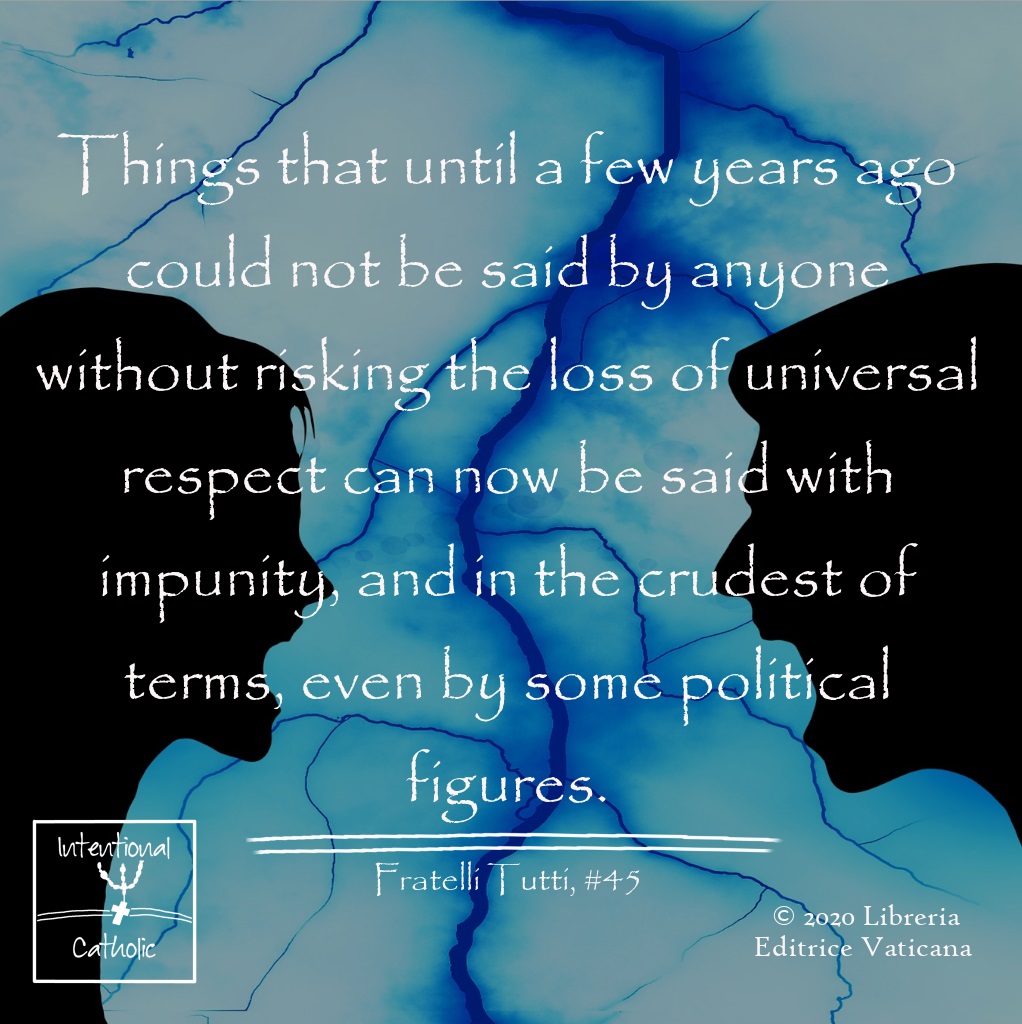
Of all the quotes that jumped out at me in that section (there were many!), I picked this one to share, because this is the truth that has twinged my own conscience in recent years. I drifted very comfortably in a black-and-white view of the world for years, until it impacted me directly when I was given the gift of a child with a developmental disability. This quote was me. And my spiritual journey now is deeply formed by wondering if, in fact, this quote still is me, and I just don’t know it.
The more I interact with Pope Francis’ writings, the more in awe I am, the more grateful that the Spirit gave us this man to lead us during this particular moment in history. And once again, I beg everyone: READ THIS ENCYCLICAL.
On Monday I shared Cardinal George’s reflections on liberalism in the Church, shared by Catholic Outreach as a series of reflections connecting Catholics in relation to the Capitol insurrection.
This reflection by Mark Shea is another in that series. Many, many…MANY things in his reflection resonated for me. The spiritual journey he describes parallels my own, although mine started earlier than his. And his “mea culpa,” though the details are quite different, resonates for the same reason.
One other thing that really struck me was his discussion of how apologetics begins from a place of defensiveness and combativeness rather than joyful evangelization. That, I fear, describes my work here as well. It gives me a lot to think about.
I invite you to read his lengthy but very, very worthwhile reflection.
“Mea Maxima Culpa” on Stumbling Toward Heaven: A Catholic Lives The Writing LIfe and Tries to Be a Disciple of Jesus, Mostly Badly
Background photo taken from the Jefferson Memorial, October 2018
It’s been a week, hasn’t it?
I saw this quote this morning in America magazine (linked below, if you’re reading on social media). I can’t find the source, which makes me think it might be not 100% word for word, but the message is one we really need.
Since day one at Intentional Catholic, I have been begging my fellow Catholics to share and read with integrity. We have a Christian responsibility to make sure we fact check the things we share, the things we take in, the opinions and philosophies we embrace.
We have a Christian responsibility to think critically and compare what we take in and say and share to the teachings of our faith. To embrace the niggling discomfort when our consciences are tweaked. To acknowledge that that discomfort is meant to point out the ways in which our worldly view is out of whack with our faith.
We have a Christian responsibility to use that discomfort to reshape our world view more authentically with our faith, even if it means setting aside long-standing idols in the form of political ideologies. (I say this as someone who’s had to do that myself. I know it’s hard. To this day, I routinely have to keep questing in order to keep myself from swinging too far the opposite direction.)
To choose instead to chase down, embrace, and share conspiracy theories, distortions, and outright lies is a violation of the ninth commandment. It is a violation of every exhortation in the Bible about living with integrity.
When large numbers of Christians fail to fact check and instead enthusiastically embrace things devoid of integrity, the events of this week become inevitable. For months, God-fearing people have been expressing terror about socialism, about dictatorships, about the shredding of the Constitution. And then, on Wednesday, people with those same beliefs shredded the Constitution themselves, far worse than anything they fear from their political opponent. I even saw one Facebook commenter say that Trump should declare martial law so he doesn’t have to leave office. Apparently, dictatorship is fine as long as it’s “my” dictator.
What we saw this week was the inevitable end of the path we embark on each time we choose to share distortions and outright lies because we haven’t undertaken the time—or embraced the humility—to examine them and recognize them as such.
We had two altercations with people over masks last weekend.
First of all, let me say that I try very hard not to go out at high traffic times. But when one’s husband works full time and you have things you need to do together, sometimes there are only high traffic times.
I’ll just describe one of our interactions. I asked one man who had his gaiter hanging around his neck to please put on his mask. He responded by rolling his eyes. Let me tell you, it’s quite something, seeing a 60-something white man roll his eyes like a teenager. He muttered something about not living in a communist country, or something equally (pardon my bluntness) idiotic and totally at odds with both Christianity and reality.
It’s mind boggling, how wearing a mask to protect the health of others got twisted into a political wedge. A few months ago a fellow Catholic on Facebook posted that it really bothered her that the Church had “bought into” the narrative that brotherly love required us to mask and distance.
I was dumbfounded.
So I’m here today to put a face on “brotherly love.”
This is my daughter. She is charming. She loves to sing. She loves to dance. She loves babies and ice cream and pasta. Since she was a toddler, she has had an uncanny ability to enter a room and instantly zero in on the one person who most needs the love of God. She goes to them and loves them.
Wherever she goes, she brings joy and love. She brings God, in other words, without ever speaking a word about it.
She also has Down syndrome.
When she was six weeks old, she contracted RSV. She had floppy airways and a heart defect that caused her blood to spin instead of properly oxygenating. She spent more than a week on a ventilator. For children that age, 93% oxygen saturation is the threshold for hospitalization. Hers dipped to the 40s every time she had a coughing fit. The doctors told my husband to “prepare himself.”
At 6.5 months, she had heart surgery to repair her heart. They stopped her heart. Put her on a heart-lung bypass. And she was on a ventilator again.
We thought that would be the end of respiratory issues, but it wasn’t. At 2.25 years, she developed pneumonia and was in the ICU, on a ventilator, yet again.
Since then, she’s been very healthy. My rational mind tells me she’d probably be fine if she got COVID, but the fact is that her airways are naturally floppy, and now they’re scarred from multiple trips down ventilator lane.
My daughter puts a face on the reason for masking. We make this sacrifice in order to protect the most vulnerable among us.
Nobody likes masking. Nobody likes being forced to hold loved ones at a physical distance. Nobody likes any of this. But if that’s what it takes to protect the life and health of others, then that is the Christian call.
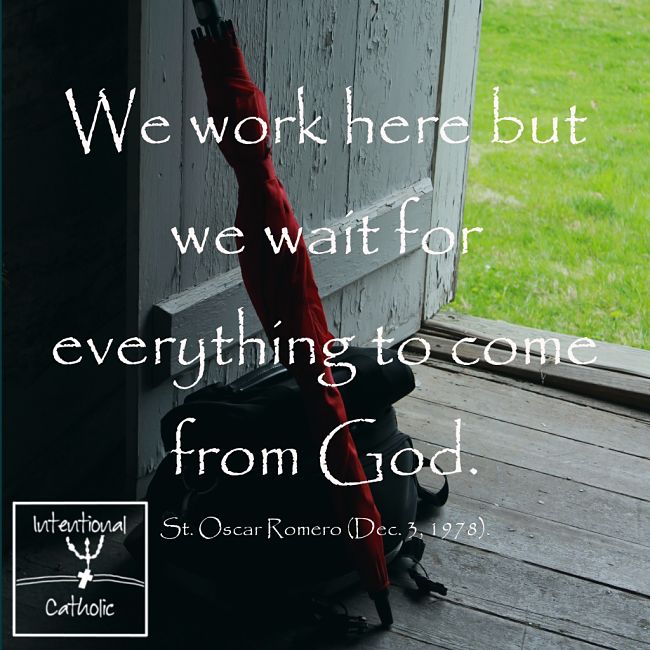
As I continue praying “Advent With Oscar Romero,” I find that so much of what he says resonates. In recent months, I’ve encountered a perspective that baffles me–one that argues we shouldn’t work for justice in the here and now, because the only thing that matters is Heaven. St. Oscar Romero’s words speak to this beautifully. He says, “In preaching the gospel I do not speak about a non-incarnated gospel, but one that is incarnated and that enlightens the realities of our time.”
And then, farther down, he summarizes the “virtues that the Word of God highlights: first, poverty and hunger for God; second, vigilance and faith; third, Christian presence and action in the world.”
What I read in this is a reminder that God came among us in bodily form for a reason–to demonstrate that what happens in the physical world matters to God. (Poverty, racism, injustices of all kinds.) And therefore, it should matter to us, too.
Every time I sit down to break open another section of Fratelli Tutti, I’m blown away all over again. I know the amount of Stuff we have to wade through in modern life is punishing, even within the writings and teachings available to Catholics by Catholics. There is value in reading the words of past popes.
But we also need to listen to THIS Pope. Reading Fratelli Tutti makes it crystal clear why the Holy Spirit chose him to lead the Church at this point in human history. He doesn’t get fancy, he doesn’t spend time being brainy. He’s right in the thick of it, speaking words we understand, pointing out all the things we already know, and drawing the connection between “the way we do things” and “how we got where we are.”
The section from #42-50 deals with the way we use social media. Being friends online has its uses, but he’s pointing out truths. You can make true friends on social media, and I have. But most of our contacts there are shallow and social, not full of depth. Social media is all about the next big thing, so building the “consensus that matures over time” is not its strength. Of course online disagreements fall to toxicity. Our goal in social media is to get likes, to spark a reaction, so really, Pope Francis points out, the fundamental purpose is to feed individuality, not community.
As someone who is trying to build a following for Intentional Catholic and for my secular fiction, this strikes very true. I got on social media specifically to network with Catholic musicians and fiction authors, and it serves its purpose well. I greatly value the relationships I’ve built here. Social media is great for helping us forge connections. And I can say honestly that there are people I consider friends now whom I’ve never met in person.
But in this year when conventions, conferences, and retreats are canceled, we’re all deeply mourning the loss of the in-person gatherings, because those are where we most often make the lasting connections.
Anyway, I’m getting pretty far afield in my stream-of consciousness reflection. Pope Francis’ point is that social media is structured to encourage us to try to stand out (an individualistic endeavor), and the algorithms are built to show us more of what we already like (or hate), as measured by what we like or comment on. So we end up getting shoved into those echo chambers, or into toxic environments—and very often both at the same time.
And because we’re a step removed from a lot of the people we’re interacting with, it’s easy to get ramped up into “remarkable hostility, insults, abuse, defamation and verbal violence destructive of others, and this with a lack of restraint that could not exist in physical contact without tearing us all apart.”
That last phrase is important. We all say things on social media we would NEVER say to another person’s face. And unfortunately we’ve started calling it “telling the truth in love,” and justifying it by saying that sometimes love hurts.
Which is true, but we’re ramping ourselves up and then deciding that our own “wisdom” is sufficient to discern what is the “truth.”
So when he says, “This has now given free rein to ideologies,” I think, YES. That’s exactly right!
And when he says, “Halfway through, we interrupt him and want to contradict what he has not even finished saying,” I think of all the careful, thoughtful attempts I’ve made to engage with people, and how they react to one phrase they think they can attack, and ignore all the rest.
And then I try to check my own conscience, because the ability to recognize it in others does not mean I am immune myself.
I know I say this every time, but please read this document. God gave us Pope Francis right now for a reason.
Returning to Fratelli Tutti today. This comes from a section subtitled “An Absence of Human Dignity on the Borders,” calls out conflicts around immigration as a violation of Christian brotherhood. “They,” in this case, refers to migrants.
This quote struck me with particular force because it encapsulates what I’ve been struggling with in arguments over race and immigration. In the abstract, we all agree that racism is bad and immigrants have human dignity, but whenever discussions of particulars arise, an almighty outcry rises in protest, saying such and such a thing is not racist, that of course they have human dignity BUT (fill in the blank). Here, Pope Francis calls that out.
One thing I found particularly interesting: the assertion that communities whose people flee are losing “their most vigorous and enterprising elements” (#38). I’d never thought about that. His point is that in addition to the right to immigrate, there’s also the right to be able to stay where you are. People flee when that right is violated. So in addition to justice for immigrants seeking new homes, responsibility also rests on those who create the dire situations that force people to flee.
As tempting as it is to read this section in light of U.S. immigration battles, we have to remember we aren’t the only ones dealing with conflicts over migration. #40 actually names Europe as particularly at risk of prioritizing its own citizens so high, it sets aside the rights of migrants.
This section ends with a heartfelt acknowledgment of the fears that cause people’s reaction to immigration, and begs us to face those fears and move beyond them, because they cause us to act in ways that are “intolerant, closed and perhaps even–without realizing it–racist.” The closing statement is just beautiful: “Fear deprives us of the desire and the ability to encounter the other.”




 Intentional Catholic