This past summer, I was honored to be invited to speak at the National Association of Pastoral Musicians national convention. Among the presentations I gave was this one, “Being Catholic in a Messy World.” I was asked to give a fifteen-minute reflection on what I mean by “Intentional Catholic.”
I have so many thoughts, I never imagined it would be a difficult talk to write, but it was–because the topic is so huge. The through-line that eventually emerged was how I wrestled with being “pro-life” in the wake of giving birth to a child with Down syndrome. I’ve often said that my daughter’s birth was the earthquake that changed everything for me, though I didn’t know it at the time. This is that story. It encapsulates many of the difficult issues we’re wrestling as a nation (badly). I hope you’ll set aside a quarter hour to listen!
(Thanks to GIA Publications, my music publisher, for making this available.)
Today’s reflection is (slightly) adapted from a post originally written seven years ago on my personal blog.
Having wrestled anxiety for most of my young adult life, I don’t often plumb the depths of my psyche too much anymore. I may be emotionally and psychologically healthy these days, but I’m far from immune to doubt. Doubt is an inevitable part of the human experience. We doubt God, we doubt our leaders, those we love, and of course, ourselves. The decisions we’ve made, especially the big ones, sometimes lead us to places that don’t look like what we envisioned, and we start thinkingif we’d chosen another path, things might be easier.
This happens to me most often when I’m ticked off at the world, i.e. husband and kids. They are my vocation, so when family life seems really hard, a niggling thought will sometimes come to mind: could I have heard the call wrong? I have always been drawn to silence and stillness. Why didn’t I ever seriously consider religious life? A life of prayer, of contemplation, without the familial demands that wear me down, the unceasing noise that shreds my inner peace, the constant busyness that makes it almost impossible to dip into the well of the Spirit. Wouldn’t I be a better disciple if my life were devoted to solitude and prayer?
The end of Thomas Merton’s Seven Storey Mountain surprised me when I read it:
“You have got me walking up and down all day under those trees, saying to me over and over again: ‘Solitude, solitude.’ And you have turned around and thrown the whole world in my lap. You have told me, ‘Leave all things and follow me,’ and then You have tied half of New York to my foot like a ball and chain. You have got me kneeling behind that pillar with my mind making a noise like a bank. Is that contemplation?”
Look at that: a contemplative monk, questioning his vocation because–gasp–it’s not contemplative enough. Because he’s got distractions. Because his mind is rattling like a piggy bank. (Oh, that is so me.)
That made me rethink another quote I’d read years earlier:
“Usually, in refusing such a gift from God, a person finds his or her path to heaven more difficult. … it seems that God calls us to the best possible vocation suited to our personalities and talents…”
When I first read it, I interpreted it to mean that I will be a better disciple if I am in a situation that challenges my weaknesses least. But in light of Merton’s quote, I realized: what if the very soul stretching that comes from struggling with my vocation is what makes me a better disciple? After all, if we’re never challenged, how in the world can we grow?
If patience, pride and self-centeredness are my weaknesses (and believe me, they are), then family life, in which patience is tried every moment of every day and self-centeredness is forced by virtue of necessity to give way to self-emptying–family life seems ideally suited to make me a better disciple.
In other words, the grass is always greener on the other side of the fence…until you get there and realize what you’ve left behind.
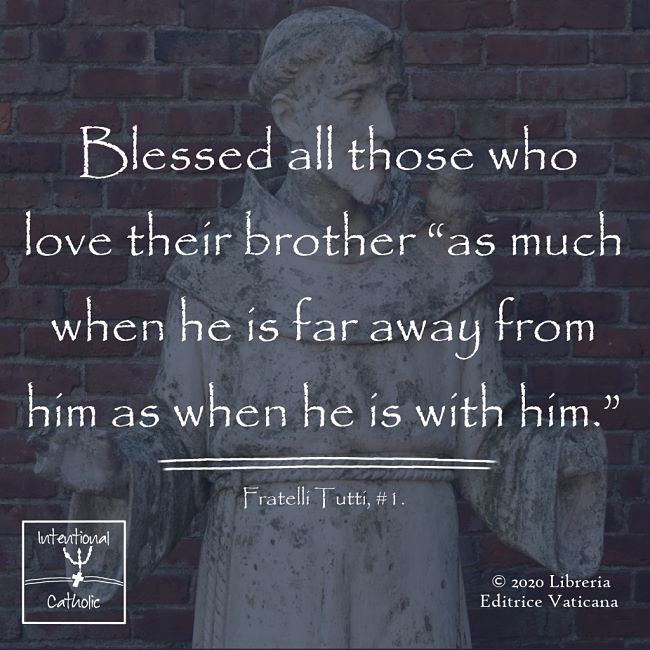
I have begun reading Pope Francis’ new encyclical, “Fratelli Tutti,” and thought it might be worth simply sharing as I read, since it’s new to all of us.
The topic seems like a timely reminder, given the state of the world right now. I can’t quote it all, but Pope Francis sets the tone in the introduction by pointing to St. Francis of Assisi’s trip to visit the Sultan Malik-el-Kamil. He went during the Crusades–a time when the goal of Christianity was to conquer and convert the Muslims–and instead modeled peaceful conversation with no agenda at all.
Two things strike me here: one is that with this trip, St. Francis, quietly and without making a production of it, issued a sharp rebuke to the entire goal of the Crusades. A rebuke that, with the benefit of hindsight, was well deserved.
The other is that Pope Francis is setting the stage to remind us that our worldwide politics of division (because it’s not just an American thing) is directly counter to holy living.
And I suppose there’s a third thing, which is that there’s more than one way to interpret “far away” and “near.” In St. Francis’ case, it was both physical and philosophical difference. My guess is that Pope Francis is gearing up to admonish us to be “brothers” in both those spheres in modern life, as well.
It’s always dangerous to read too deeply into the day’s Scriptures an overt connection to the modern world, but yesterday it was hard not to do so. I hoped for good judgment from my people, and look! What I got was violence. I hoped for just behavior, but listen to the outcry against people who are supposed to be a beacon of hope!
I’ve been quiet recently, because it’s busy, and because sometimes I feel like a wagging finger, and there’s only so much finger-wagging a person can do before people tune you out.
So I struggle with what to write. I’m overdue for a #seethegood, but that feels like a cop-out when what is on my heart is something quite different.
My bishop sent an election letter, which I shared on Facebook. (For those who might read only here, here it is.) It was a good letter, nuanced in a time when most discourse consists of bilateral apocalyptic predictions. But what really stood out to me was this:
“What I see happening in our nation, unfortunately, is a strident, rancorous discord that tears not only at the fabric of our society but also at the communion of the Church. And this disharmony endangers the salvation of souls.”
Bishop Shawn McKnight
Within my own circle, there are a growing number of people who have left the Church or struggle to remain in it because of how we act, because of the singleminded focus to the exclusion of things Jesus told us explicitly were our call.
I lie awake at night praying about this. Pray as if it all depends on God; act as if it all depends on you, the truism says. I’m praying. But action? What can I do, besides write finger-wagging posts on social media? I feel helpless.
My husband and I watched the movie “Harriet” this week, and–aside from the mind-blowing music, instrumental and vocal–what struck me most was how convinced the whites of slave times were that there was “nothing to see here, move on.” I find the same attitude in a lot of talk going on around me these days, and as I wrestle with whether the arguments about violence versus peace, the way white Christians seem to be seeking excuses to disregard the movement, I wonder how history–and more importantly, God–will judge us. Are any of the things being said against BLM valid, in the long run? Or are they just excuses?
I’ve said before, I’m a huge fan of Shannon Evans. As a faithful Catholic inthe broadest sense of the word and the adoptive mother of a Black child, she has a lot to say to us about race. Here’s the screen shot I grabbed last night off Instagram. Click it and it will go to her column.
Today I share my third and final post about fear and faith. Or rather, a fragment of a much larger post, because this is the part that’s relevant. In March 2014 I was sharing about my first spiritual direction appointment, and I wrote:
I talked at some length about the scrupulosity issue, the fear that I’m not supposed to be writing, that GOD’S WILL FOR MY LIFE (finger wagging as an illustration) is for me to be a mom and nothing else. My spiritual director said, “Do you think that’s what God’s calling you to?”
Not a question I wanted to answer. I fumbled a bit, and she rephrased: “Have you ever had a moment where you were sure you were hearing the voice of God?”
After a bit of thought I could say yes, I did. It’s never, ever about the big things, it’s always about small things that are immediate and in the here and now.
“And what does that feel like? Does it feel like the wagging finger?”
“No!” This one I could answer with certainty. “No, it feels quiet, and peaceful.”
Those words hung in the air for a couple of seconds before I realized their importance. I have identified what the voice of God sounds like to me, and more importantly, what it doesn’t sound like.
Stepping back in as 2020 Kate: I want to clarify the connection. In that post I referred to a wagging finger. But the point is what that wagging finger made me *feel*: fear. Anxiety.
How anxiety looms over life.
I have a history with anxiety–a long, tangled, ugly history. For me, fear and anxiety were twisted up in dysfunctional ways with my faith. (I still fight it sometimes.) A feeling that anything I wanted had to be contrary to God’s will, simply by definition, because “my ways are not your ways.” (I once told that fear to a good and holy friend of mine. He blinked in silence for a minute and then said, “Wow. What an unfortunate reading of that Scripture.”) A fear that if I got a discernment wrong, I was out of luck and basically doomed for all eternity (literally).
So the moment I described above, in my first spiritual direction appointment, was a game-changer. I cannot speak for others, but this I know: God does not speak to me in anxiety and fear. The Devil, however, does. The devil speaks anxiety and fear often, relentlessly, and loudly.
God speaks to me in a quiet sense of security and peace and joy.
There has always been an end-times movement. The world is always about to end in someone’s mind. There are always visions. Some of them well-respected in the Church and others, well, a lot more questionable.
I ignore them all, because I know now that is not where God speaks. Not to me, at least. And honestly, I don’t think following out of fear is what God wants for any of us. I think of Elijah. God didn’t speak in the scary, bombastic stuff, but in the tiny whispering breeze.
Is the world going to end? At some point. But that’s not where I need to keep my focus. I’ve been at this long enough to know that if I focus on fear, I’ll fall farther from him, not grow closer. I’ll only live a half life.
I wrestle many things these days, but this I am certain of: God wants more than that for us.
In light of the discussions taking place online these days, it seems like a good time to revisit what the US Bishops have to say about racism, and in particular institutional racism, in our country, and what that reality means for us as faithful Catholics. There’s a lot of anger going around these days on both sides of every issue, and we ramp each other up. Extremism on one side begets extremism on the other. Neither of which are justified, but people only want to point the finger at the other side rather than acknowledge extremism on their own.
Too many Christians seem eager to write off the entire question of civil rights and institutional racism because of violence in some protests. Of course, horrific things like people shouting “let them die” outside a hospital where police are fighting for their lives are equally indefensible.
It’s so tempting to take the extremes, because the extremes are easier. It’s really messy in the middle, where we have to call out both “let them die” and the institutional racism that has sparked the protests which, in some cases, have turned violent. It’s easier to blame one or the other and act like the problem is ONLY one thing.
The reality is, whenever we paint things in absolutes–whenever we write off one point of view because of the faults of some among them–we are part of the problem. That messy place in the middle is exactly where we must be as Christians.
Our bishops are telling us in the clearest possible way that race matters, that racism is real, that we are part of it whether we mean to be or not, and that we thus have a responsibility to act for change.
I cannot say it strongly enough: read this letter in its entirety.
I’ve been at this Intentional Catholic business officially for 18 months right now, but in reality for much longer. One does not come to such a pithy, focused phrase “just like that.” It develops over time.
One thing I’ve learned is that living the faith intentionally always, ALWAYS involves a lot wrestling. In fact, I would argue that a faith that is complacent, that thinks it has simple answers, is not intentional at all. The world is too messy for complacency. We are too small for the problems we face. When we think the answer is simple and obvious, it’s a good sign that we’re missing a LOT of context.
I’ve been wrestling hard with what being “intentionally Catholic” means when people are saying horrible things online. Self-righteous memes so badly stripped of context, they cross into falsehood; distortions; statements by Christians that do not reflect Christ.
Today I’d like to reflect on a handful of influences I’ve been wrestling lately, surrounding this conundrum.
#1: my husband saying, “You may need to stay off Facebook this fall.” I recognize the wisdom of this advice, but I struggle because my ministry is precisely to address the messiness of the issues where real life intersects with faith–issues we address via the political process. And also, Facebook is my professional networking avenue.
But as my husband constantly points out, no one ever changes their mind. So when is it worth wading in? When I do, how do I respond in a way that respects the human dignity of the person on the other end of the e-connection, when such egregious errors are on display?
#2: A friend of mine shared Bishop Barron’s podcast for yesterday’s readings with me, in which he tied together the call from Ezekiel–yes, in fact we ARE supposed to correct our fellow Christians–and the “how do we do that?” outlined in the Gospel. Bishop Barron focused narrowly on how to respond when one has been personally wounded. Truthfully, it felt insufficient. It’s not personal offenses that I feel so compelled to respond to on social media. It’s public statements by religious people who do not see the inherent conflict between their statements and the faith that is so precious to them. Jesus’ guidance, applied in this situation, seems… insufficient. Sure, I could message a person privately, but if that person is making public statements, he or she is leading others into error. Speaking to them privately seems–well, not to be repetitive, but “insufficient.”
I’ve spent a lot of time praying: “Should I ignore this, Lord? Or speak?” I responded in passion a couple times and felt that I, too, wasn’t representing my faith authentically. Another time, I walked away and found a calm, sincere response bubbling up. I thought I recognized the voice of the Spirit in that, so I went back to share, only to be publicly (and passive-aggressively, i.e. in detail but not by name) excoriated. I came away feeling that I really have no idea what the heck God is asking me to do about all this.
Which brings me to Influence #3: a story told by Steve Angrisano in a breakout session on chant that I listened to this weekend. (While pulling crabgrass in my back yard, if you want to know.) He talked about a priest who had two best friends stand at opposite ends of the room. He surrounded one of them with other girls of similar age, and had them all call out a number between 1 and 100. No one in the room could pick out the number from the original girl–except her best friend, who had spent so much time listening to her friend, she knew the voice and could pick it out of the cacophony.
I am trying to spend enough time with God to do that, but I feel no confidence in my ability to pick out God’s voice right now.
Actually, that’s not true. I feel great confidence that I can see God’s will in the issues themselves. But in how and when to speak, I have no earthly idea.
I have no answers today. Only thoughts. Wrestling. Because that’s what it means to be intentionally Catholic.
I’ve been hearing a lot lately about how public schools are indoctrinating in socialism. For that reason, this quote really struck me this morning. It comes in a section of Gaudium et Spes that is focused on peace and war. Paul VI says that those who are in charge of military will have to “give a somber reckoning of their deeds of war.” He talks about how “extravagant sums” are spent on military and on developing new weapons while the miseries that cause war remain unaddressed. He talks about how peace requires working for justice. And he calls for an international public authority with actual, universal authority to settle disputes.
That’s the context of this quote. We are called by our Church–by a saint of our Church, in a document approved by an ecumenical council of the Church–to form our children in these sentiments.
There’s a disheartened, jaded part of me that suspects many in our Church would call this “socialism,” despite the fact that it’s the teaching of our Church. And it’s interesting to me that this exhortation comes from the papacy of St. Paul VI, known and revered for Humanae Vitae. It illustrates that the Catholic faith stands independent of political ideals.
I’ve been wrestling a lot lately with the “prophetic” part of the baptismal call: priest, PROPHET, king. Like many people, until I was well into adulthood I had a wrong understanding of what it means to be a prophet. Prophecy was never about predicting the future. It was about speaking for God. Isaiah, Ezekiel, Jeremiah et al called out leaders, cultural institutions, and members of the culture for behaviors and attitudes that stood in opposition to the covenant they’d sworn to uphold.
Of course, no one likes being called out, so prophets often ended up exiled or stoned to death or beheaded (like John the Baptist). But it didn’t change the fact that they were speaking truth to power, whether anybody ever changed or not.
It’s hard to discern this call in modern life. The world is so noisy, and people speak what they believe to be “truth” with great volume and varying justification. I’ve been in far too many debates lately, and the people other side of these debates are absolutely convinced that they are the ones speaking truth and I am misguided, while I believe to the depths of my bones that it’s exactly the opposite.
Both of us can’t be right.
It’s difficult to discern when to speak and when to let someone else have the last word. My husband says, “They’re never going to change their minds. Quit arguing. Just scroll by.” But I say, “These are things that doesn’t even stand up under the weight of critical thinking and reason, let alone the faith. If we don’t speak the truth, we cede the battlefield to the devil.”
These days I bring everything back to its essence: “This post/argument/belief is inconsistent with the Gospel.” We’ve been blurring the lines between faith and politics so long, we often don’t even recognize that some of the most passionately-held opinions in Religious World have nothing whatsoever to do with the Gospel, and are, in some cases, contrary to it. I understand it, because I lived it until I was more than thirty years old. It was a hard thing, requiring a lot of humility and prayer, to allow myself to change. It only happened because the reality of parenting a child with a developmental disability put me nose to nose with inconvenient truths I had, until then, been able to ignore.
It’s very uncomfortable to envision oneself in a prophetic role. Who am I to do this? How can I be sure I’m actually speaking what God wants said? What if I’m wrong?
Except… the sea change in my world view has been so tightly woven into my spiritual growth, I don’t see how it could be wrong. I’ve been praying too long, too fervently, and too consistently for discernment, for wisdom, for clarity, for God’s will, and for God to keep me on the path of that will, whatever it is. There’s no way God would have allowed me to continue on a totally erroneous path. If I were wrong, God would have put me face to face with other inconvenient truths I couldn’t avoid, to make it clear I needed to detour. Instead, the epiphanies of the last decade or two keep being confirmed.
I’m afraid of breaking relationships. I’m afraid of going too far and abandoning God’s path in the opposite direction. I’m afraid of speaking the right thing in the wrong way and doing more harm than good. I’m afraid of failing altogether when the stakes are so high. Most of all, I’m worn out by the battle. I know in the end, God will sort it out, that “success is not the prize” as Rory Cooney wrote. But it’s hard to stand in the maelstrom and wonder if I’m being egotistical for thinking I’m meant to be in it at all.






 Intentional Catholic