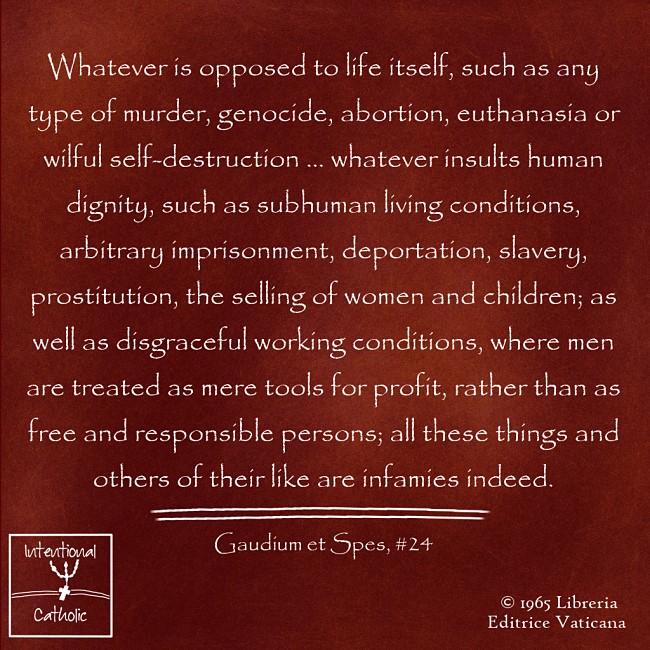
Today, on the anniversary of Roe v. Wade, we Catholics focus in very narrowly on abortion. In our discussions and arguments about connecting public policy to our faith, this issue is always presented as the issue–the only one that matters, the one that overwhelms absolutely every other tenet of our faith. Nothing else matters, because without life, none of the rest of it could happen.
But as this excerpt shows, that is not how the bishops of the Second Vatican Council viewed the world. That is not how we are called to view the world.
Our commitment to sanctity of life doesn’t–can’t–stop with abortion. To do so is to betray who we are as Catholic Christians.
“Another self.” It’s hard enough to view others this way in family life. Half of Godly parenting–maybe three-quarters of it–is trying to get kids, who are supremely selfish beings, to recognize the other as not only equal to themselves, but “another self.”
But take this beyond the confines of those we already love, and it’s downright superhuman.
-the three people you most dislike in the world, you should view as “another self.”
–the people who are a continual thorn in our sides are “another self.”
–the people living in the woods and holding signs at intersections, whether they’re drug addicts or lazy or criminals or whatever assumptions we might be tempted to make about them, are “another self.”
–the refugee, asylum seeker, and yes, even the genuine “illegal alien” is “another self.”
And as a Christian it is my *job* to enable all these “other selves” to live with dignity. This is a conciliar document saying this, not one priest or one bishop. This is the Church speaking as clearly as the Church can speak.
Now, we can argue about what is the best way to enable human dignity. That’s a totally valid argument.
But those aren’t the discussions we’re having.
Instead, almost all our arguments are focused on whether we *should* help people–whether they *deserve* it and whether “there’s money” to do it. But let’s be honest: in America, there’s plenty of money to do what needs to be done. The argument is between those who think it can’t be done piecemeal, and should therefore be done at the level of society, i.e. through higher taxes and governmental administration, and those who think government is intrinsically evil and taxes are to be avoided at all costs–that charity should be entirely a private matter, even if that means many people will get missed.
This is the fundamental logjam in America today, and the trouble is that people on both sides view their own position on that question as universally-accepted truth–a settled reality. And so instead of figuring out how to strike a balance between personal rights and societal responsibility, we end up bickering about who does and who doesn’t deserve help. We start labeling asylum seekers as criminals, and conservatives as racists, and it all falls to pieces.
Our opponents, too, are “another self.”
The following quote is too long to put in a graphic, but it’s well worth putting at the center of our minds in an election year:
…there must be made available to all men everything necessary for leading a life truly human, such as food, clothing, and shelter; the right to choose a state of life freely and to found a family, the right to education, to employment, to a good reputation, to respect, to appropriate information, to activity in accord with the upright norm of one’s own conscience, to protection of privacy and rightful freedom even in matters religious.
This social order requires constant improvement. It must be founded on truth, built on justice and animated by love; in freedom it should grow every day toward a more humane balance. An improvement in attitudes and abundant changes in society will have to take place if these objectives are to be gained.
The more time I spend with Gaudium et Spes, the more I love it. It’s just so beautiful!
You could look at this quote as a throwaway comment, but if you take the time to dig into it… wow! I can’t find myself until I don’t matter anymore. My opinions, my priorities, my philosophies, my vision of the way the world should work–all these are irrelevant, and I will be more spiritually free, more like God, the more independent of them I am. The less tightly I hold onto me, the more I will know who I actually am.
The thing is, what does it mean to make a “sincere gift of self”? The NFP community uses self-gift as a catch-phrase, to the point where for years, I only saw it in relation to questions surrounding sexuality.
But that’s only one tiny slice of self-gift. What does it mean in my family? In my marriage? What does it mean in a work or school community situation where I feel threatened or I passionately disagree with choices being made? Does emptying myself mean I should never stand up and protest injustices I’ve suffered? Never call out poor choices or un-Christlike behaviors or policies?
What about emptying myself of my own self-importance? We all know it’s God’s opinions, not ours, that matter. The trouble is, we are all 100% convinced that God agrees with us. We don’t recognize the possibility that we might have opinions we need to give up, because obviously, we’re already in the right. We never even stop to question what human priorities we have slapped with the “God’s on my side” label.
This quote from the Second Vatican Council offers a heck of a lot of food for thought in the year 2020, as we stare down the barrel of a presidential election guaranteed to be ugly–and more to the point, guaranteed to be full of the temptation to assume that my worldly philosophies, my desires, my opinions, are God’s opinions, rather than mine.
I doubt there’s a Christian out there who would argue with the sentiment expressed here, but in the context of globalization (a reality some embrace and others loathe, but inescapable reality either way), it does invite self-reflection.
Again and again in Scripture, from Cain saying, “Am I my brother’s keeper?” to the scribe asking “Who is my neighbor?” to the quotes referenced in the ellipses of this quote–Romans 13:9-10 and 1 John 4:20–it is clear that God’s definition of “love of neighbor” is bigger and much, much less comfortable than we’d like it to be. It requires self-emptying that we naturally resist. The supremacy of ego (my opinions, my right to judge) is hard to overcome, but it’s critical to living a Christian witness in an authentic and inviting way.
Right here, this is it: “Intentional Catholic,” in 28 words. The last two posts I shared are attempts to put this into concrete terms, so maybe today is a good time to zoom out and look at the big picture.
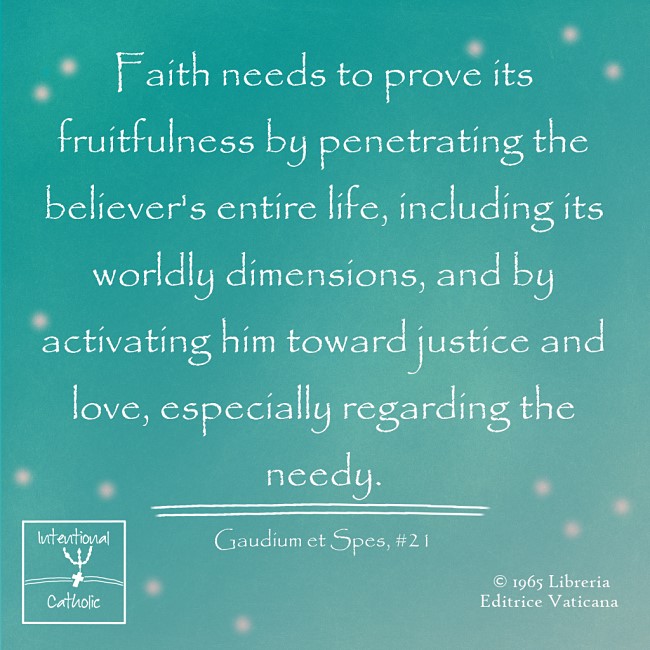
Look! It’s another one of those “no duh” quotes that we all think applies to someone else.
This is a sentiment that conservatives aim at liberals, with the assumption that only people who haven’t studied the faith properly could possibly hold such nonsensical ideas about redistribution of wealth, about mercy and tolerance; could possibly fail to see that things are either right or wrong, and any attempt to say otherwise equals relativism. (I know this, because that was me not that many years ago.)
But it’s also a sentiment that liberals aim at conservatives, with a hair-pulling level of frustration that people can’t see that Jesus was all about justice, and that money as an idol is behind many of the ideas held up as “traditional values” by conservatives. (And yes, I have to admit, this better represents where I stand now.)
Yesterday, I was reading a passage from Philippians, in which Paul took for granted that Christians living the faith would be united in thought and idea about how to view the world.
I don’t even know to deal with that. I know the Christian community was probably never as uniform as some Scripture passages make it sound, that division is an inescapable part of fallen humanity.
But where we are now–I started to try to lay it out, but the causes are too complex. There’s Steve Bannon going after the Pope, and confusing political ends with Godly ones. There’s the mishandling of the abuse crisis, which hits liberal and conservative bishops & priests alike. There’s clericalism and an inability to see outside “the way it’s always been done,” even though the world has changed around it and that model no longer works (i.e., we don’t have a glut of priests to do all the jobs in a parish, so you actually have to hire people to do work). There’s a passive laity, still thinking that our primary job is to show up and be done to, even though the mega churches have taught us that churches flourish best when everyone is involved.
All of these are examples of ways in which we, as believers, contribute to the flourishing of atheism. And it doesn’t fall on one side of the political spectrum–or of the left-right divide in the Church.
When we are nasty on Facebook, when we share emotion-heavy, but fact-questionable memes;
when we buy into stereotypes that Trump supporters are all uneducated rednecks or that people demanding just wages and just racial treatment are essentially lazy and need to pull themselves up by their bootstraps;
when we fail to recognize the ways in which our own privilege shapes our prejudices;
when we fail to recognize that we have prejudices at all;
when we make assumptions or pass judgment or don’t fact-check (or fallacy-check) whatever inflammatory argument suits our purposes–
In all these moments, we, as Christians, are part of what causes people to doubt the existence of God altogether.
This is such a striking and beautiful statement, I want to let the document stand on its own today–a good reflection as we launch into this second week of Advent. Here is some of the context surrounding it.
In the depths of his conscience, man detects a law which he does not impose upon himself, but which holds him to obedience. … Conscience is the most secret core and sanctuary of a man. There he is alone with God…
Conscience frequently errs from invincible ignorance without losing its dignity. The same cannot be said for a man who cares but little for truth and goodness, or for a conscience which by degrees grows practically sightless as a result of habitual sin.
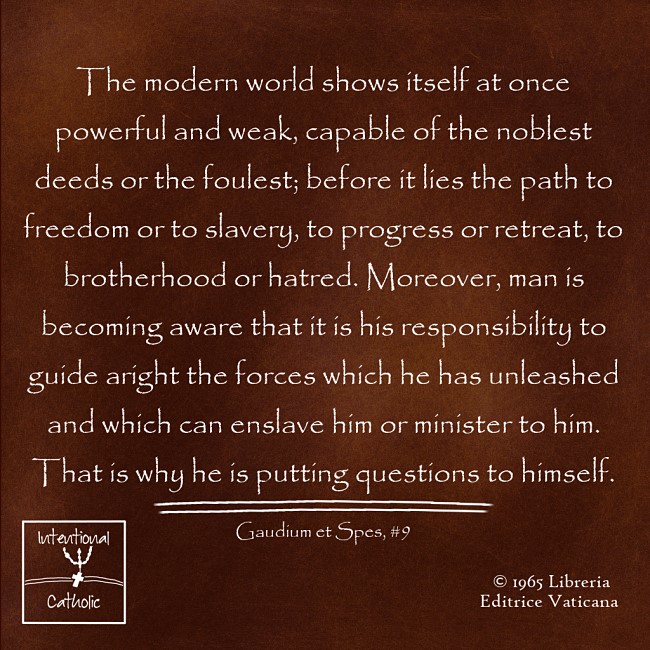
Context is important…Gaudium et Spes was published in 1965, during the cold war, and no doubt the bishops who wrote it, as well as Pope Paul VI, were thinking about the threat of nuclear war. But it’s interesting how much these words resonate today, isn’t it?
I don’t think the word “globalization” was in use yet in 1965 (though I don’t know that for sure), but that’s exactly what this is talking about. Nationalism has surged as a backlash against the reality that we’re all connected, but it doesn’t negate the reality. We are all connected. Nowhere on earth is more than a commercial plane ride away. The bombs can drop anywhere. We can Skype with someone in Thailand or Malaysia or Ukraine or Antarctica instantaneously. Parts for our technology may be made in one country and the whole assembled in another, and get shipped to a third.
We are inextricably tied together. We can’t deny that reality, no matter how threatening it feels. In fact, the overwhelming majority of us buy into it implicitly by the way we depend on smart devices and online purchasing.
We are tied together now, and if injustices and suffering in one part of the world cause conflict, the ripples will spread outward and hit us, too. That’s what we see in the refugee crises of the last few years–Syrians fleeing to Europe and Central Americans to the U.S. border, to name the most obvious. We have to recognize that the history of U.S. involvement in Central America over the past decades contributed to the suffering there (a topic I only know a little about, but enough to be aware that cold-war-era anti-Communist efforts are a factor***, and the fact that MS-13 originated in L.A. and its members were deported; now they’re a big part of the mayhem now happening). Ergo, we can’t just close up our border and say “Nope, your problem.” First, because we helped create it, and second, because this is the reality of an interconnected world. Your problems are my problems, whether I like it or not.
And the thing is, this is what Jesus called us to do voluntarily, as part of the Christian call. Jesus’ response Cain’s flippant protest, “Am I my brother’s keeper?” was this:
“Whatever you did for one of these least brothers of mine, you did for me.” (Mt. 25:41)
Well worn, but hard to embrace.
And isn’t it amazing that Pope Paul VI and the bishops of the second Vatican Council could see all this in the mid-1960s, before any of this had taken place?
***I tried to do some good research on these contextual factors this morning so I could share reliable sources about them. What I discovered is that a) Fox news doesn’t talk about it at all, only left- and left-center-leaning sources; and b) it’s too complex for me to dive down the rabbit hole to understand fully in one morning when I have deadlines pressing. What it tells me, most of all, is that we as Americans (myself included) are sinfully negligent in understanding the conflicts and sufferings outside our own borders. So for today I am relying on the understanding of faithful Catholic friends who actually know about these situations.





 Intentional Catholic