Complexity and Confidence

Photo by Rahul Pandit on Pexels.com

Our brains prefer a simple lie to a complex truth.
Our brains prefer a confident lie to a hesitant truth.

These are two of the biases explored in the โ€œLearning How To Seeโ€ podcast. Everything I heard on the first season was like an earthquake in my heart, but these two line up so thoroughly with my own experience, it reaches a whole other plane.

There are so many times when my kids ask a faith question, and I can think of a glib answer that will take three seconds and wholly misrepresent the complexity and the gravity of the issue at hand. But to do so would be to ignore the reality of the situation. More to the point, it would ignore the dignity of the soul thatโ€™s seeking authentic truth. Truth that stands up to their lived reality, which is, let’s face it, complex. Because it’s a complex world.

So I reply with complexity and hesitancy. I pause–to choose my words, to pray and think.

Believe it or not, this is me on Intentional Catholic, too. I know I come across loud and opinionated, and I am. But a lot of thought and inner wrestling goes into these posts. A lot of care for how the things I say will feel when read by different people.

Complexity bias, confidence bias. These two have played out so many times in the years Iโ€™ve been involved in discussions (and arguments) online. Through blogging, too. One memorable time, I waded into current events with unshakable certainty and ended up with egg on my face. It taught me to value caution and deliberation. Research before reacting. Well. Reacting in words, at least. Reacting in my heart is a whole different matter. I spend a lot of time talking myself down from initial reactions. But the point is, I do it.

The absolute confidence with which some people of faith respond to complex situations, erasing all complexities and nuance, waters down the Gospel. If people feel that the Gospel canโ€™t address complexity, of course theyโ€™re going to dismiss it. It doesnโ€™t help them process their own experiences. That’s not a weakness in the Gospel. It’s a weakness in those of us trying to spread it.

It is in our nature to prefer the simple lie, told confidently (stolen elections, anyone?), but I pray that we can all learn to recognize how much damage it does to be satisfied to wallow in the blindness of those biases.

(And if it’s at all unclear, that prayer is for myself, too.)
Thoughts on nonviolence and how it’s organized

A few years ago, when Ferguson, Missouri was all in the news, I remember various people saying to me, โ€œThose people are bringing in outside agitators from other places.โ€ It was a criticism, suggesting that if โ€œoutsidersโ€ werenโ€™t riling up the populace, we wouldnโ€™t be having these racial protests at all.

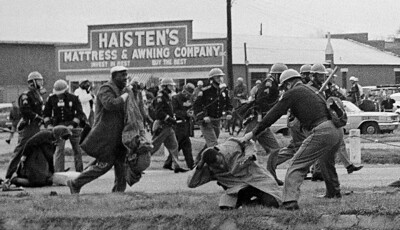
I wasnโ€™t prepared to answer that argument at that time, and I havenโ€™t heard it again since the Black Lives Matter protests swept the country. But as time goes on, I realize that the entire Civil Rights movement was structured the same way: national organizers identifying places where their presence could make a difference, and going there to support the local population.

(What we learn about history really does get distortedโ€”whether itโ€™s a concerted effort, or whether itโ€™s because thereโ€™s so much of it and it gets oversimplified in an attempt to boil it down to its most important message, is another question. Iโ€™d hazard a guess the answer is โ€œboth.โ€)

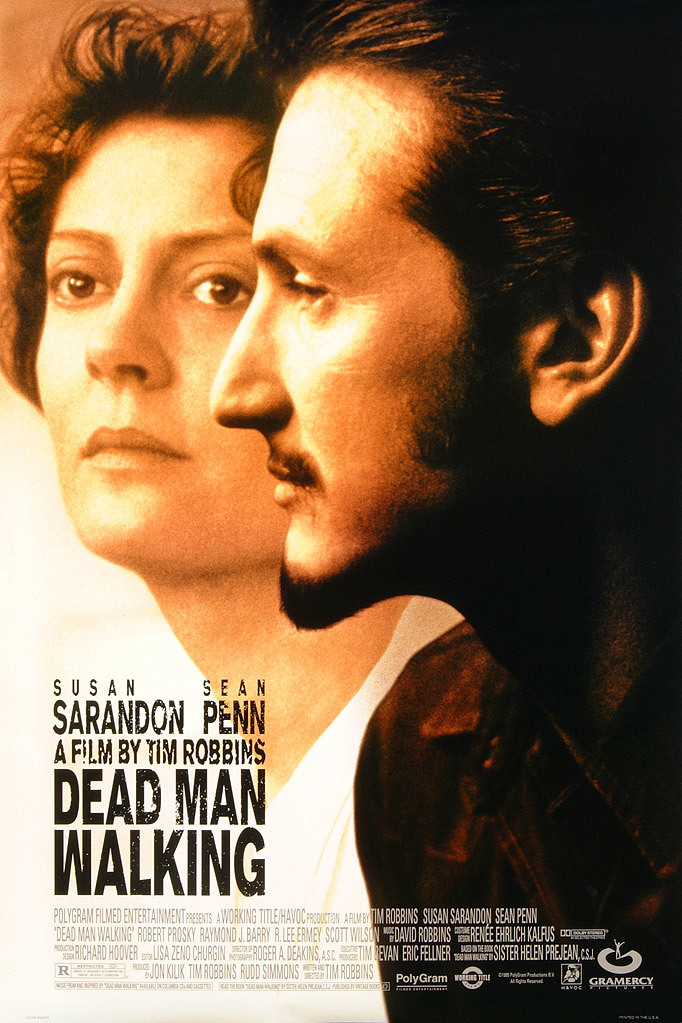
In โ€œDead Man Walking,โ€ Sister Helen Prejean quoted from another book, โ€œWild Justice,โ€ by Susan Jacoby, which appears now to be out of print. This passage really struck me.

Nonviolence, as employed by Gandhi in India and by King in the American South, might reasonably viewed as a highly disciplined form of aggression. If one defines aggression in the primary dictionary sense of โ€œattack,โ€ nonviolent resistance proved to be the most powerful attack imaginable on the powers King and Gandhi were trying to overturn. โ€ฆ King was even more explicit on this point: the purpose of civil disobedience, he explained many times, was to force the defenders of segregation to commit brutal acts in public and thus arouse the conscience of the world on behalf of those wronged by racism. King and Gandhi did not succeed because they changed the hearts and minds of southern sheriffs and British colonial administrators (although they did, in fact, change some minds) but because they made the price of maintaining control too high for their opponents.โ€

Susan Jacoby, Wild Justice, pp. 336-337

Every once in a while, someone points out that Jesusโ€™ instruction to turn the other cheek was the polar opposite of passive acceptance of injustice. (Read this for that mind-blowing take on a very familiar passage.)

This passage from Wild Justice also turns on its head the idea of nonviolence as passive. It made me rethink the whole movement. This describes a whole new level of courage: to go in, intending to provoke violence against oneself, which you will consciously not react to, in order to show the violence inherent in the system? Wow. Justโ€ฆ wow.

It was what Jesus did, too. Of course, Jesusโ€™ crucifixion was about salvation beyond the things of the world. But God could have accomplished that any way he liked. The fact that the chosen way to get there was through nonviolent resistance to earthly injustice has to mean something for us.

Detachment and other wrestlings

Dead Man Walking (1995) - IMDb

I just finished reading โ€œDead Man Walking,โ€ by Sister Helen Prejean, tracing how she became involved in the quest to abolish the death penalty. I began it intending to read as quickly as possible, but shortly realized I needed to slow down, to take time to process and sit with it. One of the most powerful things about the book is how well she weaves together her incredibly poignant personal story with the evidence that beat her over the head along the way, forming her in motion.

No doubt many realities she lays out–with exceptional precision and lots and lots of footnotes to primary source material, i.e. court cases (as well as analysis/opinion pieces)–have changed since the book was published in 1993. One that I know has changed is the public perception toward the death penalty. Less than half of Americans now support the death penalty.

And yet many of the realities she points to are still going strong. Public defenders are overworked and for that reason, the poor are those who go to death row. It costs far, far more to litigate, appeal, and re-appeal than it would simply to put a convicted killer in prison for life. And on and on.

I read this book in a time when I continue to struggle with the apparent unchangeability of all that is wrong in the world, and with those who refuse even to acknowledge the problem, let alone sacrifice to do something about it.

Image by John Hain from Pixabay

At the same time, I am encountering the word โ€œdetachmentโ€ again and again, wrestling with what that means, and how it reconciles with the call to discipleship, which presupposes trying to make the world that better reflection of Godโ€™s will that we rattle off in prayer six times in every rosary and once during every Mass and countless other times in ritual and personal piety.

And at the same time, I encountered a podcast interview of Bro. Guy Consolmagno, S.J., who called out the prolife movement for talking about protecting โ€œinnocent lifeโ€ when in fact, as Christians we are called to protect ALL life. It seemed to apply to multiple threads of my spiritual life right now.

I wish I had more answers and fewer questions. Maybe then this Intentional Catholic ministry would have a bit more impact. But then again, intentional has to be authentic above all, and if nothing else, these posts are authentic.

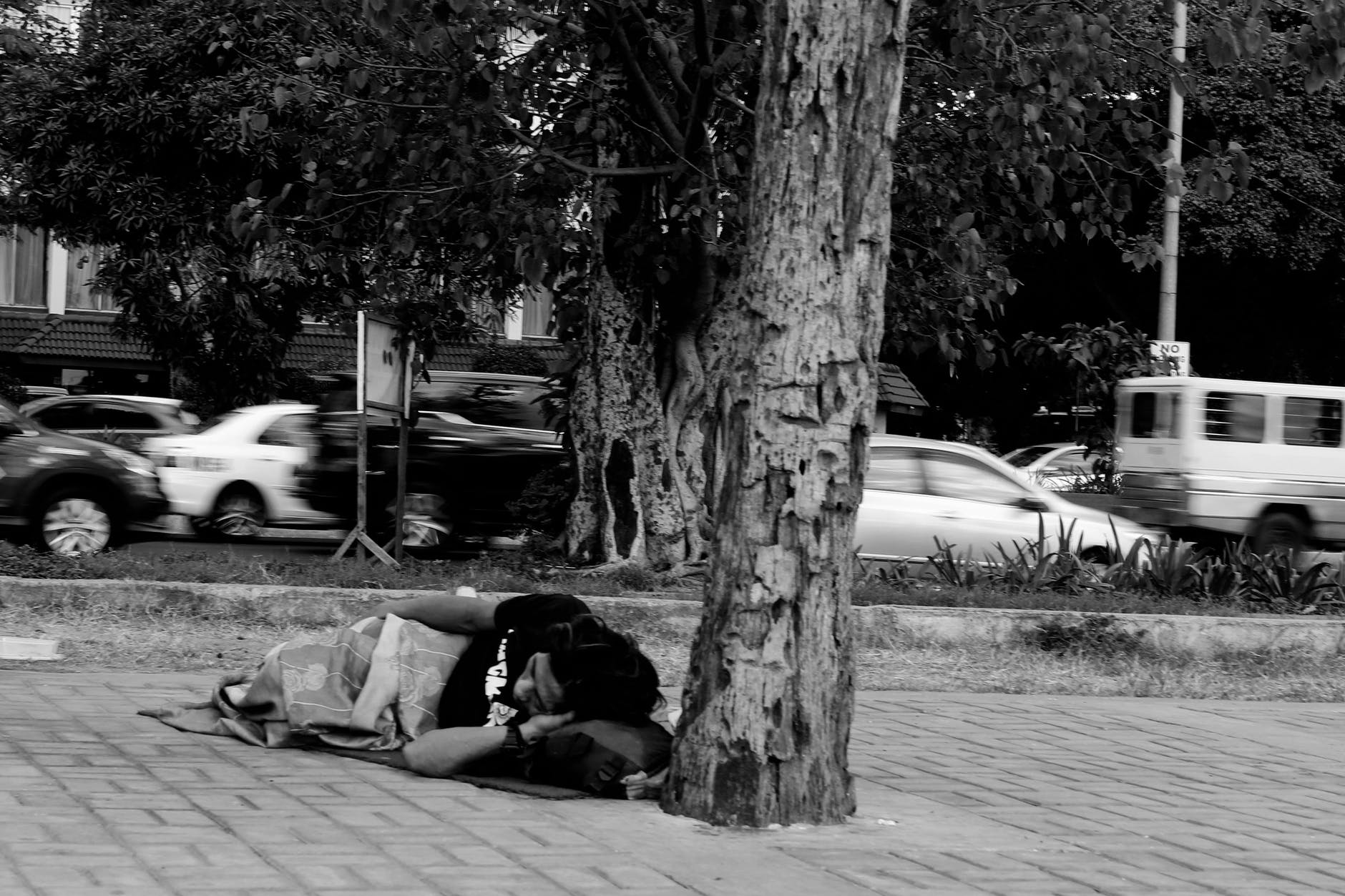
Face To Face With Homelessness in New Orleans

Photo by Alvin Decena GCASH 09561687117 on Pexels.com

I have been in New Orleans for the past nine daysโ€”first on vacation with my family, and now staying on solo for the NPM (National Association of Pastoral Musicians) conference, where Iโ€™m presenting this week.

We have so enjoyed our time hereโ€”from swamp tours to beignets to fabulous jazz, it was a great trip with the kids. But I was not prepared for the sheer scope of the face of Jesus in the homeless population that I would encounter here.

The presence of people suffering homelessness has been a cattle prod to my conscience for twenty years. I remember going to work at the church and feeling the hypocrisy of driving past the people holding signs as if they werenโ€™t even thereโ€”when I was headed to work at a CHURCH. Eventually I started keeping a stash of protein and Nutri Grain bars in the vehicles to pass out. It feels insufficient. But itโ€™s better than refusing to make eye contact at all.

I always think about Lazarus lying at the rich manโ€™s gate, begging for scraps and being ignored. That rich guy probably wasnโ€™t evil. Probably, he just was uncomfortable, didnโ€™t know how to help, and so he didnโ€™t make eye contact.

I also think about Peter and John at the Beautiful Gate, and the beggar there who couldnโ€™t walk. That story stands out to me because it says he asked for alms, and then Peter responded by saying, โ€œLook at me.โ€ Then the Bible says: He paid attention to them, expecting to receive something from them.

The eye contact raises expectations in the person on the receiving end of this equationโ€”and thatโ€™s why we donโ€™t do it. Thatโ€™s why we ignore them. Eye contact compels us to step in in some way. But if we canโ€™t even look in the eyes of Jesus in the person suffering homelessness, thenโ€ฆ Well, it says something about our commitment to the faith. Something we probably donโ€™t want to know about ourselves.

So I have made a real effort to make eye contact โ€”to SEE the people who stand at highway intersections back home. After twenty years, I know many faces and some things about them, both positive and negative.

But I was completely and totally unprepared for the magnitude of the homeless population in New Orleans.

Camps, apparently long-term, beneath the interstates (in the shadeโ€”very important). Right out in the open. A man sprawled on the sidewalk sleeping on Canal Street, a handful of steps from restaurants that would cost my family $150 to eat there. Another man using an umbrella to block the sun as he sleeps against a lovely old wrought-iron fence. A woman, her face a study in shame and hopelessness, sitting on a three-hundred-year-old stoop with a sign that says, โ€œFirst time homeless.โ€ I have seen literally hundreds of homeless people in the week I have been here.

Hundreds of the face of Jesus, looking at me.

The first day, the first HOUR of the first day, I should say, I pulled singles out of my wallet, just to do SOMETHING, knowing perfectly well that if we emptied our wallets, it would only take care of a dozen of these people for a day, maybe two. And yet–and yet! We are on vacation, spending money on ourselves!

Eventually, I had to resort to the very thing I despise: walking by without acknowledging. Food is expensive here, even for me. Do I go buy six orders of beignets and hand them out? Relatively cheap, but totally useless calories. Do I spend a hundred dollars buying $15 burgers and onion rings from the place next to my hotel, and hand those out?

I wish I could offer what Peter and John did in that moment by the Beautiful Gate. They were able to heal that man, give him back the ability to walkโ€”the thing that kept him in poverty, unable to help himself.

What this experience makes so clear to me is that the problem of homelessness is one of the many that are a systemic problem, and so the solution also must be. That does not excuse me from my responsibility to see and to be made uncomfortable and to help in whatever small way I can. (Trail mix bars from the CVS two blocks down?) But it also reminds me that I have to work for justice in the larger world, because the problem isnโ€™t mine to solve aloneโ€”it is OUR problem.

The more things change…

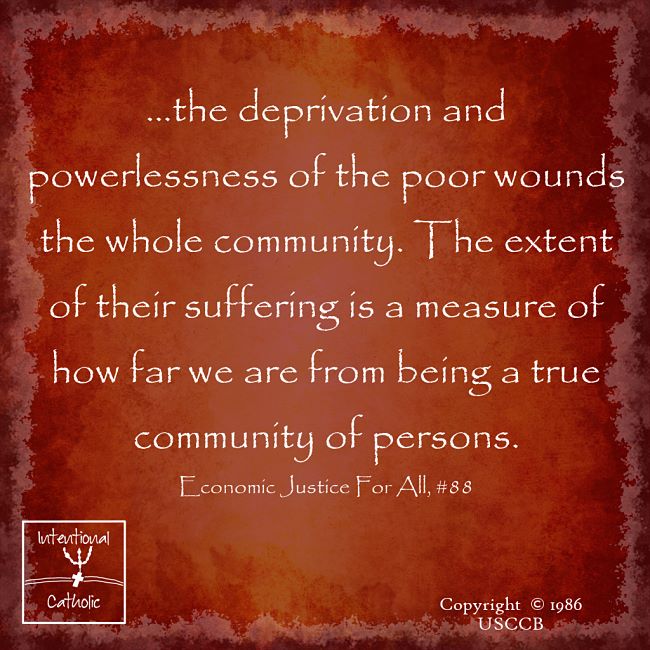
If you notice the copyright on this, it comes from 1986. In the grand scheme of things, I suppose 35 years is not a huge length of time. Nonetheless, it’s been more than a generation, and we’re still bickering about the same things. That feels a little disheartening to me.

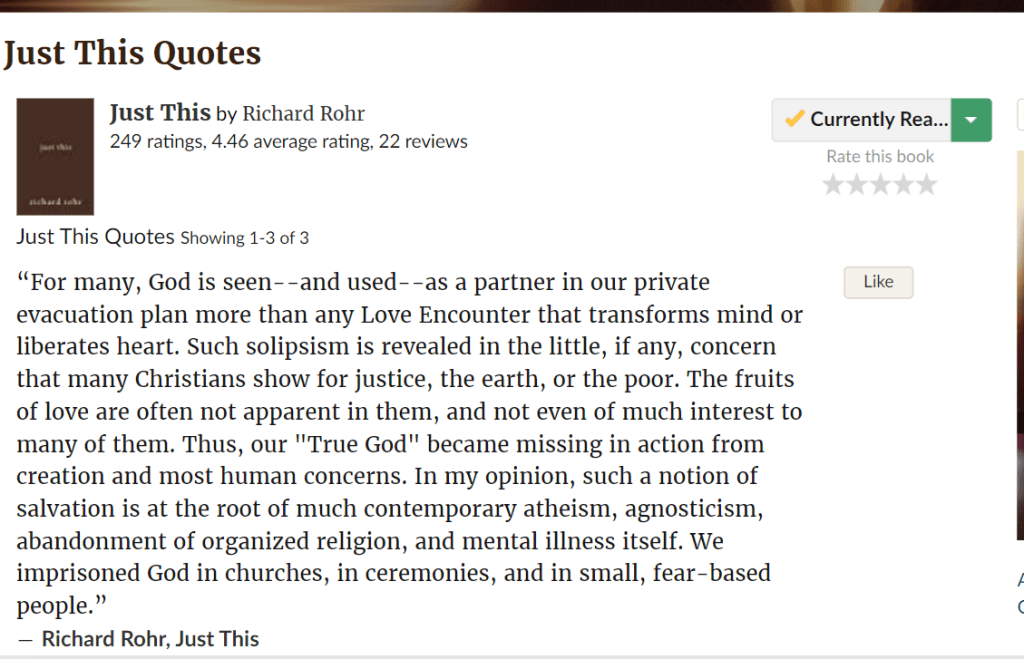
The rest of this quote says, “These wounds will be healed only by greater solidarity with the poor and among the poor themselves.” Solidarity is a scary word. A lot of us live in a pretty significant bubble, which allows us to view the problems of others in an abstract way, rather than as something concrete and heartbreaking and intensely personal. Don’t get me wrong, I’m no paragon of virtue in this respect. I’m no better at solidarity than anyone else, despite my best intentions. But it twinges my conscience and forms my approach to the political and social issues that so preoccupy modern discourse.

Freedom and Fraternity

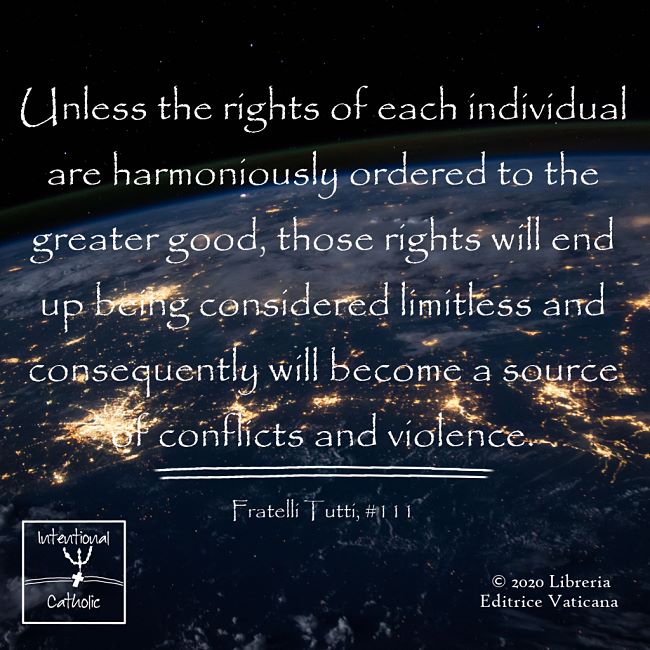
Thereโ€™s a lot in this section of Fratelli Tutti that should make us squirm in America. In #103, Pope Francis reminds us that freedom and equality are insufficient without dedication to concrete love of neighbor. Without making a political (he does use that word) priority of taking care of each other, liberty is nothing more than โ€œliving as we will, completely free to choose to whom or what we will belong, or simply to possess or exploit.โ€ Liberty, as God intends it, is directed toward the welfare of the other.

And then, of course, thereโ€™s the excerpt above. What follows it is a reminder that efficiency is often at odds with the common good.

In recent years, Iโ€™ve become deeply convicted about the fundamental flaw in the whole idea of โ€œpulling yourself up by your bootstraps.โ€ #109 addresses this. Plenty of us donโ€™t, in fact, need help from a โ€œproactive state,โ€ because weโ€™ve been born into functional educational systems and families that can get us to the doctor.

We all stand on the backs of our parents, grandparents, teachers and communities. Within our communities, we support each other; this is good. It WORKS. I certainly didnโ€™t need any of those COVID stimulus checks, and how to use them in a way that best served the common good was a matter of no small debate in our household.

But itโ€™s a mistake, and I would argue, contrary to Christian discipleship, to assume that simply because many of us donโ€™t have need for a proactive state means nobody does. Look at the injustices and inequalities that litter Americaโ€™s history:

These are just a few structural realities whose consequences have rippled down through history. If we stand on the shoulders of those who came before us, then some among us are fighting a way, way bigger battle than others.

These are hard realities to accept in a time of such profound division. But the Cross IS hard, and the Holy Spirit gave us a shepherd at this time whoโ€™s calling us to confront the things that make us uncomfortable.

The Meaning of Mercy

Photo by Mauru00edcio Eugu00eanio on Pexels.com

A few years ago, when Pope Francis declared the year of mercy, I spent some significant time pondering this on my personal blog. I’ve fallen off the radar here of late because, as we all either know or need to learn, “balance” means sometimes one thing has to give to make room for another, but eventually it will swing back. My writing life is buried right now under fiction work, with a book releasing in the next few weeks, and I simply haven’t had time to come over here.

So I went back to my personal blog to harvest a few more posts to fill in the gap, and the mercy posts really struck a chord. So here you go.


I once attended a workshop on writing liturgical texts in which the presenter challenged us to take out all the church-y words and see if anything of substance remained.

โ€œMercyโ€ is one of those words. A throwaway word, overused into gibberish. At least, it has been for me. So when I heard about an extraordinary jubilee year of mercy, I went, โ€œMercy? Why mercy? What does that even mean?โ€

It was that last question that turned out to be the most important. The problem of this simple, hackneyed word has been gnawing at me until Iโ€™ve realized that prising apart its significance for meโ€”both as a recipient and as a giverโ€”is meant to shape the coming year.

I have always viewed mercy as synonymous with forgiveness. The mind, hearing โ€œmercy,โ€ goes straight to sin and unworthiness: Iโ€™m a pathetic, undeserving wretch whose sins have been forgiven despite my general loser-li-ness. (I can coin words late at night with the best of them.)

The idea of confronting our own brokenness is really important, especially in these days of โ€œwhatโ€™s right for you may not be right for me.โ€ Built into our identity as modern men and women is a deeply-held resistance to admitting that we treat ourselves, our fellow human beings, and our world with careless disregard for our/their/its innate dignity. Mercy speaks to the humility of admitting we do crappy things sometimes. It speaks to the recognition that we deserve just consequences for our actions and instead weโ€™re blessedโ€”in fact, showeredโ€”no, delugedโ€”with goodness. Goodness we usually fail to recognize, because weโ€™re too busy asking for more, more, more.

But if thatโ€™s all there is to the word โ€œmercy,โ€ then whatโ€™s up with those โ€œcorporal and spiritual worksโ€? How do they fit into all this? What do they have to do with undeserved forgiveness?

Iโ€™m not the only person wrestling with this question. Iโ€™ve been reading anything I come across on the blogosphere, and this single quote is the one that caught me:

โ€œMercy is being willing to enter into the chaos of another.โ€

I thought, Yes! Thatโ€™s it! I understand that!

Image by Kasun Chamara from Pixabay

Itโ€™s far easier to pass judgment on the guy on the street corner begging for money. To say, โ€œHe doesnโ€™t really need it, heโ€™s trying to take advantage of peopleโ€™s gullibility.โ€ But mercy says, โ€œOkay, I will enter into his chaos by contemplating the decades of days and hours and influences I canโ€™t possibly know, the countless steps that brought him to this particular intersection on this particular day, and pry my brain open to admit that I simply cannot know whether he is or is not truly in need, and as such I am compelled, by virtue of his dignity as a human being, to give him the benefit of the doubtโ€ฆand help him.โ€

Mercy.

Itโ€™s far easier to cling to the distance separating us from the chaos in the Middle Eastโ€“to say, โ€œWe canโ€™t possibly ensure that Those People are not terrorists; therefore it is only prudent to keep Them all out and send our riches Over There so Someone Else can take care of Them.โ€ But surely Iโ€™m not the only one whose conscience whispers, If not us, who? Where is there a place of refuge for so many? Mercy responds to worldly prudence with a call to dismantle the geographical wall weโ€™ve been hiding behind for two centuries and enter into the chaos that the rest of the world already knows so well.

Mercy.

Iโ€™m finding that mercy, far from being meaningless, is an enormous, life-altering word. Terrifying, too, because it shoves me out of my safe, familiar, comfortable world full of safe, familiar, comfortable platitudes. To live mercy is to enter into the chaos of families shattered by abuse. To enter into the existence of stomach-turning poverty that, if viewed head-on, would force meโ€“even chintzy, never-spend-a-dime-if-you-can-make-do-with-a-penny meโ€“to confront my own excesses and make changes I donโ€™t want to make.

Mercy, I am beginning to realize, is a shortcut to a darned uncomfortable conscience.

The chicken and the egg (or: double standards in Christianity)

โ€œHey,โ€ my husband whispered to me before Holy Thursday Mass. โ€œI forgot to tell you. Pew research did a new survey and the number of people who go to church is below 50% for the first time ever.โ€

My first reaction was: And Christianity will blame the secular culture instead of looking in the mirror and examining whether our own failures are the problem.

Actually, itโ€™s probably a chicken-and-egg situation. The culture is definitely getting more hostile to religion. But then again, religion keeps giving more reasons for the hostility.

I know. Themโ€™s fightinโ€™ words, but painful though they might be, I think theyโ€™re fair.

The trouble is that the Gospel tells us weโ€™re SUPPOSED to expect hostility from the world. But somehow, weโ€™ve translated that into a persecution complex. We never stop to examine our own attitudes, words, and behaviors for how well they reflect the Gospel. We just assume that any pushback we encounter must, by definition, be the cultureโ€™s problem rather than ours. It couldnโ€™t possibly be that we are misrepresenting our faith.

Meanwhile, Christianity fails to recognize how incredibly uneven we are in HOW we choose to stand at odds with the world. There are these huge double standards.

Like: Christian culture is pro-life, EXCEPT when it requires taxpayer money to support people most at risk of feeling the โ€œneedโ€ for abortion (because of generational poverty and inequality of opportunity, etc., etc).

Like: Christian culture is pro-life, except when it infringes on โ€œpersonal freedomsโ€ (cough-cough-masking).

Like: Government should stay out of my business, except when itโ€™s about homosexual relationships or abortion, and then of course itโ€™s the governmentโ€™s business, absolutely.

Or: Sexual assault and harassment are sinful, but how dare we ruin the life of the accused? (Never mind the life of the victim. Whatever. We’ve been sacrificing them for millennia.)

Or: Honesty and integrity are fundamental to Christian beliefโ€”theyโ€™re in the Ten Commandmentsโ€”but how many people have wholeheartedly, even rabidly, embraced a lie about stolen elections that has zero basis in fact?

Iโ€™ve been trying not to write these kinds of posts lately. Nobody needs me haranguing them; itโ€™s not particularly effective at anything except making people mad. So Iโ€™ve been trying to focus my posts here on working out my own spiritual journey instead of lambasting everything thatโ€™s wrong with the world. I have spent this Lent praying for โ€œenemies,โ€ and more importantly, for the heart to do so authentically while remaining in union with Godโ€™s will. So much is happening in my heart this yearโ€”I am journaling it, bit by bit, but Iโ€™m deep in the weeds and I canโ€™t synthesize it yet.

But there are times when my frustration comes out. And this is one of them. And maybe, after all, Good Friday is not a bad time to have our collective conscience stung.

A Post For All Who Call Themselves Pro-Life

Today, as we march toward World Down Syndrome Awareness Day this Sunday, I’m harvesting another post I wrote long ago on my personal blog–one that marks a big step on the journey I’ve often referenced here, the journey from a black-and-white world view to the recognition that all issues have to be weighed together, because they all exert influence on each other.

I wrote this in 2011, and I’m going to leave the text exactly as it stood then.


My chromosomally-gifted girly-girl at age four, which would have been around the time this post was written.

Aย year and a half ago, I was working onย legislation to ensure that children with disabilities werenโ€™t denied therapies because of their disability. Our sponsor (my mom) was approaching her term limit, and we needed a new one. We knew we had to find a Republican, because the legislature is Republican-controlled. We also knew that putting mandates on insurers could be a tough sell. Still, we felt sure people on both sides of the aisle would recognize that this issue was bigger than political philosophy.

I contacted a former Republican state senator who was well-connected and reportedly supportive on disability issues. I told him what we were hoping to accomplish, and asked him to suggest people to approach as sponsors.

His reply raised my blood pressure for weeks afterward. (Eventually, its presence in my inbox became such an open sore that I had to just delete it. Just thinking about it still gets me going.) However he intended it, it came across as condescending: a man clearly much wiser than this do-gooder little girl, and determined to teach me the error of my ways. His philosophy went something like this:

Insurance is not meant for ordinary care. Itโ€™s meant for emergencies, for extraordinary circumstances, cataclysmic events you canโ€™t anticipate. Therapy is normal, ongoing care for kids with special needs; thus, insurers shouldnโ€™t have to pay for it unless they want to. And the government certainly shouldnโ€™t be putting a mandate on them. Itโ€™s the responsibility of the families to provide for their children what they think is important. He understood how tough this was for families to accept, but nonetheless that was the way it was.

Iโ€™m sure you can appreciate why I hit the roof when I read this email. Never mind that raising a child with special needs is extraordinary circumstances and something you often canโ€™t anticipate. I had the good sense not to respond at all, because there wasnโ€™t one polite thing I could have said. But believe me, Iโ€™ve composed many, many responses in my mind. And the more time passes, the more convinced I am of the grave flaw in his argument.

Because this man calls himself prolifeโ€”by which he means that he believes abortion is wrong. But respect for life is so much bigger than abortion. Itโ€™s an attitude that should permeate all of life, in all its forms and manifestations. Prolife politicians are very good at being outraged by the systematic termination of โ€œimperfectโ€ children. But if youโ€™re going to ask people to shoulder the responsibility of caring for children with disabilities, you canโ€™t abandon them once the child is born.

Missouri has a great program called First Steps, which provides these services. But in rural areas, itโ€™s hard to find providers to come to the home. And First Steps ends at age three, after which kids enter the school system. Weโ€™re luckyโ€”we have a great early childhood program where I live. But weโ€™re in an urban area. What about families in small towns without the resources to provide for kids through the schools?

When I was serving on the Childrenโ€™s Therapy Act committee, we heard stories of people who had to sell their homes to pay for their kidsโ€™ treatment, people who deliberately stayed in low-paying jobs so that they would qualify for Medicaid, which does cover these therapies.

How dare politicians stand on a soapbox, claiming that all life is precious, that children with disabilities have a right to live, and then turn their backs on families who actually have them? Do they not realize that, unlike insurance companies, parents canโ€™t negotiate reduced rates? Do they not realize how crippling the expense of therapy becomes? Or do they just not care?

Political philosophy is all well and good, but it cannot be so rigid that it leaves behind those it purports to serve. I happen to think that minimizing regulations is a sound principleโ€”within reason. But the reality is that power companies arenโ€™t going to implement environmental reform if itโ€™s going to cost them money. CEOs arenโ€™t going to give up their huge bonuses just because the economyโ€™s rough on the little guy. Some things MUST be mandated, or they wonโ€™t happen at all.

Doesnโ€™t it make more sense to get these kids the treatment they need to become productive, (tax-paying) members of society? And if we donโ€™t, if we shove the disabled population into a corner, behind a wall where their lack of function doesnโ€™t make everyone else uncomfortableโ€”if we donโ€™t show them the respect they are due as human beings by providing them the tools necessary to integrate into societyโ€”then how can we be horrified and outraged by the eugenics of aborting the โ€œimperfectโ€?

I share this example today in the hope that it will open peopleโ€™s eyes to the many ways besides abortion in which life is disrespected. Weโ€™re accustomed to hearing about certain issues: death penalty, abstinence education, end-of-life issuesโ€”but respect for life is everywhere, all the time, in every single issue we face as voters. As we head into an election cycle, I beg you: challenge your candidates to man up and be consistent. If youโ€™re going to respect life, you have to respect life in all its forms.