In Which I Wrestle With Race

Photo by Matheus Viana on Pexels.com

I was so clueless.

I went to a park to meet a friend and her son, my godchild, to social-distance celebrate a birthday. She was upset, and I didn’t immediately realize why. She had to lead me almost all the way there.

I have rarely felt the privilege of my own skin color so keenly.

Because unlike me, she and her son are not white. And while the events of the past week, beginning in Minnesota and spreading all over the country, are a source of grief to me, for her they are inescapable realities that she has to wrestle with on a daily basis.

What is the future for her child? For all her male loved ones? Can they not go running in their neighborhoods? Do they really need to be afraid every time they see a police officer?

We rarely recognize how deeply our unconscious biases affect us. How many ways we have taken worldly values (self-reliance, personal responsibility, small government, and money, always money–it’s my money, no one has a right to it, especially a central authority, even to help lift up vulnerable populations) and tried to use our faith to justify them.

It’s not that those values are without merit. Of course they have merit. But they so easily become idols, when the Gospels make it clear that people ALWAYS come first.

Photo by Ivan Bertolazzi on Pexels.com

As my friend and I talked, I could empathize–sort of. The cluelessness of white America is, for her, something like the cluelessness I encounter about issues surrounding disability. Whenever I share a frustration I experience with institutions that interact with my daughter–health care, schools, etc.–I get pushback from people who oversimplify the situation. People who don’t understand that the pat solutions that seem so obvious to them simply don’t work. The tangled complexities of the situation are invisible to those outside it. Even those who are closest to us generally don’t “get” it, because they haven’t experienced it themselves.

Last fall I tried to explain our family’s struggles with special ed to a group of health care workers who were studying issues surrounding special needs. I thought I could tell the story in twenty minutes. At twenty-five minutes, I realized I was only a quarter of the way through, and the audience was zoning.

Even an audience of people most poised to understand really couldn’t “get” it.

So I understood, on an intellectual level, my friend’s deep frustration and woundedness. But I don’t *understand* what it’s like to be black in America. Not at a deep, visceral level, the way the black community does.

The only solution to all this is to “hear with open hearts,” as the pastoral letter from the US Bishops on racism teaches. To accept that what we cannot “get” at a visceral level is nonetheless real, and to recognize that it calls for a response from us. Not just an express-my-outrage-on-social media, write-a-blog-post response, but a “don’t blame the victim for the way things got out of control” response. A “hold my leaders accountable for their inflammatory words and lack of positive action” response. A “quit giving them a pass because they check the box on a single issue, regardless of how poorly they reflect the rest of my faith” response.

Because this cannot continue. It must change.

It MUST. CHANGE.

Right vs. “right”

The past two weeks have been really intense for me as it is crunch time/deadline days for preparing presentations for the NPM (National Association of Pastoral Musicians) convention, which went online this year because of COVID-19. At the same time, where I live we are opening up. From this point forward, the discernments get harder. Now we have to weigh our responsibility to uphold the life and dignity of our fellow human beings against the danger of being so overprotective of physical health that we cause lasting damage to the emotional and mental health of ourselves and those we love. To say nothing of causing unnecessary suffering from deepening poverty, as more economic damage happens.

For weeks before opening, we’d had virtually no new cases where I live, so the calculation looks quite different here than it does in many other places. In some ways, it makes it more difficult. How long can we remain isolated from those we love? Yet if we loosen up in some areas and loved ones loosen in others, then we’ve both just multiplied our exposures. My state has been open 2 1/2 weeks now, and naturally we are seeing cases again. Not a lot, but to see regular cases after weeks of almost none makes it clear that we can’t be cavalier.

Which brings us, among other things, to the “do we mask?” question that has become yet another a lightning rod, another opportunity for political division in our country. The reaction of certain quarters of our population (“I’m not wearing a mask! When I woke up this morning I was in a free country!”) is what, specifically, made this Chesterton quote jump out at me this morning. This is one of those moments in which we are challenged to recognize where a worldly value has come to be more important than Godly ones. Has become an idol.

I don’t wear a mask at all times, and in masking, in opening up, every moment requires a discernment for me to make sure I’m practicing what I preach. Or at least, to try. I don’t like it, but it is the spiritual exercise of life right now–for all of us.

Small Sacrifices

Background image by Public Domain Images, via Pixabay

It’s been a hard slog, the last couple of months. Although Memeland USA has tried to lighten the mood by joking about it (my personal favorite was a picture of Doc and Marty, with the words “First Rule of Time Travel: Never go to 2020!”), the humor is only an attempt to bleed off some of the stress. Some among us are struggling financially because of lost income. Some because of the stress of illness or death–coronavirus-related or not–in a time when families can’t even gather to grieve. Some because mental health is hard to maintain in a time of anxiety and isolation.

That last was the struggle for me and my household. It took us a full month to get our equilibrium–which I achieved partly by counseling, partly by a 100% withdrawal from all news sources. And prayer, of course, but prayer guided me to those real-world solutions. Prayer is rarely a fix-all on its own. In prayer, God guides you to what *else* you need. God is the creator of science and psychology, after all.

I still have to be vigilant about mental health in certain quarters in my family, but I know we had it pretty easy compared to others. My Facebook feed is filled, top to bottom every day, with evidence that more people are still struggling than not.

I’ve started dipping a toe back in the news now, and the vehemence and acrimony of the protests against stay-at-home orders and masks are really striking. I heard a report this morning that in Stillwater, Oklahoma, a man threatened a business owner with a gun because he didn’t like the citywide requirement to wear a mask inside businesses. I mean, really? REALLY??

Full disclosure: I’m a flute player. Wearing a mask makes me feel like I’m suffocating. But I’m wearing them anyway, not when I’m outside, but when when I go to the grocery store or the hardware store. Why? Because I trust the medical authorities who say this is one small sacrifice we can make for the greater good.

That news story this morning just blew my mind. I don’t know what that man’s beliefs are. What I can say for certain is that his actions show a lack of respect for life and the Gospel. The Christian call is about self-emptying, about placing others’ needs ahead of our preferences.

And that’s my point for today. The whole point of being “intentional” about the faith is to take it out of the realm of the vague generalizations. It’s easy to talk in general about self-emptying, but the real test is what happens when you’re asked to make a sacrifice for others. Especially when you’re already struggling with loss of income or freedom of movement or mental health or loved ones.

For years, we in the religious community have criticized American culture for being hedonistic, for the idolization of instant gratification and “me, me, me.”

Those are totally just criticisms.

But the response to this pandemic shows that hedonism, instant gratification, and “me, me, me” is just as much a problem among religious people. (How many of those signs demanding an end to stay-at-home orders invoke God?)

This pandemic is nothing if not a series of opportunities to make sacrifices. When I think of people in Italy and Spain, who weren’t even allowed outside (because where would they go without encountering others?), it is abundantly clear to me that my stay-at-home order, which allows for biking and hiking and playing outside and taking walks in the neighborhood and going to the grocery store and on and on and on, is really a *very* small ask for the health of the community.

And now, as my community begins to open up–today, in fact–the discernments are going to get more complex. With schools and businesses closed, there wasn’t really anywhere to go, anyway. We had no choice but to honor the greater good by staying home.

Now, we have to start learning a new balance, because as important as “flattening the curve” was, economic motion is vital to the community, too.

But we can’t be cavalier about it. To be a Christian in this new reality means we have to think, rethink, and rethink again. All the rules and rituals we take for granted have to be re-examined. How do we best balance the safety of the community and the need to slowly expand exposure to this new virus, against the need to get the economy moving again so that everyone can regain the dignity inherent in work?

It’s inevitable that for the foreseeable future, we’re all going to have to give up things we’d like and deny ourselves things we’d like to do on our own schedule, but which now have to be planned around the greater good. It’s not going to be fun.

But we can view this as an invitation to grow in faith and holiness–by self-emptying, by doing the things we don’t like for the greater good.

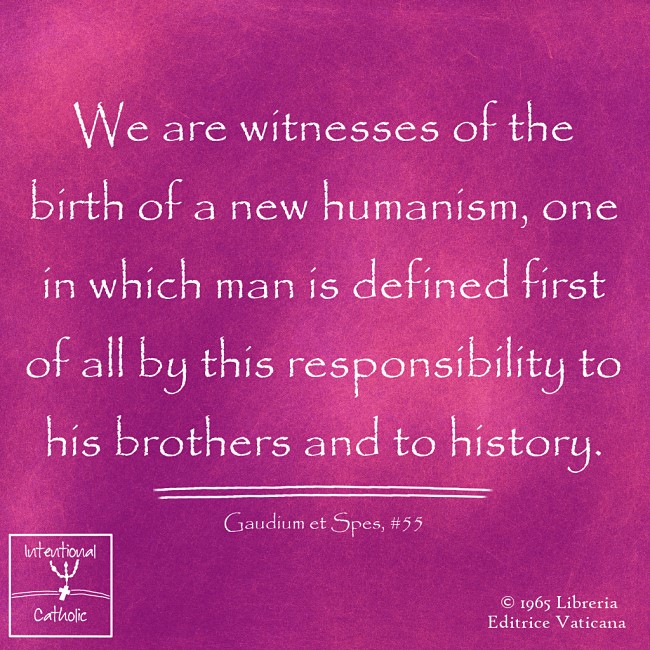
“New humanism”

This seems like such a simple quote. I was going to let it stand without commentary, but I realized that this is really the essence of the convictions of all Christians who are passionate about social justice. To be a Christian is to care, in a self-emptying, physical, sacrificial way, for others. And to recognize that the things we do now have ripples down through history, on generations not yet born.

This quote expresses why we have a responsibility to act on environmental issues, on racial issues, on issues of poverty and inequality–the whole range of questions that are the most uncomfortable to address, because they challenge cherished ideals of self-reliance and rugged individualism.

We *do* have responsibilities on earth

There’s been an uptick recently in the expression of a point of view that suggests that since we are citizens of Heaven, not earth, we should not pay attention to earthly suffering or strive to alleviate it. The Church says otherwise.

The complex interplay of limits, freedom, and dignity

My husband and I have been natural family planning users since day one of our marriage. NFP saw us through infertility (the data from the charts facilitated treatment), four babies conceived without medical intervention, and another eight years of charting.

I bring this up because Church teaching on birth control probably represents the biggest sticking point for many people in the modern world–the biggest perceived encroachment on “personal rights.”

I used to be a lot judgier on this issue than I am now. NFP is hard for some people, and often the reasons are not as easily dismissed as many NFP devotees would like them to be. Sometimes it’s physical (tough charts, long abstinence), and sometimes it’s emotional–when practicing NFP causes people to excavate deep, long-standing wounds, wounds with ripple effects that make marital intimacy a point of contention rather than an opportunity for intimacy.

Also, none of us are perfect at the way we use our sexuality. None of us. So I’m less, well, judgy these days.

Nonetheless, I still believe passionately that NFP is a great thing. The self-knowledge that comes from charting has been liberating and empowering to me as a woman, and I see the practice of NFP as a source of healing for a world where relationships between men and women are suffering the wounds caused by dominance. Where sex is used as a bludgeon, mostly by men against women. To use NFP successfully requires two people to respect each other in all their God-given dignity, to hold in honor and awe the total gift of the way the other is made. Not to try to turn off an entire healthy, functioning system of the body.

It’s also a no-brainer for environmental stewardship. Pharmaceuticals go back into the water, and not all chemicals are filtered out. Lawn & agricultural chemicals in the water supply were half of our infertility issues.

And I see the fruits of NFP in my relationship with my husband. The openness, honesty, and mutuality of communication surrounding this most sensitive topic has helped me understand what total security in a relationship means. What true intimacy means.

Which is not to say we’re a happy-happy couple. Those who know us know we pick at each other all.the.time. And sometimes the conversations are hard–it’s not just “do we try for a child or do we try to avoid?” It’s “I don’t feel close to you” and “I don’t want to be close to you when you do X or Y.” It’s “I feel resentful because of Z.”

But we always grow in love because of them.

So this quote strikes great resonance for me. NFP is a big limit, but it’s also freeing–in many ways, but I’ll focus on one: it’s a limit forces the issue of dignity and mutual respect. It’s not that you can’t have mutual respect and treat each other with dignity if you don’t use NFP, because clearly you can. But being successful with NFP–by which I mean “We are equal members of the team,” not just “we didn’t get pregnant”–REQUIRES us to pay attention to issues of dignity and mutual respect.

Respect and Love…even for those we don’t like?

Very few of us are good at extending respect and love to those who think differently than ourselves. It seems all issues today are all-or-nothing.

I’ve never been able to watch so-called reality TV, because so much of it consists of people shredding each other’s dignity. People come to fitness classes and laugh about the hateful things said by one contestant about another, and I just feel revulsion. I don’t understand how good people can fail to recognize how awful it is that we’re laughing at other people’s dignity being shredded.

And if that’s how we get our entertainment, then it’s no wonder we can’t even have civil discourse on the issues that matter most. The sentence following this quote in Gaudium et Spes talks about how, the more we respect and learn to understand the person who thinks or believes differently, the better we are able to enter into dialogue with them.

Doesn’t that sound like exactly what we need right now? This whole impeachment trial is a great example: the two sides aren’t even having the same conversation, let alone dialoguing. Those who support Trump won’t address the specifics of the case at hand, they just keep saying “Democrats have been looking for a reason to impeach since day one.” And those who loathe Trump won’t address that accusation. So it’s like we have two separate realities, because people will not treat each other with the respect and love called for in this excerpt from Vatican II. (And this is not just in Washington, but on our social media feeds.)

It’s worth reading all of Gaudium et Spes #28, because the context around this quote addresses the balance between respect and love and caring passionately about truth and goodness. It talks about the difference between error and the person in error. Lots of us say, “I love everyone, I just hate the sin,” but the actions and tone of voice and words used don’t show the love; they only show the hate. I’m well aware of my own struggles in this area, and I think the people who most vehemently insist on “love the sinner, hate the sin” are often those whose words and actions feel the most hate-filled.

How do we turn this around?

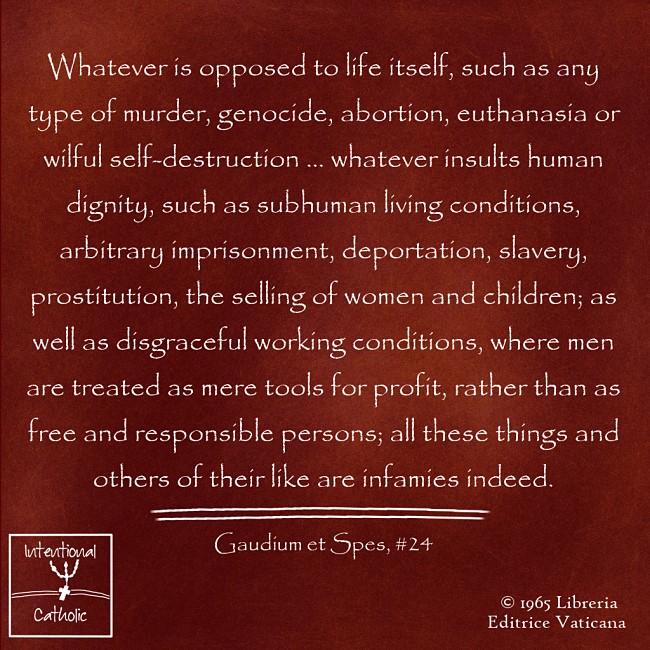
Abortion, but not just abortion

Today, on the anniversary of Roe v. Wade, we Catholics focus in very narrowly on abortion. In our discussions and arguments about connecting public policy to our faith, this issue is always presented as the issue–the only one that matters, the one that overwhelms absolutely every other tenet of our faith. Nothing else matters, because without life, none of the rest of it could happen.

But as this excerpt shows, that is not how the bishops of the Second Vatican Council viewed the world. That is not how we are called to view the world.

Our commitment to sanctity of life doesn’t–can’t–stop with abortion. To do so is to betray who we are as Catholic Christians.

Related posts:

How We Talk About Abortion, part 1

How We Talk About Abortion, part 2

Pope Francis On Abortion

“Another Self”

“Another self.” It’s hard enough to view others this way in family life. Half of Godly parenting–maybe three-quarters of it–is trying to get kids, who are supremely selfish beings, to recognize the other as not only equal to themselves, but “another self.”

But take this beyond the confines of those we already love, and it’s downright superhuman.

-the three people you most dislike in the world, you should view as “another self.”

–the people who are a continual thorn in our sides are “another self.”

–the people living in the woods and holding signs at intersections, whether they’re drug addicts or lazy or criminals or whatever assumptions we might be tempted to make about them, are “another self.”

–the refugee, asylum seeker, and yes, even the genuine “illegal alien” is “another self.”

And as a Christian it is my *job* to enable all these “other selves” to live with dignity. This is a conciliar document saying this, not one priest or one bishop. This is the Church speaking as clearly as the Church can speak.

Now, we can argue about what is the best way to enable human dignity. That’s a totally valid argument.

But those aren’t the discussions we’re having.

Instead, almost all our arguments are focused on whether we *should* help people–whether they *deserve* it and whether “there’s money” to do it. But let’s be honest: in America, there’s plenty of money to do what needs to be done. The argument is between those who think it can’t be done piecemeal, and should therefore be done at the level of society, i.e. through higher taxes and governmental administration, and those who think government is intrinsically evil and taxes are to be avoided at all costs–that charity should be entirely a private matter, even if that means many people will get missed.

This is the fundamental logjam in America today, and the trouble is that people on both sides view their own position on that question as universally-accepted truth–a settled reality. And so instead of figuring out how to strike a balance between personal rights and societal responsibility, we end up bickering about who does and who doesn’t deserve help. We start labeling asylum seekers as criminals, and conservatives as racists, and it all falls to pieces.

Our opponents, too, are “another self.”

The following quote is too long to put in a graphic, but it’s well worth putting at the center of our minds in an election year:

…there must be made available to all men everything necessary for leading a life truly human, such as food, clothing, and shelter; the right to choose a state of life freely and to found a family, the right to education, to employment, to a good reputation, to respect, to appropriate information, to activity in accord with the upright norm of one’s own conscience, to protection of privacy and rightful freedom even in matters religious.

This social order requires constant improvement. It must be founded on truth, built on justice and animated by love; in freedom it should grow every day toward a more humane balance. An improvement in attitudes and abundant changes in society will have to take place if these objectives are to be gained.

Gaudium et Spes, #26