A little less talk, a little more action

You know that saying: whenever you point a finger at someone else, four fingers are pointing back at you? (Well, it’s really three, as you can see, but…)

I think about that a lot in the context of Intentional Catholic. Anything I write, integrity forces me to turn back on myself, mirror-like.

Iโ€™ve been struggling through the Bible in a Year podcastโ€ฆ valuing it for the sake of hearing Scripture in a way that helps me grasp the historical context, but struggling because sometimes the commentaries really set me off. The one on Matthew 25โ€”which is sort of the whole foundation of Intentional Catholic–pretty much gave permission for people to say โ€œIโ€™m clothing my naked children and feeding my hungry family. Iโ€™m covered.โ€ In fairness, I do not believe thatโ€™s what he intended to convey, but it certainly does give tacit permission to ignore the plight of ACTUAL poverty and suffering.

Which is not to belittle feeding and clothing a family. I am up to the tips of my frizzy curls in caring for kids. Itโ€™s a real thing.

But it doesnโ€™t negate our responsibility to the poor, marginalized, and vulnerable. First of all because keeping our kids fed and clothed is only a sliver of what keeps us so busy. The vast majority of what keeps us hopping is not essential. We could ALL cut back on some of our luxury and busy-ness and refocus some of that energy on the poor, marginalized, and vulnerable.

But as I sat there stewing and fuming over this, it occurred to me that me sitting in my house writing blogs and social media posts is not clothing the naked and feeding the hungry, either.

Hereโ€™s the thing. The conventional wisdom is that not everyone is called to everything. We are supposed to find what we, individually, are called to.

But I am an Enneagram 1, which means Iโ€™m very concerned with Getting It Right. For myself AND for the larger world. Enneagram 1s are deeply susceptible to scrupulousness. (Scrupulosity?)

The trouble is, when I, as an Enneagram 1, try to parse out what I feel most passionate about, I canโ€™t do it. It all matters!

I have a child with a disability. Our health care system of access & payment is deeply dysfunctional and a burden on families.

My conscience stings every time I see a homeless person at an exit ramp. How dare we drive by, avoiding eye contact to preserve our own comfort? How dare people on my โ€œNextdoorโ€ app call them โ€œzombies,โ€ as if these are not human beings with the same innate dignity as themselves?

I see the chaos and suffering that causes people in Central America to flee for the U.S.โ€”and the way some people here villainize those who are desperate for the same security we treat as a divine right. How can I not be passionate about refugee and immigration?

I have godchildren and family members whose skin color will make them a target when they grow up. How can I not rail against those who deny systemic racism?

I had infertility that the medical community wanted to treat by slapping bandaids on it (birth control, artificial procedures) while ignoring the problems that caused it. We have a family because an NFP doctor took the time to find the root cause (PCO + agricultural chemicals in the waterโ€”how can I not be passionate about the environment?). So when I see how abortion is the symptom of a host of other problems that are systemic in our culture, how can I fail to rage at those who want to address the symptom while ignoring the causes?

I donโ€™t know what my โ€œoneโ€ issue is, because dang it, theyโ€™re all equally important. Thank you very much, Enneagram 1. But I canโ€™t do everything. For years, Iโ€™ve been trying to learn to respect my limits, to create healthy boundaries.

But sooner or later you have to say โ€œyes,โ€ too.

So for now, I am working a shift at the Food Bank into my schedule, and exploring volunteer possibilities with Refugee and Immigration Services. Because at least thereโ€™s a known entry point there.

I am not going to stop talking. But Iโ€™m going to start mixing more action in with it.

What Dorothy Day’s views on Communism teach us about today’s conflicts

Photo by by Roman Harak, via Flickr

I want to talk about Dorothy Day and Communism. This was the original post I wanted to write about her, but I felt it needed to be prepared by the two Iโ€™ve already shared.

Dorothy Dayโ€™s stalwart both/and-nessโ€”and the fact that she WAS a Communist before her conversion to Catholicism–gave her a unique perspective on communism, which of course was THE issue that shaped the world during much of her ministry.

And with all the talk of โ€œsocialismโ€ today, itโ€™s still relevant.

As I shared before, Dorothy Day believed in personal responsibility. She had no faith in changing things through the political process–she thought transformation could only come by changing hearts and minds. And she was worried about regulation because of the danger of fascism (she wrote strong words about it in the 1930s, in the era of Hitler, Mussolini, and FDR). Yet despite her antipathy, she DID speak up on political issues, and those words have deep resonance still today:

โ€œI do not think, however, that we are guilty of envy or begrudging a rich man his wealth if we point out the abuses of the capitalist system which allows one man to accumulate the most of the worldโ€™s goods while other families suffer year after year, the aching pinch of poverty if not of actual destitution.โ€ (All The Way To Heaven, Kindle edition, 86).

Stop and read that quote again. Let it sink in. Not a whole lot has changed since then, has it? In the past 40 years, since Reagan redefined for the entire country (left AND right) our fundamental approach to taxes and government, total wealth in the U.S. has grown by $77 trillion, but almost all of that went to the richest 10% and especially the richest 1%, while the poorest families among us are all but flat.

Source: Congressional Budget Office report: “Trends in the Distribution of Family Wealth, 1989-2019,” published Sept. 2022

How can anyone deny that capitalism serves the rich, not the poor?

Here’s another quote.

โ€œThe Bishops of the Catholic Church have stated that many of the social aims of the Communists are Christian aims and should be worked for by Christians. We feel that Communism is gaining in this country, because Christian people do not protest against injustice as they do.โ€ (Ibid., 95).

Communism gained BECAUSE Christians didnโ€™t stand up against injustice. Thereโ€™s a lesson in that for us in 2022, too.

One of the major messaging points of todayโ€™s conservative movement is that America needs to โ€œreturn to its traditional Judeo-Christian values.โ€ Or, โ€œthe Judeo-Christian values on which this nation was founded.โ€

I see the connection between modern conservatism and traditional Christian values on sexuality. But outside of that I donโ€™t see much connection at all. In preparation for my letter to the bishops on the Eucharist, I read the entire Pentateuch. One of the things that struck me most profoundly was how the early nation of Israel dealt with issues of social security.

Israel was, in fact, a religious nationโ€ฆ unlike the U.S., which was explicitly founded on freedom of religionโ€”James Madison viewed it as THE fundamental liberty, without which the others meant nothing.

And unless Iโ€™ve profoundly misinterpreted, in proto-Israel, religion WAS governmentโ€”until they rebelled against God and demanded a king. But in those early generations, there was a tithe whose express purpose was to support the livelihood of the priests and provide for the โ€œwidow and the orphan and the resident alien.โ€ A nationwide tax, in other words, that everyone paid in order to take care of the most vulnerable among them.

Fast forward to early Christianity. In Acts of the Apostles, no one held any property in common; they all laid it at the feet of the Apostles and it was distributed according to need.

Was it really that easy? I have my doubts. People are people, after all. Still, that was the intended foundation of Christian society.

And, umโ€ฆ pretty sure we can all see that thatโ€™s the literal definition of communism.

Now, donโ€™t misunderstand me. It is eminently clear that communism, and all its lingering forms of government (cough-cough-Putin-cough-cough), are unequivocally Bad News.

But anyone who legitimately wants to claim a desire to return to Judeo Christian principles is being intellectually and morally dishonest if they ignore the parts of Judeo-Christian history that donโ€™t line up with their worldly values. Because values of low taxes and small government are not, in fact, Judeo Christian at all, but secular ones.

In her lifetime, Dorothy Day called out capitalism AND communism, because theyโ€™re both fundamentally in conflict with Christian world view.

Christian Brotherhood and Immigration

Background image by Dimitris Vetsikas from Pixabay

Returning to Fratelli Tutti today. This comes from a section subtitled โ€œAn Absence of Human Dignity on the Borders,โ€ calls out conflicts around immigration as a violation of Christian brotherhood. “They,” in this case, refers to migrants.

This quote struck me with particular force because it encapsulates what I’ve been struggling with in arguments over race and immigration. In the abstract, we all agree that racism is bad and immigrants have human dignity, but whenever discussions of particulars arise, an almighty outcry rises in protest, saying such and such a thing is not racist, that of course they have human dignity BUT (fill in the blank). Here, Pope Francis calls that out.

One thing I found particularly interesting: the assertion that communities whose people flee are losing โ€œtheir most vigorous and enterprising elementsโ€ (#38). Iโ€™d never thought about that. His point is that in addition to the right to immigrate, thereโ€™s also the right to be able to stay where you are. People flee when that right is violated. So in addition to justice for immigrants seeking new homes, responsibility also rests on those who create the dire situations that force people to flee.

As tempting as it is to read this section in light of U.S. immigration battles, we have to remember we aren’t the only ones dealing with conflicts over migration. #40 actually names Europe as particularly at risk of prioritizing its own citizens so high, it sets aside the rights of migrants.

This section ends with a heartfelt acknowledgment of the fears that cause peopleโ€™s reaction to immigration, and begs us to face those fears and move beyond them, because they cause us to act in ways that are โ€œintolerant, closed and perhaps even–without realizing it–racist.โ€ The closing statement is just beautiful: โ€œFear deprives us of the desire and the ability to encounter the other.โ€

Human Dignity Depending On Our Own Convenience. (Ouch.)

The problem with being the center of world culture is that we tend to be really myopic–so focused on ourselves, we tune out the rest of the world. Every time Iโ€™m out and about at 2p.m., I butt up against this reality in myself. While I really enjoy listening to NPR news programs, to dig deeper into big questions, itโ€™s excruciating to listen to the BBC News Hour. Unless, of course, theyโ€™re talking about the USA.

Three quarters of what is talked about on that program is talking about situations that are so off my radar, I canโ€™t summon any desire to pay attention.

This is what comes to mind while reading todayโ€™s section of Fratelli Tutti (#22-28). Pope Francis points out in reality, all human rights are NOT given equal time. Some of us live in opulence and othersโ€™ rights are totally discarded. We pay lip service to women having equal dignity to men, but reality paints a different picture. Human trafficking, organ harvesting, etc. further illustrate the divide.

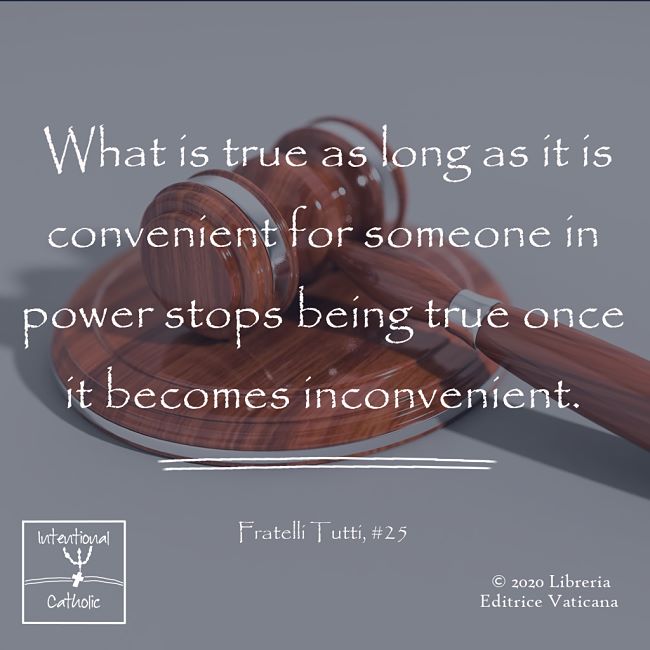
Where he really hits his stride, though, is in #25, where he skewers the habit of defending or dismissing assaults on human dignity, โ€œdepending on how convenient it proves.โ€

This feels very, very familiar. The difference in how we perceive the dignity of the unborn versus that of the refugee fleeing Central America (with or without going through โ€œproper channelsโ€) springs instantly to mind. If it doesnโ€™t cost ME anything, of course Iโ€™m going to uphold human dignity. But if it has the potential, however remote, to inconvenience ME, well, then I can find all kinds of reasons why itโ€™s not my problem, itโ€™s theirs.

Next, he points out the tendency to build walls, both figurative and literal, separating humanity into โ€œusโ€ and โ€œthem.โ€ Itโ€™s so beautiful, itโ€™s nearly poetry. Just go read #27. And he rounds out this section by pointing out that the disenfranchisement caused by these sinful behaviors is precisely what leads to โ€œmafias,โ€ which I would suggest is a blanket term that includes terrorism.

So many Christian teachings have an incredibly practical element. Yes, we should treat each other as โ€œbrothersโ€ (in the non-gender-specific meaning of the word) just because thatโ€™s Godโ€™s will. But the reality is that the failure to follow that teaching has all kinds of real-world ripple effects.

The way those ripple effects bang into each other and intensify is what made me start Intentional Catholic in the first place. Because I think an awful lot of us spend our lives totally unaware of them. That certainly was true of me until the arrival of my daughter set me on a small boat in the middle of all those ripples, and I had no choice but to recognize them because of the bumpiness of the ride.

Until then, I had compartmentalized life, thinking, โ€œSure, THESE issues are connected to my faith, but all THESE have nothing to do with it.โ€ I was totally wrong. All issues are connected to faith.

“New humanism”

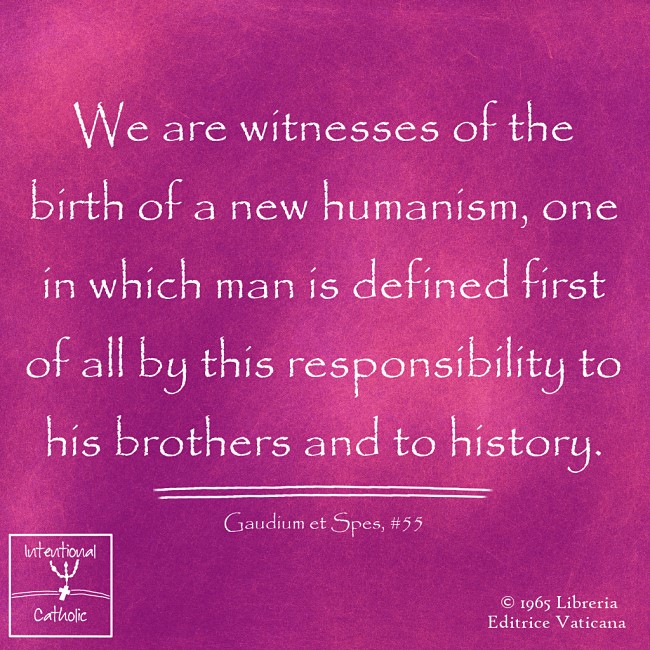
This seems like such a simple quote. I was going to let it stand without commentary, but I realized that this is really the essence of the convictions of all Christians who are passionate about social justice. To be a Christian is to care, in a self-emptying, physical, sacrificial way, for others. And to recognize that the things we do now have ripples down through history, on generations not yet born.

This quote expresses why we have a responsibility to act on environmental issues, on racial issues, on issues of poverty and inequality–the whole range of questions that are the most uncomfortable to address, because they challenge cherished ideals of self-reliance and rugged individualism.

“Another Self”

“Another self.” It’s hard enough to view others this way in family life. Half of Godly parenting–maybe three-quarters of it–is trying to get kids, who are supremely selfish beings, to recognize the other as not only equal to themselves, but “another self.”

But take this beyond the confines of those we already love, and it’s downright superhuman.

-the three people you most dislike in the world, you should view as “another self.”

–the people who are a continual thorn in our sides are “another self.”

–the people living in the woods and holding signs at intersections, whether they’re drug addicts or lazy or criminals or whatever assumptions we might be tempted to make about them, are “another self.”

–the refugee, asylum seeker, and yes, even the genuine “illegal alien” is “another self.”

And as a Christian it is my *job* to enable all these “other selves” to live with dignity. This is a conciliar document saying this, not one priest or one bishop. This is the Church speaking as clearly as the Church can speak.

Now, we can argue about what is the best way to enable human dignity. That’s a totally valid argument.

But those aren’t the discussions we’re having.

Instead, almost all our arguments are focused on whether we *should* help people–whether they *deserve* it and whether “there’s money” to do it. But let’s be honest: in America, there’s plenty of money to do what needs to be done. The argument is between those who think it can’t be done piecemeal, and should therefore be done at the level of society, i.e. through higher taxes and governmental administration, and those who think government is intrinsically evil and taxes are to be avoided at all costs–that charity should be entirely a private matter, even if that means many people will get missed.

This is the fundamental logjam in America today, and the trouble is that people on both sides view their own position on that question as universally-accepted truth–a settled reality. And so instead of figuring out how to strike a balance between personal rights and societal responsibility, we end up bickering about who does and who doesn’t deserve help. We start labeling asylum seekers as criminals, and conservatives as racists, and it all falls to pieces.

Our opponents, too, are “another self.”

The following quote is too long to put in a graphic, but it’s well worth putting at the center of our minds in an election year:

โ€ฆthere must be made available to all men everything necessary for leading a life truly human, such as food, clothing, and shelter; the right to choose a state of life freely and to found a family, the right to education, to employment, to a good reputation, to respect, to appropriate information, to activity in accord with the upright norm of one’s own conscience, to protection of privacy and rightful freedom even in matters religious.

This social order requires constant improvement. It must be founded on truth, built on justice and animated by love; in freedom it should grow every day toward a more humane balance. An improvement in attitudes and abundant changes in society will have to take place if these objectives are to be gained.

Gaudium et Spes, #26

Globalization

I don’t think the word “globalization” was in use yet in 1965 (though I don’t know that for sure), but that’s exactly what this is talking about. Nationalism has surged as a backlash against the reality that we’re all connected, but it doesn’t negate the reality. We are all connected. Nowhere on earth is more than a commercial plane ride away. The bombs can drop anywhere. We can Skype with someone in Thailand or Malaysia or Ukraine or Antarctica instantaneously. Parts for our technology may be made in one country and the whole assembled in another, and get shipped to a third.

We are inextricably tied together. We can’t deny that reality, no matter how threatening it feels. In fact, the overwhelming majority of us buy into it implicitly by the way we depend on smart devices and online purchasing.

We are tied together now, and if injustices and suffering in one part of the world cause conflict, the ripples will spread outward and hit us, too. That’s what we see in the refugee crises of the last few years–Syrians fleeing to Europe and Central Americans to the U.S. border, to name the most obvious. We have to recognize that the history of U.S. involvement in Central America over the past decades contributed to the suffering there (a topic I only know a little about, but enough to be aware that cold-war-era anti-Communist efforts are a factor***, and the fact that MS-13 originated in L.A. and its members were deported; now they’re a big part of the mayhem now happening). Ergo, we can’t just close up our border and say “Nope, your problem.” First, because we helped create it, and second, because this is the reality of an interconnected world. Your problems are my problems, whether I like it or not.

And the thing is, this is what Jesus called us to do voluntarily, as part of the Christian call. Jesus’ response Cain’s flippant protest, “Am I my brother’s keeper?” was this:

“Whatever you did for one of these least brothers of mine, you did for me.” (Mt. 25:41)

Well worn, but hard to embrace.

And isn’t it amazing that Pope Paul VI and the bishops of the second Vatican Council could see all this in the mid-1960s, before any of this had taken place?


***I tried to do some good research on these contextual factors this morning so I could share reliable sources about them. What I discovered is that a) Fox news doesn’t talk about it at all, only left- and left-center-leaning sources; and b) it’s too complex for me to dive down the rabbit hole to understand fully in one morning when I have deadlines pressing. What it tells me, most of all, is that we as Americans (myself included) are sinfully negligent in understanding the conflicts and sufferings outside our own borders. So for today I am relying on the understanding of faithful Catholic friends who actually know about these situations.

Go Beyond the Surface

Background image by analogicus from Pixabay

Whether we are talking about the justification for raising or lowering taxes, the question of Dreamers and refugees, whether “voting prolife” must mean voting Republican or whether it can or should incorporate a larger view of the total life issues, or arguing over musical styles in worship, one thing is pretty much universally true: conflict gets ugly because we focus on issues instead of people.

Am I talking about the dignity of the person on the opposing side of the debate? Yes, but also the dignity of the people who are impacted by whatever issue we’re talking about. It’s much easier to look at issues as black and white, with no room for discussion or working together, when they are looked at in the abstract, rather than considering the real life people involved. When you start thinking about the dignity and well-being of refugees and Dreamers as beloved children of God, and of the Biblical call to be “our brothers’ keeper,” it becomes a lot less defensible to chant “build a wall” and tell Dreamers to go to the “back of the line.”

When we consider the dignity of the people involved, we have to look for solutions that take into account everyone, not just our own well-being. If we want to be a Christian nation, this is what we must do. It’s unsatisfying. Every one of us would be happier if the world laid itself out neatly in exactly the way we think it should. But we have to recognize that the world is flawed, and we’re not God. We can’t see the whole picture, and the only way we get anywhere close to seeing the big picture is by looking through the eyes of everyone else and figuring out how to set up the world to meet their needs as well as our own.

This is a lesson we learn as children: walk a mile in another’s shoes, see the situation through their eyes. Why do we stop thinking it matters when we reach adulthood?

Primary Motivator

The readings this weekend were all about money. Amos was talking about the dishonesty of those with money–how they were so focused on their own profits that they didn’t really care what happened to the “have not”s of the world. And Jesus said, “Guess what? How you use your money matters.”

Listening yesterday at Mass, it really struck me how those readings should skewer America. The obvious application is the question of income inequality: how many of the huge profits made by companies are held by those at the top of the food chain, how little is actually shared with those down the ranks.

But you know, so much of what we talk about in America centers on money. Many would like to believe we’re a Christian nation, but money–capitalism–is the primary thing that preoccupies our social and political discourse, even among Christians. So many things come back to money: health care and social programs would require more taxes, and we can’t possibly suggest raising taxes. Immigrants are perceived as a threat to American jobs, so again–it comes back to money. The question of whether a president deserves re-election is always about the economy. We’re having all these discussions about China and intellectual property and trade fairness, but nowhere on anyone’s radar is the question of just wages for labor, which is–let’s face it–the only reason manufacturing went overseas in the first place. It went overseas because we, the rank and file Americans, aren’t willing to pay what it would cost to make a product while paying a just wage to the laborer who made it.

We have a lot to answer for, and I don’t pretend to have a pat solution. I personally try to take a step back from the consumer culture by starting with secondhand clothing purchases as much as possible. But those clothes, too, were made by cheap labor overseas, and I order from Amazon just like every other red-blooded American. What do I think God will say to me when it comes time for me to answer for my choices? I don’t like pondering that question any more than anyone else.

In any case, when I was looking through the possibilities for things to share today, this quote from my Beatitudes book seemed to dovetail with what we heard at church yesterday. Because what if? What if, instead of money, we made God’s will, God’s kingdom, God’s priorities, the central principle that guided every other choice?

Okay, But Who Is the “Other” We’re Talking About Here?

If you reacted to this with, “well, duh,” I hear you. This is the kind of religious platitude that we usually skim right over: so general and familiar, we can nod our heads and move on, totally failing to see how it applies in concrete ways in real life.

What if, in place of the word “others,” we substituted the actual people we struggle to love, i.e. will the best for? For example:

“to see God in and seek the good of…

…. that political figure I think is possessed by the devil. (And people have thought that about more than one recent figure, so be honest and don’t write this one off. It applies to both sides of the political spectrum.)

…those people who hold beliefs contrary to my own on important issues.

… that person who likes the OTHER kind of liturgical music.

…. that person who told lies to me or about me and deeply harmed my emotional well-being.

…. that school administrator/boss/coworker who is combative and uncooperative and makes my life miserable.

…that refugee on the southern border whose desire to come here feels threatening to me on some level.

If you didn’t squirm at this recitation, then you probably didn’t dig deep enough, because I definitely squirmed writing it.

This is the problem with religious platitudes: we can all, whatever our opinions on divisive matters within the Church and outside it, applaud and feel affirmed by such statements as long as we don’t dig down to what they actually mean in real life.

That’s why I’m here, doing this work at Intentional Catholic: because we don’t grow in holiness until we dig deep enough to get uncomfortable with the status quo.