Book Recommendation: When Helping Hurts

How about a chance of pace for a Monday morning? I have a book recommendation to share:

When Helping Hurts:
How to Alleviate Poverty Without Hurting the Poor…And Yourself
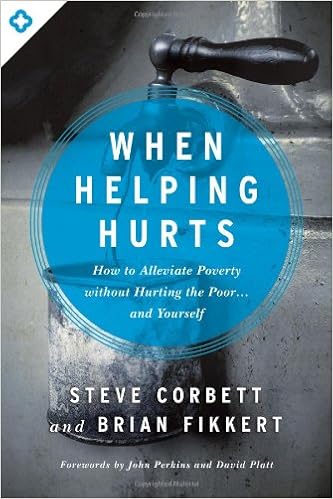
I can’t say enough good things about this book. Written by two Christians (not Catholic) who have been involved for decades in mission work, they share wisdom on how to be helpful, rather than going in with great intentions and making everything worse. In a nutshell, it boils down to this: we can’t come in and be saviors. Our job is to facilitate others helping themselves. There are three types of help: relief, recovery, and development. Most of the time, what’s needed is development, but the vast majority of the time what we offer is relief–because it’s easier. It’s easy to measure, its results make good reports to the investors.

The authors take a “both/and” approach. Many Christians look at the poor and assume they got that way by their own bad choices/sins; therefore their problems are theirs, not ours, to deal with.

Sin is an issue, the authors stress, but so are unjust societal institutions. As an example, they point to civil rights work in the south in the 1960s, and a particular pastor who didn’t speak out on racism.

“Both Reverend Marsh and the civil rights workers were wrong, but in different ways,” the authors wrote. “Reverend Marsh sought the King without the kingdom. The civil rights workers sought the kingdom without the King.”

The authors address overseas missions as well as efforts undertaken within the U.S. When Helping Hurts suggests that successful solutions are not either/or; they have to acknowledge both the effects of personal sin and the effects of institutional oppression, because those two things exert an influence over each other:

“What happens when society crams historically oppressed, uneducated, unemployed, and relatively young human beings into high-rise buildings, takes away their leaders, provides them with inferior education, health care, and employment systems, and then pays them not to work? Is it really that surprising that we see out-of-wedlock pregnancies, broken families, violent crimes, and drug trafficking? Worse yet, we end up with nihilism, because these broken systems do serious damage to people’s worldviews. Worldviews affect the systems, and the systems affect the worldviews.”

(p. 92)

When Helping Hurts offers the concept of “poverty alleviation” as a solution to the complexities of institutional injustice and personal sin. It is a “ministry of reconciliation” in which we use our money in such a way as to empower those in desperate circumstances to begin to help themselves. It acknowledges that they do, in fact, need help from outside, but that as much as possible we should honor the God-given human dignity of the poor by allowing them to be the leaders and the experts in their own lives. That our job is to empower them, not rescue them.

I’ve long believed that in most issues we bicker about, God is in the middle. This book shows us a Godly middle to issues of poverty. Both conservatives and liberals will find things that resonate and things that challenge in this book–which is, to me, the strongest argument that they are on target.

Inequality leads to violence

It’s interesting to hear this argument, given the conversations/arguments we are having as a nation about gun violence. I’ve never heard anyone talk about this factor. Of course, violence goes way beyond mass shootings:

– Domestic violence is made possible by unequal relationships between life partners.

– War is quite often a symptom of one group imposing its greater power upon another weaker (i.e., unequal) population.

– Violent protests are quite often a symptom of a weaker, poorer, or oppressed group rising up against the institutions of power that hold them down. (Race protests in the wake of police shootings come to mind right away. And what happened in Puerto Rico.)

And so on. I find this statement really striking because we bemoan violence, we come up with all these ideas for what will stop it, and we miss this obvious reality, which means we can’t talk about violence without also talking about race, poverty, discrimination, and so on. It’s the spaghetti bowl principle all over again.

Trickle-Down Economics: Who’s right, and what does it mean for Christians?

I have to be honest: it’s terrifying to share this excerpt from Evangelii Gaudium. The idea of free market and trickle-down economics is foundational to the world view of so many Americans who hold the Christian faith, it’s often viewed as fundamental to being a Christian. Heck, I grew up that way. I know how defensive a reaction this quote is likely to provoke in many faithful Catholic readers.

So I guess we have to start by acknowledging that we can’t examine this question solely from the perspective of faith, because there is a very concrete, practical reality underlying it. The fundamental practical question we have to answer before we can address the faith component is this: does trickle-down economics work? Does it actually bring prosperity (and, far more important, greater human dignity) to all? Because if so, more power to it. But this weigh-in from the Church indicates otherwise.

According to this analysis, faith in trickle-down economics as a boon to all is on pretty shaky ground, with the financial benefits extremely lopsided–over 25 years and two trickle-down tax cuts, 6% growth for the bottom fifth versus 80% growth for the top fifth; the economic growth credited to those tax cuts uncertain because of other strong influences at work at the same time.

(To hearken back to the topic of honesty and fact checking in social media: The site hosting that analysis is one of the very few sources given the rating “least biased” by Media Bias/Fact Check, a site I visit routinely when I’m not familiar with the source I’m reading.)

Back to the topic at hand. If Pope Francis is right, then what does this mean for us as Christians?

I’ve spent an hour trying to formulate an answer to that question that doesn’t trip political land mines. Maybe the answer is that we all, regardless of where we stand politically, need to pray for the grace and wisdom to be able to self-reflect more honestly. We’ve always embraced it when our leadership has called out the failures and injustices in the Communist systems. And with good reason. But we’ve often turned a blind eye when the popes and bishops have called out the same offenses within capitalism. It’s easy to assume we know God’s will and not even recognize when what we’re actually worshiping is our own.

Starving

Background image by Tama66, via Pixabay

This is probably one of the best illustrations a girl could hope for in trying to explain what I mean when I talk about being “intentional” about the faith. We’ve all heard about food waste, but how often do we actually connect it to our Christian faith? Plus, it’s such a general, “out there” kind of concept. Places like this, that put it in concrete terms we can wrap our heads around, paint the issue in big, global terms, which means we don’t always connect it with our individual habits. For instance:

We don’t make our kids finish eating whatever they don’t want, because it might teach them an unhealthy relationship to food… but we don’t wrap it up and save it for the kid’s next meal, either; we throw it away.

Restaurant portions are gargantuan and sometimes we take home the leftovers, sometimes we don’t; it gets thrown away.

And all the while we’re enjoying the bounty of our own privileged existence, people are starving.

What if we were more intentional about how we eat and how we deal with food waste? (This link from the EPA gives some great tips.) What savings might we be able to achieve, and thus redirect toward providing food for those not as blessed as ourselves?

These are the piddly little habits we don’t always recognize as being connected to our faith. Being intentional means we have to stop think instead of doing what we’ve always done on autopilot.

I know. This means devoting time and mental energy none of us feel like we have. Believe me, I get it!

But having been on this journey for several years, I can promise this: Whatever you invest in living your faith intentionally–in these real, concrete, practical ways–will come back to you many times over.