Public Prayer and Religious Freedom

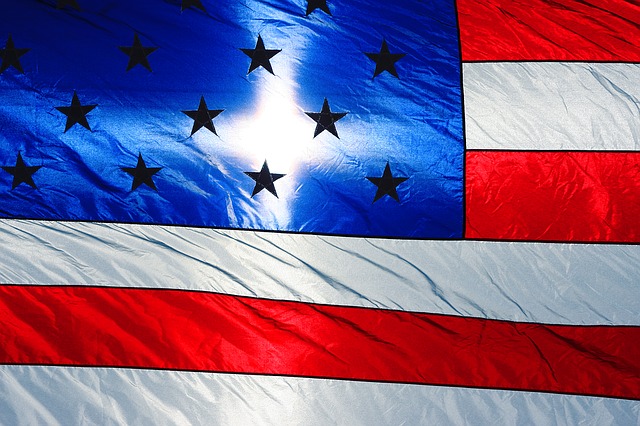
Image by Beverly Lussier from Pixabay

Every so often a meme goes around Facebook that riles up Christians about public prayer and religious freedom. It’s not always the same one, but the idea is the same: we Christians are persecuted, we should rise up and demand that America act like the Christian nation it is.

The problem is, America is not a Christian nation. Many of America’s first immigrants came here to escape religious persecution. That persecution was very much on the minds of those who set up the system of government. They structured America specifically so that nobody’s faith would get to knock down anyone else’s. Everyone gets the chance to worship as they see fit. Whether we as Godly people like it or not, that also means freedom FROM religion. Not having publicly-sanctioned prayer is not persecution. It’s simply a recognition that we are a nation built on religious liberty. No one’s prayer can be imposed on all.

We as Christians may not like that idea, but this is what makes America great. Because in fact, it’s a system that mirrors God’s own heart.

As the saying goes, God is a gentleman. He doesn’t force himself on us. When has it ever gone well for us to try to force him on others? The Crusades. The Inquisition. The suppression of native cultures. Every time we try to force God on others, we end up gravely sinning in His name.

Our job is to do as God does: invite.

Instead, I would argue that much of what we as Christians display publicly is not inviting at all. Inviting could mean different things in different situations, but surely the fundamental quality of one who invites is a joyful heart. A heart so welcoming and kind and compassionate and peaceful in spirit that others say, “Hey, I want some of that. How do I get it?”

Instead, so often we Christians display anger, resentment, bitterness, judgment, and attitudes of exclusion when faced with those in crisis situations. We focus on our own preferences and emotional comfort while turning a blind eye to inconvenient facts—like the fact that if my free expression of religion requires the suppression of someone else’s free expression of religion, then it really isn’t religious freedom at all.

Like the fact that if we were truly a Christian nation, we wouldn’t be looking for ways to avoid helping our neighbors in desperate need. (“Who is my neighbor?”) Like the fact that a truly Christian nation would prioritize making sure all its citizens have health care and equal opportunity in education. Would prioritize support for the poor, recognizing that poverty, lack of opportunity and inequality are factors that undercut our ability to build a holistic culture of life.

When we turn a blind eye to these realities (which admittedly are hard, complicated to navigate, and resist neat and tidy solutions) and instead let ourselves be manipulated into outrage over something that’s really not a threat at all, we damage our ability to evangelize. We alienate those we are meant to invite.
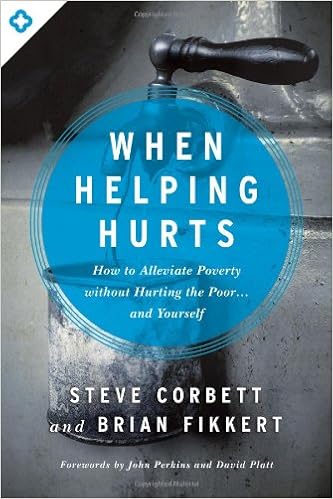
Book Recommendation: When Helping Hurts

How about a chance of pace for a Monday morning? I have a book recommendation to share:

When Helping Hurts:
How to Alleviate Poverty Without Hurting the Poor…And Yourself

I can’t say enough good things about this book. Written by two Christians (not Catholic) who have been involved for decades in mission work, they share wisdom on how to be helpful, rather than going in with great intentions and making everything worse. In a nutshell, it boils down to this: we can’t come in and be saviors. Our job is to facilitate others helping themselves. There are three types of help: relief, recovery, and development. Most of the time, what’s needed is development, but the vast majority of the time what we offer is relief–because it’s easier. It’s easy to measure, its results make good reports to the investors.

The authors take a “both/and” approach. Many Christians look at the poor and assume they got that way by their own bad choices/sins; therefore their problems are theirs, not ours, to deal with.

Sin is an issue, the authors stress, but so are unjust societal institutions. As an example, they point to civil rights work in the south in the 1960s, and a particular pastor who didn’t speak out on racism.

“Both Reverend Marsh and the civil rights workers were wrong, but in different ways,” the authors wrote. “Reverend Marsh sought the King without the kingdom. The civil rights workers sought the kingdom without the King.”

The authors address overseas missions as well as efforts undertaken within the U.S. When Helping Hurts suggests that successful solutions are not either/or; they have to acknowledge both the effects of personal sin and the effects of institutional oppression, because those two things exert an influence over each other:

“What happens when society crams historically oppressed, uneducated, unemployed, and relatively young human beings into high-rise buildings, takes away their leaders, provides them with inferior education, health care, and employment systems, and then pays them not to work? Is it really that surprising that we see out-of-wedlock pregnancies, broken families, violent crimes, and drug trafficking? Worse yet, we end up with nihilism, because these broken systems do serious damage to people’s worldviews. Worldviews affect the systems, and the systems affect the worldviews.”

(p. 92)

When Helping Hurts offers the concept of “poverty alleviation” as a solution to the complexities of institutional injustice and personal sin. It is a “ministry of reconciliation” in which we use our money in such a way as to empower those in desperate circumstances to begin to help themselves. It acknowledges that they do, in fact, need help from outside, but that as much as possible we should honor the God-given human dignity of the poor by allowing them to be the leaders and the experts in their own lives. That our job is to empower them, not rescue them.

I’ve long believed that in most issues we bicker about, God is in the middle. This book shows us a Godly middle to issues of poverty. Both conservatives and liberals will find things that resonate and things that challenge in this book–which is, to me, the strongest argument that they are on target.

Inequality leads to violence

It’s interesting to hear this argument, given the conversations/arguments we are having as a nation about gun violence. I’ve never heard anyone talk about this factor. Of course, violence goes way beyond mass shootings:

– Domestic violence is made possible by unequal relationships between life partners.

– War is quite often a symptom of one group imposing its greater power upon another weaker (i.e., unequal) population.

– Violent protests are quite often a symptom of a weaker, poorer, or oppressed group rising up against the institutions of power that hold them down. (Race protests in the wake of police shootings come to mind right away. And what happened in Puerto Rico.)

And so on. I find this statement really striking because we bemoan violence, we come up with all these ideas for what will stop it, and we miss this obvious reality, which means we can’t talk about violence without also talking about race, poverty, discrimination, and so on. It’s the spaghetti bowl principle all over again.

How to Discern?

We all have our preconceived ideas about what elements of modern life run counter to God’s plan. I could list mine, and no doubt some of them would be quite different from yours. Contradictory, even. We’d probably get into an argument about it. Isn’t that what happens every time we talk about guns, immigration, health care, poverty initiatives, race, or climate change? Half of us think the kingdom points in one direction; the other half sees that direction as heresy.

When God works in our lives, we are challenged to grow. Growth requires change, and change is threatening to our equilibrium. So we resist. We come up with a hundred ways to dismiss what we recognize as a threat to our own comfort.

How, then, do we truly discern when God is at work, challenging our preset assumptions, as opposed to when something is truly counter to God’s plan?

I would argue that we have to start by subordinating our preconceived opinions long enough to think around divisive issues and see them from another side. We might not change our minds. In some cases, we shouldn’t. But we’ll recognize the nuance and complexity of the issues, and that would allow us to enter into conversations in a productive, rather than toxic, way. It would go a long way toward bringing us, collectively, out of the place of acrimony and extremism in which we, as a nation, have become imprisoned. And that, in turn, would bring us closer to God’s kingdom.

Okay, But Who Is the “Other” We’re Talking About Here?

If you reacted to this with, “well, duh,” I hear you. This is the kind of religious platitude that we usually skim right over: so general and familiar, we can nod our heads and move on, totally failing to see how it applies in concrete ways in real life.

What if, in place of the word “others,” we substituted the actual people we struggle to love, i.e. will the best for? For example:

“to see God in and seek the good of…

…. that political figure I think is possessed by the devil. (And people have thought that about more than one recent figure, so be honest and don’t write this one off. It applies to both sides of the political spectrum.)

…those people who hold beliefs contrary to my own on important issues.

… that person who likes the OTHER kind of liturgical music.

…. that person who told lies to me or about me and deeply harmed my emotional well-being.

…. that school administrator/boss/coworker who is combative and uncooperative and makes my life miserable.

…that refugee on the southern border whose desire to come here feels threatening to me on some level.

If you didn’t squirm at this recitation, then you probably didn’t dig deep enough, because I definitely squirmed writing it.

This is the problem with religious platitudes: we can all, whatever our opinions on divisive matters within the Church and outside it, applaud and feel affirmed by such statements as long as we don’t dig down to what they actually mean in real life.

That’s why I’m here, doing this work at Intentional Catholic: because we don’t grow in holiness until we dig deep enough to get uncomfortable with the status quo.

Love Is A Concrete Thing

Photo by Ylanite Koppens on Pexels.com

Tell me if this sounds familiar: you tell a kid to put away a piece of clothing, and ten minutes later you look and discover it hasn’t been done. You tell them to do it again, and this time it makes it up the stairs and gets dumped on the floor. By the third time, you’ve pretty well lost your temper, and it’s all downhill from there.

This is my life right now: dishonesty, serial disobedience, and difficulty discerning how much is developmental and how much is spacey personality versus testing behavior. My husband reminds me we’ve been through it before and we’ll get through it this time, but it’s wearying.

Why does this warrant a blog post on a site about living the faith?

Because I’m starting to recognize that this parenting issue has a lot to teach us about love—real, self-giving, sacrificial love. How can we teach such a big concept to our children without starting with small, intimate relationships and small—maybe even petty—examples?

Little kids experience the world in concrete ways, after all. I need my child to learn that love doesn’t just mean cuddles and kisses and being tucked into bed at night and giving me a hug on the way out the door. That’s a tiny child’s version of love, but as they grow, they need to learn that a bare minimum, love means you don’t do things that harm the other.

And since Jesus Christ was never in the business of bare minimum, I’d go a step further and say, as the Catechism says: love means willing the good of the other.

So your actions show your love—or the lack of it.

To wit: if you cause your favorite parent to LOSE HER EVER LOVING MIND because you just don’t feel like doing what she asked you to do, then you’re causing harm and you’re definitely not willing the good of said parent.

In other words: NOT. LOVE.

Okay, it’s petty, I know. But really, if you start spinning out the implications, this is a big deal, and not just for the kiddos, but for us as adult Catholics.

Because if:

a) everyone is our neighbor (Luke 10:29-37), and

b) loving God means loving our neighbor (Luke 10:27-28; Galatians 5:14), and

c) love means willing the good of others (Catechism of the Catholic Church 1766)…

…then we’d darned well better be thinking about willing the good of asylum seekers at the southern border.

And about how to alleviate the strain on of living on women who see abortion as their only option.

And how to erase discrimination (which might mean, for a start, acknowledging that it still exists).

And what it means to steward the earth God gave us for future generations.

And how to create policies that put the good of workers and society before personal or corporate profit.

And how to protect victims of abuse and assault, rather than shame them and blame them and assume they’re lying for underhanded political reasons.

Because with every word we speak about those issues and every policy solution we advocate (or fight against), we show our love for Jesus Christ.

Or the lack of it.

The fruit of the Spirit

Image by Bruno Glätsch from Pixabay

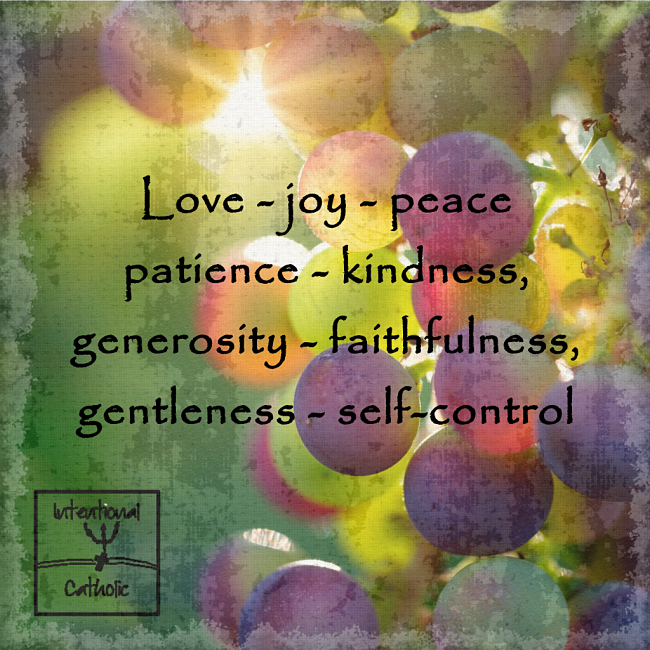
In today’s Gospel, Jesus talks about false prophets and urges us not to trust too easily. “By their fruits you will know them,” he says. Bishop Barron’s accompanying reflection referred that back to the fruit of the spirit. (Item: an editor once pointed out that it’s not “fruits,” plural, but “fruit,” as in: a single fruit with all these facets. I had never noticed that before.)

What struck me this morning was that it sounds great to say “by their fruits you will know them,” but discernment is harder than it looks. We all produce fruit both good and bad. We can be incredibly generous in certain situations (natural disasters) and appallingly stingy in others (homeless people at intersections). We can be generous in thought, giving the benefit of the doubt to some (many within our close sphere of influence), and yet we leap instantly and irrevocably to the worst conclusions about whole groups of people (the assumption that asylum seekers are freeloaders and/or criminals; the assumption that immigration opponents are racists).

The fruit of the spirit is distinctly lacking in our public discourse today, and I don’t just mean the leadership. It’s on us, too. Is there a single one of those facets that we do not see violated daily on both sides of every debate? There are real problems in the world, real things to be angry about, but when we indulge the worst that is within us, we dump fuel on the fire instead of working toward the Kingdom. (This is one of the topics I discuss in my new Beatitudes book.)

Today’s reading is a reminder that a prophet who does not seek to manifest the fruit of the Spirit can and will be dismissed, no matter how true the message. It’s a personal challenge to each of us to shape up, and an equally difficult one: not to give our leaders a pass, either.

How We Talk About Abortion

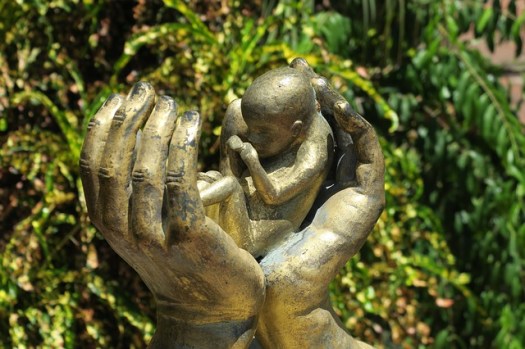
I doubt anyone reading this would argue with me when I say abortion is the central, pivotal issue at the heart of the divide in America today. In recent weeks, with different states passing various abortion bans as test strikes against a new Supreme Court, the magma that simmers uneasily beneath all our toxic discourse has erupted.

Current discussions are excruciating for someone like me, who believes we as Christians have too long taken a facile approach to this issue: A child is a child, a life is a life, end of discussion. Any protest issued by the pro-choice movement does not require answer, because it can’t possibly outweigh that central, fundamental tenet.

Well, a life is a life; it’s true. It’s not that the core belief is wrong. But I heard a quote recently. I haven’t been able to verify it, but it resonates as true to what we as Catholics believe about God:

When God sees sin, he sees wounds.

(For what it’s worth, I heard it attributed to Julian of Norwich.)

What I hear, in the hysteria of those who are pro-choice, is pain.

The pain of sexual abuse, assault, and harassment. The pain of discrimination. A thousand pinprick wounds (and plenty of traumatic ones, too). The pain of deep wounds not healed. People who encounter a hardline “life is sacred, and there’s no more to talk about” stance—a stance which fails to address their pain—will experience a further ripping of wounds they might not even recognize they have. Wounds they have no idea how to heal, because the God that could heal them has been too often represented by people who don’t acknowledge their pain, and in some cases are the cause of it. Which means they dig down and become even more entrenched and unable to hear.

We are not changing hearts when we focus our efforts in this way. And if we want to create a culture of life, we have to change hearts.

So how do we change hearts? I’ve been thinking a lot about this lately, and I’ve realized that not one of the moments of conversion in my life ever happened because I was scolded, hammered with a truth I wasn’t ready to receive, or told my concerns were irrelevant. It always happened slowly, organically, through insights that grew from truths I already recognized.

If we want to change hearts, we have to learn to speak in such a way that the people who need to hear the message are actually able to receive it.

If we who believe in the sanctity of life can only answer the sincere, heartfelt anguish of people who are pro-choice with a “mic drop” argument that means nothing to them (no matter how true it is), then we are tone deaf. We are noisy gongs, clanging. We are without love.

So the next question is: what pain, what concerns, of the pro-choice movement are we ignoring, to the detriment of our goal of creating a culture of life?

My spiritual director once said that the intersection of faith and politics is a mess, because it’s like a bowl of spaghetti. Tug on one thread/issue and you dislodge dozens of others. Abortion simmers beneath everything else because it’s connected to almost everything.

An author in the National Review recently wrote that something she wrote years ago has been quoted both pro-choice and pro-life writers: “No one wants an abortion as she wants an ice cream cone or a Porsche. She wants an abortion as an animal, caught in a trap, wants to gnaw off its own leg.”

This resonates with both sides because it’s true. Women really don’t go around looking for excuses to kill their children. They seek abortion because they truly feel they have no other choice.

Now why would that be?

It can be because they’re in abusive relationships, and they simply feel they’re not capable of bearing one more burden. Or because they are in poverty, and can’t bear one more burden. And yes, a child is a burden. A joyful burden, we hope, but a burden nonetheless. We all complain about parenthood too much to pretend otherwise.

It can be because health care (before and after ACA) is astronomically expensive and handled by private companies in a callous and punitive manner, in which profit counts more than the good of the customer.

It can be because mothers know the system is stacked against them. If they don’t have a support network, how can they care for a child and also work?

It can be because schools in poor areas are a pale shadow of what more affluent families (i.e., us) demand as a given. Or because discrimination still exists, in ways we can’t fathom, because we won’t accept the word of those who experience it, preferring to think they’re overreacting.

The upshot is that women seeking abortion feel—with reason—that they are simply birthing a child into a desperate life of discrimination and struggle and pain.

And again, we know any life is better than no life. But is that facile response going to cut it when we face God? I can’t help thinking God’s going to say, “Thank you for working so hard to protect the unborn ‘least of these,’ but what did you do for all those OTHER ‘least of these’?”

The upshot is: it’s not that we’re wrong to say the baby’s right to life outweighs all other concerns. Of course it does.

But that doesn’t erase the need to address all those other concerns. And my entire life, the prolife movement has been singlemindedly focused on the legal question of abortion, while actively working against attempts to address these other issues at the level of society.

I have more to say about this, but this post is too long already, so I’ll close for today and pick up again tomorrow.

Note: Part 2 is here, and is significantly shorter!

Racism is a prolife issue

Open Wide - prolife

This quote may seem shocking, but it speaks to the larger prolife issue. To be truly pro-life, we have to be thinking beyond the legality of abortion; we need to think about the larger issues that exert societal pressures. Why is the abortion rate so much higher among black women, do you think?

I have a lot of thoughts on the current state of the debates around abortion, but I will leave this for now and hope that it encourages many to click through and read the whole pastoral letter.

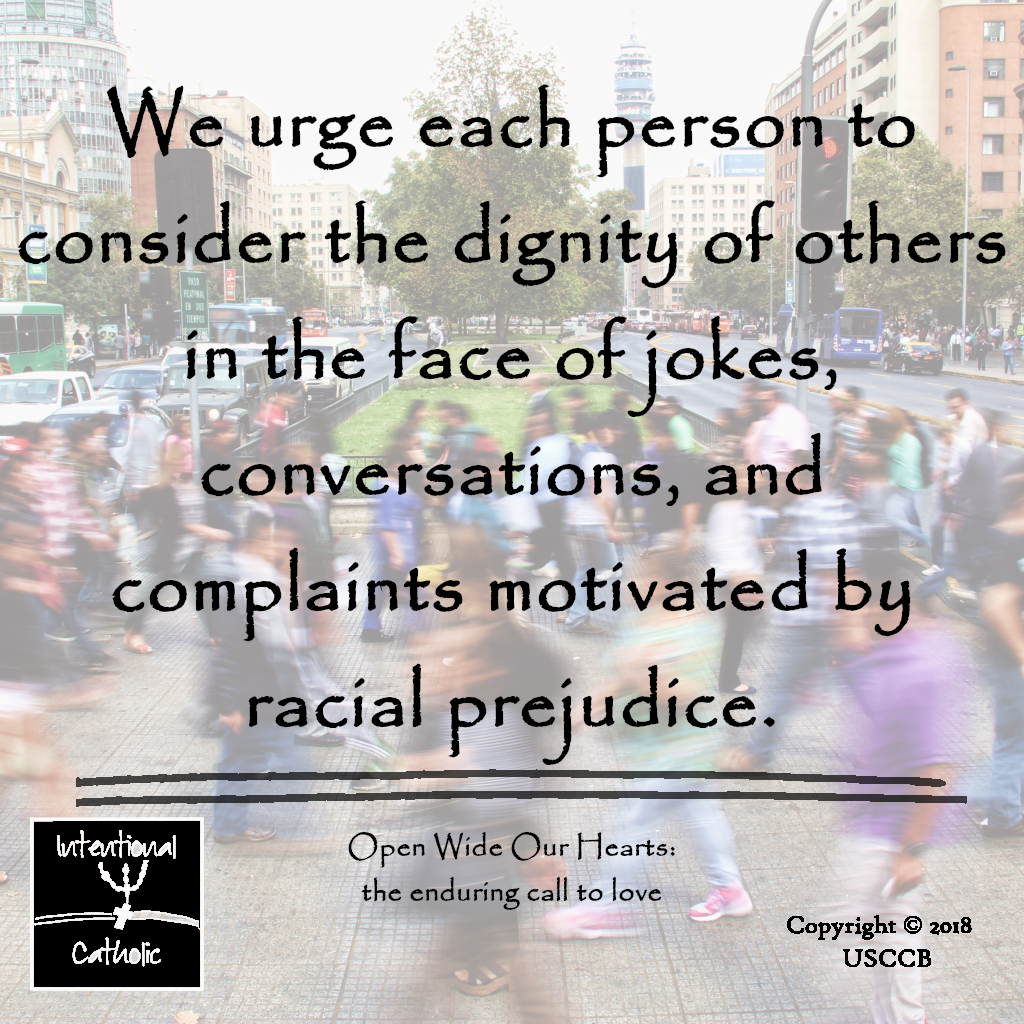
“Consider the dignity of others”

Open Wide - jokes

I think all of us intend to do as the US Bishops urge in this quote. I think, in fact, that all of us think we *are* doing it. This is one of those areas in which I believe it will benefit us all to simply be more intentional–more self-analytical–to pull off the blinders and recognize when we aren’t, in fact, keeping the human dignity of others front and center…when we brush aside their protests because to take them seriously would require us to make uncomfortable changes. It’s certainly not a problem that’s isolated to issues of race, but it’s a place to start.