This seems like a throwaway, but so much of recent history has revolved around the need for Christians to recognize how our faith interacts with the real world–what does it mean to live Christian faith in a world where misinformation is so rampant? Where social media rules, and encourages us to be our worst selves? What does it mean to live the Gospel when we face problems of lack of respect for human dignity–from abortion through inequality of education and opportunity leading to poverty, homelessness? How does the Gospel call interact with questions of tax code and societal responsibility? With policies around immigration and race?
It’s easy to get complacent about one’s faith if that faith is totally disconnected from the real world–or if one issue overshadows all others. But Romero, in the part that lives in those ellipses, says when the Gospel is taken out of the context of the real world, it ceases to become the word of God at all.
These are the questions I wrestle–knowing always that when I get self-righteous, I’m part of the same problem.
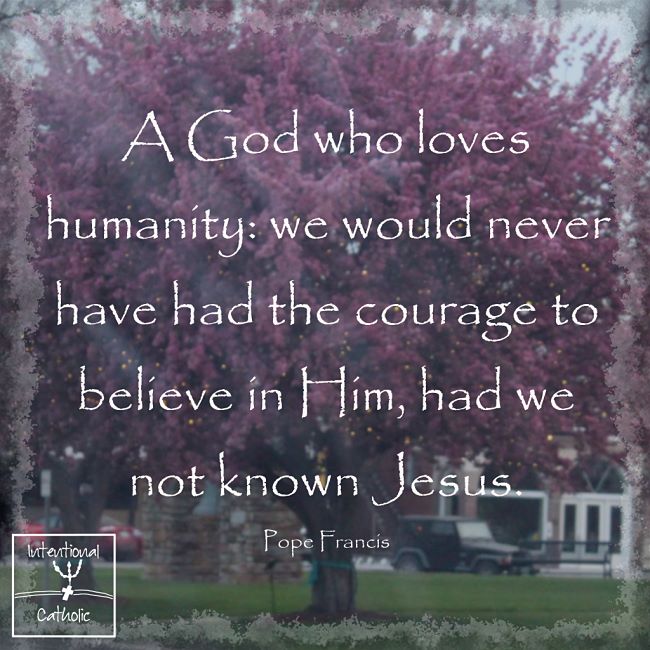
I have been receiving emails from Pope Francis’ charity, “Missio,” for some time now. They send appeals but also daily quotes from the Pope. This one came this week and caused me to stop. I can see a lot of reflection to be done around this. I’ve only just begun that process, but I suppose the reason it arrested my attention was that yes, the Old Testament presents a God who is often vengeful, punishing generations after for their parents’ sins (as the first reading this past weekend said). And it’s hard to imagine love (at least, as we think of love) in that context. It’s not that God changed between the Old and New testaments, it’s that we figured out something new about God. And that could not have happened “had we not known Jesus.” Jesus coming to earth–showing what it means to love in life and death and resurrection–shows us something about God we couldn’t have understood before that.
That’s the baseline reflection. I think there are a lot more depths to be plumbed.
In the Bible, people are always being told what to do in dreams and bushes that don’t burn and angelic visits. Not only that, half the time what they’re being told doesn’t make sense. Go sacrifice your only child, the one who’s supposed to grow up and give you descendants beyond count. You’re gonna have a baby even though you’ve never had sex. Go, thou stutter-er, and tell the king of Egypt to free his slaves.
And they always do it. And it works out because it was God talking.
We set these people up as examples to emulate. But in my life I’ve had to learn to stop twisting that into a totally wrongheaded view of my will versus God’s will. A view that says anything that makes sense to me must, because it seems rational, be contrary God’s will. And any whisper in the brain suggesting something I don’t want to do must, by definition, be God’s will.
(I said it was twisted.)
As I get older, this neurosis has less power over me, but it was the focus of my spiritual life for years, most notably when I was battling anxiety. I believe now that it stems from the faulty understanding of Scripture that causes Scripture itself to be a stumbling block for so many reason-minded people.
Being modern people, we tend to take words at face value. Being people of written history, people whose grandparents’ grandparents’ grandparents have been literate, we approach the Bible like a newspaper, rather than a compilation of tales and poetry passed down through oral tradition over the course of generations before it was written down. The book And God Said What?taught me a lot about literary forms of Biblical times. The author goes through the forms, most of which are no longer in use–hence our difficulty in making sense of them–and stresses that the point of Scripture is to communicate truths about God, not historical events.
People get really nervous about the idea that you can’t take every word of the Bible as literal, historical truth. We think if that’s the case, is any of it true? I struggle with this a bit myself, in all honesty. But again, that’s a sign that we’re imposing a modern sensibility, formed and steeped in the idea that you must be able to prove something scientifically in order for it to be true, upon people who just didn’t experience the world that way.
Photo by spratmackrel, via Flickr
I think we’ve all at one time or another wondered, “Why doesn’t God talk to people the way he did in Biblical times?” And although it feels like blasphemy to say it, I can’t help wondering if many of those stories about dreams and burning bushes were less historical events and more images people came up with to try to explain to others how they experienced God’s presence, voice, and guidance. I knew a girl once, angry, broken, seeking and resisting, who sat in an oak forest in the fall and threw a challenge to the skies: Prove it, then. At that moment, an autumn breeze swept a cascade of leaves down and one of them landed on her palm. That was how she encountered God.
Modern audiences recognize that God didn’t literally pick one leaf off a tree and place it in her hand. At the same time, we recognize her encounter as genuine. That’s the form our narratives take today–and we’ve all seen similar stories come through on email and Facebook.
Discerning the right course of action is hard enough without placing unreasonable expectations for clarity on God. We’d all like to have a billboard with our name on it, laying out in black and white the “right” decision. But putting those kinds of expectations on God throws roadblocks in the way of faith. It’s time to stop expecting God to behave the way He does in stories and start paying attention to the ways He does speak in real life.
(This post is updated from one I wrote on my personal blog several years ago. I woke up thinking of it and decided to pull it out and share it here.)
This morning’s reading presents a real challenge. “Stop judging and you will not be judged.” (Luke 6:37). I know very well that judginess is a great fault of mine (and a great many others in these polarized times, across the spectrum of disagreements). It twinges my conscience.
I was roundly scolded a few weeks ago for being judgy about people who wouldn’t wear masks (one of whom threw around the word “communism” to justify it).
But at that time, COVID cases were still quite high, and people refusing to wear masks were willfully putting others at risk. There’s an injustice being perpetrated there, and while we’re not supposed to judge others, God is also all about justice. Where does discipleship lie in that situation?
That gets me thinking about other big disagreements. To me, it seems patently obvious that some attitudes and behaviors NEED to be judged and called out by faithful Christians, because they are violations of Godly justice. For instance: the refusal to acknowledge that racism still impacts the world in institutional ways.
Where is the line between calling out injustice and, well, judgment?
All this illustrates that the seemingly straightforward sound bytes of the Gospel are a whole lot more complicated to apply in the real world. Maybe that’s why we so often give up and go for the over-simplistic view. (Hence, the Chesterton quote.)
I don’t pretend to have the answer to the conundrum. I only wrestle with it with as much integrity as I can.
I woke up early this morning with this Scripture in my mind. I sort of wince at the words “enemies” and “persecute.” They seem like really extreme words. I’d like to think I don’t have any enemies. Opponents, yes, but not enemies. And persecute? There’s such a glut of persecution complex these days, where people see themselves as harassed and mistreated and use that as an excuse not to examine their own behavior and beliefs for places where they’re out of line. I feel a tremendous antipathy toward applying this Scripture to myself.
Still, this Lent I knew I needed to connect my spiritual practice to the examination of conscience I was already going through, and while I may quibble with the extremity of the labeling, the concept Jesus lays out here is exactly what I most need to do right now.
But it’s hard, and not just from the perspective of humility. HOW does one pray for one’s enemies? I mean, if you pray for them to be converted and changed, you’re assuming you are 100% right and they are 100% wrong, and we all know how Jesus felt about such self-righteousness. I can’t pray for them to find success in their endeavors, though, because the reason I feel such angst toward them is because I see their endeavors as deeply contrary to God’s will. And praying for God to bless them seems like a cop-out.
So this is my Lenten discipline: seeking to find the words that can be prayed authentically, for people I disagree with profoundly, while remaining humble enough not to think I have all the answers.
My spiritual group has been slowly working through The Reckless Way of Love, a collection of reflections from Dorothy Day’s writings and journals. Yesterday’s chapter was pregnant with resonance. It was so affirming to see her reflect on a day she’d been in a bad mood and bitten someone’s head off. Saints always call themselves sinners, but we rarely see someone (even someone in the process) actually do something that makes us go, “Oh yeah, that’s a sin. I do that all the time.” But her reaction to it was really profound. It got her thinking about how awful it was that she’d bitten the head off someone who was totally dependent on her. It caused her to reflect on how humility before God is beautiful, but humility because your bread and butter depend on it strips a person of his or her dignity. This is a great book–bite sized excerpts saturated with profound insight.
This book consists of bite sized reflections on contemplative prayer. For the past half dozen chapters, he has been reflecting on Jesus reciting Ps. 22 on the cross. Grappling with the collision of despair and trust in God contained in that psalm.
How do these two conflicting realities coexist? Meninger points to 12-step programs. People often have to hit bottom before they can start going up. And when you’re in that “bottom,” like Jesus on the cross, your faith in God’s salvation has no form. It’s just trust that God has a way through this muckfest, even if you can’t see what it is.
“Misery was so great he was not able even to imagine what that salvation would consist in,” Meninger says.
When I read these words, I literally caught my breath for a moment. Because that is precisely what I’ve been feeling for the past few months, as the world seems to burn around me. Where is salvation in this situation? Where is the way forward, when anger and division are so great that we can’t even agree on what constitutes “truth” and “lie”?
And oddly (or perhaps not so oddly), there is comfort in knowing that this is when God really shows power through our weakness. Because God can make a way where there isn’t one. There’s comfort in the reassurance that God can use the worst failures of humanity to awaken the collective conscience and bring us, well… closer, anyway, to on track.
On my spiritual journey right now I am trying to focus on my own failings rather than those of the world. I see this playing out all over the place in the world (please tell me you can too), but I’m trying to focus on changing me right now. I could point this at newsworthy items. I could point it at my kids. Hoo-boy, do I ever see it play out there. But I’m keenly aware that if I want the conversion of the world, I have a duty to work with God for my own conversion first. Because “the world” includes me, too.
This is part of the conclusion of Pope Francis’ reflections on the Good Samaritan. I find that it’s easy for these parables and teachings to become trite by repetition. It’s not a fault of the story, it’s a fault of human nature: we start tuning out b/c hey, we already know this story. I did a presentation on this parable a year or two ago, and reflecting on it anew really changed my relationship with it. This reflection does the same thing–renews and adds insight to something I’ve known for a long time.
Pope Francis spent this reflection pointing out that this parable is about individuals, but it’s also about groups of people. That it applies in person-to-person situations close to home, but also in communities and nations and the world. And there’s no neutral in this story: at each level, you’re either a victim, a passerby, or a person who undertakes the uncomfortable work of engaging. Most of us end up being passers-by, but we don’t want to admit it, and so we come up with all kinds of excuses. Hence, the bickering over policy that has caused the Church to divide along “abortion” and “everything else.” I see this as a call to recognize that those entrenched philosophies are themselves the problem. A sin.
I’m not sure how to change myself. I still want to point everything I read at others. That’s my sin. And so I begin simply by admitting it. Change my heart, O God.
I’ve been wrestling painfully lately with what it means to love people with whom there seems to be so little common ground. People who believe and do and say things I find so horribly contrary to my faith and world view. A friend told me that Fratelli Tutti‘s third chapter addresses that.
But first I had to read chapter two–a reflection on the parable of the Good Samaritan.
Of all the quotes that jumped out at me in that section (there were many!), I picked this one to share, because this is the truth that has twinged my own conscience in recent years. I drifted very comfortably in a black-and-white view of the world for years, until it impacted me directly when I was given the gift of a child with a developmental disability. This quote was me. And my spiritual journey now is deeply formed by wondering if, in fact, this quote still is me, and I just don’t know it.
The more I interact with Pope Francis’ writings, the more in awe I am, the more grateful that the Spirit gave us this man to lead us during this particular moment in history. And once again, I beg everyone: READ THIS ENCYCLICAL.








 Intentional Catholic