It’s OUR fault, too

Photo by Anete Lusina on Pexels.com

This morning as I was reading this reflection written by a Steubenville alum, this quote stuck out at me:

“I’m scared that if I pull this thread and start to doubt and reexamine my experiences at Franciscan, my faith will start to unravel, too.”

As I watch people very close to me shedding their Catholic faith, it is clear to me that how the Church, institutionally, and how we, as individual Catholics within it, represent Christianity MATTERS. It can lead people to Christ, but lately it seems to me that it more often damages the faith of others. I think about my own culpability in this as, over the past years, I have been so often frustrated by how things are going in the Church, and express that frustration at home.

But there is also the reality that those frustrations are pointing to something real.

A while back, I wrote about the sin of scandal. Our disconnect between the faith we profess and the things we say, the attitudes we hold, and the candidates and policies we support, have an impact on others. When the Church fails the way it did in the abuse of minors over generations; when it fails the way it did at Steubenville, and people leave, it is hard not to think of Jesus saying in Luke 17: Those of you who lead these little ones astray…. better off to hang a millstone around your neck and jump in the water.

It matters, how we interact with the world. And this applies to abortion, yes, but it applies every bit as much to guns and environment and the dismissal of women who were assaulted and the embrace of lies about stolen elections and continued support of politicians who claim Christianity while brazenly breaking commandments by telling those continued lies.

These. Things. MATTER.

These things DRIVE PEOPLE AWAY FROM CHRIST.

A frequent commenter here often laments how the turning away from God is the source of all our problems in modern America. Well, that’s true, though it has been true at every moment throughout history; it’s not a new problem. The veneer of Christianity in the past covered a lot of not-Godliness.

But we cannot conveniently ignore the reality that when we represent God in, forgive my bluntness, crappy ways, WE also bear responsibility when people turn away from God.

The chicken and the egg (or: double standards in Christianity)

“Hey,” my husband whispered to me before Holy Thursday Mass. “I forgot to tell you. Pew research did a new survey and the number of people who go to church is below 50% for the first time ever.”

My first reaction was: And Christianity will blame the secular culture instead of looking in the mirror and examining whether our own failures are the problem.

Actually, it’s probably a chicken-and-egg situation. The culture is definitely getting more hostile to religion. But then again, religion keeps giving more reasons for the hostility.

I know. Them’s fightin’ words, but painful though they might be, I think they’re fair.

The trouble is that the Gospel tells us we’re SUPPOSED to expect hostility from the world. But somehow, we’ve translated that into a persecution complex. We never stop to examine our own attitudes, words, and behaviors for how well they reflect the Gospel. We just assume that any pushback we encounter must, by definition, be the culture’s problem rather than ours. It couldn’t possibly be that we are misrepresenting our faith.

Meanwhile, Christianity fails to recognize how incredibly uneven we are in HOW we choose to stand at odds with the world. There are these huge double standards.

Like: Christian culture is pro-life, EXCEPT when it requires taxpayer money to support people most at risk of feeling the “need” for abortion (because of generational poverty and inequality of opportunity, etc., etc).

Like: Christian culture is pro-life, except when it infringes on “personal freedoms” (cough-cough-masking).

Like: Government should stay out of my business, except when it’s about homosexual relationships or abortion, and then of course it’s the government’s business, absolutely.

Or: Sexual assault and harassment are sinful, but how dare we ruin the life of the accused? (Never mind the life of the victim. Whatever. We’ve been sacrificing them for millennia.)

Or: Honesty and integrity are fundamental to Christian belief—they’re in the Ten Commandments—but how many people have wholeheartedly, even rabidly, embraced a lie about stolen elections that has zero basis in fact?

I’ve been trying not to write these kinds of posts lately. Nobody needs me haranguing them; it’s not particularly effective at anything except making people mad. So I’ve been trying to focus my posts here on working out my own spiritual journey instead of lambasting everything that’s wrong with the world. I have spent this Lent praying for “enemies,” and more importantly, for the heart to do so authentically while remaining in union with God’s will. So much is happening in my heart this year—I am journaling it, bit by bit, but I’m deep in the weeds and I can’t synthesize it yet.

But there are times when my frustration comes out. And this is one of them. And maybe, after all, Good Friday is not a bad time to have our collective conscience stung.

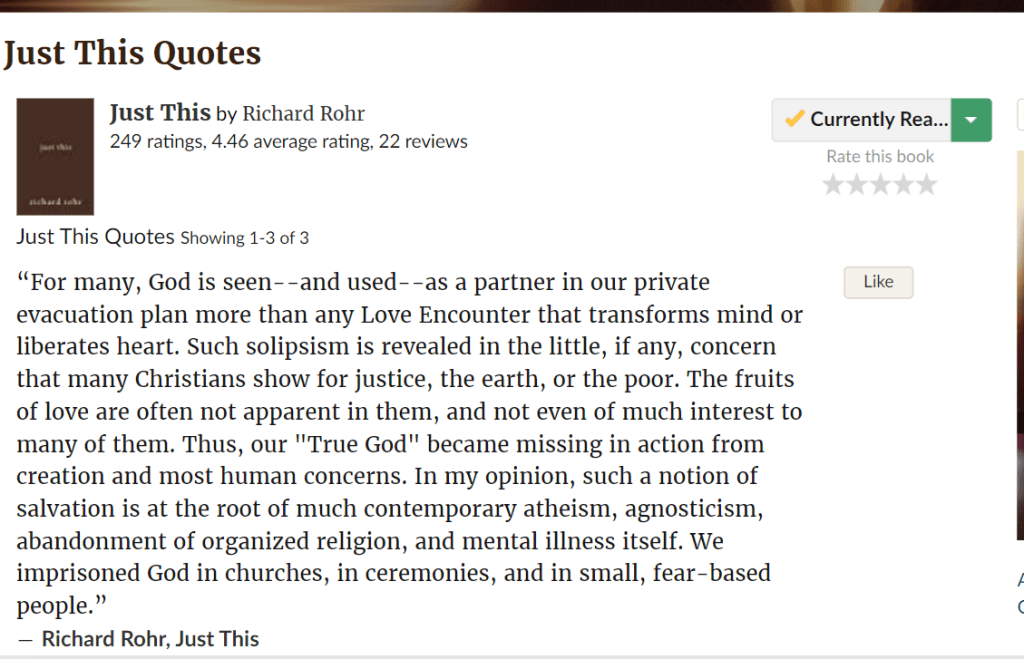
Sometimes atheism is our fault

Look! It’s another one of those “no duh” quotes that we all think applies to someone else.

This is a sentiment that conservatives aim at liberals, with the assumption that only people who haven’t studied the faith properly could possibly hold such nonsensical ideas about redistribution of wealth, about mercy and tolerance; could possibly fail to see that things are either right or wrong, and any attempt to say otherwise equals relativism. (I know this, because that was me not that many years ago.)

But it’s also a sentiment that liberals aim at conservatives, with a hair-pulling level of frustration that people can’t see that Jesus was all about justice, and that money as an idol is behind many of the ideas held up as “traditional values” by conservatives. (And yes, I have to admit, this better represents where I stand now.)

Yesterday, I was reading a passage from Philippians, in which Paul took for granted that Christians living the faith would be united in thought and idea about how to view the world.

I don’t even know to deal with that. I know the Christian community was probably never as uniform as some Scripture passages make it sound, that division is an inescapable part of fallen humanity.

But where we are now–I started to try to lay it out, but the causes are too complex. There’s Steve Bannon going after the Pope, and confusing political ends with Godly ones. There’s the mishandling of the abuse crisis, which hits liberal and conservative bishops & priests alike. There’s clericalism and an inability to see outside “the way it’s always been done,” even though the world has changed around it and that model no longer works (i.e., we don’t have a glut of priests to do all the jobs in a parish, so you actually have to hire people to do work). There’s a passive laity, still thinking that our primary job is to show up and be done to, even though the mega churches have taught us that churches flourish best when everyone is involved.

All of these are examples of ways in which we, as believers, contribute to the flourishing of atheism. And it doesn’t fall on one side of the political spectrum–or of the left-right divide in the Church.

When we are nasty on Facebook, when we share emotion-heavy, but fact-questionable memes;

when we buy into stereotypes that Trump supporters are all uneducated rednecks or that people demanding just wages and just racial treatment are essentially lazy and need to pull themselves up by their bootstraps;

when we fail to recognize the ways in which our own privilege shapes our prejudices;

when we fail to recognize that we have prejudices at all;

when we make assumptions or pass judgment or don’t fact-check (or fallacy-check) whatever inflammatory argument suits our purposes–

In all these moments, we, as Christians, are part of what causes people to doubt the existence of God altogether.

We need to own that…and do something about it.