In Which I Begin To Understand Anger

Image by Gerd Altmann from Pixabay

This week, a group one of my kids is involved in pretty much gave up on pandemic-mitigating strategies. Because now the weather is cold and it’s, y’know, hard, because you can’t be outside anymore.

And for this reason, we’re going to have to say no to at least one major event this child really wanted to attend.

I had a conversation with the leadership, asking if the group would consider voluntarily taking on masking. I explained the medical history that makes our caution necessary: a child with naturally floppy airways who nearly died of RSV as a newborn, had open heart surgery at 7 months, and was intubated again at age 2 for pneumonia.

I got about the response I expected. The burden is on us to just abstain.

I expected it, but it made me angry. In fact, my reaction bordered on rage.

I totally get being tired of COVID limits. Me too, people. Me too. But masking is such a small sacrifice to make for the good of others. We want America to be a Christian nation, but when the rubber meets the road, what does that mean?

Well, Jesus was clear that the most vulnerable among us are supposed to be our priority.

To say, “Hey, if you think you’re at risk, just stay home” places the entire burden on those who already bear the heaviest burden–and to those who love them. (Like my kid.) It forces them into isolation that erodes their mental health, all so the strongest people don’t have to be bothered with small sacrifices like wearing a mask that would reduce spread and make the world safer for more vulnerable people.

Where is Jesus in that world view?

But what was most significant last night was what I learned from that hard spark of outrage: helpless, choking, impotent rage. I felt powerless against an inexorable machine that was perpetrating an injustice that stands in direct opposition to Christian values–but which the perpetrators do not recognize as such.

And for the first time, I really “got”—even if only the barest, palest shade of an echo–what it must feel like to be a person of color in the United States.

I understood why the Black community is angry. I understood at some speck of a level what it might feel like from the inside of a system that thinks itself righteous while imposing unjust burdens on entire communities. And which, when challenged, blames the victims.

The offense against me (really, my child) is ludicrously small. It barely registers on the scale. But it really clarified for me how a lifetime of micro-aggressions would cause exactly the kinds of reactions we’ve seen across the country this year in response to police violence against unarmed black men. I can’t even imagine living every day with the kind of righteous anger I was feeling last night. Let alone multiplying it exponentially.

I can’t walk a mile in the shoes of a person of color, but last night, for the first time, I felt like I kind of understood.

If only…

This entire document is full of parental tough love!

I think we would all agree with the sentiments. The question is how we put them into practice. That’s where division lies. But to me, this document is a reminder that problems that affect us all–at a society level (whether that’s local, national, or global) can’t be left to individuals. We have to act as a society.

Networking ≠ Fraternity

Background image by Gerd Altmann from Pixabay

WOW. Isn’t this the truth? Hasn’t the truth of this been smeared all over Facebook and Twitter the last, well, a long time, but especially the last four to five years?

The context of this quote (which actually comes from one of Pope Francis’ homilies) is how the global economy has been trying to remove “human costs,” and to rely on free market to keep everything “secure.” The pandemic, he says, makes it clear that we have to worry about people again. At the end of the paragraph he talks about rethinking lifestyle and relationships–which is something we all experienced this past spring–and also societal organization, ending with a call to rethink the meaning of life.

Human Dignity Depending On Our Own Convenience. (Ouch.)

The problem with being the center of world culture is that we tend to be really myopic–so focused on ourselves, we tune out the rest of the world. Every time I’m out and about at 2p.m., I butt up against this reality in myself. While I really enjoy listening to NPR news programs, to dig deeper into big questions, it’s excruciating to listen to the BBC News Hour. Unless, of course, they’re talking about the USA.

Three quarters of what is talked about on that program is talking about situations that are so off my radar, I can’t summon any desire to pay attention.

This is what comes to mind while reading today’s section of Fratelli Tutti (#22-28). Pope Francis points out in reality, all human rights are NOT given equal time. Some of us live in opulence and others’ rights are totally discarded. We pay lip service to women having equal dignity to men, but reality paints a different picture. Human trafficking, organ harvesting, etc. further illustrate the divide.

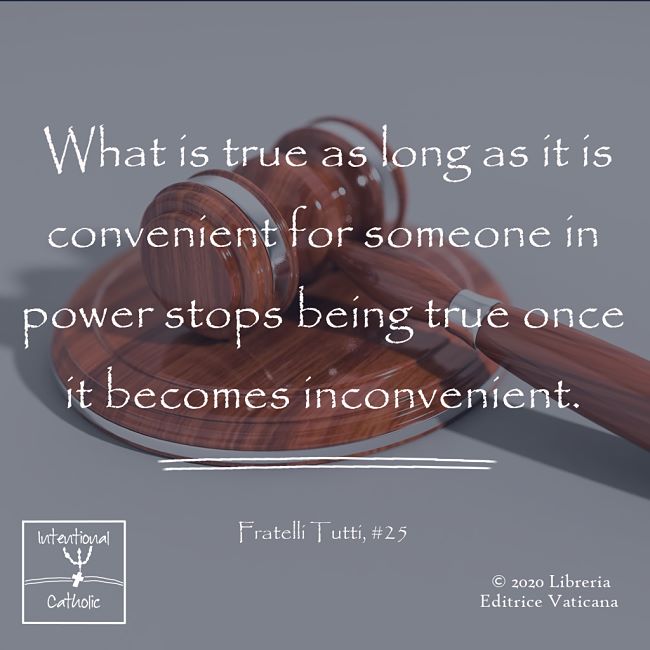
Where he really hits his stride, though, is in #25, where he skewers the habit of defending or dismissing assaults on human dignity, “depending on how convenient it proves.”

This feels very, very familiar. The difference in how we perceive the dignity of the unborn versus that of the refugee fleeing Central America (with or without going through “proper channels”) springs instantly to mind. If it doesn’t cost ME anything, of course I’m going to uphold human dignity. But if it has the potential, however remote, to inconvenience ME, well, then I can find all kinds of reasons why it’s not my problem, it’s theirs.

Next, he points out the tendency to build walls, both figurative and literal, separating humanity into “us” and “them.” It’s so beautiful, it’s nearly poetry. Just go read #27. And he rounds out this section by pointing out that the disenfranchisement caused by these sinful behaviors is precisely what leads to “mafias,” which I would suggest is a blanket term that includes terrorism.

So many Christian teachings have an incredibly practical element. Yes, we should treat each other as “brothers” (in the non-gender-specific meaning of the word) just because that’s God’s will. But the reality is that the failure to follow that teaching has all kinds of real-world ripple effects.

The way those ripple effects bang into each other and intensify is what made me start Intentional Catholic in the first place. Because I think an awful lot of us spend our lives totally unaware of them. That certainly was true of me until the arrival of my daughter set me on a small boat in the middle of all those ripples, and I had no choice but to recognize them because of the bumpiness of the ride.

Until then, I had compartmentalized life, thinking, “Sure, THESE issues are connected to my faith, but all THESE have nothing to do with it.” I was totally wrong. All issues are connected to faith.

Being Catholic in a Messy World

This past summer, I was honored to be invited to speak at the National Association of Pastoral Musicians national convention. Among the presentations I gave was this one, “Being Catholic in a Messy World.” I was asked to give a fifteen-minute reflection on what I mean by “Intentional Catholic.”

I have so many thoughts, I never imagined it would be a difficult talk to write, but it was–because the topic is so huge. The through-line that eventually emerged was how I wrestled with being “pro-life” in the wake of giving birth to a child with Down syndrome. I’ve often said that my daughter’s birth was the earthquake that changed everything for me, though I didn’t know it at the time. This is that story. It encapsulates many of the difficult issues we’re wrestling as a nation (badly). I hope you’ll set aside a quarter hour to listen!

(Thanks to GIA Publications, my music publisher, for making this available.)

“Brotherhood”

Background image: Wiki Commons

I have begun reading Pope Francis’ new encyclical, “Fratelli Tutti,” and thought it might be worth simply sharing as I read, since it’s new to all of us.

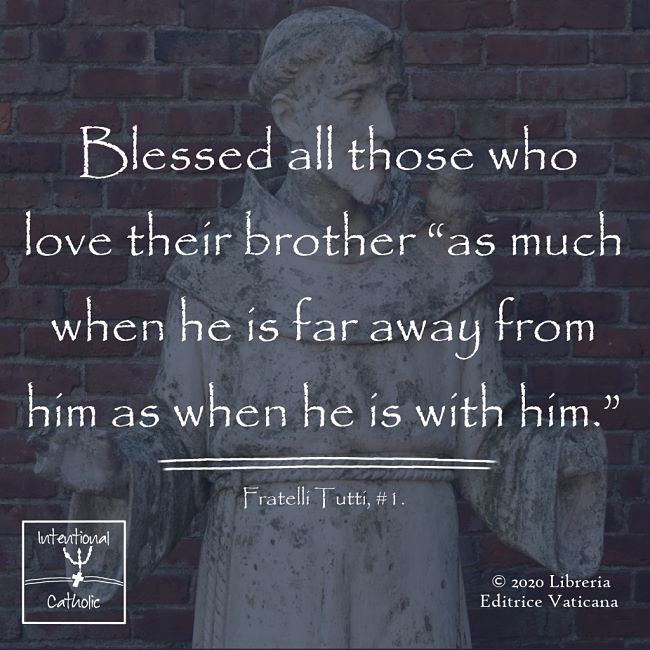
The topic seems like a timely reminder, given the state of the world right now. I can’t quote it all, but Pope Francis sets the tone in the introduction by pointing to St. Francis of Assisi’s trip to visit the Sultan Malik-el-Kamil. He went during the Crusades–a time when the goal of Christianity was to conquer and convert the Muslims–and instead modeled peaceful conversation with no agenda at all.

Two things strike me here: one is that with this trip, St. Francis, quietly and without making a production of it, issued a sharp rebuke to the entire goal of the Crusades. A rebuke that, with the benefit of hindsight, was well deserved.

The other is that Pope Francis is setting the stage to remind us that our worldwide politics of division (because it’s not just an American thing) is directly counter to holy living.

And I suppose there’s a third thing, which is that there’s more than one way to interpret “far away” and “near.” In St. Francis’ case, it was both physical and philosophical difference. My guess is that Pope Francis is gearing up to admonish us to be “brothers” in both those spheres in modern life, as well.

We shall see if I am correct.

What Can I Do?

It’s always dangerous to read too deeply into the day’s Scriptures an overt connection to the modern world, but yesterday it was hard not to do so. I hoped for good judgment from my people, and look! What I got was violence. I hoped for just behavior, but listen to the outcry against people who are supposed to be a beacon of hope!

I’ve been quiet recently, because it’s busy, and because sometimes I feel like a wagging finger, and there’s only so much finger-wagging a person can do before people tune you out.

So I struggle with what to write. I’m overdue for a #seethegood, but that feels like a cop-out when what is on my heart is something quite different.

My bishop sent an election letter, which I shared on Facebook. (For those who might read only here, here it is.) It was a good letter, nuanced in a time when most discourse consists of bilateral apocalyptic predictions. But what really stood out to me was this:

“What I see happening in our nation, unfortunately, is a strident, rancorous discord that tears not only at the fabric of our society but also at the communion of the Church.  And this disharmony endangers the salvation of souls.”

Bishop Shawn McKnight

Within my own circle, there are a growing number of people who have left the Church or struggle to remain in it because of how we act, because of the singleminded focus to the exclusion of things Jesus told us explicitly were our call.

I lie awake at night praying about this. Pray as if it all depends on God; act as if it all depends on you, the truism says. I’m praying. But action? What can I do, besides write finger-wagging posts on social media? I feel helpless.

How will be judged?

My husband and I watched the movie “Harriet” this week, and–aside from the mind-blowing music, instrumental and vocal–what struck me most was how convinced the whites of slave times were that there was “nothing to see here, move on.” I find the same attitude in a lot of talk going on around me these days, and as I wrestle with whether the arguments about violence versus peace, the way white Christians seem to be seeking excuses to disregard the movement, I wonder how history–and more importantly, God–will judge us. Are any of the things being said against BLM valid, in the long run? Or are they just excuses?

I’ve said before, I’m a huge fan of Shannon Evans. As a faithful Catholic in the broadest sense of the word and the adoptive mother of a Black child, she has a lot to say to us about race. Here’s the screen shot I grabbed last night off Instagram. Click it and it will go to her column.

Everyday Ignatian: Finding God in Others When Racial Injustice Feels Too Painful to Bear

Revisiting Race

In light of the discussions taking place online these days, it seems like a good time to revisit what the US Bishops have to say about racism, and in particular institutional racism, in our country, and what that reality means for us as faithful Catholics. There’s a lot of anger going around these days on both sides of every issue, and we ramp each other up. Extremism on one side begets extremism on the other. Neither of which are justified, but people only want to point the finger at the other side rather than acknowledge extremism on their own.

Too many Christians seem eager to write off the entire question of civil rights and institutional racism because of violence in some protests. Of course, horrific things like people shouting “let them die” outside a hospital where police are fighting for their lives are equally indefensible.

It’s so tempting to take the extremes, because the extremes are easier. It’s really messy in the middle, where we have to call out both “let them die” and the institutional racism that has sparked the protests which, in some cases, have turned violent. It’s easier to blame one or the other and act like the problem is ONLY one thing.

The reality is, whenever we paint things in absolutes–whenever we write off one point of view because of the faults of some among them–we are part of the problem. That messy place in the middle is exactly where we must be as Christians.

Our bishops are telling us in the clearest possible way that race matters, that racism is real, that we are part of it whether we mean to be or not, and that we thus have a responsibility to act for change.

I cannot say it strongly enough: read this letter in its entirety.

Educating for Peace

I’ve been hearing a lot lately about how public schools are indoctrinating in socialism. For that reason, this quote really struck me this morning. It comes in a section of Gaudium et Spes that is focused on peace and war. Paul VI says that those who are in charge of military will have to “give a somber reckoning of their deeds of war.” He talks about how “extravagant sums” are spent on military and on developing new weapons while the miseries that cause war remain unaddressed. He talks about how peace requires working for justice. And he calls for an international public authority with actual, universal authority to settle disputes.

That’s the context of this quote. We are called by our Church–by a saint of our Church, in a document approved by an ecumenical council of the Church–to form our children in these sentiments.

There’s a disheartened, jaded part of me that suspects many in our Church would call this “socialism,” despite the fact that it’s the teaching of our Church. And it’s interesting to me that this exhortation comes from the papacy of St. Paul VI, known and revered for Humanae Vitae. It illustrates that the Catholic faith stands independent of political ideals.