Ever since “it’s the economy, stupid,” this has been how every issue is approached, both personal and societal. Who am I kidding? If the Vatican II bishops were talking about this, clearly it’s been this way since before the 1990s. But it’s impossible to escape the message these days. No matter what crisis is happening (coronavirus is one, but there have been plenty of other instances), the go-to response is always “how is it going to impact the economy?” As if that were the only–or even the most–important factor.
As a Catholic striving to put my faith above all else–far, far above money, which is supposed to be how we survive and do good in the world, not the defining factor of existence–I find this fixation problematic. We say we want to be a Christian nation, but that only holds as long as the topic is some moral issue that costs me nothing, because it doesn’t impact me personally. As soon as it’s a Gospel directive that affects *my* pocketbook, it’s a whole different story.
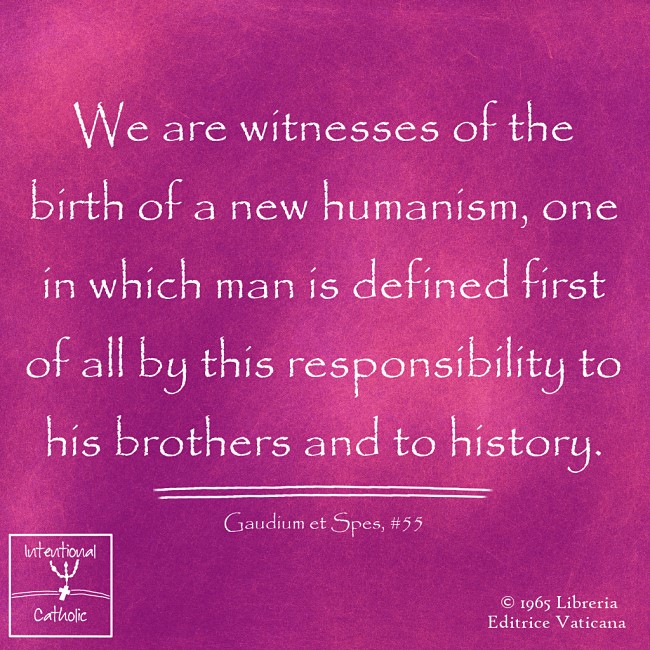
This seems like such a simple quote. I was going to let it stand without commentary, but I realized that this is really the essence of the convictions of all Christians who are passionate about social justice. To be a Christian is to care, in a self-emptying, physical, sacrificial way, for others. And to recognize that the things we do now have ripples down through history, on generations not yet born.
This quote expresses why we have a responsibility to act on environmental issues, on racial issues, on issues of poverty and inequality–the whole range of questions that are the most uncomfortable to address, because they challenge cherished ideals of self-reliance and rugged individualism.
There’s been an uptick recently in the expression of a point of view that suggests that since we are citizens of Heaven, not earth, we should not pay attention to earthly suffering or strive to alleviate it. The Church says otherwise.
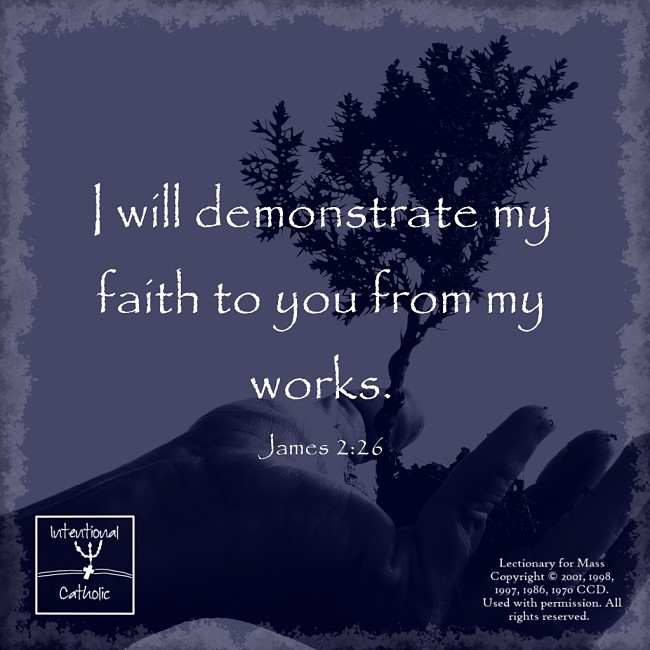
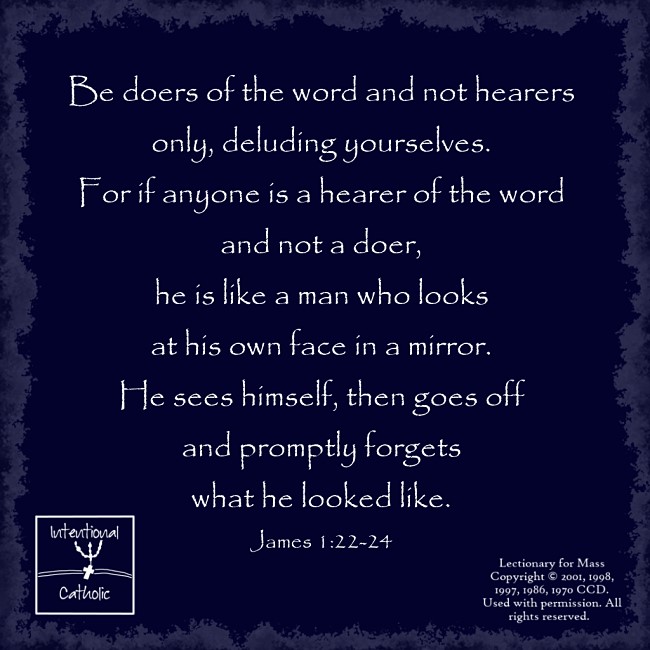
Listening to today’s daily reading caused me to perk up. What an image James uses to remind his community that simply talking about being a disciple isn’t really being a disciple! Farther down in the reading, he clarifies what he means by “doing something”: to care for orphans and widows in their affliction and to keep oneself unstained by the world. What struck me is the both/and of it–social justice AND personal piety. No false binaries here.
What this reminds me of, though it’s a separate issue, is tax shelters, offshore corporations, and tax loopholes. I’ve often heard, in relation to taxes, “As long as it’s legal I’m going to take advantage of it.” But we recognize that just because something is legal doesn’t mean it’s morally right (cough-cough-abortion). So using this argument as justification for doing whatever possible to hoard as much money as possible has never sat well with me.
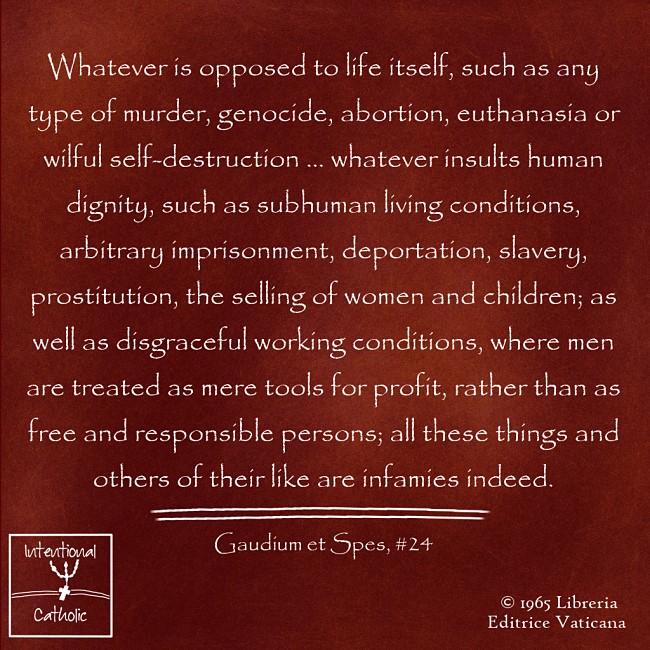
Today, on the anniversary of Roe v. Wade, we Catholics focus in very narrowly on abortion. In our discussions and arguments about connecting public policy to our faith, this issue is always presented as the issue–the only one that matters, the one that overwhelms absolutely every other tenet of our faith. Nothing else matters, because without life, none of the rest of it could happen.
But as this excerpt shows, that is not how the bishops of the Second Vatican Council viewed the world. That is not how we are called to view the world.
Our commitment to sanctity of life doesn’t–can’t–stop with abortion. To do so is to betray who we are as Catholic Christians.
How many times have I read this Scripture passage and never noticed before? I always stopped with learning how to live in humble circumstances. Why on earth would there be anything to learn about living with abundance?
But there is. When you live with abundance, there’s more temptation: temptation to hoard; temptation to resent the imposition when the call of the Gospel means you have to let others have more of “your” wealth; temptation to get priorities out of whack and give too much importance to wealth and its trappings; temptation for preservation of wealth to become the deciding factor in every discernment.
It’s a huge temptation on a personal level that simply doesn’t exist if you have nothing. When you have nothing, there’s little moral dilemma surrounding money.
This also really resonates at the policy level. In America, there’s a lot of “temptation for preservation of wealth to become the deciding factor.” Virtually everything in American politics is a money-first discussion. It doesn’t matter if it’s right; it only matters if one side or the other sees an initiative as a an economic boon or difficulty. We renegotiate trade deals in our favor, even if the only way they can possibly be honored is for us to get more and someone else to get less. We decide environmental policy by cheapness and the perception of preserving status-quo jobs rather than by the damage to the earth and the ripple effect that will have on future generations. The foundation of discussions of health care is not the fact that it’s a basic need of human existence, but instead how much it’s going to cost, as if cost, rather than need, is the primary question.
We have abundance in America, but we haven’t figured out how to live with it. Not well, at least.
“Another self.” It’s hard enough to view others this way in family life. Half of Godly parenting–maybe three-quarters of it–is trying to get kids, who are supremely selfish beings, to recognize the other as not only equal to themselves, but “another self.”
But take this beyond the confines of those we already love, and it’s downright superhuman.
-the three people you most dislike in the world, you should view as “another self.”
–the people who are a continual thorn in our sides are “another self.”
–the people living in the woods and holding signs at intersections, whether they’re drug addicts or lazy or criminals or whatever assumptions we might be tempted to make about them, are “another self.”
–the refugee, asylum seeker, and yes, even the genuine “illegal alien” is “another self.”
And as a Christian it is my *job* to enable all these “other selves” to live with dignity. This is a conciliar document saying this, not one priest or one bishop. This is the Church speaking as clearly as the Church can speak.
Now, we can argue about what is the best way to enable human dignity. That’s a totally valid argument.
But those aren’t the discussions we’re having.
Instead, almost all our arguments are focused on whether we *should* help people–whether they *deserve* it and whether “there’s money” to do it. But let’s be honest: in America, there’s plenty of money to do what needs to be done. The argument is between those who think it can’t be done piecemeal, and should therefore be done at the level of society, i.e. through higher taxes and governmental administration, and those who think government is intrinsically evil and taxes are to be avoided at all costs–that charity should be entirely a private matter, even if that means many people will get missed.
This is the fundamental logjam in America today, and the trouble is that people on both sides view their own position on that question as universally-accepted truth–a settled reality. And so instead of figuring out how to strike a balance between personal rights and societal responsibility, we end up bickering about who does and who doesn’t deserve help. We start labeling asylum seekers as criminals, and conservatives as racists, and it all falls to pieces.
Our opponents, too, are “another self.”
The following quote is too long to put in a graphic, but it’s well worth putting at the center of our minds in an election year:
…there must be made available to all men everything necessary for leading a life truly human, such as food, clothing, and shelter; the right to choose a state of life freely and to found a family, the right to education, to employment, to a good reputation, to respect, to appropriate information, to activity in accord with the upright norm of one’s own conscience, to protection of privacy and rightful freedom even in matters religious.
This social order requires constant improvement. It must be founded on truth, built on justice and animated by love; in freedom it should grow every day toward a more humane balance. An improvement in attitudes and abundant changes in society will have to take place if these objectives are to be gained.
I doubt there’s a Christian out there who would argue with the sentiment expressed here, but in the context of globalization (a reality some embrace and others loathe, but inescapable reality either way), it does invite self-reflection.
Again and again in Scripture, from Cain saying, “Am I my brother’s keeper?” to the scribe asking “Who is my neighbor?” to the quotes referenced in the ellipses of this quote–Romans 13:9-10 and 1 John 4:20–it is clear that God’s definition of “love of neighbor” is bigger and much, much less comfortable than we’d like it to be. It requires self-emptying that we naturally resist. The supremacy of ego (my opinions, my right to judge) is hard to overcome, but it’s critical to living a Christian witness in an authentic and inviting way.





 Intentional Catholic