
The fruit of unity
Real Faith for a Real World

This is profound on multiple levels. My first reaction upon reading this quote was to nod vehemently at the words “unverified data.” I have been appalled at the things people are unshakably convinced are true, when a quick internet search easily disproves them.
On the other hand… I do a lot of fact-checking as I scroll social media, and I’m in a terrible rush when I do it. Quick searches are good for making sure something is legit. But not for the pursuit of wisdom. Wisdom takes time and prayer and processing.

It’s been a week, hasn’t it?
I saw this quote this morning in America magazine (linked below, if you’re reading on social media). I can’t find the source, which makes me think it might be not 100% word for word, but the message is one we really need.
Since day one at Intentional Catholic, I have been begging my fellow Catholics to share and read with integrity. We have a Christian responsibility to make sure we fact check the things we share, the things we take in, the opinions and philosophies we embrace.
We have a Christian responsibility to think critically and compare what we take in and say and share to the teachings of our faith. To embrace the niggling discomfort when our consciences are tweaked. To acknowledge that that discomfort is meant to point out the ways in which our worldly view is out of whack with our faith.
We have a Christian responsibility to use that discomfort to reshape our world view more authentically with our faith, even if it means setting aside long-standing idols in the form of political ideologies. (I say this as someone who’s had to do that myself. I know it’s hard. To this day, I routinely have to keep questing in order to keep myself from swinging too far the opposite direction.)
To choose instead to chase down, embrace, and share conspiracy theories, distortions, and outright lies is a violation of the ninth commandment. It is a violation of every exhortation in the Bible about living with integrity.
When large numbers of Christians fail to fact check and instead enthusiastically embrace things devoid of integrity, the events of this week become inevitable. For months, God-fearing people have been expressing terror about socialism, about dictatorships, about the shredding of the Constitution. And then, on Wednesday, people with those same beliefs shredded the Constitution themselves, far worse than anything they fear from their political opponent. I even saw one Facebook commenter say that Trump should declare martial law so he doesn’t have to leave office. Apparently, dictatorship is fine as long as it’s “my” dictator.
What we saw this week was the inevitable end of the path we embark on each time we choose to share distortions and outright lies because we haven’t undertaken the time—or embraced the humility—to examine them and recognize them as such.
We are meant for more.
We had two altercations with people over masks last weekend.
First of all, let me say that I try very hard not to go out at high traffic times. But when one’s husband works full time and you have things you need to do together, sometimes there are only high traffic times.
I’ll just describe one of our interactions. I asked one man who had his gaiter hanging around his neck to please put on his mask. He responded by rolling his eyes. Let me tell you, it’s quite something, seeing a 60-something white man roll his eyes like a teenager. He muttered something about not living in a communist country, or something equally (pardon my bluntness) idiotic and totally at odds with both Christianity and reality.
It’s mind boggling, how wearing a mask to protect the health of others got twisted into a political wedge. A few months ago a fellow Catholic on Facebook posted that it really bothered her that the Church had “bought into” the narrative that brotherly love required us to mask and distance.
I was dumbfounded.
So I’m here today to put a face on “brotherly love.”

This is my daughter. She is charming. She loves to sing. She loves to dance. She loves babies and ice cream and pasta. Since she was a toddler, she has had an uncanny ability to enter a room and instantly zero in on the one person who most needs the love of God. She goes to them and loves them.
Wherever she goes, she brings joy and love. She brings God, in other words, without ever speaking a word about it.
She also has Down syndrome.
When she was six weeks old, she contracted RSV. She had floppy airways and a heart defect that caused her blood to spin instead of properly oxygenating. She spent more than a week on a ventilator. For children that age, 93% oxygen saturation is the threshold for hospitalization. Hers dipped to the 40s every time she had a coughing fit. The doctors told my husband to “prepare himself.”
At 6.5 months, she had heart surgery to repair her heart. They stopped her heart. Put her on a heart-lung bypass. And she was on a ventilator again.
We thought that would be the end of respiratory issues, but it wasn’t. At 2.25 years, she developed pneumonia and was in the ICU, on a ventilator, yet again.
Since then, she’s been very healthy. My rational mind tells me she’d probably be fine if she got COVID, but the fact is that her airways are naturally floppy, and now they’re scarred from multiple trips down ventilator lane.
My daughter puts a face on the reason for masking. We make this sacrifice in order to protect the most vulnerable among us.
Nobody likes masking. Nobody likes being forced to hold loved ones at a physical distance. Nobody likes any of this. But if that’s what it takes to protect the life and health of others, then that is the Christian call.
I am praying Advent this year with Cameron Bellm’s “Advent with St. Oscar Romero,” and the reality of my life is that my first day, I was looking at last year’s edition instead of this year’s. The takeaway of the day was:: if God was present in all the upheaval and injustice taking place in El Salvador in 1977, when Romero wrote the homily I was praying with, then that applies today, too. God is present. Even in this. The good, yes, but also the bad.
Given the reality of pandemic, persistent injustice, fake news, and the constant apocalyptic thinking that characterizes both sides of the political spectrum these days, this seems like a particularly beautiful thought for this Advent.
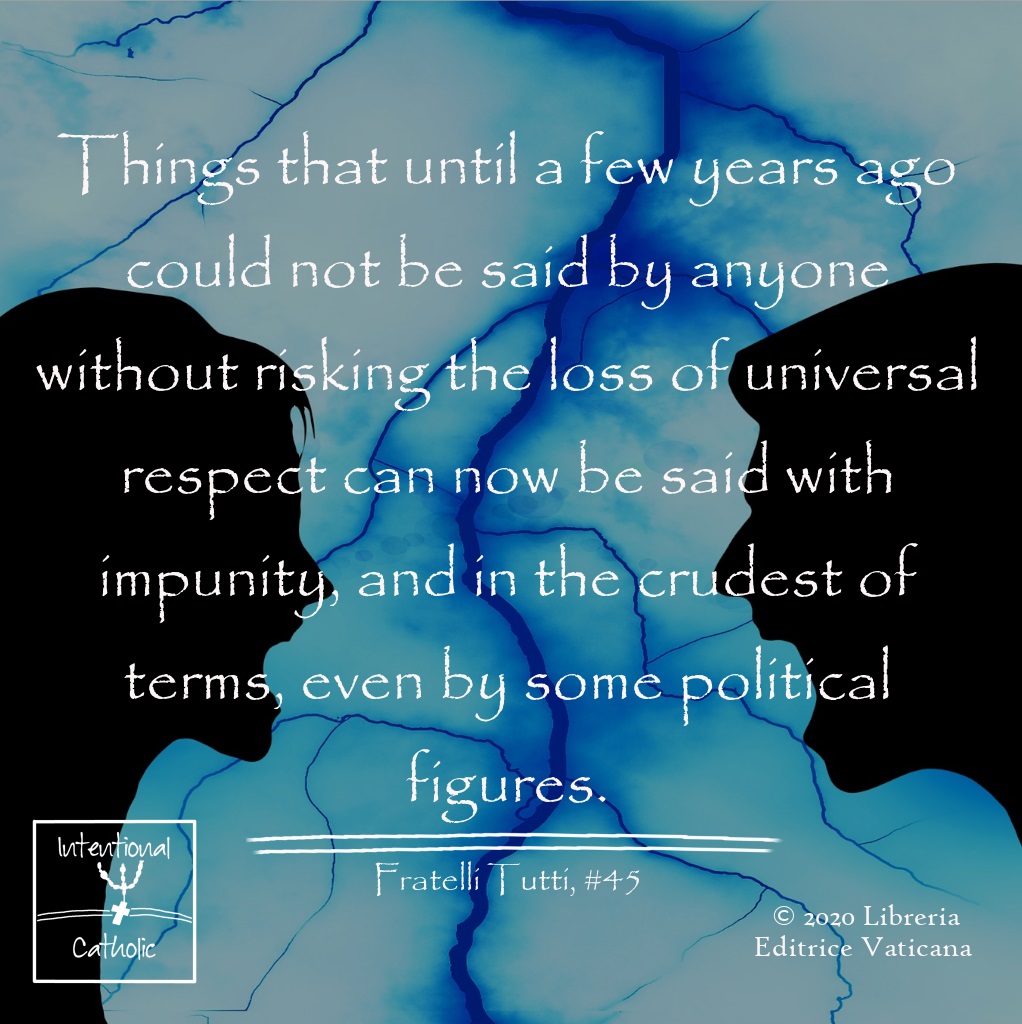
Every time I sit down to break open another section of Fratelli Tutti, I’m blown away all over again. I know the amount of Stuff we have to wade through in modern life is punishing, even within the writings and teachings available to Catholics by Catholics. There is value in reading the words of past popes.
But we also need to listen to THIS Pope. Reading Fratelli Tutti makes it crystal clear why the Holy Spirit chose him to lead the Church at this point in human history. He doesn’t get fancy, he doesn’t spend time being brainy. He’s right in the thick of it, speaking words we understand, pointing out all the things we already know, and drawing the connection between “the way we do things” and “how we got where we are.”
The section from #42-50 deals with the way we use social media. Being friends online has its uses, but he’s pointing out truths. You can make true friends on social media, and I have. But most of our contacts there are shallow and social, not full of depth. Social media is all about the next big thing, so building the “consensus that matures over time” is not its strength. Of course online disagreements fall to toxicity. Our goal in social media is to get likes, to spark a reaction, so really, Pope Francis points out, the fundamental purpose is to feed individuality, not community.
As someone who is trying to build a following for Intentional Catholic and for my secular fiction, this strikes very true. I got on social media specifically to network with Catholic musicians and fiction authors, and it serves its purpose well. I greatly value the relationships I’ve built here. Social media is great for helping us forge connections. And I can say honestly that there are people I consider friends now whom I’ve never met in person.
But in this year when conventions, conferences, and retreats are canceled, we’re all deeply mourning the loss of the in-person gatherings, because those are where we most often make the lasting connections.
Anyway, I’m getting pretty far afield in my stream-of consciousness reflection. Pope Francis’ point is that social media is structured to encourage us to try to stand out (an individualistic endeavor), and the algorithms are built to show us more of what we already like (or hate), as measured by what we like or comment on. So we end up getting shoved into those echo chambers, or into toxic environments—and very often both at the same time.
And because we’re a step removed from a lot of the people we’re interacting with, it’s easy to get ramped up into “remarkable hostility, insults, abuse, defamation and verbal violence destructive of others, and this with a lack of restraint that could not exist in physical contact without tearing us all apart.”
That last phrase is important. We all say things on social media we would NEVER say to another person’s face. And unfortunately we’ve started calling it “telling the truth in love,” and justifying it by saying that sometimes love hurts.
Which is true, but we’re ramping ourselves up and then deciding that our own “wisdom” is sufficient to discern what is the “truth.”
So when he says, “This has now given free rein to ideologies,” I think, YES. That’s exactly right!
And when he says, “Halfway through, we interrupt him and want to contradict what he has not even finished saying,” I think of all the careful, thoughtful attempts I’ve made to engage with people, and how they react to one phrase they think they can attack, and ignore all the rest.
And then I try to check my own conscience, because the ability to recognize it in others does not mean I am immune myself.
I know I say this every time, but please read this document. God gave us Pope Francis right now for a reason.

Yesterday I rode out to the spot by the river I call my Breakfast Cafe. It was unseasonably warm (a lot of that this November) but very, very windy.
The wind sounds different in the winter. I once said, “In the winter you hear the wind itself instead of the rustle of leaves.” But I realized yesterday that’s not true. Wind has no sound of its own. What you hear is the way the wind plays the earth like a musical instrument. It vibrates differently depending on what it touches. The wind sounds different on soft grasses than it does on deciduous trees, or the whisper-sigh it makes running over pine needles. The bamboo-like reeds, dry now, but still green, create something more like a rattle. But the bare treetops of wintertime give a low, round, rich, smooth sound, heavy on bass, absent almost all treble.
Sitting there reflecting on the way the wind can only be perceived in the way it interacts with other forces and objects brought to mind this meme.
We like to pull things apart, to examine them in isolation–because it is easier to process, I think. The complexity of the world often overwhelms. But the danger in focusing on things in isolation is that we risk believing they actually exist in isolation. In reality, every object, every person, every issue, is constantly being pushed and pulled, and thus reshaped, by other factors.
I think this desire to simplify and isolate issues into separate boxes is the cause of our American “culture wars.” The foundation of our polarization. The world is too complicated, so we pick the thing that seems most obvious to us–the thing that seems, to us, to have the most obvious answer.
But in doing that, we miss the reality that every problem we face, every issue we have to address as a nation, has multiple causes and multiple ripple effects, and each of those exerts a pull on issues all around it.
I don’t have a pat answer for why the problem of oversimplification and polarization seems so much more severe now than it used to. It’s always been there. What made it explode as it has in recent years?
Truthfully, I think there are a lot of factors. It’s easy to point fingers, but to do that risks proving the larger point: trying to isolate ONE cause, as if it happened without a host of other factors pushing and pulling and shaping that one factor into the form and influence we know, can’t possibly reflect reality.
Just some thoughts to ponder.

This week, a group one of my kids is involved in pretty much gave up on pandemic-mitigating strategies. Because now the weather is cold and it’s, y’know, hard, because you can’t be outside anymore.
And for this reason, we’re going to have to say no to at least one major event this child really wanted to attend.
I had a conversation with the leadership, asking if the group would consider voluntarily taking on masking. I explained the medical history that makes our caution necessary: a child with naturally floppy airways who nearly died of RSV as a newborn, had open heart surgery at 7 months, and was intubated again at age 2 for pneumonia.
I got about the response I expected. The burden is on us to just abstain.
I expected it, but it made me angry. In fact, my reaction bordered on rage.
I totally get being tired of COVID limits. Me too, people. Me too. But masking is such a small sacrifice to make for the good of others. We want America to be a Christian nation, but when the rubber meets the road, what does that mean?
Well, Jesus was clear that the most vulnerable among us are supposed to be our priority.
To say, “Hey, if you think you’re at risk, just stay home” places the entire burden on those who already bear the heaviest burden–and to those who love them. (Like my kid.) It forces them into isolation that erodes their mental health, all so the strongest people don’t have to be bothered with small sacrifices like wearing a mask that would reduce spread and make the world safer for more vulnerable people.
Where is Jesus in that world view?
But what was most significant last night was what I learned from that hard spark of outrage: helpless, choking, impotent rage. I felt powerless against an inexorable machine that was perpetrating an injustice that stands in direct opposition to Christian values–but which the perpetrators do not recognize as such.
And for the first time, I really “got”—even if only the barest, palest shade of an echo–what it must feel like to be a person of color in the United States.
I understood why the Black community is angry. I understood at some speck of a level what it might feel like from the inside of a system that thinks itself righteous while imposing unjust burdens on entire communities. And which, when challenged, blames the victims.
The offense against me (really, my child) is ludicrously small. It barely registers on the scale. But it really clarified for me how a lifetime of micro-aggressions would cause exactly the kinds of reactions we’ve seen across the country this year in response to police violence against unarmed black men. I can’t even imagine living every day with the kind of righteous anger I was feeling last night. Let alone multiplying it exponentially.
I can’t walk a mile in the shoes of a person of color, but last night, for the first time, I felt like I kind of understood.

WOW. Isn’t this the truth? Hasn’t the truth of this been smeared all over Facebook and Twitter the last, well, a long time, but especially the last four to five years?
The context of this quote (which actually comes from one of Pope Francis’ homilies) is how the global economy has been trying to remove “human costs,” and to rely on free market to keep everything “secure.” The pandemic, he says, makes it clear that we have to worry about people again. At the end of the paragraph he talks about rethinking lifestyle and relationships–which is something we all experienced this past spring–and also societal organization, ending with a call to rethink the meaning of life.
On days when I ride out to the Missouri River, I often take the book The Ignatian Adventure (Kevin O’Brien, S.J.) to guide reflection and prayer. Yesterday, the Scripture verse was Jesus asking, “What are you looking for?”
Instantly, I thought: “Peace.”
Then I thought: “No, it can’t be that easy.”
As previously established on this blog, my Enneagram personality type is #1, The Crusader. I am hyper-aware of everything in the world that is NOT AS IT SHOULD BE, and I feel if I do not expand my last drop of energy attempting to fix it, I am derelict in my duty. I am very hard on others, but I’m harder on myself. Integrity tops the list of traits I value most.
None of this facilitates a peaceful spirit.
Further complicating the acquisition of a peaceful spirit is the sheer intensity of family life in a time of division and pandemic. Peace, for me, is achieved in solitude and quiet. These days, solitude is hard to come by. I walk around my house all day turning off things people turned on, closing doors they opened, yelling at them to put away things they got out and left (food, dishes, dirty socks, electronics, you name it), and to quit annoying each other out of sheer boredom… and (let’s call a spade a spade) boy mischief.
And all of you who are out there feeling smug right now about “well, if you’d just teach them,” just remember how resistant your own kids are/were to the lessons you tried to teach. And imagine being stuck in a house for seven-plus months trying to correct such patterns with people whose mental health is as precarious as your own, during one of the most blisteringly, ugly, divisive times our country has ever experienced.
So yes. When Jesus asks, “What are you looking for in following me?” the honest answer is: “peace.” The peace that comes from assurance that everything is going to be okay, and not just someday on the far side of death, but here, in this world. This beautiful, fragile, fractured world given to us as practice for Heaven.
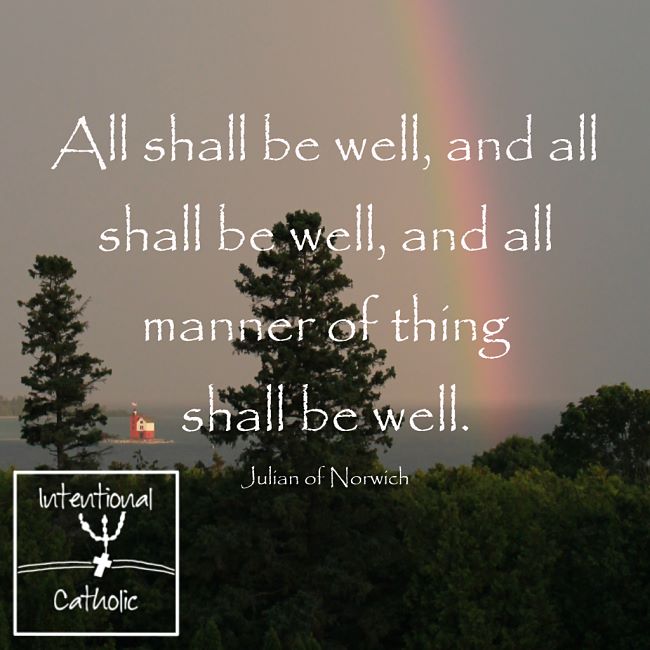
I love this quote from Julian of Norwich. It is so comforting–except when people use the quote to suggest that we shouldn’t be worrying about solving real world problems because the only thing that matters is what comes later. As if you’re ever going to be allowed INTO the world beyond without working for its realization on this side of the great divide.
And yet, also, I have been slowly waking to a new insight, these past weeks. Sometimes situations are so messed up, there IS no human solution. The division in America, for instance. No matter who wins this election, the problem at the foundation isn’t going away. We don’t have a solution for the ugliness and bitterness and extremism of our politics. We’ve chained ourselves to them.
There must be away out—a way toward unity and cooperation—but I can’t see it, and I don’t have much faith that anyone else can, either.
So my prayers, of late, have been asking God to show us the path we can’t find on our own. And recognizing that the path TO that path may be so steep, tick-and-poison-ivy-infested, and rugged, we may just have to take it on total faith that we’re heading the right direction at all. That regardless of what I can see or comprehend–no matter what it looks like right now–all will, eventually, be well.
 Intentional Catholic