I absolutely love this quote. WE are the creators of our culture. Holding ourselves apart from it, putting ourselves in a bubble to protect ourselves from the evils of the world, is actually an abdication of our job. We’re supposed to leaven the world by being part of it. By influencing it. Not by hiding from it.
That also doesn’t mean we take a combative stand to everything in the culture. By being part of it, we can shape it. If all we do is criticize it and not participate, we give over our chance to make it better.
By the time I got on Facebook the morning after Thanksgiving, it had already started.
There was the meme saying “It’s okay to say Merry Christmas! Share if you agree.” Another friend shared an article saying something like “the post-Christian America will be a meaner place.” And among liturgists, there was the discussion of “should we try to convince people not to sing O Come, O Come Emmanuel before the 17th of December?”
Why are we wasting so much time and outrage on all the wrong things?
I have a lot to say about this, so for today, I’ll just address the first example.
Getting mad about “Merry Christmas” versus “happy holidays” is fight picking.
It doesn’t matter.
In fact, this supposed conflict doesn’t actually exist. Who is going around trying to force anyone not to say Merry Christmas?
True, some people (including lots of advertisers) have chosen to say “Happy Holidays” instead of Merry Christmas, out of a sense of respect for those who celebrate holidays other than Christmas. What’s wrong with basic, common courtesy? In what way is empathy and thoughtfulness for others contrary to Christianity?
(Breaking news: it’s not.)
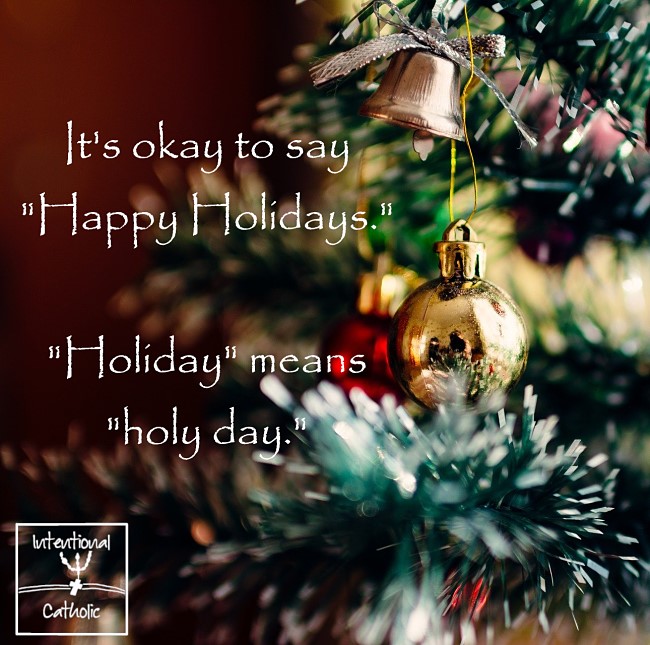
Also: there’s no reason for Christians to object to the word “holiday.”
Further: In fact, there are multiple holidays (i.e., “holy days”) at this time of year. Thanksgiving and Christmas and Hanukkah and New Year’s, yes. But even within Catholicism, there are many holy days that are important to different ethnic groups: St. Lucy in one part of the world, Guadalupe in another. For all of us, Mary, Mother of God. It is perfectly fine to say “happy holidays.” It is not contrary to our faith. In fact, that phrase originated with the Christian faith.
Plus, we need to be realistic. When people say “Merry Christmas,” they’re thinking about parties and presents and decorations and travel way more than they’re thinking about Jesus Christ. Even those of us who believe that Christ is the reason for the season spend way more bandwidth during it on things that have nothing whatsoever to do with Incarnation and salvation. The two terms are completely interchangeable.
I get frustrated about such nonsensical manufactured crises because they are part of a completely unnecessary culture war, and because they take up too much bandwidth that is needed for things that actually matter. Getting angry because someone says “happy holidays” instead of “Merry Christmas” distracts us from focusing on the things we ought to be caring about—the real issues that God cares about.
Of course, questions of violence, poverty, suffering, abuse of power, and injustice in the world are a lot harder to deal with. But substituting manufactured crises does damage to us as individual followers of Jesus, because whatever time we waste on this nonsense, we’re not devoting to the things that matter. And it does damage to the Church as a whole, because why would anybody take us seriously when we’re howling with outrage over persecutions that don’t even exist?
When people try to turn this into a culture war, they are picking fights for the sake of causing division. At this time of year above all others, we should not accept that. When you see those memes, just scroll on past. God will not send you to hell for not sharing. I promise.
And of course, there’s the ongoing stain of the sex abuse scandal.
Given all this, it was pretty demoralizing when that Pew research survey came out a few months ago. The one suggesting that Catholics don’t even really understand the one thing that, above all others, defines us: the Eucharist.
Today I want to offer two points as words of hope. First, this article. Words matter, and the way the Pew questions were written, many of us would hesitate, caught between our faith and the way certain words are used in the modern secular world. I mentioned this at choir practice shortly after the survey came out, when people were expressing their dismay about the survey, and a recent convert, who had to navigate those waters on the way into the Church, nodded vigorously in agreement. The authors of this analysis suggest a more hopeful picture, and their argument resonates with me.
Which brings me to the second point: part of the reason for that resonance is an experience I had when I was working as a full-time liturgy director. I was jaded even then about the view and understanding of the Eucharist among the average Catholic Mass-goer. Convinced that most people really didn’t “get” it.
Then one day, when we had a no-show, I substituted as an extraordinary Eucharistic minister.
It was an amazing experience. One after another, people raised their eyes and their hands. The looks on their faces remain with me to this day: raw, naked, vulnerable, longing, hopeful, reverent, transfigured. Those people knew they were receiving Jesus. Knew it at a visceral level that tells a truth far deeper than any survey can illuminate. By the end of Communion, I was nearly in tears.
So when the division in the Church seem ready to rip us apart at the seams—when despair tries to get a hold on my heart—I choose to hope. To believe that what I was taught as a child remains true now: the Spirit is in control, that we are led at this point in time by the person the Spirit knows we need, and that nothing can destroy the Church. Not even us.



 Intentional Catholic