Ever since “it’s the economy, stupid,” this has been how every issue is approached, both personal and societal. Who am I kidding? If the Vatican II bishops were talking about this, clearly it’s been this way since before the 1990s. But it’s impossible to escape the message these days. No matter what crisis is happening (coronavirus is one, but there have been plenty of other instances), the go-to response is always “how is it going to impact the economy?” As if that were the only–or even the most–important factor.
As a Catholic striving to put my faith above all else–far, far above money, which is supposed to be how we survive and do good in the world, not the defining factor of existence–I find this fixation problematic. We say we want to be a Christian nation, but that only holds as long as the topic is some moral issue that costs me nothing, because it doesn’t impact me personally. As soon as it’s a Gospel directive that affects *my* pocketbook, it’s a whole different story.
I’ve never succumbed to communal panic about crises. The closest I came was my senior year of high school, when some dude who’d “never been wrong” in predicting an earthquake predicted the biggest one ever on the New Madrid Fault, and it happened to line up with the day I was out of town auditioning for all-state band. I think my response was to pack a blanket in the car.
So it felt very… wrong… somehow, yesterday, to go to the grocery store a day early and spend more than twice what I normally spend on a week’s worth of groceries to freeze–vegetables, snack packs with nuts & cheese, milk & pizza makings. It felt like abandoning a long-held principle.
But if things do follow recent patterns, we could find ourselves quarantined in our home for two weeks, and if that happens, well, I have six people to feed. Extra groceries seems like a reasonable precaution.
Here’s what I’m realizing this week: in the coronavirus era, more than ever, living the faith intentionally requires humility and self-checking one’s biases.
I, for instance, have been very resistant to the limitations on worship that have come down. But I remind myself that devotion to purity of worship is a golden calf just as deadly as idols of political philosophy or money. There are immuno-compromised people to consider, and their dignity is more important than the externals of worship.
We all have some hangup to get over. Some people are so certain that “on the tongue” is the only proper way to receive the Eucharist, they are unwilling to bend in the interest of public health. Others insist we shouldn’t ban the Cup or stop the sign of peace because obviously God will protect us.
For all of us, the coronavirus outbreak is a wakeup call. For years, we’ve been warned that something like this was inevitable, but we all shrugged it off.
And now that it’s here, we’re reaping the fruit of our collective failure to listen and compromise. While Americans up and down the political food chain have been busy screaming at each other about a handful of hot button issues, a bunch of critical things have been ignored. We’re not prepared for a health crisis like the one China and Italy have been facing. This morning, a family member sent the text of an article from the Economist (a British magazine which is rated “least biased” by Media Bias/Fact Check, a rare distinction), which stated that “In 2010 the CDC budget was $12.7 billion in current dollars; today it is $8 billion.”
Meanwhile, the talk in some quarters is more tax cuts. Tax cuts *might* stimulate some minor economic movement (although with everything closed/canceled, what are we going to spend it on?), but the nation is already deeply in debt. You can’t keep cutting government’s funding and expect it to be able to carry out its proper function–i.e. the protection of the population.
Our basic vocation as Christians is to care for each other. Sometimes that’s on an individual basis, person to person. But if we want to be a “Christian” nation, then we should view that as a collective, societal vocation. To accomplish that is going to require taxes. Taxes are not evil; the pandemic illustrates that some functions simply *cannot* be carried out on an individual basis. They *require*, by definition, centralized intervention. We can’t hold any philosophy, whether it’s Communion under both species, Communion on the tongue, or low taxes, so tightly that we give up the thing that’s most important–the Christian call to care for each other.
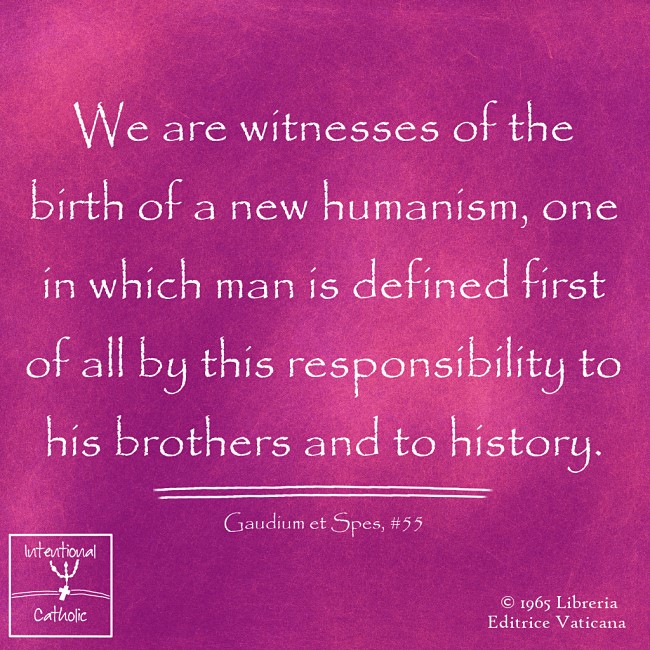
This seems like such a simple quote. I was going to let it stand without commentary, but I realized that this is really the essence of the convictions of all Christians who are passionate about social justice. To be a Christian is to care, in a self-emptying, physical, sacrificial way, for others. And to recognize that the things we do now have ripples down through history, on generations not yet born.
This quote expresses why we have a responsibility to act on environmental issues, on racial issues, on issues of poverty and inequality–the whole range of questions that are the most uncomfortable to address, because they challenge cherished ideals of self-reliance and rugged individualism.
I absolutely love this quote. WE are the creators of our culture. Holding ourselves apart from it, putting ourselves in a bubble to protect ourselves from the evils of the world, is actually an abdication of our job. We’re supposed to leaven the world by being part of it. By influencing it. Not by hiding from it.
That also doesn’t mean we take a combative stand to everything in the culture. By being part of it, we can shape it. If all we do is criticize it and not participate, we give over our chance to make it better.
Disclaimer: I’m a big believer that faith is never easy, and if it is, it almost certainly means you’re not digging deep enough. If you think you have it all figured out, you’re probably more pharisee than seeker.
When I started Intentional Catholic, I knew I couldn’t just ignore the bits of the documents that are hard for me to swallow. So I admit it: this is one of them.
Certainly the most “traditional” among us believe very strongly that moms should be in the home, always and forever. But that second half of the quote, about not underrating legitimate social progress, seems to indicate that even the bishops had to wrestle with how rigidly to hold that principle.
Because if a woman’s rightful place is in the home as long as she has children, the reality is she will ONLY have a place in the home. The reality of the world is that one cannot have children, raise them in isolation from a professional career, and then blithely step into the workplace at age 45 or 50.
As crazy as my life is—as stretched-thin as I am by the various irons I have in the fire—I recognize how incredibly blessed I am that my gifts & passions lend themselves to working from home. But my situation is the exception, not the norm. God gives women gifts just as he gives men; surely He means for them all to be used? Surely they were all given for a purpose in the divine plan. Yes, mothers have something irreplaceable to give to their children, but does it necessarily follow that that gift can ONLY be expressed by staying home?
Also, the male-dominated professional world really suffers from the lack of the feminine gifts—peacemaking, teamwork, empathy come to mind; I’m sure there are others. Those, too, are gifts given by God for a purpose.
I know families in which the father is the one with the gift for homemaking, and it works beautifully. I also know families who move Heaven and Earth to work opposing schedules so they share the tasks of breadwinning and child care.
I’ve heard it said many times that stay-at-home-mom is a pretty new invention, one enjoyed only by the wealthy. I’m not able to confirm this quickly, but it tracks with knowledge of women working in clothing factories and washing houses in earlier times. If you think of moms at home pre-industrial revolution, they were growing vegetables and preserving, baking bread and sewing clothes for the family.
And if you are tempted to say, “Well, duh, that’s what you do when you stay home,” I’d remind you that at the same time the husbands were working fields and raising livestock, also at home. Home and work were the same thing for EVERYONE in the agricultural era.
And in the industrial age, how many of those wealthy at-home moms employed other women as wet nurse, nanny, and tutor? So they were home, but they still weren’t really raising their own kids. Plus, that picture reveals even more women working outside the home in an era we tend to idealize as the era of SAHMs.
So all in all, I think we have a tendency to oversimplify this whole picture of what a mother’s domestic role is, and what it means to safely preserve it. A mother does have a unique place in her children’s heart and in their upbringing. But it doesn’t follow that if she goes to work outside the house, that role is being discarded.
I have a family member who works full-time and points out that being a working mom does NOT mean work is more important. When kids are off school or sick, they frequently camp out in her office all day. When she can’t work it another way, she sacrifices work time. “I am always a mom first,” she says.
A lot of this reflection is not strictly faith-related, but many times general expressions of faith—i.e. “we are all given unique gifts by God for a specific purpose”—require us to get down in the weeds on practical things to see how that principle can or should be lived out in the real world.
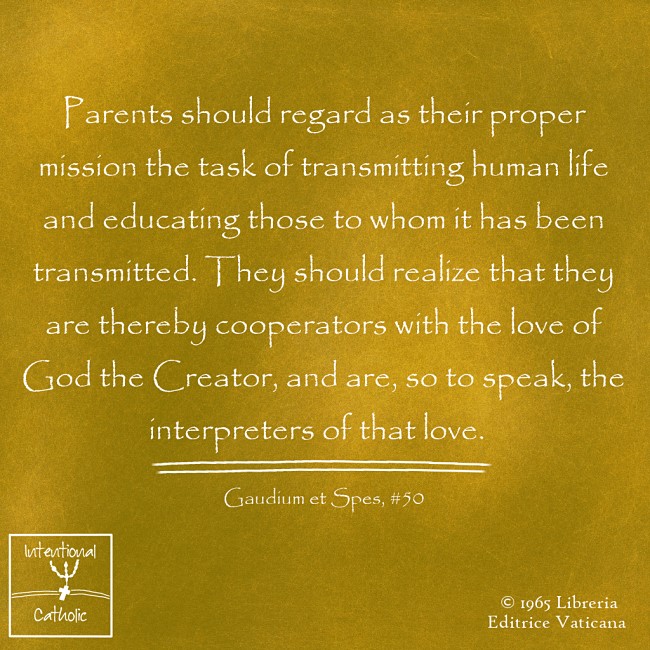
There’s a sequence in Gaudium et Spes that addresses marriage and family, and is often quoted for its guidance on discerning family size. Children are the supreme good of marriage; marriage is ordained for children (though not solely so); educating the next generation; discernment of family size.
This is from the middle of that sequence, but it isn’t among the most well-known extracts. (Well anyway, they’re well-known to me from years in the natural family planning community. In any case, see #s 48 and the rest of 50 for that.) But I pick this bit because it’s a smaller, more-easily processed excerpt, and because I think it really crystallizes the big picture: we are cooperators with God when we bring children into the world, and we interpret that love through the way we raise our children. That’s big stuff!
There’s been an uptick recently in the expression of a point of view that suggests that since we are citizens of Heaven, not earth, we should not pay attention to earthly suffering or strive to alleviate it. The Church says otherwise.
Posted on
As Catholics, I think we’re often in danger of putting ourselves in a bubble. The thing that strikes me most in Gaudium et Spes is the implicit idea that we’re supposed to be in the world, not isolated from it. It seems so obvious. Of course–how can we leaven the world if we don’t interact with it?
But another danger of the bubble is that we develop a combative, competitive view of ourselves vs. the world. THE WORLD is bad, nothing good can possibly come of it, all secular movements are inherently contrary to the Gospel, etc. We do this all the time.
Here, the bishops and Pope Paul VI urge the faithful to remember that even when the world doesn’t get it all right, the heart is often in the right place. To me, the lesson is: Rather than battling everything that comes out of the secular realm, we should look for what is of value, and find how to work in cooperation for the betterment of all. To me, that seems the best chance for true evangelization.
Listening to today’s daily reading caused me to perk up. What an image James uses to remind his community that simply talking about being a disciple isn’t really being a disciple! Farther down in the reading, he clarifies what he means by “doing something”: to care for orphans and widows in their affliction and to keep oneself unstained by the world. What struck me is the both/and of it–social justice AND personal piety. No false binaries here.





 Intentional Catholic