At the beginning of this year, I committed to wrestling how to balance Godly anger (i.e., Jesus-and-the-money-changers) with detachment. I do not see how these coexist.
I spent a whole heck of a lot of time this summer pulling crabgrass and driving while listening to Fr. Richard Rohr’s 1993 (1992?) reflections on the Sermon on the Mount. This set of talks was mind blowing on several levels, but the thing that has really crystallized in recent weeks is this:
There are things that are genuinely, and permanently, and irreconcilably, in conflict with each other. And yet they are both 100% true, both of God.
For instance: we are called to rage at injustice in the world, to be angry with what makes God angry, to mourn what breaks God’s heart—to agitate and advocate for the Kingdom on earth—the thing we, incidentally, pray for every danged time we pray the Lord’s prayer. Jesus absolutely excoriated people who didn’t make their religious beliefs concrete. Matt. 25 and the cleansing of the temple are good examples, of course, but also think of Jesus ripping into the Pharisees for tying up heavy burdens, heavy to lift, and raising no finger to help. Clearly, to Jesus, the things of the world MATTER. Religion is totally bogus if it’s only in the head and heart. It must be lived, concretely, in the real world. (That’s the whole point of the Theology of the Body.)
Yet we are also called to remember that the only way to really follow Jesus is to bow out of the worldly system altogether. Jesus’ whole thing about the tax and Caesar was meant to say, “Quit freaking out about questions of taxation and authority. It is IRRELEVANT, because you don’t belong to this world. Who cares about the taxes?” No matter what happens here on earth, the end goal is Heaven, so what happens here… doesn’t matter?
It does matter… and it doesn’t.
It is the now-and-not-yet. The both/and.
This is what I have realized in recent weeks. I’m feeling tension because there IS tension. There’s SUPPOSED to be.
Now what do I do with this insight?
To be clear, that’s a rhetorical question. I suspect answering it will take the rest of my life.
You know that saying: whenever you point a finger at someone else, four fingers are pointing back at you? (Well, it’s really three, as you can see, but…)
I think about that a lot in the context of Intentional Catholic. Anything I write, integrity forces me to turn back on myself, mirror-like.
I’ve been struggling through the Bible in a Year podcast… valuing it for the sake of hearing Scripture in a way that helps me grasp the historical context, but struggling because sometimes the commentaries really set me off. The one on Matthew 25—which is sort of the whole foundation of Intentional Catholic–pretty much gave permission for people to say “I’m clothing my naked children and feeding my hungry family. I’m covered.” In fairness, I do not believe that’s what he intended to convey, but it certainly does give tacit permission to ignore the plight of ACTUAL poverty and suffering.
Which is not to belittle feeding and clothing a family. I am up to the tips of my frizzy curls in caring for kids. It’s a real thing.
But it doesn’t negate our responsibility to the poor, marginalized, and vulnerable. First of all because keeping our kids fed and clothed is only a sliver of what keeps us so busy. The vast majority of what keeps us hopping is not essential. We could ALL cut back on some of our luxury and busy-ness and refocus some of that energy on the poor, marginalized, and vulnerable.
But as I sat there stewing and fuming over this, it occurred to me that me sitting in my house writing blogs and social media posts is not clothing the naked and feeding the hungry, either.
Here’s the thing. The conventional wisdom is that not everyone is called to everything. We are supposed to find what we, individually, are called to.
But I am an Enneagram 1, which means I’m very concerned with Getting It Right. For myself AND for the larger world. Enneagram 1s are deeply susceptible to scrupulousness. (Scrupulosity?)
The trouble is, when I, as an Enneagram 1, try to parse out what I feel most passionate about, I can’t do it. It all matters!
I have a child with a disability. Our health care system of access & payment is deeply dysfunctional and a burden on families.
My conscience stings every time I see a homeless person at an exit ramp. How dare we drive by, avoiding eye contact to preserve our own comfort? How dare people on my “Nextdoor” app call them “zombies,” as if these are not human beings with the same innate dignity as themselves?
I see the chaos and suffering that causes people in Central America to flee for the U.S.—and the way some people here villainize those who are desperate for the same security we treat as a divine right. How can I not be passionate about refugee and immigration?
I have godchildren and family members whose skin color will make them a target when they grow up. How can I not rail against those who deny systemic racism?
I had infertility that the medical community wanted to treat by slapping bandaids on it (birth control, artificial procedures) while ignoring the problems that caused it. We have a family because an NFP doctor took the time to find the root cause (PCO + agricultural chemicals in the water—how can I not be passionate about the environment?). So when I see how abortion is the symptom of a host of other problems that are systemic in our culture, how can I fail to rage at those who want to address the symptom while ignoring the causes?
I don’t know what my “one” issue is, because dang it, they’re all equally important. Thank you very much, Enneagram 1. But I can’t do everything. For years, I’ve been trying to learn to respect my limits, to create healthy boundaries.
But sooner or later you have to say “yes,” too.
So for now, I am working a shift at the Food Bank into my schedule, and exploring volunteer possibilities with Refugee and Immigration Services. Because at least there’s a known entry point there.
I am not going to stop talking. But I’m going to start mixing more action in with it.
Fires in the west. The slow and inevitable draining of the Colorado River. Floods in Mississippi and in Pakistan.
These are just a few of the effects of climate change in very recent history.
By now I think most of us recognize that human-caused climate change is not some made up thing. The frequency and severity of natural disasters are becoming so much worse, it’s hard to cling to denial anymore.
But the question is, what do we do about it?
Environmental stewardship has been a passion of my Christian life since my husband and I discovered that half of our long battle with infertility was caused by poor male fertility numbers stemming from diazanon, alachlor, and atrazine in the water supply. In case there are doubters here, we discovered this in backwards order. My husband encountered the study about the connection between low fertility numbers and these chemicals through his work as a science writer; then he went through testing and found he was the classic case; then we got a water filter and conceived within three months.
So I’m really tuned in to how we interact with creation. To be intentional about an area of faith means you have to examine how your actions do (or don’t) reflect what you think you believe. We wash and reuse plastic Ziploc bags. Watch the weather so we can pull the house temperature down to 65 on cool mornings and then close it up, thus minimizing the need for the air conditioner. Etc.
What makes me want to pull my hair out is the thoughtlessness surrounding creation that I see around me.
Every time I pull into Jazzercise, or Ace Hardware, or Target, or church, I see someone sitting in their car with the car running while they’re scrolling their phone. Every time. Sometimes I have even seen people get INTO their car, turn it on, and THEN pull their phones out. Why? It has nothing to do with the weather, because it happens in perfect weather as well as bad.
School pickup is even worse. People queue up beginning 25 minutes before school dismissal, and they will sit there running their cars the entire time. Not everyone—it’s improved over the years, thank God—but it’s still pretty bad. I used to go over to school after noon Jazzercise and wait until school let out—a deliberate choice, made to combine trips and reduce gas consumption. I’d bring my laptop and work remotely.
But every afternoon, when I pulled into a shady spot at 1:30 p.m., there was a guy in a huge white pickup truck who LEFT IT RUNNING FOR HOUR AND A HALF. This is a person who is ostensibly Catholic, a religion that values stewardship of creation.
None of these people are horrible human beings who care nothing for the earth and the life and health of future generations. Chances are, it’s just never occurred to people to examine what they’re doing. We are creatures of habit.
And yet the wellness and dignity of future generations—not to mention ourselves—is compromised by such ongoing and habitual abuse of the earth. How much carbon could we cut if we just turned off the cars when they don’t need to be running?
So this is my invitation for today. First, turn your car off! At long stoplights (you know where they are), while you’re at soccer practices or piano lessons, and above all when all you’re doing is checking your phone.
And second, to examine your days and routines for small but concrete ways you can show more reverence for creation through the way you use and interact with the things of the earth.
And feel free to share any of those here. I always like to get new ideas.
* All the photos in this post are pictures I took on my nature rambles in the last 6 weeks. This is the earth we are trying to protect, because it is how we live, and because look at the gift it is to us!
I woke up early on Sunday morning to the sound of a much-needed long, soaking rain. I laid in bed a long time, alternating prayers of gratitude with wrestling something that is probably going to get me in trouble.
Sunday, of course, was 9/11. At my parish on any national commemoration, it’s become tradition to sing America the Beautiful as a recessional. I’ve been in a leadership role in music for twenty-two years now, and in that time my feelings on this have gone back and forth multiple times. I’ve led the song PLENTY of times.
America the Beautiful is a beautiful song. It’s an aspirational song—in other words, it describes what America is meant to be.
But I’m not sure it belongs at Mass.
For a long time, the single phrase, “God mend thine every flaw” has saved it for me in a liturgical context. But Sunday morning, lying in bed, I thought:
We have a strong contingent of Americans who are systematically trying to erase America’s flaws from history books. They don’t think we need to know them. They think it’s unpatriotic to name America’s national sins… even though this same philosophy calls America to “get back to its Christian values,” which would include the reality that acknowledging our failures is intrinsic to the practice of Christianity.
In contemplative circles lately, I have been encountering the idea of holding conflicting ideas in tension. America has been a place of great freedom, innovation, and human achievement. It has also been, in the same places and the same times, a place of great oppression, injustice, and hedonism and the pursuit of money without concern for the good of others. (A modern example: Regulation is looked at as bad because people perceive it as stymying economic growth. By our national actions, then, we demonstrate that we believe money is more important than safety, health, and the dignity of human beings made in God’s image. Theology of the Body in action: it is through our bodies that we do–or don’t–make God’s image visible in the world.)
I love America the Beautiful. But I think when we tear up singing it, it’s not because of what America COULD be or SHOULD be, but because of a false sense that this is what America IS.
Christian life—for Catholics especially—is supposed to embrace the tension between what we aspire to be and the ways we fall short. We have penitential seasons. We are supposed to go to confession often.
But most of us don’t, and even those of us who do (full disclosure: I am not one of them, by default of busy-ness, and I recognize that’s just an excuse) don’t recognize the flaws in the way we view patriotism.
In recent years, a large segment of Christianity has wrapped up the cross in the flag. A lot of people have pursued, and more have justified, or at least winked at, some pretty heinous things in pursuit of that false worship. False, because God and patriotism are not the same thing. God comes first. Way, WAY before country.
There is no question that it is appropriate to sing America the Beautiful at patriotic events.
But at church?
Doesn’t singing America the Beautiful put things in the wrong order? Like, we put the nation in first place, highlighting its ideals and ignoring its failures, and then, as an afterthought, ask God to bless it?
I’m asking this as a legit question. I’m willing to listen to another perspective on this, for sure. Because of COURSE, it is totally appropriate to ask God to bless America. But what purpose does it serve to ignore the divided, toxic reality in which America exists right now and substitute an idealized version of America that never has really existed except in our hopes and prayers? Not a Godly one.
A lot of people died on 9/11. They deserve to be remembered. They deserve to be prayed for. They deserve to be remembered and prayed for at Mass. But America the Beautiful doesn’t do any of that. It shifts the focus away from the victims and substitutes rah-rah patriotism. Wouldn’t it be more appropriate to sing, for instance, “On Eagle’s Wings” or “Be Not Afraid”?
If we want to show a proper priority of God and country, wouldn’t it be better to observe national holiday weekends with “Eternal Father, Strong to Save” or “This Is My Song, O God of All The Nations”?
Basically, we use America the Beautiful because it’s beloved on a secular level. We do it because of the “pastoral” judgment. But I’m not convinced it actually IS pastoral in impact.
As I said, I am willing to be convinced, but I ask that if you respond, please do so courteously and respectfully, and with prayer, as I prayed through the discernment of this post. I am putting this out there for respectful discussion in the spirit of Jesus Christ.
There once was a little girl who had a red dress she loved. It was a long red sundress and, for a farm girl in the 1980s, it was the closest thing to a princess dress she was ever going to get.
That little girl was me. And as an aside… my classmates in primary school pulled me aside and told me Santa wasn’t real, in the tone of: “I’m about to destroy your world.” I knew I had to play it cool, but I wasn’t really upset. I’d seen what the other girls got for Christmas compared to what I got, and it made way more sense to think that my parents, who’d just been through a devastating drought year followed by a devastating flood year, were the ones in charge of my Christmas, rather than thinking some benevolent fairy liked the other girls better. It made me feel better about the whole thing.
I shared that aside because unless you understand what it was like growing up on a farm in the 80s, there’s no way you can understand the importance of this red dress to me.
But at some point, my conscience twinged me. I saw those kids in Africa. I felt I was called to give this dress away to some girl who was much poorer than me. Because after all, we had cattle and hogs and chickens and a big garden I had to work for two hours every day all summer, and we never, EVER went hungry. I wasn’t comparing myself to the girls whose Christmas haul was so much bigger than mine. I was thinking of those who had it harder than I did.
So I wore the dress one last time and asked my mom to give it away. Years later I found it in a pile in the utility room, and I was pretty mad at her. Ha! Don’t you know how much that cost me??? As a mom I totally get it… that is called “I have four kids and too much to do and how do you send a dress to Africa, anyway?”
I tell this story because I’ve been thinking lately that maybe my daughter’s arrival really didn’t change everything for me, after all. Maybe it just forced me to face the misalignment between what I believed about living the faith–as a set of concrete actions taken in a concrete world–and how I was actually applying it.
A year or two after that Red Dress story, I was going to Confession—still pretty young—no older then ten—and I confessed to the priest, “I don’t FEEL anything about God.” I was really, really worried about this, worried about my soul.
The priest said to me, “If you see a guy with no coat and you FEEL bad for him, your FEELING does nothing at all for him. He needs a coat. It doesn’t matter if you FEEL compassion. It matters that you give him a coat.”
I walked out of that confessional feeling free and very empowered, because man, DOING things is within my control!
The question that invites reflection is this: what happened in between those two formative experiences and the arrival of my daughter to cause me to embrace a world view that blamed others for their mistakes and their bad luck alike, and refused to see that the systems under which we live are structurally skewed toward people like me and against others?
That’s a big question, and probably the answer is less important to you reading this than it is to answer similar questions for ourselves individually. But I thought I would share, because I am reading Eric Clayton’s Cannonball Moments, and the first question in that book is an invitation to reflect on the moments when we recognize the conflict between what we think we are, or want to be, and what we are living in our bodies. The first insight I gained was that when I was young, there wasn’t one. The misalignment he highlights, for me, happened later.
I’ve been listening to the Bible in a Year, and the long exploration of the prophets, where I am now, has been quite illuminating. First of all, I never really processed that a whole lot of the prophetic books don’t mean “Israel” as the nation of Israel, but the northern kingdom. It clarified for me that Judah is in fact what I spent most of my life thinking of as Israel. I just figured prophets were speaking to the whole nation of Israel all the time, but that’s not actually true. That’s why we hear so much about Judah. Not every prophet is speaking to everyone. They have specific crowds they are called to talk to, to address specific problems in those communities.
I have been wrestling with the idea of the prophetic call for quite some time. Priest, prophet, king: through baptism, we are all called to all these things. Prophets, by definition, have the task of saying what the considers-ourselves-religious crowd doesn’t want to hear, because it is inconvenient and uncomfortable. Occasionally they talk to the pagans (the unchurched), but mostly they’re talking to people who think they are God’s chosen and are not living it.
As I listen to Isaiah, Jeremiah, Hosea, Ezekiel et al rail against their various audiences, what strikes me is how blatant the idolatry seems. If people were burning incense and sacrificing children on mountains and building “gods” out of wood and gilding them with gold, that’s pretty flagrant!
And yet I feel that most of the charges being leveled against God’s people in ancient times still ring heartbreakingly true today. But our idols are more subtle. Money is a big one. I struggle with its influence in my own life and household. Politics is HUGE, and individual political figures & issues, in particular. Idolatry. No one who professes Christianity wants to acknowledge that, but I do not see how anyone could argue that I am wrong. I’ve never had anyone do so. When I point it out, they just pretend I didn’t say it and move on. If you can’t answer the charge, it seems to me, that’s an invitation to examine one’s conscience. It certainly has been in my life. That’s how I’ve ended up where I am.
The last few weeks, I have also been listening to Fr. Richard Rohr’s series of talks on the Sermon On the Mount. It was recorded shortly after the fall of Communism, and his references to Communism versus capitalism (isn’t it odd how we capitalize one, to demonize it, and not the other?) are startling both because they are so out of context and still so right on point, because 30-odd years later we, the Christian capitalists, are still arguing about communism.
This series of talks was really eye-opening. I highly recommend it. To break open what the Kingdom really is, and what it means to live in the Kingdom—to acknowledge how far off our so-called Christian culture is from what Jesus actually called us to do—to be challenged in our judgments both as liberals and conservatives… it’s a very Christ-centered, radical approach to the intersection of faith and the real world. It is giving me a lot to think about. I don’t have it worked out; I’m just beginning to process. In fact, I think I might go back to the beginning and start again. (FYI, it is on Hoopla for audio download, which is how I am listening, so check your library.)
So that’s what my spiritual life looks like at present. I’m not sure how valuable any of this is to anyone out there—I feel like effective blog posts are supposed to present a problem and solve it, and I’m more just faith sharing here—but who knows? There has to be some reason I felt compelled to write all out, right?
For a change, I don’t have much to say. This was quoted in one of the Center for Action and Contemplation’s daily reflection this week, and it struck me as deeply relevant to my spiritual journey. Isn’t defensiveness where the “bad” anger comes from, after all? It resonates strongly with a line from Rory Cooney’s song “Do Not Fear To Hope”– “our God sees not as we see; success is not the prize”– which itself reflects Mother Teresa: “God has called us not to be successful, but to be faithful.”
The reference provided by the CAC is: Gregory Boyle, The Whole Language: The Power of Extravagant Tenderness (New York: Avid Reader Press, 2021), 130. Which, I think, needs to be a book I explore now…)
I’ve developed a new morning ritual the last few months. I get up, warm my hot pack, and listen to two podcasts while doing the stretches and exercises required by a couple of chronic conditions. The two podcasts are the Bible in a Year and Evolving Faith. They’re quite different… one quite self-aware in its orthodoxy and the other quite aware of its not-orthodoxy. I think this is probably a good balance.
Sometime in my tween/teen years, I read the Bible straight through. But having it read to me as an adult is enlightening. I’m making connections I never did before. I’m understanding the relationship between different books in a new way. I appreciate Scripture on a whole new level. When you are steeped in the Lectionary, as most of us Catholics are, and liturgy people more than most, it’s really good to get a sense of the way the very familiar excerpts fit into the larger context.
The Evolving Faith podcast hits in a whole different way. More visceral, more immediate. These are people—almost entirely non-Catholics—who are wrestling with faith and the world in the same way that I am. Unlike me, many have abandoned institutional churches (though not Jesus). The podcast consists of talks from the Evolving Faith conference, which was founded by a group including Rachel Held Evans—whose work, in my mind, all Catholics should read, even though her perspective on the world came from a very different faith tradition. She has so much to offer us.
And so do the other speakers I’m hearing.
It’s a truism that faith formation is generally pretty bad… everywhere. Some blame it on Vatican 2, but I would submit that the older crowd might have known plenty ABOUT the faith, but they weren’t any better equipped to apply it to the real world. Plus, far too many quit faith formation at a certain point—graduation from Catholic school? Confirmation? etc.—so faith doesn’t always mature the way understanding does.
So then, as we interact with the world, we have head-on collisions with realities that don’t fit what our faith taught us about How Things Are Supposed To Work. At that point, a few different things can happen.
One is to deny the validity of the thing that is challenging our faith, so as to protect the faith as it stands. (I believe the focus on “Marxism” at the expense of honest examination of the ripple effects of racism is one example of this.)
Another is to admit that the faith in its current, comfortable form is woefully insufficient for said realities, and to throw the baby out with the bathwater. (Which is why so many people leave organized religion, or even God.)
The third is to get down in the weeds and ask the really hard, uncomfortable questions, and deal with the doubt and turmoil and lack of clarity that come with them. To accept as your faith gets bruised and bumped. To accept the muddiness of faith in the real world, and the reality that sometimes there AREN’T pat answers. To quest, to seek, to wrestle with the hard stuff.
It’s not an easy thing to do, because basically it means you’re uncomfortable all the time. (All those fingers pointing at myself.)
But isn’t that exactly what it means to be “in the world, yet not of it?” There’s a now and not yet, a tension that human nature doesn’t like. According to one narrative I’ve been bludgeoned with a lot in recent memory, the Kingdom is Jesus, it’s not something we build. It was never meant to be on earth–only in Heaven.
But then why did Jesus tell us to pray “Thy Kingdom come, Thy will be done ON EARTH AS IT IS IN HEAVEN”?
This weekend, two of my kids were confirmed, and the bishop said, in essence, your words about faith are not enough. People need to SEE the kingdom of God embodied in YOU.
Which means we HAVE to get our hands dirty, working the earth around those messy subjects like abortion and immigration and racism and health care and the balance of personal and social responsibility and the common good. We have to accept that neither of our political extremes has it entirely right and be willing to take a deep breath and enter into dialogue. The world is always going to try to box us into an either/or, and we’re all susceptible to picking a side and planting our flag and failing to recognize when we’ve made that flag—or money (so much of our political discourse is about our own financial self-interest!)—the center of our world view, rather than God.
All of this to introduce a quote from speaker Nish Weiseth, because when she said these words, they rang a deafening bell in my soul:
“What we see from those previously mentioned leaders is a faith that is formed by politics, and not a politics that is informed by faith.”
If I have the energy, I’ll do more specific writing on this in a day or two. We shall see.
It’s been a minute since I posted here, but not for lack of spiritual journeying… just struggling with how to write it publicly. God continues to place signposts in my journey to balance Godly anger and detachment. Sometimes I don’t quite know how to balance the two.
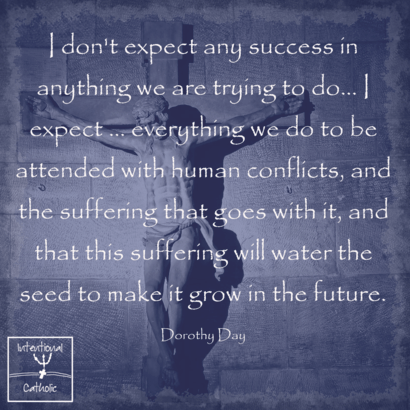
I spent Lent reading the letters of Dorothy Day, because I thought, “If anyone has figured out this balance, she’s that one.” “All The Way To Heaven” was the recommendation of a priest friend of a friend.
In the first 40% of the book she was not at all what I expected from Dorothy Day. It’s really interesting to watch her own spiritual journey unfold. Then there comes a sharp turn. I’m still only at the 46% mark (she wrote a lot of letters!) but I am thoroughly engrossed by it all. But I wasn’t finding the nugget I was looking for–the thing that showed me how to be an activist and advocate for social justice without being angry all the time.
Then, without warning: this.
Whoa.
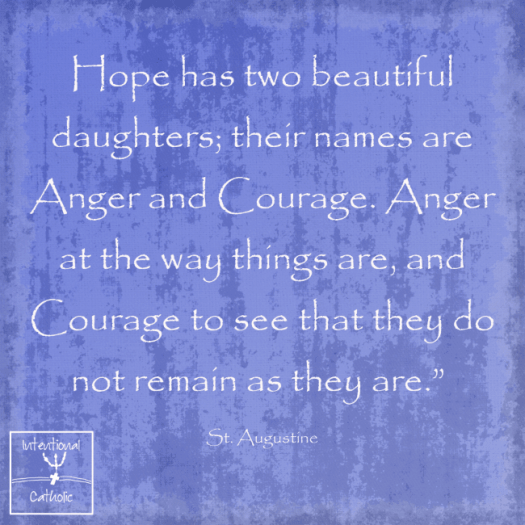
But, because God doesn’t deal in the obvious and the clear-cut and the black-and-white–he just doesn’t–within 24 hours, I stumbled across this quote in the front of a novel I pulled from the library to read:
Okay, then.
So… I suppose the divine message here is to hold things in tension? That this struggle is real, and inevitable, and a part of the journey?
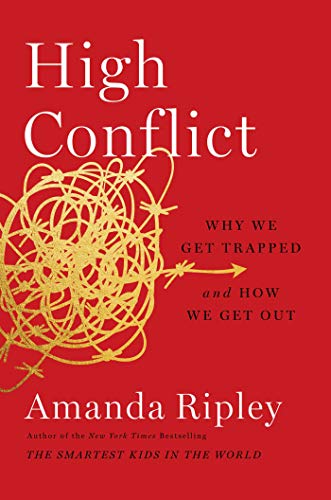
A while back, I heard a discussion on the radio about a book called “High Conflict.” As I listened, I thought, “That’s me. That’s what I’m feeling.” I put it on hold at the library, but I was way down the list. And when my turn came a few weeks ago, my heart quailed. I thought, “This is not going to be an enjoyable read.”
Then I pulled up my big girl panties and read it, praying throughout for openness. Because this, clearly, was God’s next signpost in my spiritual journey this year, toward balancing Godly anger at injustice with detachment. Because—also clearly—high conflict is NOT what God is calling me to.
Or any of us.
It was an incredible book… eye opening for myself, and extremely balanced in calling people across spectrums on the carpet. (You can tell a well balanced book by the fact that reviewers from both sides of the High Conflict that is American politics gripe about how their side was treated more harshly than the other.)
Reading that book did change me. Among the many valuable things she urged was to “muddy the waters.” The fact is that we like to put people in “us” and “them” categories, and we need to remember that we are all products of multiple influences, and just because two people share an identity in one of those influences doesn’t mean they will in others.
For myself, Catholic is my identity above all others. It is the filter through which I view everything. It is the measuring stick by which I gauge my secular work and my advocacy (“Disability Mom” and “writer” are tied for a close second in my identity)– and advocacy is, in fact, one of the red flags she warns of as an indicator of high conflict.
The point is that it helped me. It cooled down the temperature of my passion. Let me tell you, in the past two to three weeks, that cooling trend was critical… and not for any of the reasons I thought it would be. It’s just been a rough few weeks, personally.
And yet, yesterday I found myself triggered again. Multiple times. By multiple triggers, in multiple places. I found myself starting arguments with no one again.
The most bizarre thing was that I had a flashback to an incredibly contentious… and thankfully, defunct… relationship that caused me tremendous mental anguish over the course of COVID. I have zero contact with these people anymore. I have almost, if not completely, removed myself from these people’s orbit.
And yet, suddenly I was there in the middle of the emotions again, reliving the offenses, reliving the, well, anguish of trying to behave in a Christlike manner, cringing at the one mistake I made, raging at the certainty that they didn’t learn a thing from that conflict, that because of my mistake, they never admitted their own.
It was as if it happened yesterday instead of more than a year ago.
And sometime during Mass, as I sat behind the piano, wrenching my mind back to the liturgy again and again, it occurred to me: “I wonder if this is a spiritual attack.”
Because I WAS making progress toward what I know God is calling me to do.
I don’t have a neat and tidy bow to wrap around this post. I am just sharing the journey. Maybe high conflict, itself, is indication of a spiritual attack almost all of us are suffering…
Anyway… here’s that book you should all read, regardless of where you stand on any of the multitudes of points of contention we have all elevated to High Conflicts.




 Intentional Catholic