How would politics be different if we really did believe we are all family?

So there’s an election next week. Let’s talk politics? (Yippee!)

Because I feel pretty certain that the timing of the release of the encyclical “Fratelli Tutti” was not accidental. Pope Francis released it right before the US elections for a reason.

Background Image by Alexas_Fotos from Pixabay

Over the course of my life, papal documents have generally been pointed at someone else. At least, thatโ€™s how it felt. Like America was the good guy–not that we were perfect, but generally we were on the right side of the Gospel–and all those other countries were the ones getting their body parts handed to them by popes.

Fratelli Tutti doesnโ€™t feel that way. In fact, it feels the opposite.

#15 begins a section subtitled “lacking a plan for everyone,” and ouch! does it ever capture modern American life. He calls out politics that make use of hyperbole, extremism and polarization. He talks about strategies of ridicule, suspicion and criticism. About political life being focused on marketing techniques rather than long-term efforts to better the plight of humanity. I mean, thatโ€™s a mirror for all of us, whatever our political persuasion, if I ever saw one!

In #18-21 he returns to a familiar topic of the โ€œthrowaway culture,โ€ naming the unborn and elderly, and expanding the circle to recognize that wastefulness (like food waste) is also a symptom of the throwaway culture, one that harms the most vulnerable. Discarding people also comes in forms like corporate cost-cutting and racism, and even the declining birth rate.


This is the part where I pivot from “Here’s what the pope says” to “here’s my reflection on it.”

This list of modern problems echoes the questions that preoccupy me, the ones I gnaw over, day in and day out. Trying to understand how good people can fail to recognize bad things, and end up embracing them instead. The frustration that people will always point these kinds of examens at others, refusing to examine our own consciences for times when we, too, participate in or enable evil.

This concept of universal brotherhood is the central problem of our time. Well. Of all human history, but it seems particularly apt in this day and age.

We deal with problems in our families in a far different way than we do in matters of policy. In a family, we have our own concerns, but we also recognize the rights and needs of others, and we know we must look for solutions that serve everyone’s interest.

If we truly regarded everyone in America as members of our family, how would that change the way we look for national solutions? I think weโ€™d have to move beyond โ€œhow does this affect ME and MY rightsโ€ and add, โ€œHow can I balance my needs against the valid needs of this other person with a conflicting interest?โ€

We need both right and left in order to keep us in balance. What we don’t need is the villifying, the mocking, the “contrast ads” and editorials and memes whose “truths” are stretched so far, they’re actually falsehoods. We wouldn’t treat our families this way. How can we, as Christians, think it’s justified in politics?
More #seethegood in virtual learning

I have four kids, and each of them is in a different school this year. (Long story.) Two of them are in seat (one because parochial school, one because special ed), the other two are all online so far.

Today is the first day I have to have one of my in-seat kids at home for learning, and since I’m groaning internally about it, I want to stop to acknowledge the great blessing that my two highest-maintenance kids have, in fact, been able to have relatively normal schooling all the way to October 21st. I have been on fire in my writing–laser focused and accomplishing a lot.

At the same time, some really beautiful things have come out of having two kids at home for school. I’ve gone running with my 6th grader a few times. Taken afternoon walks with him at other times. Eaten lunch with my high schooler, who, in an ordinary year, we’d barely see because he’d transition between school and marching band and be gone for ten hours and do homework the rest.

Also, I have a lot better picture of what my kids are doing at school this year. I’m puttering around the kitchen during middle school zooms and for that reason I know all the teachers by voice and name and I know that one teacher has a chirping smoke detector in her house, and I can hear the banter in the class. I can ask intelligent questions about the things the kids are studying, because I have some clue what they are.

It’s a give and take. There are plenty of things that feel constraining about this mode of education, and keeping spirits high… or, well, in the neutral range or better… requires constant vigilance. I feel much more guilty for going to take my hike/bike/sit/pray times when there are kids at home. But there are things to love about it, too.

Interconnectivity and Materialism (Fratelli Tutti, #9-14)

Background image credit: Cass Kelly

I’ve been trying for several days to find the entry point to reflect on the first section of Fratelli Tutti’s Chapter One. Like many papal encyclicals, FT begins by laying out the problem. It seemed, Pope Francis says, that for a few decades the world was heading in a positive direction–greater peace and international cooperation; an understanding of where we’d been and why we didn’t want to go there again. But it’s been shifting in recent years. He calls out “myopic, extremist, resentful and aggressive nationalism” and individualist ideologies that shred the idea of “social sense.”

This whole section is rich with resonance to me: consumerism, corporations that succeed by feeding individualistic priorities, leading to a loss of the sense of human interconnectivity and even an understanding of history. (This is my best attempt to sum it up. Really, you just need to read it.) In such an environment, high ideals such as democracy, freedom, justice, unity, etc., become meaningless catchwords that can be abused by anyone. Hence, the quote above.

Pope Francis catches a lot of flak in some quarters for being “liberal;” as far as I’m concerned, passages like this disprove that. To me, this sounds like the same conservative rallying cry that permeated my childhood. For decades, popes have been warning that when big conglomerates control the narrative of the world, it’s bad for us. Certainly, in my conservative Catholic upbringing, Hollywood and the music industry were the focus of this criticism.

I think we’re getting ready to hear that those targets aren’t the only ones–just the easiest to call out.

Being Catholic in a Messy World

This past summer, I was honored to be invited to speak at the National Association of Pastoral Musicians national convention. Among the presentations I gave was this one, “Being Catholic in a Messy World.” I was asked to give a fifteen-minute reflection on what I mean by “Intentional Catholic.”

I have so many thoughts, I never imagined it would be a difficult talk to write, but it was–because the topic is so huge. The through-line that eventually emerged was how I wrestled with being “pro-life” in the wake of giving birth to a child with Down syndrome. I’ve often said that my daughter’s birth was the earthquake that changed everything for me, though I didn’t know it at the time. This is that story. It encapsulates many of the difficult issues we’re wrestling as a nation (badly). I hope you’ll set aside a quarter hour to listen!

(Thanks to GIA Publications, my music publisher, for making this available.)

The Grass Is Always Greener

Today’s reflection is (slightly) adapted from a post originally written seven years ago on my personal blog.

Having wrestled anxiety for most of my young adult life, I donโ€™t often plumb the depths of my psyche too much anymore. I may be emotionally and psychologically healthy these days, but Iโ€™m far from immune to doubt. Doubt is an inevitable part of the human experience. We doubt God, we doubt our leaders, those we love, and of course, ourselves. The decisions weโ€™ve made, especially the big ones, sometimes lead us to places that donโ€™t look like what we envisioned, and we start thinking if weโ€™d chosen another path, things might be easier.

This happens to me most often when Iโ€™m ticked off at the world, i.e. husband and kids. They are my vocation, so when family life seems really hard, a niggling thought will sometimes come to mind: could I have heard the call wrong? I have always been drawn to silence and stillness. Why didnโ€™t I ever seriously consider religious life? A life of prayer, of contemplation, without the familial demands that wear me down, the unceasing noise that shreds my inner peace, the constant busyness that makes it almost impossible to dip into the well of the Spirit. Wouldnโ€™t I be a better disciple if my life were devoted to solitude and prayer?

The end of Thomas Mertonโ€™s Seven Storey Mountain surprised me when I read it:

โ€œYou have got me walking up and down all day under those trees, saying to me over and over again: โ€˜Solitude, solitude.โ€™ And you have turned around and thrown the whole world in my lap. You have told me, โ€˜Leave all things and follow me,โ€™ and then You have tied half of New York to my foot like a ball and chain. You have got me kneeling behind that pillar with my mind making a noise like a bank. Is that contemplation?โ€

Thomas Merton, Seven Storey Mountain
Photo by Krivec Ales on Pexels.com

Look at that: a contemplative monk, questioning his vocation becauseโ€“gaspโ€“itโ€™s not contemplative enough. Because heโ€™s got distractions. Because his mind is rattling like a piggy bank. (Oh, that is so me.)

That made me rethink another quote I’d read years earlier:

โ€œUsually, in refusing such a gift from God, a person finds his or her path to heaven more difficult. โ€ฆ it seems that God calls us to the best possible vocation suited to our personalities and talentsโ€ฆโ€

Richard Hogan, The Theology of the Body in John Paul II

When I first read it, I interpreted it to mean that I will be a better disciple if I am in a situation that challenges my weaknesses least. But in light of Merton’s quote, I realized: what if the very soul stretching that comes from struggling with my vocation is what makes me a better disciple? After all, if weโ€™re never challenged, how in the world can we grow?

If patience, pride and self-centeredness are my weaknesses (and believe me, they are), then family life, in which patience is tried every moment of every day and self-centeredness is forced by virtue of necessity to give way to self-emptyingโ€“family life seems ideally suited to make me a better disciple.

In other words, the grass is always greener on the other side of the fenceโ€ฆuntil you get there and realize what youโ€™ve left behind.

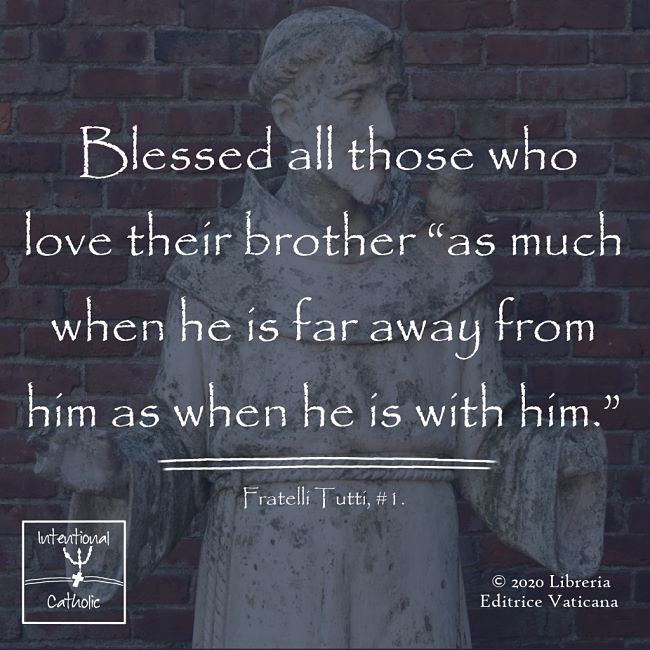
“Brotherhood”

Background image: Wiki Commons

I have begun reading Pope Francis’ new encyclical, “Fratelli Tutti,” and thought it might be worth simply sharing as I read, since it’s new to all of us.

The topic seems like a timely reminder, given the state of the world right now. I can’t quote it all, but Pope Francis sets the tone in the introduction by pointing to St. Francis of Assisi’s trip to visit the Sultan Malik-el-Kamil. He went during the Crusades–a time when the goal of Christianity was to conquer and convert the Muslims–and instead modeled peaceful conversation with no agenda at all.

Two things strike me here: one is that with this trip, St. Francis, quietly and without making a production of it, issued a sharp rebuke to the entire goal of the Crusades. A rebuke that, with the benefit of hindsight, was well deserved.

The other is that Pope Francis is setting the stage to remind us that our worldwide politics of division (because it’s not just an American thing) is directly counter to holy living.

And I suppose there’s a third thing, which is that there’s more than one way to interpret “far away” and “near.” In St. Francis’ case, it was both physical and philosophical difference. My guess is that Pope Francis is gearing up to admonish us to be “brothers” in both those spheres in modern life, as well.

We shall see if I am correct.

What Can I Do?

It’s always dangerous to read too deeply into the day’s Scriptures an overt connection to the modern world, but yesterday it was hard not to do so. I hoped for good judgment from my people, and look! What I got was violence. I hoped for just behavior, but listen to the outcry against people who are supposed to be a beacon of hope!

I’ve been quiet recently, because it’s busy, and because sometimes I feel like a wagging finger, and there’s only so much finger-wagging a person can do before people tune you out.

So I struggle with what to write. I’m overdue for a #seethegood, but that feels like a cop-out when what is on my heart is something quite different.

My bishop sent an election letter, which I shared on Facebook. (For those who might read only here, here it is.) It was a good letter, nuanced in a time when most discourse consists of bilateral apocalyptic predictions. But what really stood out to me was this:

“What I see happening in our nation, unfortunately, is a strident, rancorous discord that tears not only at the fabric of our society but also at the communion of the Church.  And this disharmony endangers the salvation of souls.”

Bishop Shawn McKnight

Within my own circle, there are a growing number of people who have left the Church or struggle to remain in it because of how we act, because of the singleminded focus to the exclusion of things Jesus told us explicitly were our call.

I lie awake at night praying about this. Pray as if it all depends on God; act as if it all depends on you, the truism says. I’m praying. But action? What can I do, besides write finger-wagging posts on social media? I feel helpless.

How will be judged?

My husband and I watched the movie “Harriet” this week, and–aside from the mind-blowing music, instrumental and vocal–what struck me most was how convinced the whites of slave times were that there was “nothing to see here, move on.” I find the same attitude in a lot of talk going on around me these days, and as I wrestle with whether the arguments about violence versus peace, the way white Christians seem to be seeking excuses to disregard the movement, I wonder how history–and more importantly, God–will judge us. Are any of the things being said against BLM valid, in the long run? Or are they just excuses?

I’ve said before, I’m a huge fan of Shannon Evans. As a faithful Catholic in the broadest sense of the word and the adoptive mother of a Black child, she has a lot to say to us about race. Here’s the screen shot I grabbed last night off Instagram. Click it and it will go to her column.

Everyday Ignatian: Finding God in Others When Racial Injustice Feels Too Painful to Bear

Fear, Faith, and Recognizing God’s Voice

Today I share my third and final post about fear and faith. Or rather, a fragment of a much larger post, because this is the part that’s relevant. In March 2014 I was sharing about my first spiritual direction appointment, and I wrote:


I talked at some length about the scrupulosity issue, the fear that Iโ€™m not supposed to be writing, that GODโ€™S WILL FOR MY LIFE (finger wagging as an illustration) is for me to be a mom and nothing else. My spiritual director said, โ€œDo you think thatโ€™s what Godโ€™s calling you to?โ€

Not a question I wanted to answer. I fumbled a bit, and she rephrased: โ€œHave you ever had a moment where you were sure you were hearing the voice of God?โ€

After a bit of thought I could say yes, I did. Itโ€™s never, ever about the big things, itโ€™s always about small things that are immediate and in the here and now.

โ€œAnd what does that feel like? Does it feel like the wagging finger?โ€

โ€œNo!โ€ This one I could answer with certainty. โ€œNo, it feels quiet, and peaceful.โ€

Those words hung in the air for a couple of seconds before I realized their importance. I have identified what the voice of God sounds like to me, and more importantly, what it doesnโ€™t sound like.


Stepping back in as 2020 Kate: I want to clarify the connection. In that post I referred to a wagging finger. But the point is what that wagging finger made me *feel*: fear. Anxiety.

How anxiety looms over life.

I have a history with anxiety–a long, tangled, ugly history. For me, fear and anxiety were twisted up in dysfunctional ways with my faith. (I still fight it sometimes.) A feeling that anything I wanted had to be contrary to God’s will, simply by definition, because “my ways are not your ways.” (I once told that fear to a good and holy friend of mine. He blinked in silence for a minute and then said, “Wow. What an unfortunate reading of that Scripture.”) A fear that if I got a discernment wrong, I was out of luck and basically doomed for all eternity (literally).

So the moment I described above, in my first spiritual direction appointment, was a game-changer. I cannot speak for others, but this I know: God does not speak to me in anxiety and fear. The Devil, however, does. The devil speaks anxiety and fear often, relentlessly, and loudly.

God speaks to me in a quiet sense of security and peace and joy.

There has always been an end-times movement. The world is always about to end in someone’s mind. There are always visions. Some of them well-respected in the Church and others, well, a lot more questionable.

I ignore them all, because I know now that is not where God speaks. Not to me, at least. And honestly, I don’t think following out of fear is what God wants for any of us. I think of Elijah. God didn’t speak in the scary, bombastic stuff, but in the tiny whispering breeze.

Is the world going to end? At some point. But that’s not where I need to keep my focus. I’ve been at this long enough to know that if I focus on fear, I’ll fall farther from him, not grow closer. I’ll only live a half life.

I wrestle many things these days, but this I am certain of: God wants more than that for us.

Fear and Faith, Part 2

Sharing today the second of three posts about my journey in pondering the relationship between faith and fear. This one dates from March 2, 2011.


Photo by icon0.com on Pexels.com

A pastor named Rob Bell wrote a book that raised peopleโ€™s hackles because they felt it espouses โ€œuniversalism,โ€ the idea that nobodyโ€™s going to go to Hell. I ran across this topic here, and it got me thinking. Not about Rob Bell, his book, or the existence of Hellโ€”frankly, because I think the whole discussion is a distraction from the primary issue.

I have no patience with the sentiment โ€œI believe in God, but Iโ€™m not really religious.โ€ Or โ€œIโ€™m more spiritual than religious.โ€ Cop-out! If you believe in God, that God is creator of all and above all, then it makes no sense to act as if that belief doesnโ€™t matter. When the stakes are so highโ€”Heaven and Hell, eternal life and eternal deathโ€”how can you stick your fingers in your ears and ignore the call to act, saying โ€œla la la I canโ€™t hear you?โ€

On the other hand, being โ€œreligiousโ€ because youโ€™re scared of going to Hell is a pretty poor version of Christianity. If thatโ€™s all your faith is based on then itโ€™s bound to do one of two things: get twisted into some hideous distortion of true holiness (how often do we see that happen?), or fall to pieces entirely. Holy living should be a response born of gratitude to the One who gave us everything, love for the One who continues to pour out goodness on us, even amid the pain and difficulty of this fallen world. And by love, I mean a conscious decision to act, not some touchy-feely, ephemeral happy place.

When you love someone, you try to get to know them, to understand what they want, what makes them tick. When you love someone, you look for ways to make them happy, you look for ways to deepen your relationship with them. When faith becomes an act of love, the discussion of Hell, its existence or lack thereof, isโ€ฆ.well, perhaps not completely irrelevant, but certainly beside the point.

Hell is the absence of God. Look around the world. Everything beautiful in this world, everything that makes it worth living, is from God: love, cuddles, creation, skies and outdoors and fresh air and friendship and music and all the things that make our hearts skip a beat. To be separated from all that? If that doesnโ€™t give you the shudders, then I donโ€™t know what will.

I donโ€™t think much about Hell, end-times or the apocalypse, because it scares me, and when Iโ€™m scared I focus on fear instead of on my true job as a Christian. My true job is love. Iโ€™m trying to learn to live in such a way that I am acting out of love for the One who made me, acted out toward the people and the world He created. I have a long way to go; Iโ€™m well aware that Iโ€™m not guaranteed a place in Heaven just because I say I believe in God. Actions speak louder than words, and fear is not a good long-term motivator. Besides, itโ€™s not like I have any control over the apocalypse (or lack thereof). Godโ€™s the editor of the final markup, not me. Thankโ€ฆwell, thank God.


The Kate of 2020 steps back in to note that I apparently had a lot more answers when I was in my thirties than I do now. ๐Ÿ™‚