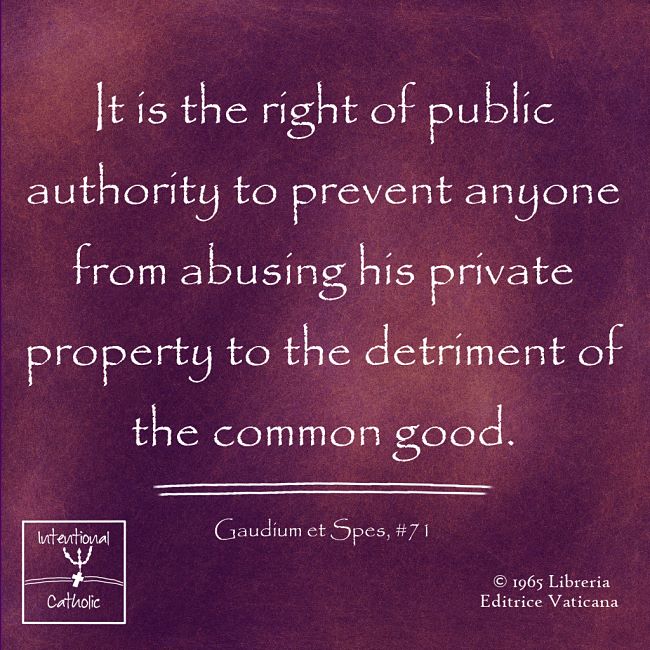
I’ve been sidetracked often lately in sharing these quotes from Gaudium et Spes. This excerpt comes from a chapter called “the life of the political community,” and it’s really striking in an era of political division that rests, fundamentally, on the question of how much government control, regulation, and oversight is appropriate.
As Catholics, we’re supposed to let the Church’s teachings guide our world view, but if this quote raises hackles, as I expect it will, I would suggest that it indicates an area in need of examination of conscience and–better still–of digging in to what the Church actually teaches.
The sentence immediately following this quote does address government overreach, but the wording is clearly referring to dictatorships. As much as we love to throw around such claims in America, a rational view of the world should make it clear that we have never been anywhere close to the dictatorial regimes of Europe or Central America. And the paragraphs following this excerpt talk about the need to frame all political philosophy in the context of the common good (in other words, common good is more important than adherence to a theoretical philosophy) and about the proper relationship between Church and the political community–shades of both religious liberty *and* separation between Church and state. It’s well worth digging into this, given the bitter divisions of our time and the devotion to political ideology over Catholic teaching (on both sides of the spectrum).
“Trample my courts no more! To bring offerings is useless; incense is an abomination to me.” (Is. 10:13)
Isaiah really didn’t mess around, did he? Most of the time we focus in on the feel-good prophecies about the coming of the Messiah.
But in yesterday’s first reading, Isaiah says, “Guys, seriously. God’s not interested in what you’re bringing to the altar. You’re trying to substitute ritual for meaningful action in your real life. Your worship is useless. What gives worship meaning is what you do outside these walls, and you’re not doing it.”
This reminded me powerfully of a lengthy reflection I read a few weeks ago. The context is race, but the part that struck me most profoundly was about the way we interpret various passages in Scripture. When we hear passages like today’s, we shake our heads at those poor blind, hard-hearted Israelites. But when the readings of comfort come, we think they’re meant for us.
Today I just want to share a couple of paragraphs from that article, which was an uncomfortable but eye-opening read. In fact, the article is one of many in a magazine issue devoted to forgiveness; the whole issue this came from is on my to-read list. I encourage you to click through.
There’s a lot on my mind these days that speaks to how we live the faith in the real world—a world that, at the moment, is defined by crises and division. More now than ever. I didn’t think that was possible.
It seems there is no safe subject; even small talk leads to conflict. This morning on a bike ride, I encountered my kids’ former bus driver, and stopped to chat (from across the street). I asked about coming back in the fall. The answer was a hard pushback on the forthcoming citywide masking requirement—a requirement that makes a lot of sense given that during the first wave, we had practically zero cases, and now we are averaging 30+ per day. “I’m VERY strongly anti-mask,” she said. ”I think it’s a personal choice.”
How does one respond to such vehemence? I know what I WANT to say. I WANT to say that as Christians, our world view is supposed to reflect a Gospel that tells us self-emptying, treating the other’s needs as equal to our own, is the way of discipleship. A Gospel that we believe tell us life is precious, and the right to life far outweighs personal “choice.”
I WANT to say, “Can’t you see that you’re setting aside your prolife convictions? That you’re using the exact same language used by the pro-choice movement for decades?”
But how do you communicate any of that without sounding holier-than-thou, preachy, and generally self-righteous?
It didn’t matter, because all I got out was, “Oh, I’m not.” Then she was pouring out her grievances, and thirty seconds in, I thought, I’m supposed to be home in 40 minutes. I just need to politely say “good luck” and move on.
So I did.
I spent the rest of my ride pondering this exchange and others. So many things have become wedge political issues that have no business being so. A pandemic should NOT be a political wedge issue. Racial justice should NOT be a political issue. Supporting women who have experienced harassment, abuse, or assault should NOT be a political issue. These are things people of faith should be unified on. Certainly the Catholic Church, flawed as it has been in practice, has spoken clearly on them all. How on earth has politics become more important in forming our world view than our faith?
But I realize that a lot of the refusal to budge on these issues is a reaction to scrupulousness–a scrupulousness that leads to making assumptions about people. From there, it’s a short skip to judgment.
There’s a lot of judgment on social media these days.
*I’m* judging a lot. Most of the time I don’t post my judgy thoughts, but that doesn’t mean they’re not there.
I think those of us who believe we have a societal responsibility to public health, who care passionately about racial justice and victims’ rights–those of us who care about these issues are so angry, we don’t always recognize that our words and our tone can do more harm than good. That sometimes, in our passion for justice, we cross the boundaries of Christian charity.
I know, that sounds like “tone policing.” I get it. But tone DOES matter, because when we make assumptions about what people are or aren’t doing; when we pass judgment; when we belittle and dismiss and make sweeping generalizations about everyone who (fill-in-the-blank)—
When we do these things, we make everything worse. We aren’t bringing people to a greater understanding of the truth. In fact, all we’re accomplishing is hardening people in their perception of persecution. They become less open to hearing, less open to examining the conflict between their worldly perspective and the Gospel.
Below (in the comments, on Facebook), I am sharing an op-ed that really hit me hard. I don’t often share (or read, for that matter) from the New York Times, because to so many people, it epitomizes the “liberal media.” But I think people across political spectrums will be surprised by what this man has to say.
A few weeks ago I decided we’d all adjusted as well as we could to COVID and I could return to Gaudium et Spes. I posted once, with the quote “…man should regard the external things that he legitimately possesses not only as his own but also as common in the sense that they should be able to benefit not only him but also others.”
Right after that, current events overtook me again. But here I am now, sharing this quote, the second in a group of three that really struck me. In our polarized political atmosphere, a point of view has developed that believes government has no right to limit personal property–that to do so is an overreach.
But it turns out that this point of view is inconsistent with Church teachings. This sequence from G&S (it’s paragraphs 69-71) makes very clear that government *does* have a right to regulate private holdings. We can debate all day the extent and the appropriate use of that right, but government does have a licit and totally morally upright role.
The basic premise behind “Intentional Catholic” is that we should examine everything we encounter–every gut reaction, every human encounter, every decision, every news story, every moral question and political issue–through the lens of our faith.
Many of the songs we love and sing robustly at church are about justice: Canticle of the Turning; Send Down the Fire; All That Is Hidden; Anthem; Christ Be Our Light; We Are Called; City of God; We Will Serve the Lord; Lift Up Your Hearts, to name a few.
These songs stir us because they awaken in us a connection between a real, tangible world and “Thy kingdom come ON EARTH AS IT IS IN HEAVEN.”
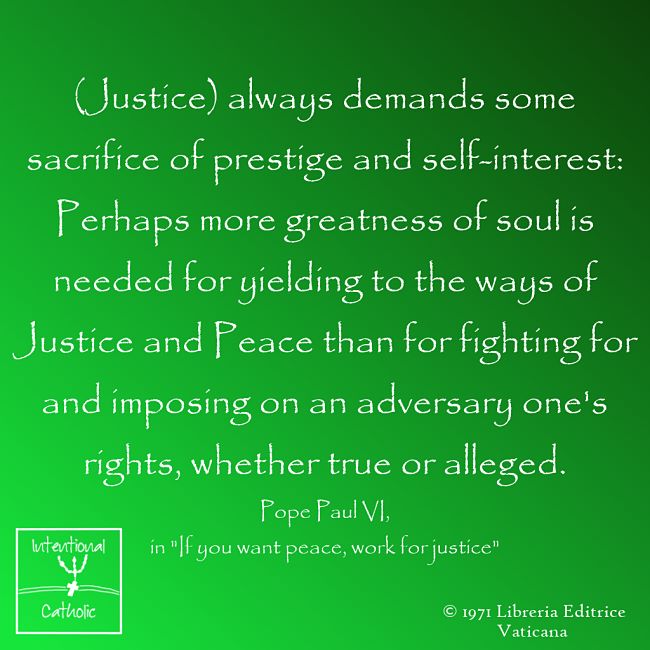
They stir us, in other words, because they underscore that justice is *supposed* to be something to be something we work toward on earth. That’s literally what we’re praying for in every Our Father we recite.
This presupposes that we have a role to play in that, because as Teresa of Avila famously said, we are now God’s hands and feet on the earth. They stir us to desire that just, peaceful world.
But when it comes to putting in the effort to make that happen, we crash into our own idols. We start fussing about what actually constitutes “justice,” because we start to realize seeking it is going to threaten some of our own worldly priorities and political philosophies. At some level, we begin to recognize how our idols might have to give way in order to truly see the Kingdom made reality on earth as it is in Heaven. We start feeling threatened by how much we might be asked to give up.
And in the end, we’re stirred by the music, and we talk the talk, but we don’t walk the walk.
And so justice remains a far away dream. People who have experienced oppression protest. Some among us look for reasons to justify dismissing them, while others with the best of intentions react so strongly to such dismissals that they end up perpetrating a whole other kind of injustice.
I’m really struggling with the world right now, if you can’t tell. Toss some hope my direction.
I’m posting this today, not because any of us think what happened to George Floyd was okay–I’ve yet to meet the person who thinks that–but because we, as Catholics, need to be reminded that it’s not enough just to think it’s not okay.
Our bishops have talked about the realities of institutional racism through this document, “Open Wide Our Hearts: The Enduring Call To Love.” They’ve told us also that we have a responsibility to act, and that the first part is to recognize how we are complicit in the continuation of racism in our country. And that is the part too many in the Catholic community are unwilling to do. This week I’ve encountered Catholics who won’t even read this document because it calls us into that hard examination of conscience, and they refuse to believe there’s anything to examine.
This is one of those times when being Catholic requires us to be intentional. Because if we aren’t, then we aren’t really being Catholic at all. We’re letting pre-determined worldly values determine how we interact with the world, rather than doing the hard work required when our faith directs us.
Disclaimer: I’m a big believer that faith is never easy, and if it is, it almost certainly means you’re not digging deep enough. If you think you have it all figured out, you’re probably more pharisee than seeker.
When I started Intentional Catholic, I knew I couldn’t just ignore the bits of the documents that are hard for me to swallow. So I admit it: this is one of them.
Certainly the most “traditional” among us believe very strongly that moms should be in the home, always and forever. But that second half of the quote, about not underrating legitimate social progress, seems to indicate that even the bishops had to wrestle with how rigidly to hold that principle.
Because if a woman’s rightful place is in the home as long as she has children, the reality is she will ONLY have a place in the home. The reality of the world is that one cannot have children, raise them in isolation from a professional career, and then blithely step into the workplace at age 45 or 50.
As crazy as my life is—as stretched-thin as I am by the various irons I have in the fire—I recognize how incredibly blessed I am that my gifts & passions lend themselves to working from home. But my situation is the exception, not the norm. God gives women gifts just as he gives men; surely He means for them all to be used? Surely they were all given for a purpose in the divine plan. Yes, mothers have something irreplaceable to give to their children, but does it necessarily follow that that gift can ONLY be expressed by staying home?
Also, the male-dominated professional world really suffers from the lack of the feminine gifts—peacemaking, teamwork, empathy come to mind; I’m sure there are others. Those, too, are gifts given by God for a purpose.
I know families in which the father is the one with the gift for homemaking, and it works beautifully. I also know families who move Heaven and Earth to work opposing schedules so they share the tasks of breadwinning and child care.
I’ve heard it said many times that stay-at-home-mom is a pretty new invention, one enjoyed only by the wealthy. I’m not able to confirm this quickly, but it tracks with knowledge of women working in clothing factories and washing houses in earlier times. If you think of moms at home pre-industrial revolution, they were growing vegetables and preserving, baking bread and sewing clothes for the family.
And if you are tempted to say, “Well, duh, that’s what you do when you stay home,” I’d remind you that at the same time the husbands were working fields and raising livestock, also at home. Home and work were the same thing for EVERYONE in the agricultural era.
And in the industrial age, how many of those wealthy at-home moms employed other women as wet nurse, nanny, and tutor? So they were home, but they still weren’t really raising their own kids. Plus, that picture reveals even more women working outside the home in an era we tend to idealize as the era of SAHMs.
So all in all, I think we have a tendency to oversimplify this whole picture of what a mother’s domestic role is, and what it means to safely preserve it. A mother does have a unique place in her children’s heart and in their upbringing. But it doesn’t follow that if she goes to work outside the house, that role is being discarded.
I have a family member who works full-time and points out that being a working mom does NOT mean work is more important. When kids are off school or sick, they frequently camp out in her office all day. When she can’t work it another way, she sacrifices work time. “I am always a mom first,” she says.
A lot of this reflection is not strictly faith-related, but many times general expressions of faith—i.e. “we are all given unique gifts by God for a specific purpose”—require us to get down in the weeds on practical things to see how that principle can or should be lived out in the real world.
Posted on
As Catholics, I think we’re often in danger of putting ourselves in a bubble. The thing that strikes me most in Gaudium et Spes is the implicit idea that we’re supposed to be in the world, not isolated from it. It seems so obvious. Of course–how can we leaven the world if we don’t interact with it?
But another danger of the bubble is that we develop a combative, competitive view of ourselves vs. the world. THE WORLD is bad, nothing good can possibly come of it, all secular movements are inherently contrary to the Gospel, etc. We do this all the time.
Here, the bishops and Pope Paul VI urge the faithful to remember that even when the world doesn’t get it all right, the heart is often in the right place. To me, the lesson is: Rather than battling everything that comes out of the secular realm, we should look for what is of value, and find how to work in cooperation for the betterment of all. To me, that seems the best chance for true evangelization.
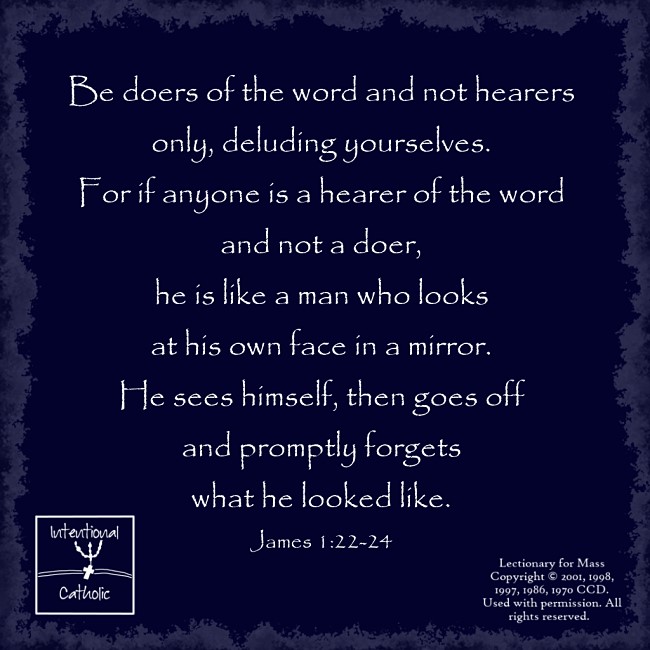
Listening to today’s daily reading caused me to perk up. What an image James uses to remind his community that simply talking about being a disciple isn’t really being a disciple! Farther down in the reading, he clarifies what he means by “doing something”: to care for orphans and widows in their affliction and to keep oneself unstained by the world. What struck me is the both/and of it–social justice AND personal piety. No false binaries here.




 Intentional Catholic