Freedom means saying no to ourselves

It’s been six years since I read Thomas Merton’s “New Seeds of Contemplation,” but the experience remains with me. It resonated so deeply with my experience of finding God in the silence of nature, beyond cell signals and wifi, beyond human noise. So many things stood out to me, but this quote in particular seemed noteworthy, because we think of “freedom” as “I get to do whatever I want to do.” We fail to recognize that self-gratification makes us prisoner within a set of chains far more inescapable than the strictures we rail against.

Here’s the larger quote:

It should be accepted as a most elementary human and moral truth that no man can live a fully sane and decent life unless he is able to say “no” on occasion to his natural bodily appetites. No man who simply eats and drinks whenever he feels like eating and drinking, who smokes whenever he feels the urge to light a cigarette, who gratifies his curiosity and sensuality whenever they are stimulated, can consider himself a free person. He has renounced his spiritual freedom and become the servant of bodily impulse. Therefore his mind and will are not fully his own. They are under the power of his appetites.

Thomas Merton, New Seeds of Contemplation

Pointing Scripture at others

The interesting thing is that the section of Evangelii Gaudium from which I drew both yesterday’s and today’s posts is addressed to preachers. Yet both days resonate really strongly with me as a lay person. I’m guilty of this… are you?

Faith Formation

I spent some time yesterday morning–the first full day of school for all my kids–thinking about faith formation for my oldest child, who has now transitioned to public schools. Not all forms of religious formation are going to serve every kid.

And what does good formation look like? One of the things I talked about in my books for families with young kids is that it’s not just about knowing the what. Is it more important to be able to name the commandments in order, or to know what they are and how they apply in real life?

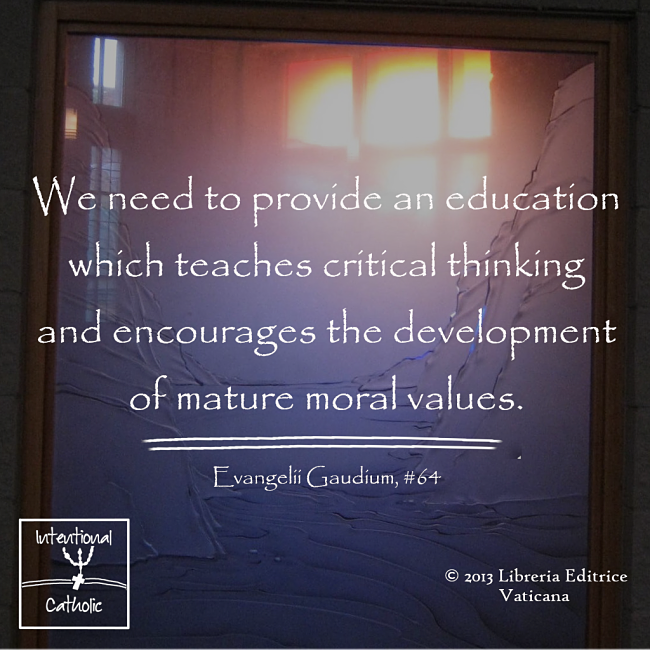
I don’t know what we’ll end up deciding, but I love the idea set forth in this quote: critical thinking formed by mature moral values. What a fabulous vision to set at the center of one’s educational goals! Critical thinking, to inoculate them from the worst of the manipulation practiced by modern life; mature moral values–not oversimplified ones that can’t stand up to the complexities of real life. I love it.

Now I just have to figure out how to get there….