
This section is speaking to those who prepare homilies, but it resonates for me, too.
Real Faith for a Real World
This section is speaking to those who prepare homilies, but it resonates for me, too.

For years, I’ve maintained that *living* the faith is the truest form of evangelization. I still believe that, and it’s tempting–because I really have zero comfort level with talking about the faith to people who don’t already share it–to gloss right over this snippet of Evangelii Gaudium.
The trouble is, I put it in bold face in my notes, which means I thought it was important. Probably because it makes me uncomfortable.
But here’s what I appreciate about it: it’s very authentic. It doesn’t say “go out and stand on a street corner and thump on a Bible.” It’s asking me to examine my life and recognize where God has touched it–and that is my witness. I have no problem saying, “Hey, everybody, I went to this great restaurant and the staff was friendly and the food was great and we had a great time!” I just have to learn to do that with my faith, too.
My book, “The Beatitudes,” is now available from Our Sunday Visitor’s Companions in Faith series. If you’re not familiar with this series, they’re small books meant to be compact–to get right to the point, because we all know nobody has time to waste. “The Beatitudes” looks at the nitty-gritty issues of real life through the lens of these statements, which encapsulate the Christian faith.
I loved this idea from the moment OSV approached me about it. We hear the Beatitudes so often, it’s easy for them to lose their punch. They sort of roll over our heads without really impacting. This book uses them as a way to examine our attitudes and actions and discern where God might be calling us to grow. You can read a section in about three minutes and spend the next several days mulling over and praying about it. Sounds about perfect for modern life! (Where are the emojis when you need them?)
In any case, I’m very excited about this book. It is perhaps the most compact, focused way I’ve been able to lay out what I mean by the words “intentional Catholic.” So over the next week or two, I’ll share a few quotes from the book off and on. I hope you’ll check it out!


The subject of unity has been on my mind a lot lately.
A well-formed, 100% orthodox Catholic friend shared an editorial addressing the danger of the organized dissidence against Pope Francis. It’s from NCR, which conservative Catholics often don’t trust, so I didn’t share. But I’ve been troubled for a long time by this as well as other signs of division in the Church. How can I make a difference? How can I foster unity in the Church–and, for that matter, in the world?
Wrestling with those questions brings me back to this:

Dang it.
This is hard to swallow. I mean, I know I am flawed and weak. The rush to judgment I excoriate others for is my greatest sin, too. But I’m trying so hard to think around the issues that divide us. To form myself, educate myself, and discern whether the good in one side outweighs the good in the other. And to share whatever good there is with others. My hope is that taking a measured approach can help bridge the gaps between us. Am I really powerless?
I was contemplating this question with great angst when my laptop unexpectedly switched documents. There’s nothing particularly remarkable about that (unfortunately); being an old computer with a first-generation touch screen, it does random things like that pretty regularly. What was remarkable was the document it flipped over to—a nugget carved off another post that wandered too far from its original topic:
For years, I’ve wanted to pull my hair out as our society—both within the Church and outside it—makes a run for the all-or-nothing extremes. If one dares challenge trickle down economic theory, one must, by definition, be against capitalism. If one says “America should be better than this,” one must, by definition, hate America.
Of course, it happens the other direction, too. Words like “racist” are getting thrown around pretty freely these days. Now, I’m a big believer that white privilege and unexamined bias are real problems. I see them manifest in myself daily, and the struggle to conquer them is part of my spiritual journey. But it also seems perfectly self-evident that well-intentioned people suffering from white privilege and unexamined bias are not going to be convinced to confront said privilege by being called racists for it. How we talk about things matters.
I had to stop and chuckle at the Holy Spirit’s timing. It was like a little Divine nudge saying, “Yeah, unity is my problem–but I have a job for you, don’t worry.”
As for the division in the Church: I’ve now read two of Pope Francis’ documents in full, and I am baffled by the voices raised so loudly against him. Everything I see is so clearly, authentically Catholic. He’s called out people for getting too focused on a sliver of the Kingdom to the exclusion of the rest; he’s called out legalism and extremism; he’s called out the misidentification of things of the world as things of God. But there’s nothing threatening to the faith in any of that. So my best (most charitable) guess is that people get defensive when challenged to grow beyond the comfortable and familiar.
There’s a lot of demonizing going on within the Church, and it’s got to stop. There’s got to be room in the Church both for people who are passionately committed to annihilating abortion and people who believe we can’t sacrifice every other Gospel command in pursuit of that worthy goal.
I can’t help feeling that a lot of the negative chatter about Pope Francis is a reaction to him being outspoken on social justice rather than abortion. I have to keep reminding myself of this:

Both in our Church and in the larger world, our habit is to do exactly the opposite—and to cling so tightly to our assumptions that we end up not even seeing there could be another interpretation.
When we do that, the Devil is the only winner. When we do that, we’re giving the Church and the world to Satan.
How about a chance of pace for a Monday morning? I have a book recommendation to share:
When Helping Hurts:
How to Alleviate Poverty Without Hurting the Poor…And Yourself
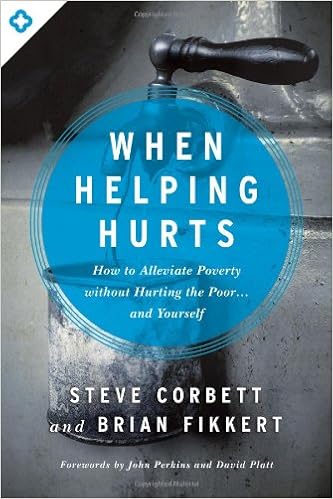
I can’t say enough good things about this book. Written by two Christians (not Catholic) who have been involved for decades in mission work, they share wisdom on how to be helpful, rather than going in with great intentions and making everything worse. In a nutshell, it boils down to this: we can’t come in and be saviors. Our job is to facilitate others helping themselves. There are three types of help: relief, recovery, and development. Most of the time, what’s needed is development, but the vast majority of the time what we offer is relief–because it’s easier. It’s easy to measure, its results make good reports to the investors.
The authors take a “both/and” approach. Many Christians look at the poor and assume they got that way by their own bad choices/sins; therefore their problems are theirs, not ours, to deal with.
Sin is an issue, the authors stress, but so are unjust societal institutions. As an example, they point to civil rights work in the south in the 1960s, and a particular pastor who didn’t speak out on racism.
“Both Reverend Marsh and the civil rights workers were wrong, but in different ways,” the authors wrote. “Reverend Marsh sought the King without the kingdom. The civil rights workers sought the kingdom without the King.”
The authors address overseas missions as well as efforts undertaken within the U.S. When Helping Hurts suggests that successful solutions are not either/or; they have to acknowledge both the effects of personal sin and the effects of institutional oppression, because those two things exert an influence over each other:
“What happens when society crams historically oppressed, uneducated, unemployed, and relatively young human beings into high-rise buildings, takes away their leaders, provides them with inferior education, health care, and employment systems, and then pays them not to work? Is it really that surprising that we see out-of-wedlock pregnancies, broken families, violent crimes, and drug trafficking? Worse yet, we end up with nihilism, because these broken systems do serious damage to people’s worldviews. Worldviews affect the systems, and the systems affect the worldviews.”
(p. 92)
When Helping Hurts offers the concept of “poverty alleviation” as a solution to the complexities of institutional injustice and personal sin. It is a “ministry of reconciliation” in which we use our money in such a way as to empower those in desperate circumstances to begin to help themselves. It acknowledges that they do, in fact, need help from outside, but that as much as possible we should honor the God-given human dignity of the poor by allowing them to be the leaders and the experts in their own lives. That our job is to empower them, not rescue them.
I’ve long believed that in most issues we bicker about, God is in the middle. This book shows us a Godly middle to issues of poverty. Both conservatives and liberals will find things that resonate and things that challenge in this book–which is, to me, the strongest argument that they are on target.

I spent some time yesterday morning–the first full day of school for all my kids–thinking about faith formation for my oldest child, who has now transitioned to public schools. Not all forms of religious formation are going to serve every kid.
And what does good formation look like? One of the things I talked about in my books for families with young kids is that it’s not just about knowing the what. Is it more important to be able to name the commandments in order, or to know what they are and how they apply in real life?
I don’t know what we’ll end up deciding, but I love the idea set forth in this quote: critical thinking formed by mature moral values. What a fabulous vision to set at the center of one’s educational goals! Critical thinking, to inoculate them from the worst of the manipulation practiced by modern life; mature moral values–not oversimplified ones that can’t stand up to the complexities of real life. I love it.
Now I just have to figure out how to get there….

It’s important to recognize that this applies not just to the issues we immediately recognize as evil, but to realities we resist recognizing as such.
We have a distressing tendency in America to decide that one issue or set of issues matters so much more than another issue or set of issues, we have the right to dismiss those others. It happens on both sides of the political divide. I would argue this is how we become people whose political affiliations (of whatever color), rather than our faith, end up becoming our primary identity.
I don’t think any of us intend to put politics before faith, but it’s really easy to fall into the trap. I’ve pointed that finger outward a lot in recent years, but you know what they say about pointing fingers: for every one you point at someone else, four are pointed back at you. In other words, I’ve been wrestling with this reality in myself, too.
Surely we can all acknowledge that America has been greatly weakened by the competing rigid extremisms that have been growing for the last twenty years. Extremisms that refuse to seek common ground and build from there. Extremisms so committed to the righteousness of that refusal that gradually, they cease to see there is any common ground.
But I would argue that the “either-or” mentality weakens the Church as well. Because when we dismiss an entire swath of issues as somehow less important, we look like hypocrites to a world we’re supposed to be evangelizing.
And they’re not wrong to think so.
When we decide to pick and choose what injustices matter, we thumb our nose at God. We imply that God isn’t big enough to deal with all the issues, so we have to decide for him which ones are worth fighting. We thus dismiss the suffering of everyone touched by every issue we didn’t choose. Is it any wonder that our efforts at evangelization aren’t successful?
Finally–to most people who are just along for the ride on these posts, it may not have really registered, but the breadth of topics covered in Evangelii Gaudium really underscores the spaghetti-bowl effect. This document, which is titled “the JOY” of the Gospel,” has wandered very far from the topic of joy itself. It underscores that to really spread Gospel joy, we have to embrace the whole Gospel, in all its difficult, messy glory.

It’s interesting to hear this argument, given the conversations/arguments we are having as a nation about gun violence. I’ve never heard anyone talk about this factor. Of course, violence goes way beyond mass shootings:
– Domestic violence is made possible by unequal relationships between life partners.
– War is quite often a symptom of one group imposing its greater power upon another weaker (i.e., unequal) population.
– Violent protests are quite often a symptom of a weaker, poorer, or oppressed group rising up against the institutions of power that hold them down. (Race protests in the wake of police shootings come to mind right away. And what happened in Puerto Rico.)
And so on. I find this statement really striking because we bemoan violence, we come up with all these ideas for what will stop it, and we miss this obvious reality, which means we can’t talk about violence without also talking about race, poverty, discrimination, and so on. It’s the spaghetti bowl principle all over again.

It’s hard to be Catholic these days.
Faithful Catholics have no home in public discourse, because we’re presented with false absolutes: rhetoric that demonizes or “other”-izes half of God’s children, or a world view that leaves no room for a person who doesn’t support abortion. Too many of us act as if one or the other of those is an acceptable choice. It isn’t. Not for a follower of Jesus Christ.
And of course, there’s the sex abuse scandal. The Church has taken a beating from the secular world on that–with good reason. Yet even now, we as laity aren’t really dealing with it. To do so would force us to grapple with a really hard truth: that the Catholic Church’s strength–the apostolic structure that shields it from being swayed by the vagaries of public opinion–is also, in this case, its weakness.
Because, let’s face it: we are a passive laity. We’ve been trained that way: “The Church is not a democracy.” Well, of course not, but when did that come to mean the laity are supposed to lie down and abdicate our baptismal calling as priest, prophet, and king? Too many of us see ourselves as lesser vassals of the hierarchy. Somewhere in our Catholic psyche is a deeply-ingrained belief that it’s neither our right nor our responsibility to speak to them on matters of Church governance. And that, among other things, is how we got the abuse crisis.
So what’s the way forward? If we try to claim any authority, we’re in danger of being called “dissenters.” Nobody wants to get slapped with that label, so we cede the field of spiritual battle. We settle for bickering over sexual orientation, guns, immigration, and organ vs. guitar.
I sound jaded, don’t I? This is not at all the tone I intended for Intentional Catholic. I love my Church. But I’m feeling worn down lately. The institutional Church is in defense mode, terrified of doing the wrong thing—so terrified, it’s failing, at least on a large scale, to call out abuses of power and violations of justice and God-given human dignity, lest we lose any more people who might be offended by having their consciences stung.
Well, that fear is justified, too. Surely your parishes look like mine. Fifteen years ago, our biggest Mass had people standing around the back every Sunday. Now, the only time pew space is at a premium is Christmas and Easter.
But for every person who’s thrown up his hands and left the Church in disgust, there’s another clinging by his fingernails at the edge, tottering. Desperate for grounding, strengthening, spiritual fortification. And every time some zealous Catholic (ordained or lay) launches into legalistic hair-splitting–which of course they never recognize as hair-splitting–the fine thread tethering that wavering soul to the Church trembles. Stretches. Weakens.
We’ve got to make room for people’s questions, for their doubts. We’ve got to accept that we have to have open conversations that are going to be unpleasant. Faith grows when it is stretched, which always means stress and discomfort. But God is big enough to handle it, and–even now–so is the Church.

We have to let people be broken and imperfect. We have to accept the messiness of having a Church full of broken, imperfect people. We have to recognize that unity does not mean uniformity, and if we ignore the issues that are rocking people’s faith, if we talk obliquely about them while getting into knock-down, drag-out fights over liturgy, we’re in great danger of losing all those who are clinging desperately to their faith by a thread. Who see us bickering over minutiae while they’re crying out for survival.
This is spiritual warfare if I’ve ever seen it. And we’ve got to stop giving the Devil ammunition.

Looking at the stars is one of my favorite things to do, but it’s often nearly impossible to find a spot to go where I can actually see stars and feel comfortable because I actually have permission to be there. The bed and breakfast where my husband and I stayed for our “anniversary-moon” is one of those rare spots. I stayed up late most nights sitting on the grass or standing beside the horse paddock at the ranch simply drinking in the glory of the night sky.
I identified constellations I’ve never known before, because they lie too close to the horizon, and at home they’re lost in the city wash. I got to watch the Milky Way emerge incrementally from the darkness. The last night I saw 5 meteors and 10 satellites.
Most of us rarely (if ever) get to marvel at the vastness of the universe in this visceral way. We spend our nights inside, and even when we do go outside, the sky is washed out.
We could all say, “Sure, I know the stars are there.” But we don’t know it, not the way we know the movement of the sun from east to west: where the shadows fall, what time of day we have to close the blinds because the summer heat will overcome the a/c, or what time to open them in winter to take advantage of natural warmth and light.

In the same way, the reality of God and responding to/living out his call are things we know to be there, but they often get lost in the washout of the brighter, more attention-getting concerns of daily life. We don’t have time to think about things like what does human dignity mean, beyond the obvious question of abortion: in terms of racial tension, questions of immigration and gun violence and honesty in the things we choose to read and share online.
Things like God’s presence in all the places in the world, and the way our tendency toward hyperbole leads us to outright heresy without even realizing it.
Or how often we go to war over minutiae of worship while relegating to the sidelines the fundamental call of Jesus to feed the hungry, clothe the naked, care for the sick of body and mind, and basically work to see the Kingdom made manifest on Earth. Good liturgy is important, but not as an end in itself. The liturgy is strength for the work of doing God’s will in the real world. When we get stuck in a war with each other over questions of style, we’ve missed the point.
The devil has many ways to get to us, and unfortunately it’s often by working on our religious sensibilities. Or simply our busy-ness.
I’m devoting the time and energy to this ministry because I’ve spent the last several years trying to quit bouncing along the surface of my faith on autopilot and dig down to something deeper. It’s been spiritually challenging, but also extremely rewarding and energizing for me to recognize the profusion of ways in which my belief in God touches the most trivial minutiae of daily life. I’m not perfect by a long shot, but what I’ve discovered is that I’m better able to teach my children a faith that–I hope, at least–will have the real-world grounding to stick for a lifetime.
 Intentional Catholic