Clinging to security

Background image by KasunChamara, on Pixabay

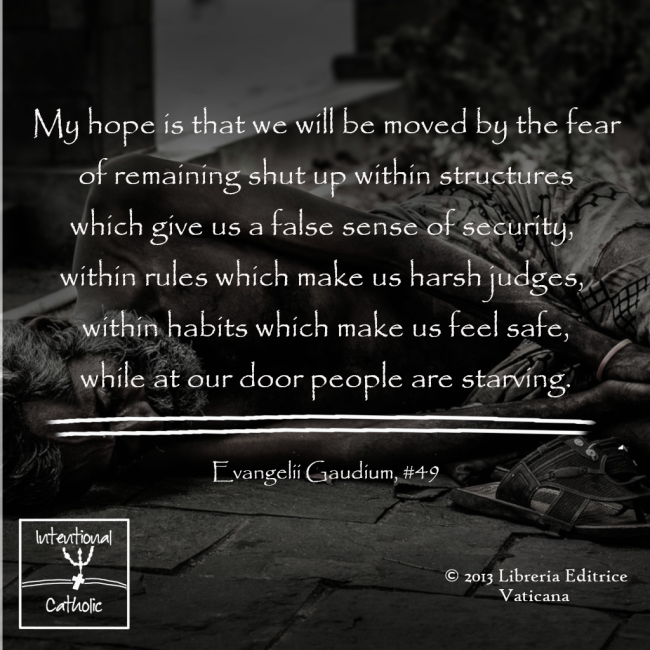
People are starving, not just for food, but for being treated with dignity and for acknowledgment of their wounds. Earlier in #49, Pope Francis talks about preferring a Church bruised and hurting from being out there with people to one that is “unhealthy from being confined and from clinging to its own security.” That description seems uncomfortably apt.

He also names a fear that I think drives a lot of religious people: the fear of “going astray,” which I interpret as the fear that if we go out into a sinful world, we’ll be corrupted by it. (We put our kids in bubbles for this reason, too.)

It occurs to me that if our faith is so weak it can’t survive the challenge of being around temptation, then the solution isn’t to hide from temptation, but to do some good work strengthening our faith.

I freely admit that I am no model for going out into the world and getting my feet dirty. In my case, it’s a result of an introvert’s paralyzing dread of interacting with strangers. But it’s something I’m thinking about a lot these days, and feeling called to address in that intersection of my own faith and the real world I inhabit.

To Love Is…

Since the Church considers this quote important enough to be underscored in the Catechism, I thought it deserved a graphic of its own, even if I did already write a whole post on the topic. Sometimes a picture is worth a thousand words, right?

Love Is A Concrete Thing

Photo by Ylanite Koppens on Pexels.com

Tell me if this sounds familiar: you tell a kid to put away a piece of clothing, and ten minutes later you look and discover it hasnโ€™t been done. You tell them to do it again, and this time it makes it up the stairs and gets dumped on the floor. By the third time, youโ€™ve pretty well lost your temper, and itโ€™s all downhill from there.

This is my life right now: dishonesty, serial disobedience, and difficulty discerning how much is developmental and how much is spacey personality versus testing behavior. My husband reminds me weโ€™ve been through it before and weโ€™ll get through it this time, but itโ€™s wearying.

Why does this warrant a blog post on a site about living the faith?

Because Iโ€™m starting to recognize that this parenting issue has a lot to teach us about loveโ€”real, self-giving, sacrificial love. How can we teach such a big concept to our children without starting with small, intimate relationships and smallโ€”maybe even pettyโ€”examples?

Little kids experience the world in concrete ways, after all. I need my child to learn that love doesnโ€™t just mean cuddles and kisses and being tucked into bed at night and giving me a hug on the way out the door. Thatโ€™s a tiny childโ€™s version of love, but as they grow, they need to learn that a bare minimum, love means you donโ€™t do things that harm the other.

And since Jesus Christ was never in the business of bare minimum, Iโ€™d go a step further and say, as the Catechism says: love means willing the good of the other.

So your actions show your loveโ€”or the lack of it.

To wit: if you cause your favorite parent to LOSE HER EVER LOVING MIND because you just donโ€™t feel like doing what she asked you to do, then youโ€™re causing harm and youโ€™re definitely not willing the good of said parent.

In other words: NOT. LOVE.

Okay, itโ€™s petty, I know. But really, if you start spinning out the implications, this is a big deal, and not just for the kiddos, but for us as adult Catholics.

Because if:

a) everyone is our neighbor (Luke 10:29-37), and

b) loving God means loving our neighbor (Luke 10:27-28; Galatians 5:14), and

c) love means willing the good of others (Catechism of the Catholic Church 1766)โ€ฆ

โ€ฆthen weโ€™d darned well better be thinking about willing the good of asylum seekers at the southern border.

And about how to alleviate the strain on of living on women who see abortion as their only option.

And how to erase discrimination (which might mean, for a start, acknowledging that it still exists).

And what it means to steward the earth God gave us for future generations.

And how to create policies that put the good of workers and society before personal or corporate profit.

And how to protect victims of abuse and assault, rather than shame them and blame them and assume they’re lying for underhanded political reasons.

Because with every word we speak about those issues and every policy solution we advocate (or fight against), we show our love for Jesus Christ.

Or the lack of it.

The fruit of the Spirit

Image by Bruno Glรคtsch from Pixabay

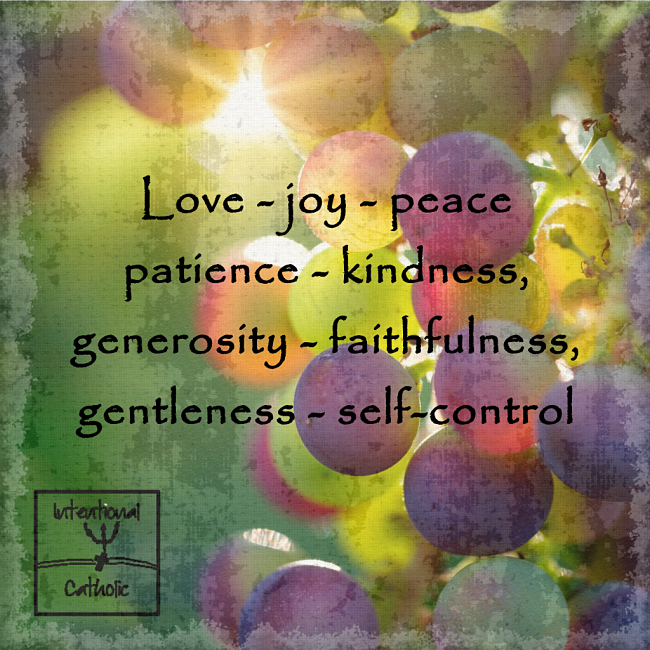
In today’s Gospel, Jesus talks about false prophets and urges us not to trust too easily. “By their fruits you will know them,” he says. Bishop Barron’s accompanying reflection referred that back to the fruit of the spirit. (Item: an editor once pointed out that it’s not “fruits,” plural, but “fruit,” as in: a single fruit with all these facets. I had never noticed that before.)

What struck me this morning was that it sounds great to say “by their fruits you will know them,” but discernment is harder than it looks. We all produce fruit both good and bad. We can be incredibly generous in certain situations (natural disasters) and appallingly stingy in others (homeless people at intersections). We can be generous in thought, giving the benefit of the doubt to some (many within our close sphere of influence), and yet we leap instantly and irrevocably to the worst conclusions about whole groups of people (the assumption that asylum seekers are freeloaders and/or criminals; the assumption that immigration opponents are racists).

The fruit of the spirit is distinctly lacking in our public discourse today, and I don’t just mean the leadership. It’s on us, too. Is there a single one of those facets that we do not see violated daily on both sides of every debate? There are real problems in the world, real things to be angry about, but when we indulge the worst that is within us, we dump fuel on the fire instead of working toward the Kingdom. (This is one of the topics I discuss in my new Beatitudes book.)

Today’s reading is a reminder that a prophet who does not seek to manifest the fruit of the Spirit can and will be dismissed, no matter how true the message. It’s a personal challenge to each of us to shape up, and an equally difficult one: not to give our leaders a pass, either.

On Sarcasm, Mercy, and having your conscience walking around in the body of a six-year-old

In 2016, I wrote a series of posts called โ€œMercy on a Mondayโ€ for my personal blog. Many of them are just as applicable today as they were then, so Iโ€™m mining my archives to share here.

Photo by Pixabay on Pexels.com

It didnโ€™t take long for this list of ways to live out the year of mercy to nail me between the eyes:

1) Resist sarcasm; it is the antithesis of mercy: โ€œโ€Set, O Lord, a guard over my mouth; keep watch, O Lord, at the door of my lips!โ€ (Psalm 141:3).

Umโ€ฆouch.

Sarcasm is the cloak I wear at certain times of the month. It is my instant response to being asked a) stupid questions, b) questions Iโ€™ve already answered, and c) stupid questions Iโ€™ve already answered.

Itโ€™s also my instant response when a political candidate gets on my nerves (daily, at a minimum), when a driver does something I donโ€™t like, or a piece of technology causes me inconvenience. And itโ€™s always aimed at the people behind those irritants, who should have been smarter and more polite than to bother Almighty Me.

Iโ€™m a word pictures kind of girl, and in the past month, mercy has come to be associated with something soft and cool, pliable, able to bridge the gap between square pegs and round holes. Sarcasm, on the other hand, is a hard, hot slap in the face. It raises hackles and solidifies them into brick walls. It makes both parties hard and unforgiving (in every sense).

Sarcasm is demeaning to others. It excoriates the soul and causes sensitive people to retreat into themselves. It shuts down communication. It might be funny, but the laughter only makes the belittling and the soul scouring feel even more belittling and soul scouring. It feeds bad feelings on both sides: self-hatred on the part of the victim and self-righteousness on the part of the one who doles it out.

It can be death on a marriage, in particular, and cause real pain to children, who only want to be loved, even when theyโ€™re completely clueless how to express that need appropriately.

Resist sarcasm; it is the antithesis of mercy.

I read those words and instantly vowed to change. And just in case there was any doubt that this was what I was called to do, the Holy Spirit gave me a big wakeup call the next day. It was in the van on the way home from school, and my mini-me responded to his little brother with blistering sarcasm, his tone dripping with contempt. It cut me to the soul, instantly and so profoundly that I even remember where we were on the route.

Because this is my fault. Iโ€™ve taught them this.

I donโ€™t remember what I said. I do know it was not a scolding; it was heartfelt and involved confessing my own fault in the matter. I told them part of what I was doing for the year of mercy was to quit being sarcastic.

The car was quiet for a few moments, which, if youโ€™ve ever had three, four, five, or six kids in the car (as I do on a regular basisโ€“am I not lucky?), youโ€™ll know is no small thing.

You know that old saying about how parenthood means having your heart walking around outside your body?

Well, I think God gives you children in order to make sure you have a conscience walking around in someone elseโ€™s body, commenting out loud on your foibles. In this case, the body of my six-year-old.

โ€œMom, are you being sarcastic?โ€ my child will ask me.

โ€œUmโ€ฆyes, I was. Iโ€™m so sorry, honey. Youโ€™re right.โ€

โ€œMom, I think that was sarcastic!โ€

โ€œWe-ell, that was sort on the edge. It was more like a joke.โ€

Itโ€™s been good for me. Itโ€™s making me stop and think before I share the effervescence of my own wit.

I donโ€™t like it. But I can feel the difference. Iโ€™m not so angry, so volatile, like a pump primed and ready to react to the slightest provocation. The inside of my chest feels a little cooler and settled, more relaxed, more open. It feels like growth. And that is, after all, what Iโ€™m going for, in this year of mercy.

It’s not about what we say

Background Image by Soorelis from Pixabay

It seems like everyone these days is focused on “what do we say to the ‘none’s?” and “How do we talk about Jesus?”

I can’t help feeling that those are the wrong questions. Pope Francis’ contention in Evangelii Gaudium is that when we’re filled with the Gospel, it’ll overflow from us automatically.

These days, I’m becoming more and more convinced that simply living the Gospel authentically, holistically, and with joy is the simple, yet difficult part of evangelization that we have to master first. For better or for worse, the world sees an image of God in us–in our words, in our actions, and in the way we approach everyday situations and hot button issues. If the image we present is beautiful and inviting, we don’t have to say anything at all. If it’s off-putting, nothing we say will make any difference anyway.

Racism is a prolife issue

Open Wide - prolife

This quote may seem shocking, but it speaks to the larger prolife issue. To be truly pro-life, we have to be thinking beyond the legality of abortion; we need to think about the larger issues that exert societal pressures. Why is the abortion rate so much higher among black women, do you think?

I have a lot of thoughts on the current state of the debates around abortion, but I will leave this for now and hope that it encourages many to click through and read the whole pastoral letter.

“Consider the dignity of others”

Open Wide - jokes

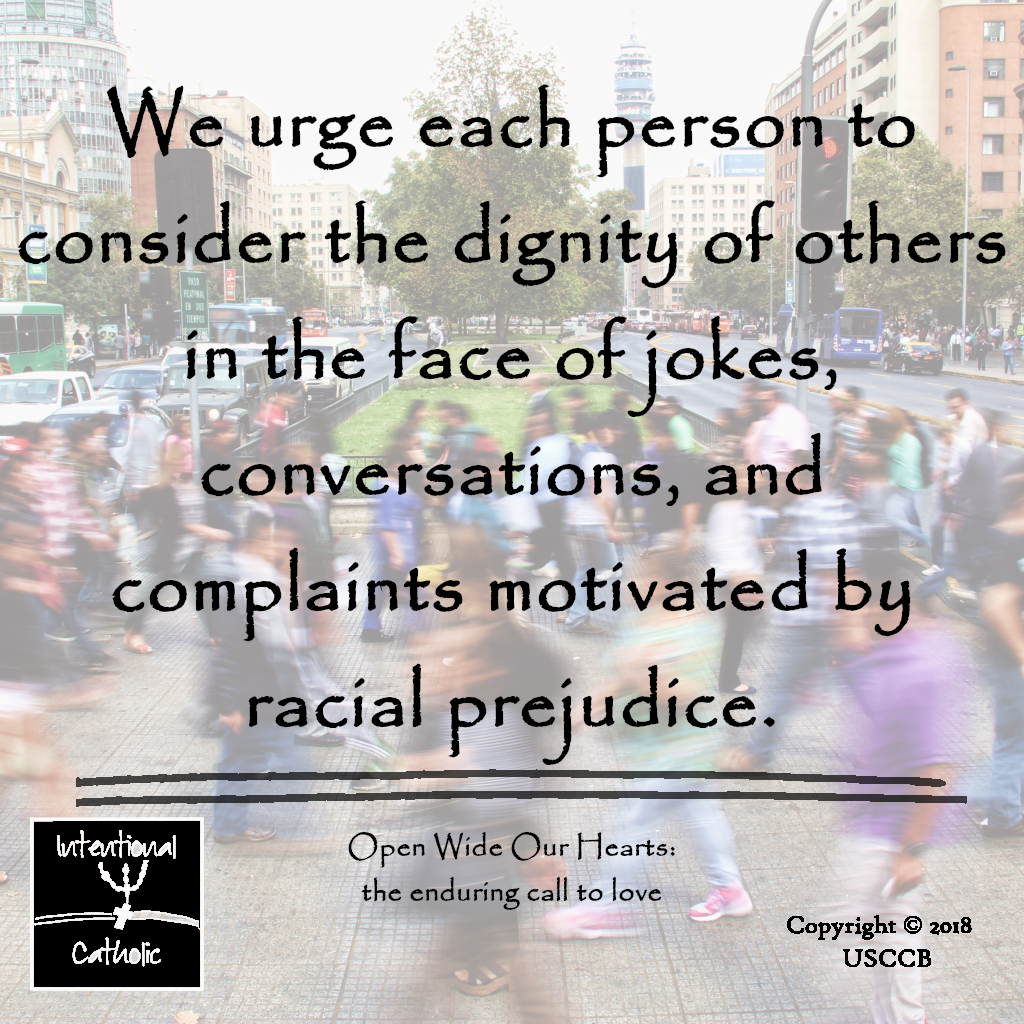
I think all of us intend to do as the US Bishops urge in this quote. I think, in fact, that all of us think we *are* doing it. This is one of those areas in which I believe it will benefit us all to simply be more intentional–more self-analytical–to pull off the blinders and recognize when we aren’t, in fact, keeping the human dignity of others front and center…when we brush aside their protests because to take them seriously would require us to make uncomfortable changes. It’s certainly not a problem that’s isolated to issues of race, but it’s a place to start.

Fulfillment of human dignity

EG 9 - dignified and fulfilling - resize

Happy Memorial Day to my U.S. readership! It’s been a crazy May for me, so if I take a hiatus next week, bear with me. I have a lot of catchup to do, and now the kids are out of school–time to get some healthy summer habits set up!

On that topic…Yesterday, some friends and I were chatting about what it takes to get our children to really connect the faith with the real world. There was discussion about whether working at the soup kitchen might be just as effective as formal religious education. Perhaps not a substitute, but definitely food for thought as summer break begins and parents have a little time to breathe, to live intentionally with our families…

If goodness wants to spread, why do I harden my heart to others?

EG 9 - profound liberation.jpg

One of the hardest things about harvesting quotes from Church documents is that, taken out of context, we don’t always appreciate the magnitude of what we’re reading. This quote, for instance, is in the middle of a passage on goodness. Goodness, Pope Francis says, spreads outward by its very nature. What goodness we receive wants to expand out to others.

Is this really how we receive goodness? Do we desire to take what has filled us and spill it over to others? If so, what does that mean for the way we interact with others?

Yesterday morning my son and I took a bike ride along a trail near our house. Along the way we crossed paths with two people, one of whom I think was homeless and the other I’m sure of. I said hello and waved as I do with everyone I encounter on the trails, but where most people respond with “beautiful morning!” or “good morning!” these two men appeared guarded. I got to thinking about how we, the with-homes crowd, react to homeless people. I can list off a series of things I’ve heard or thought myself, and none of them are charitable. All of them focus on the fact that the homeless are an inconvenience, they make us uncomfortable, or they got themselves into their own messes and thus they are Not Our Problem.

These people, who areย notย beneficiaries of the good things you and I have, have to know that this is how they’re viewed. No wonder they feel a need to be on the defensive whenever they cross paths with us. They’re probably bracing for being reported to the police and kicked out, when they have nowhere to go.

Where is the evidence, in these instances, that goodness desires to spread outward? If we are truly receiving goodness–in other words, if we are cognizant of it, if we are truly grateful for all we have been given–why do we default to judging those less fortunate based on assumptions about their situations? Are we truly free from sin? Because if we are, shouldn’t we be more willing to acknowledge and responsive to–not just individually but as a society–the needs of others?