It’s interesting to hear this argument, given the conversations/arguments we are having as a nation about gun violence. I’ve never heard anyone talk about this factor. Of course, violence goes way beyond mass shootings:
– Domestic violence is made possible by unequal relationships between life partners.
– War is quite often a symptom of one group imposing its greater power upon another weaker (i.e., unequal) population.
– Violent protests are quite often a symptom of a weaker, poorer, or oppressed group rising up against the institutions of power that hold them down. (Race protests in the wake of police shootings come to mind right away. And what happened in Puerto Rico.)
And so on. I find this statement really striking because we bemoan violence, we come up with all these ideas for what will stop it, and we miss this obvious reality, which means we can’t talk about violence without also talking about race, poverty, discrimination, and so on. It’s the spaghetti bowl principle all over again.
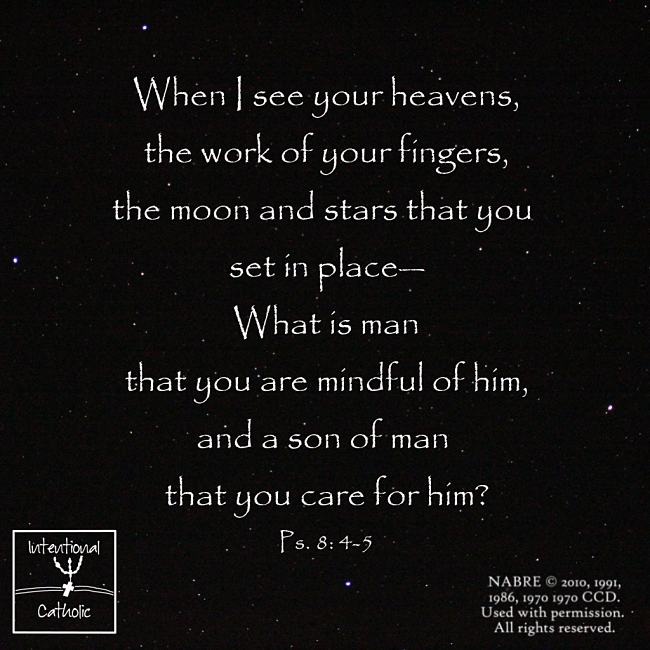
I took this picture using a shoe as a tripod for my DSLR last Sunday night
Looking at the stars is one of my favorite things to do, but it’s often nearly impossible to find a spot to go where I can actually see stars and feel comfortable because I actually have permission to be there. The bed and breakfast where my husband and I stayed for our “anniversary-moon” is one of those rare spots. I stayed up late most nights sitting on the grass or standing beside the horse paddock at the ranch simply drinking in the glory of the night sky.
I identified constellations I’ve never known before, because they lie too close to the horizon, and at home they’re lost in the city wash. I got to watch the Milky Way emerge incrementally from the darkness. The last night I saw 5 meteors and 10 satellites.
Most of us rarely (if ever) get to marvel at the vastness of the universe in this visceral way. We spend our nights inside, and even when we do go outside, the sky is washed out.
We could all say, “Sure, I know the stars are there.” But we don’t know it, not the way we know the movement of the sun from east to west: where the shadows fall, what time of day we have to close the blinds because the summer heat will overcome the a/c, or what time to open them in winter to take advantage of natural warmth and light.
Sometimes we pause to drink in sunset, but most of us give up soon after. What took the place of this glow, when it faded, was the Big Dipper. But you to devote another hour to waiting for it to happen.
In the same way, the reality of God and responding to/living out his call are things we know to be there, but they often get lost in the washout of the brighter, more attention-getting concerns of daily life. We don’t have time to think about things like what does human dignity mean, beyond the obvious question of abortion: in terms of racial tension, questions of immigration and gun violence and honesty in the things we choose to read and share online.
Or how often we go to war over minutiae of worship while relegating to the sidelines the fundamental call of Jesus to feed the hungry, clothe the naked, care for the sick of body and mind, and basically work to see the Kingdom made manifest on Earth. Good liturgy is important, but not as an end in itself. The liturgy is strength for the work of doing God’s will in the real world. When we get stuck in a war with each other over questions of style, we’ve missed the point.
The devil has many ways to get to us, and unfortunately it’s often by working on our religious sensibilities. Or simply our busy-ness.
I’m devoting the time and energy to this ministry because I’ve spent the last several years trying to quit bouncing along the surface of my faith on autopilot and dig down to something deeper. It’s been spiritually challenging, but also extremely rewarding and energizing for me to recognize the profusion of ways in which my belief in God touches the most trivial minutiae of daily life. I’m not perfect by a long shot, but what I’ve discovered is that I’m better able to teach my children a faith that–I hope, at least–will have the real-world grounding to stick for a lifetime.
I have to be honest: it’s terrifying to share this excerpt from Evangelii Gaudium. The idea of free market and trickle-down economics is foundational to the world view of so many Americans who hold the Christian faith, it’s often viewed as fundamental to being a Christian. Heck, I grew up that way. I know how defensive a reaction this quote is likely to provoke in many faithful Catholic readers.
So I guess we have to start by acknowledging that we can’t examine this question solely from the perspective of faith, because there is a very concrete, practical reality underlying it. The fundamental practical question we have to answer before we can address the faith component is this: does trickle-down economics work? Does it actually bring prosperity (and, far more important, greater human dignity) to all? Because if so, more power to it. But this weigh-in from the Church indicates otherwise.
Back to the topic at hand. If Pope Francis is right, then what does this mean for us as Christians?
I’ve spent an hour trying to formulate an answer to that question that doesn’t trip political land mines. Maybe the answer is that we all, regardless of where we stand politically, need to pray for the grace and wisdom to be able to self-reflect more honestly. We’ve always embraced it when our leadership has called out the failures and injustices in the Communist systems. And with good reason. But we’ve often turned a blind eye when the popes and bishops have called out the same offenses within capitalism. It’s easy to assume we know God’s will and not even recognize when what we’re actually worshiping is our own.
We all have our preconceived ideas about what elements of modern life run counter to God’s plan. I could list mine, and no doubt some of them would be quite different from yours. Contradictory, even. We’d probably get into an argument about it. Isn’t that what happens every time we talk about guns, immigration, health care, poverty initiatives, race, or climate change? Half of us think the kingdom points in one direction; the other half sees that direction as heresy.
When God works in our lives, we are challenged to grow. Growth
requires change, and change is threatening to our equilibrium. So we
resist. We come up with a hundred ways to dismiss what we recognize as a
threat to our own comfort.
How, then, do we truly discern when God is at work, challenging our preset assumptions, as opposed to when something is truly counter to God’s plan?
I would argue that we have to start by subordinating our preconceived opinions long enough to think around divisive issues and see them from another side. We might not change our minds. In some cases, we shouldn’t. But we’ll recognize the nuance and complexity of the issues, and that would allow us to enter into conversations in a productive, rather than toxic, way. It would go a long way toward bringing us, collectively, out of the place of acrimony and extremism in which we, as a nation, have become imprisoned. And that, in turn, would bring us closer to God’s kingdom.
I have a love-hate relationship with Facebook. Like everyone else, I love getting “likes,” and I love sharing and staying in touch with friends and professional contacts. It eases an introvert’s anxiety going into social situations if I already know something I can talk about with the people I’ll be seeing.
But the very thing that makes Facebook so great—how easy it is to share with others—also encourages us to share indiscriminately, without taking time to think through whether it’s inflammatory, whether it’s manipulating our emotions, and in fact, whether it’s reliable information at all.
Having been caught myself too many times by reacting instead of pausing to think–embarrassing for someone who strives to be fair-minded–I’ve become a huge skeptic of all inflammatory social media posts. I’ve spent the last several years fact-checking things on Facebook and trying desperately to get others to do the same–mostly without success.
There are plenty of non-religious reasons why we ought to be making sure what we share is actually true and not skewed:
-the ease with which outside powers manipulate us and endanger the trustworthiness of our elections;
-the way half-truths and distortions inflame anger, which leads us to abandon the middle ground–where compromise and fair progress are birthed–in pursuit of the extremes;
-the way families and friendships have been damaged by commitment to views formed by bad information;
-the shattering of lives in the wake of private mistakes becoming public humiliations.
But if we set aside all those reasons and focus solely on our faith, there’s another one:
We should fact check because honesty is in the Ten Commandments. It’s fundamental to right relationship with God.
Throughout Scripture, the righteous one is praised: the one who does not swear, the one whom everyone knows can be trusted to be truthful. One who speaks with integrity. Let your yes mean yes and your no mean no (a shot at the hyperbole that characterizes modern “communication”). The upright one is like a tree planted by a running stream. And so on.
Telling the truth is one of those basic rules of humanity we teach our kids. Dishonesty from our kids is one of the most relationship-damaging offenses, because it destroys trust.
And yet when it comes to social media, we forget all of this. We take every meme at its word, without even pausing to think, “Maybe I should double-check whether this is legit before I hit ‘share’.”
Or: “Does this even make sense?”
The misinformation, distortions, and misleading inflammatory things we share online may not be our own words, but they become our words when we speak them, and therefore it is our responsibility as Christians to make sure we do our due diligence before sharing. If a headline makes you angry, you’d better be on your guard, because it’s probably a sign that someone’s taking liberties with the truth in order to manipulate you.
Everybody wants lots of likes, you know, and too many don’t care if they bend the truth to the breaking point to get them.
It takes all of 30 seconds to type a search string into Google and see if something’s been flagged on one of the fact-checking sites. Also, we need to pay attention to the sites where we get information. We tend to trust any “news” site that agrees with us in their editorial slant, and we turn off the brain God gave us to think critically about what we take in. Some sites routinely shared by Christians ought to be boycotted altogether, because they’re among the worst offenders.
Honesty. It’s one of the foundations of our faith, let alone any successful society. If we want to stand before God with a clear conscience, we have got to check the accuracy of the things we choose to share.
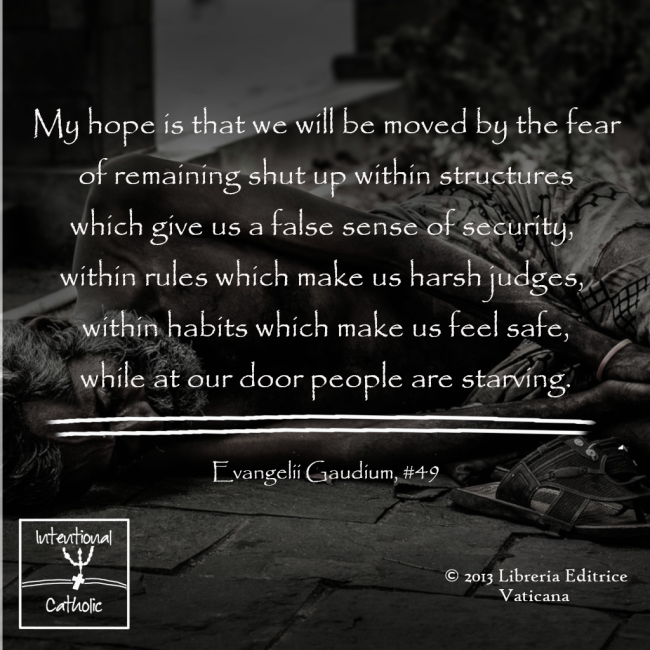
People are starving, not just for food, but for being treated with dignity and for acknowledgment of their wounds. Earlier in #49, Pope Francis talks about preferring a Church bruised and hurting from being out there with people to one that is “unhealthy from being confined and from clinging to its own security.” That description seems uncomfortably apt.
He also names a fear that I think drives a lot of religious people: the fear of “going astray,” which I interpret as the fear that if we go out into a sinful world, we’ll be corrupted by it. (We put our kids in bubbles for this reason, too.)
It occurs to me that if our faith is so weak it can’t survive the challenge of being around temptation, then the solution isn’t to hide from temptation, but to do some good work strengthening our faith.
I freely admit that I am no model for going out into the world and getting my feet dirty. In my case, it’s a result of an introvert’s paralyzing dread of interacting with strangers. But it’s something I’m thinking about a lot these days, and feeling called to address in that intersection of my own faith and the real world I inhabit.
I said before, on a different graphic: Dorothy Day struggled with joining the Church because of the contradiction between Catholic social teaching and the reality of communities whose focus was Bingo and card games. What about us?
Right now, the Church is doing a lot of soul searching about how to evangelize the “nones.” In my opinion, we’re driving the “nones” away by, among other things, insisting that in order to be welcome in our midst, they have to come all the way to meet us where we are, instead of us going out to meet them where they are.
Of course, we have a vision we want others to share. But we also have to recognize that conversion is a lifelong process, and we’re not done with it, either. Nobody’s saying we can’t belong, so why should we say that to others?
We need to accept the imperfections in others, because we’re all walking the same path, even if we’re in different places along it. Jesus didn’t get tax collectors to stop being dishonest by standing apart and wagging his finger at them. He went into their houses and made friends with them, and they realized he had something they wanted, which made them want to change. He didn’t go to them with a pre-existing condition: “I’ll come eat with you if, first, you promise to change.” No, he went to them with no guarantee that they’d step up to the plate. He made the effort, and that was what made the difference.
Notice also, he didn’t go into the house saying, “I’ll come eat with you and give you a witness talk to convert you.” How off-putting would that be? No, he just went, trusting the relationship to do the work of conversion. And it did.
So I think evangelization begins with evangelizing ourselves. We need to work at excising judgment and conditional love from our attitudes, and replacing them with a genuine, unconditional desire for the best for others. Not a desire to tell everyone else what they’re doing wrong, and how they should change for their own good. Not a great academic argument based on dozens of source documents.
Don’t get me wrong: I love that kind of stuff, and it’s good for our own growth in understanding. But if that’s how we start conversations with those outside the faith, we might as well not bother. No one listens to that kind of message. It’s a waste of time.
No, we need simply to wish the best for others, and model a life of joy and peace that will make others go, “Hey…I want that! How do I get some?”
I’ve been trying to write this post for a while, but I can’t seem to come up with a hooky opening. (Or title.) Maybe that means there isn’t one. Maybe I just have to write it and hope you’ll all read it, even without a hook.
During a discussion of Henri Nouwen’s “Life of the Beloved” a year or two ago, I had this moment in which God pried my brain open and I understood something so liberating, it was almost dizzying.
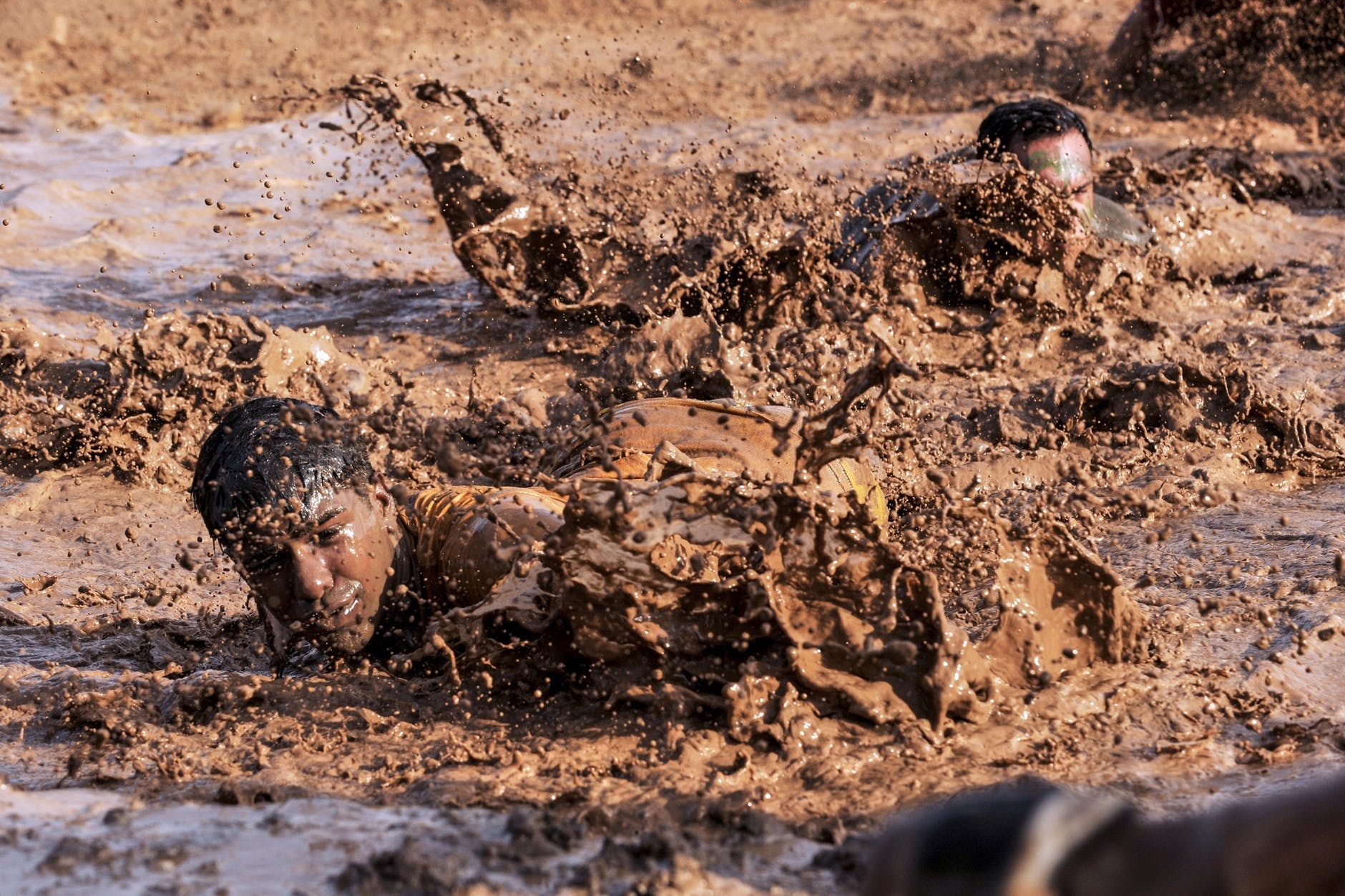
My whole life, I’ve looked at sin as falling down in a pit of muck.
Most of the time, we talk about sin as a huge, inescapable reality: a systemic failure to which we’re inevitably and forever doomed as part of our humanity. We can fight it and fight it, but we’re always going to get dragged down into that muck again, because that’s who we are.
It had never before occurred to me to look at discipleship and the Christian life as a lifelong hike up a beautiful mountain whose pinnacle is Heaven. Of course you’re going to get tired along the way. Of course you’re going to slip and trip. Mountain climbing involves rocks and uneven ground.
The difference between these two perspectives is profound. In one, we view ourselves as mud dwellers. It’s our natural state of being.
In the other, we view ourselves as good people seeking to be better. Even when we trip and fall, we get up and keep going. Notice I didn’t say “get up and try again,” as if we’re running on a treadmill sunk in the mud and will never be anywhere other than in the mud.
No. I said we get up and keep going. We acknowledge that we fell down, but we brush ourselves off and keep heading for the heights.
This is a tremendously liberating thought. It takes away the hopelessness of sin. I still recognize my need for mercy—the fact that tripping on the way up the mountain doesn’t get me kicked off the mountain is a grace I can never fully comprehend. On Earth, after all, tripping up is routinely used as grounds for getting kicked out.
But because I belong to God and God is my end point, sin doesn’t have to define me. I can see myself as beloved. As worthy of receiving mercy. I can see hope for getting farther up the mountain, closer to God.
And if I see myself this way, I can learn to see others this way, too.
If I see myself and everyone else basically as mud dwellers, then Pope Francis’ quote makes no sense.
We Christians have a tendency to take an all-or-nothing view of things. When we see what we perceive to be weeds growing in the field, we filter out any fruit those people might be bearing. If the fruit is being produced by someone who doesn’t look like we think Godliness is supposed to look, we don’t want it, thank you very much.
But “weedy” people have gifts and wisdom and worth to offer, too. Thank God, nobody has to be perfect to have a place in God’s Church. And if we go around making a big list of things you have to do to be “good enough” to belong, then we’re driving away the people we’re supposed to bring to Christ.
And who’s to say that one of these days, that “weedy” person won’t be the one offering us the hand up on that steep, difficult climb toward God?
Since the Church considers this quote important enough to be underscored in the Catechism, I thought it deserved a graphic of its own, even if I did already write a whole post on the topic. Sometimes a picture is worth a thousand words, right?








 Intentional Catholic