“Outside Agitators” and Martin Luther King, Jr.

Background image by EasyGiftWizard, via Pixabay

On Martin Luther King, Jr.’s birthday, I read the Letter from a Birmingham Jail.

One of the first things that struck me was that he was writing because he had been chastised by a fellow clergyman for being an “outside agitator.” Why did this strike me so forcefully? Because I live not terribly far from Ferguson, Mo., and I heard people invoke the “outside agitator” argument myself. And at that time, I didn’t know what to make of it.

That argument goes something like this: “Those protests weren’t organized by people from ___. They were organized by national organizations who shipped people in to stir up trouble.”

I don’t think I had fully realized, until reading MLK’s letter, that “outside agitators” is how the civil rights movement works.

Martin Luther King, Jr., wrote a lengthy paragraph in the letter from the Birmingham jail, explaining this. But then he gave the quote above. Here it is, in context.

Beyond this, I am in Birmingham because injustice is here. Just as the eighth-century prophets left their little villages and carried their “thus saith the Lord” far beyond the boundaries of their hometowns; and just as the Apostle Paul left his little village of Tarsus and carried the gospel of Jesus Christ to practically every hamlet and city of the Greco-Roman world, I too am compelled to carry the gospel of freedom beyond my particular hometown.

Moreover, I am cognizant of the interrelatedness of all communities and states. I cannot sit idly by in Atlanta and not be concerned about what happens in Birmingham. Injustice anywhere is a threat to justice everywhere. We are caught in an inescapable network of mutuality, tied in a single garment of destiny. Whatever affects one directly affects all indirectly. Never again can we afford to live with the narrow, provincial “outside agitator” idea. Anyone who lives inside the United States can never be considered an outsider.
-Martin Luther King, Jr. – Letter from a Birmingham Jail

I have to admit, it was really disheartening to realize that after all this time, despite how much honor is accorded MLK across political divides, we are still using the same arguments that were used to try to shame and discredit him and his work.

The Letter from a Birmingham Jail is a breathtakingly beautiful piece which remains every bit as relevant today as it was in 1963. Well worth reading.

Archbishop Tutu on Christian’s responsibility to address racism

Photo credit: John Mathew Smith & www.celebrity-photos.com via Flickr

This quote landed in my email inbox this morning within the Center for Contemplation and Action’s daily reflection*. Archbishop Desmond Tutu’s words here affirmed the convictions that have been growing in me for the past decade and a half or so: that the political issues of our time are part of our responsibility as Christians to address.

The blatant examples of racism in the U.S. are an easy target–the way in which nationalism has become inextricably (and bafflingly!) tied to racism.

But I would argue that stopping there is the easy way out. If we make the Proud Boys et al the scapegoat, then it’s tempting to give ourselves a pass on the subtler manifestations of racism—the ones that make many of us squirm when we are forced to look at them honestly. Things like inequality of educational opportunity and funding, unevenness in the justice system from top to bottom, the generational ripple effect of redlining and discrimination in housing and the GI bill… and on and on.

The “Learning How To See” podcast episode I listened to most recently explored comfort bias—the idea that our brains reject information that makes us uncomfortable. Information that is inconvenient to us.

For sure, the idea that racism is baked into American society, and that I, as a white person, am benefiting from it, is uncomfortable! To accept that would mean that if I want to be a Christian, I am required, by my faith, to do something about it. And it might even mean working against my own worldly interests, i.e., my own comfort.

The static from certain quarters surrounding critical race theory strikes me as a perfect example of comfort bias.

Which brings us right back to Desmond Tutu, doesn’t it? What is a Christian’s response to evidence of baked-in racism? Will we lean into the discomfort and allow ourselves to be made holier by advocating for just and equitable systems in our nation? Or will we dig in to our biases and continue to “spit in the face of God”?

*The reflection carried this note about sourcing: Desmond M. Tutu, “My Credo,” in Living Philosophies: The Reflections of Some Eminent Men and Women of Our Time, ed. Clifton Fadiman (New York: Doubleday, 1990), 234, 235. Note: Minor changes made to incorporate inclusive language.

The Now And The Not Yet

At this time of year, Catholic sites are generally be gentle and meditative, wreathed in evergreen and violet candles. (Did you see what I did there? 🙂 )

I’m not feeling that this year. Advent is normally a big thing in my household, but this year I’m giving myself a pass on some of our traditions. It’s just not where we are right now. I told my spiritual group yesterday that this year, I’m writing a book and learning how to live with a celiac diagnosis for my child, and that’s quite enough mental/spiritual wrestling for me this Advent.

But what I AM doing this Advent is pondering the tension that is intrinsic to life in the faith.

The kingdom of God is now, here, in the person of Jesus, but also unfolding in real time, and never to be fully realized in this world.

We are to accept authority—but at the same time, questioning and wrestling is the only way we grow in faith. Without it, we stagnate. Even fester, growing ever more rigid in our binary, simplistic view of the world. Kind of like all those pirates on Davy Jones’ ship in Pirates of the Caribbean—ever more inflexible, until eventually we freeze solid and lose our humanity altogether. In other words, we are called to submit, but also to be prophetic.

We are given, by virtue of our baptism, the power to heal—this is a conversation we had yesterday in my small faith group—and yet I would argue that the chronic conditions of my life are the things that have allowed me to grow.

I think there’s a lesson in all this for me as I begin this discernment surrounding detachment. Because that is the essential question I can’t wrap my brain around—the one I shared here a couple of weeks ago. Godly anger is what fuels us to pursue Godly justice. Yet this seems to stand at odds with the idea of detachment, which would suggest that we remain a step back emotionally, setting aside such passions altogether.

That’s why this graphic caught my attention when it crossed my feed last week. It’s not about religion, but my faith is integral to my view of the world, and that gets expressed through real-world events, i.e. the news. So it resonated on the level of faith for me.

In my last appointment, my counselor and I were grappling with balance, and she said, “I just want to make sure you know that balance means it’s always changing. It’s not the same from day to day.”

She was right, of course; I’ve known this for a long time in my family life—that one or another of my responsibilities takes precedence at any given time, and it’s constantly shifting. We tend to think of balance as a static thing: a beam BALANCED on a point. But that only works if all the factors acting on it are static. As the forces of my life act upon me, I have to adjust constantly. I do it automatically on a bicycle. Or walking. Or when a small child runs and tackles me while I’m sitting in the middle of the floor.

But somehow when it comes to the bigger things, the spiritual life, I have this fantasy that there’s some magical island within me that if I can just find it, I’ll never have to adjust again.

Photo by Chinmay Singh on Pexels.com

But the reality of the “now-and-not-yet” dynamic is that those two things DO stand at odds. That tension will never be resolved in this life. On one side is the passion to see God’s justice made real in the world: “Thy will be done, they kingdom come on earth as it is in Heaven.” We pray for that daily. God’s will for the earth can’t happen if we shrug our shoulders and say, “Oh well, in Heaven all will be well, so I just won’t worry about everything that’s wrong.”

At the same time, the righteous anger that fuels the passion can easily become unhealthy. Crippling. Damaging to the connection to God and neighbor. Detachment is necessary too.

There’s a tension there that can’t be avoided. Neither of the extremes contains the whole truth. The truth comes in the balance between them.

But finding it… that’s the thing I’m beginning to grapple with now.

Thoughts on nonviolence and how it’s organized

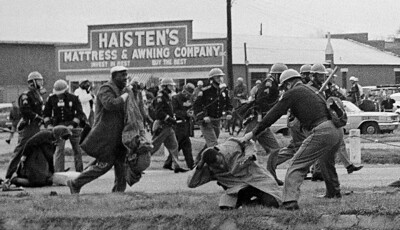
A few years ago, when Ferguson, Missouri was all in the news, I remember various people saying to me, “Those people are bringing in outside agitators from other places.” It was a criticism, suggesting that if “outsiders” weren’t riling up the populace, we wouldn’t be having these racial protests at all.

I wasn’t prepared to answer that argument at that time, and I haven’t heard it again since the Black Lives Matter protests swept the country. But as time goes on, I realize that the entire Civil Rights movement was structured the same way: national organizers identifying places where their presence could make a difference, and going there to support the local population.

(What we learn about history really does get distorted—whether it’s a concerted effort, or whether it’s because there’s so much of it and it gets oversimplified in an attempt to boil it down to its most important message, is another question. I’d hazard a guess the answer is “both.”)

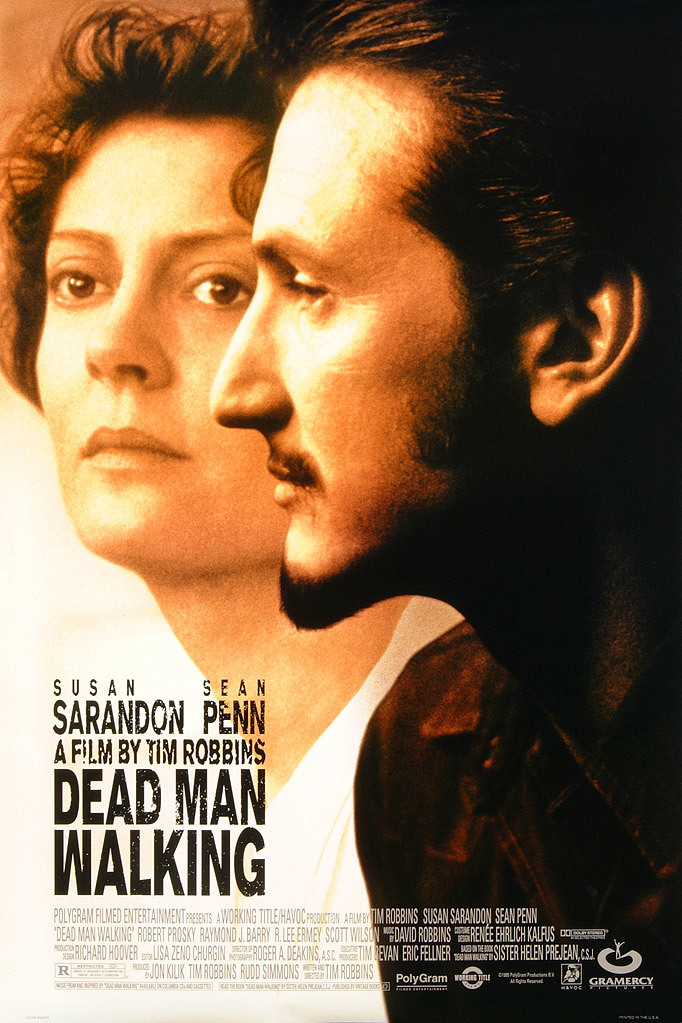
In “Dead Man Walking,” Sister Helen Prejean quoted from another book, “Wild Justice,” by Susan Jacoby, which appears now to be out of print. This passage really struck me.

Nonviolence, as employed by Gandhi in India and by King in the American South, might reasonably viewed as a highly disciplined form of aggression. If one defines aggression in the primary dictionary sense of “attack,” nonviolent resistance proved to be the most powerful attack imaginable on the powers King and Gandhi were trying to overturn. … King was even more explicit on this point: the purpose of civil disobedience, he explained many times, was to force the defenders of segregation to commit brutal acts in public and thus arouse the conscience of the world on behalf of those wronged by racism. King and Gandhi did not succeed because they changed the hearts and minds of southern sheriffs and British colonial administrators (although they did, in fact, change some minds) but because they made the price of maintaining control too high for their opponents.”

Susan Jacoby, Wild Justice, pp. 336-337

Every once in a while, someone points out that Jesus’ instruction to turn the other cheek was the polar opposite of passive acceptance of injustice. (Read this for that mind-blowing take on a very familiar passage.)

This passage from Wild Justice also turns on its head the idea of nonviolence as passive. It made me rethink the whole movement. This describes a whole new level of courage: to go in, intending to provoke violence against oneself, which you will consciously not react to, in order to show the violence inherent in the system? Wow. Just… wow.

It was what Jesus did, too. Of course, Jesus’ crucifixion was about salvation beyond the things of the world. But God could have accomplished that any way he liked. The fact that the chosen way to get there was through nonviolent resistance to earthly injustice has to mean something for us.

Detachment and other wrestlings

Dead Man Walking (1995) - IMDb

I just finished reading “Dead Man Walking,” by Sister Helen Prejean, tracing how she became involved in the quest to abolish the death penalty. I began it intending to read as quickly as possible, but shortly realized I needed to slow down, to take time to process and sit with it. One of the most powerful things about the book is how well she weaves together her incredibly poignant personal story with the evidence that beat her over the head along the way, forming her in motion.

No doubt many realities she lays out–with exceptional precision and lots and lots of footnotes to primary source material, i.e. court cases (as well as analysis/opinion pieces)–have changed since the book was published in 1993. One that I know has changed is the public perception toward the death penalty. Less than half of Americans now support the death penalty.

And yet many of the realities she points to are still going strong. Public defenders are overworked and for that reason, the poor are those who go to death row. It costs far, far more to litigate, appeal, and re-appeal than it would simply to put a convicted killer in prison for life. And on and on.

I read this book in a time when I continue to struggle with the apparent unchangeability of all that is wrong in the world, and with those who refuse even to acknowledge the problem, let alone sacrifice to do something about it.

Image by John Hain from Pixabay

At the same time, I am encountering the word “detachment” again and again, wrestling with what that means, and how it reconciles with the call to discipleship, which presupposes trying to make the world that better reflection of God’s will that we rattle off in prayer six times in every rosary and once during every Mass and countless other times in ritual and personal piety.

And at the same time, I encountered a podcast interview of Bro. Guy Consolmagno, S.J., who called out the prolife movement for talking about protecting “innocent life” when in fact, as Christians we are called to protect ALL life. It seemed to apply to multiple threads of my spiritual life right now.

I wish I had more answers and fewer questions. Maybe then this Intentional Catholic ministry would have a bit more impact. But then again, intentional has to be authentic above all, and if nothing else, these posts are authentic.

A house divided…

I have not been posting much the last few months. I keep chewing over the same baffling questions again and again, and feeling that I am shouting into a void. So I’ve focused my energy instead on my fiction. There’s precious little time in my life for splitting my focus these days, anyway.

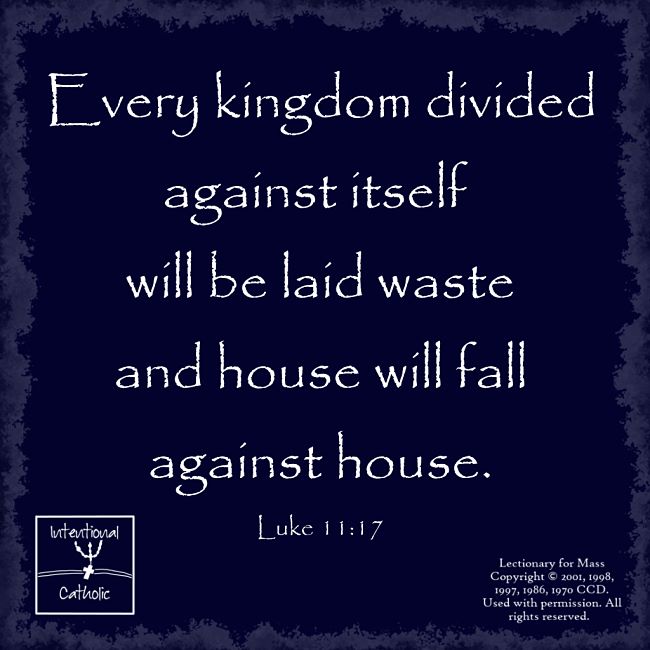
But the US bishops’ daily reflection Friday morning was on the topic of division and unity. A house divided cannot stand, Jesus cautioned. If good work is being done, it can’t be of the devil. And if there’s division, it is not of Christ.

The Church is a hot mess of division right now, just as our nation is. Every time I come up against an entrenched position that baffles me, because it is so clearly contrary to my faith, and it’s being held by people who are using their faith as justification for their beliefs, I think of this question of division. I think, “How can this be, when we all claim to believe the same things?”

Spoiler alert: if you’re reading this post in hope of there being an answer at the end, prepare to be disappointed.

Every time I come up against one of these, I think, “There’s no way God could be calling both of these sides to these beliefs. Is there?” Then I pause to search my own conscience and try to see how I could be the one who is wrong. I frequently find that I am wrong in my anger toward, judgment of, and assumptions about people who think differently than me. But I have rarely found the Spirit nudging me that I am, in fact, wrong in my beliefs. Not given the information I have.

So then I go and do research to see if my information could be wrong. I look at the sources, I think, “Nope, not going to read that, it’s too far left and I can’t trust it to be objective. Nope, not going to read that either, because that’s clearly a group with a dog in this fight. There, that’s a moderately-right-leaning source, that should give me a good counterbalance to my own biases.” Occasionally I moderate a position; I think, “this thing people are freaking out about on the left is probably not as big a deal as they’re making it out to be.”

But not often.

It is deeply disturbing to me that so much of our discourse these days is arguing over things that are so easy to disprove. It really isn’t hard to discern between credible sources and conspiracy-theories.

A good friend of mine recently left Facebook, because it was an exercise in scrolling through things that made her angry. “I feel like we’re conditioned to look for the next thing to get angry about,” she said. “I just needed to get away from that.”

How do we seek unity—Christ—instead of division—the devil—when it seems that so many of our conflicts are based, not on reason, but on appeals to all that is sinful within us—our selfishness, our lack of empathy for others?

Face To Face With Homelessness in New Orleans

Photo by Alvin Decena GCASH 09561687117 on Pexels.com

I have been in New Orleans for the past nine days—first on vacation with my family, and now staying on solo for the NPM (National Association of Pastoral Musicians) conference, where I’m presenting this week.

We have so enjoyed our time here—from swamp tours to beignets to fabulous jazz, it was a great trip with the kids. But I was not prepared for the sheer scope of the face of Jesus in the homeless population that I would encounter here.

The presence of people suffering homelessness has been a cattle prod to my conscience for twenty years. I remember going to work at the church and feeling the hypocrisy of driving past the people holding signs as if they weren’t even there—when I was headed to work at a CHURCH. Eventually I started keeping a stash of protein and Nutri Grain bars in the vehicles to pass out. It feels insufficient. But it’s better than refusing to make eye contact at all.

I always think about Lazarus lying at the rich man’s gate, begging for scraps and being ignored. That rich guy probably wasn’t evil. Probably, he just was uncomfortable, didn’t know how to help, and so he didn’t make eye contact.

I also think about Peter and John at the Beautiful Gate, and the beggar there who couldn’t walk. That story stands out to me because it says he asked for alms, and then Peter responded by saying, “Look at me.” Then the Bible says: He paid attention to them, expecting to receive something from them.

The eye contact raises expectations in the person on the receiving end of this equation—and that’s why we don’t do it. That’s why we ignore them. Eye contact compels us to step in in some way. But if we can’t even look in the eyes of Jesus in the person suffering homelessness, then… Well, it says something about our commitment to the faith. Something we probably don’t want to know about ourselves.

So I have made a real effort to make eye contact —to SEE the people who stand at highway intersections back home. After twenty years, I know many faces and some things about them, both positive and negative.

But I was completely and totally unprepared for the magnitude of the homeless population in New Orleans.

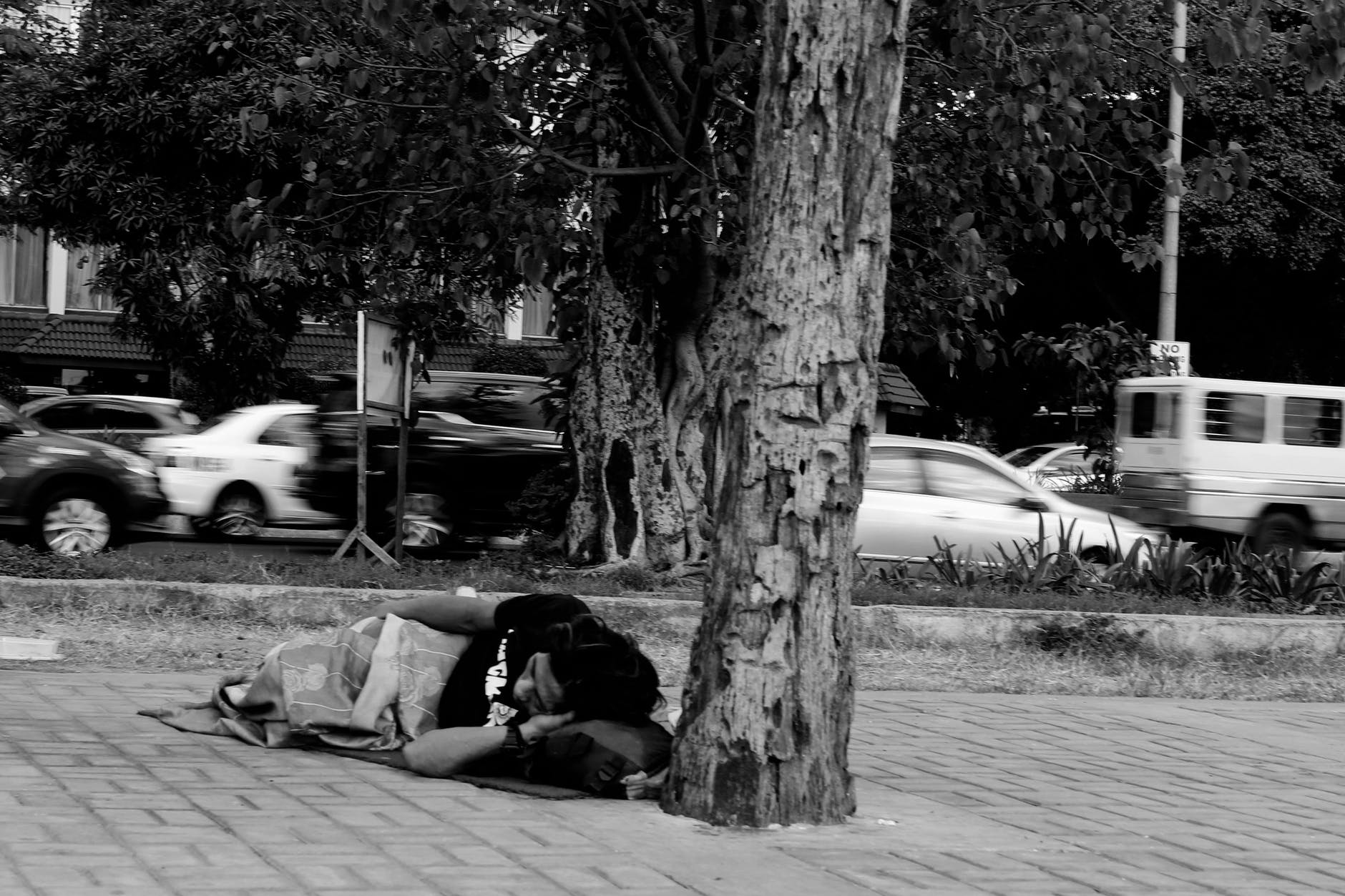
Camps, apparently long-term, beneath the interstates (in the shade—very important). Right out in the open. A man sprawled on the sidewalk sleeping on Canal Street, a handful of steps from restaurants that would cost my family $150 to eat there. Another man using an umbrella to block the sun as he sleeps against a lovely old wrought-iron fence. A woman, her face a study in shame and hopelessness, sitting on a three-hundred-year-old stoop with a sign that says, “First time homeless.” I have seen literally hundreds of homeless people in the week I have been here.

Hundreds of the face of Jesus, looking at me.

The first day, the first HOUR of the first day, I should say, I pulled singles out of my wallet, just to do SOMETHING, knowing perfectly well that if we emptied our wallets, it would only take care of a dozen of these people for a day, maybe two. And yet–and yet! We are on vacation, spending money on ourselves!

Eventually, I had to resort to the very thing I despise: walking by without acknowledging. Food is expensive here, even for me. Do I go buy six orders of beignets and hand them out? Relatively cheap, but totally useless calories. Do I spend a hundred dollars buying $15 burgers and onion rings from the place next to my hotel, and hand those out?

I wish I could offer what Peter and John did in that moment by the Beautiful Gate. They were able to heal that man, give him back the ability to walk—the thing that kept him in poverty, unable to help himself.

What this experience makes so clear to me is that the problem of homelessness is one of the many that are a systemic problem, and so the solution also must be. That does not excuse me from my responsibility to see and to be made uncomfortable and to help in whatever small way I can. (Trail mix bars from the CVS two blocks down?) But it also reminds me that I have to work for justice in the larger world, because the problem isn’t mine to solve alone—it is OUR problem.

The more things change…

If you notice the copyright on this, it comes from 1986. In the grand scheme of things, I suppose 35 years is not a huge length of time. Nonetheless, it’s been more than a generation, and we’re still bickering about the same things. That feels a little disheartening to me.

The rest of this quote says, “These wounds will be healed only by greater solidarity with the poor and among the poor themselves.” Solidarity is a scary word. A lot of us live in a pretty significant bubble, which allows us to view the problems of others in an abstract way, rather than as something concrete and heartbreaking and intensely personal. Don’t get me wrong, I’m no paragon of virtue in this respect. I’m no better at solidarity than anyone else, despite my best intentions. But it twinges my conscience and forms my approach to the political and social issues that so preoccupy modern discourse.

Freedom and Fraternity

There’s a lot in this section of Fratelli Tutti that should make us squirm in America. In #103, Pope Francis reminds us that freedom and equality are insufficient without dedication to concrete love of neighbor. Without making a political (he does use that word) priority of taking care of each other, liberty is nothing more than “living as we will, completely free to choose to whom or what we will belong, or simply to possess or exploit.” Liberty, as God intends it, is directed toward the welfare of the other.

And then, of course, there’s the excerpt above. What follows it is a reminder that efficiency is often at odds with the common good.

In recent years, I’ve become deeply convicted about the fundamental flaw in the whole idea of “pulling yourself up by your bootstraps.” #109 addresses this. Plenty of us don’t, in fact, need help from a “proactive state,” because we’ve been born into functional educational systems and families that can get us to the doctor.

We all stand on the backs of our parents, grandparents, teachers and communities. Within our communities, we support each other; this is good. It WORKS. I certainly didn’t need any of those COVID stimulus checks, and how to use them in a way that best served the common good was a matter of no small debate in our household.

But it’s a mistake, and I would argue, contrary to Christian discipleship, to assume that simply because many of us don’t have need for a proactive state means nobody does. Look at the injustices and inequalities that litter America’s history:

These are just a few structural realities whose consequences have rippled down through history. If we stand on the shoulders of those who came before us, then some among us are fighting a way, way bigger battle than others.

These are hard realities to accept in a time of such profound division. But the Cross IS hard, and the Holy Spirit gave us a shepherd at this time who’s calling us to confront the things that make us uncomfortable.