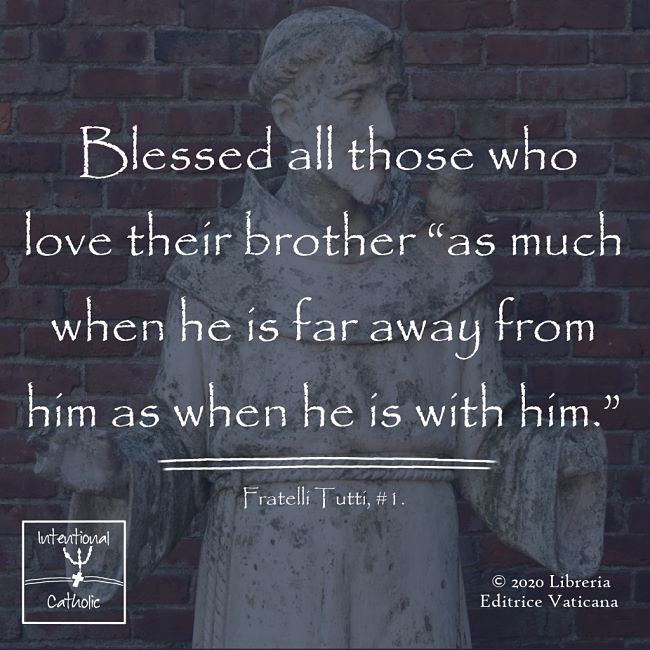
I have begun reading Pope Francis’ new encyclical, “Fratelli Tutti,” and thought it might be worth simply sharing as I read, since it’s new to all of us.
The topic seems like a timely reminder, given the state of the world right now. I can’t quote it all, but Pope Francis sets the tone in the introduction by pointing to St. Francis of Assisi’s trip to visit the Sultan Malik-el-Kamil. He went during the Crusades–a time when the goal of Christianity was to conquer and convert the Muslims–and instead modeled peaceful conversation with no agenda at all.
Two things strike me here: one is that with this trip, St. Francis, quietly and without making a production of it, issued a sharp rebuke to the entire goal of the Crusades. A rebuke that, with the benefit of hindsight, was well deserved.
The other is that Pope Francis is setting the stage to remind us that our worldwide politics of division (because it’s not just an American thing) is directly counter to holy living.
And I suppose there’s a third thing, which is that there’s more than one way to interpret “far away” and “near.” In St. Francis’ case, it was both physical and philosophical difference. My guess is that Pope Francis is gearing up to admonish us to be “brothers” in both those spheres in modern life, as well.
It has not been pretty in my house, these last 125 days. Have you intuited that from my posts? It seems all I do these days is fret, gnash my teeth, and talk about the lack of peace in my house–the strain of kinda-sorta-not-exactly-quarantine, the lack of structure, the endless snipping and sometimes screaming, the teenage hormones and the childhood overreactions.
The other day I had my youngest two children working on dishes. In their resentment at being forced to work (not that they had anything else to do; they were totally bored), they instantly fell to squabbling. “You can’t use the spray hose that way,” “you’re taking too much space at the sink.” That kind of nonsense.
I turned to them and said, “That’s enough! I don’t want you two to say anything to each other you wouldn’t say to ME if you were working with ME.” Because they are kind to me, if not to each other.
It was a stroke of brilliance–the Holy Spirit’s, not mine, just to be totally clear. They are accustomed to being horrible to each other. To be told to treat each other as they treat the person they trust the most required a hard reset. They didn’t like it, but for one of them, the tone of voice changed instantly. In the other it happened after I said, “Would you use that tone of voice talking to me?”
Yesterday’s readings struck a chord so deep, it resonated in my whole being. Our new associate’s homily tied together the various parables brilliantly. It can be much harder than we realize to judge between good and evil, he said. Which is why it’s not our job to rip out the “weeds,” but instead to be leaven–to live the faith in a way that causes the whole culture to “rise.”
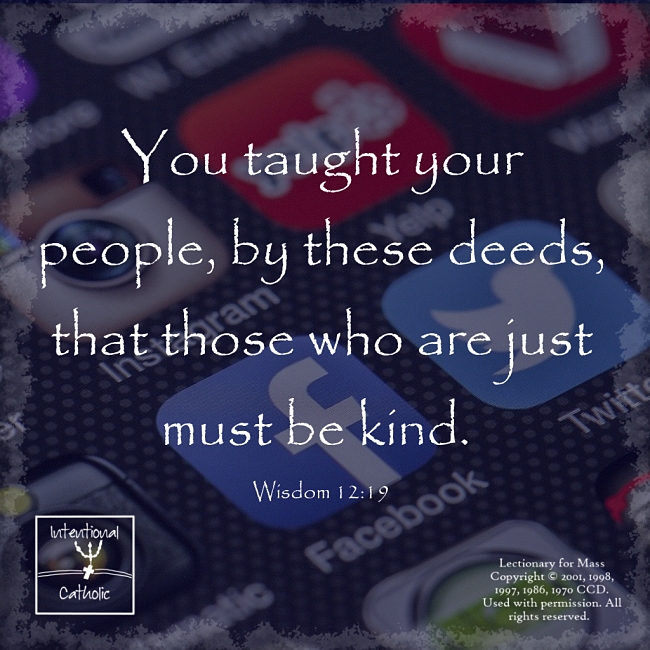
But the words that stay with me the most were those from the book of Wisdom. “You taught your people, by these deeds, that those who are just must be kind.”
In these heavy, momentous days of pandemic and communal examination of conscience, there are many of us concerned with justice. There’s a lot of righteous indignation, a lot of holy anger at the way huge sections of the Catholic faith have been lopped off, cafeteria-Catholic style, to force them into a political box.
People are speaking up for justice, but too often there’s no kindness involved. I fear that the pursuit of justice will fail, because of the way the campaign is pursued. Without kindness, calls for justice often come across as bullying. Nobody’s heart is being changed when they feel they’re being bullied.
None of which changes the fact that the world is crying out for God’s justice. I want to be clear on that, lest anyone read this post as a justification for dismissing calls for justice. Or for resisting guidelines put in place to protect the life and health of all God’s children. The right has plenty to answer for. Blistering the “mainstream media” for liberal bias makes no sense when one eagerly and uncritically gobbles up sources whose violations of journalistic integrity are far more heinous, if in the opposite direction.
For right and left alike, what we choose to do now–whether we are willing to examine our hearts and work to overcome our biases–this is truly a question of following God versus making an idol of self. Calls for justice, specific to this time and place, are necessary. In fact, they’re an imperative of discipleship. These things need to be said.
But the way we say them matters.
Maybe, in the days and weeks to come, “justice = kindness” can be our guiding principle, the standard by which we measure our online presence. We want justice. But are we actually modeling Godly justice–by our kindness?
What if we all vowed to say nothing we wouldn’t say to the person we respect and honor most in the world? How much more calm, measured, and productive might our national discourse be?
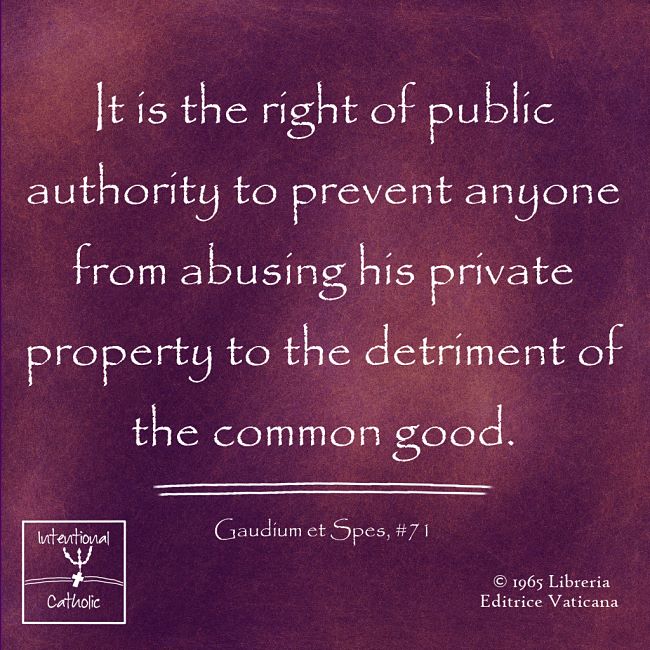
I know this is kind of a long quote to process, so let me rephrase it to clarify why it struck me so forcefully. If we forget that our personal property has a “social dimension,” we’ll end up making an idol of it, making it all about ME and what I want. Getting resentful at the suggestion that the “social dimension” exists at all.
And when that happens, it’s easy for people to say, “See? This system of private property is corrupt. It doesn’t serve the common good.”
In other words, if we are too grabby about what’s MINE, it’s going to give people ammunition to suggest that the whole system is flawed.
The writers were undoubtedly thinking of giving ammunition to communism when they wrote this, but given the unpardonable and growing disparity between rich and poor these days–underscored by who gets COVID and who doesn’t; who has to put themselves at risk to go do low-income “essential” labor while the rest of us work safely from home–it seems like a pretty spot-on reminder for our day and age, too.
A few weeks ago I decided we’d all adjusted as well as we could to COVID and I could return to Gaudium et Spes. I posted once, with the quote “…man should regard the external things that he legitimately possesses not only as his own but also as common in the sense that they should be able to benefit not only him but also others.”
Right after that, current events overtook me again. But here I am now, sharing this quote, the second in a group of three that really struck me. In our polarized political atmosphere, a point of view has developed that believes government has no right to limit personal property–that to do so is an overreach.
But it turns out that this point of view is inconsistent with Church teachings. This sequence from G&S (it’s paragraphs 69-71) makes very clear that government *does* have a right to regulate private holdings. We can debate all day the extent and the appropriate use of that right, but government does have a licit and totally morally upright role.
A small but vocal segment of my social media circle has been spam-sharing memes that, whatever the intention, give the message “Racism isn’t a real thing, and blacks need to get over it.”
I’ve seen people do character assassination on George Floyd. Quotes from MLK urging nonviolence that are accurate, but ignore the fact that he also acknowledged “Riots are the language of the unheard.” Posts about how one of the first slaveowners was black, so clearly nothing going on now has anything to do with whites or institutional racism. How we don’t have to listen to any of the current outrage, because violence negates their moral authority. Etc., etc.
Well, yes, obviously violence is bad. But think of your kid saying, “Mom. Mom. Mom. Mom.”
And you keep saying, “Hang on, wait a minute,” because you have Important Things to do.
So then they say again, “Mom!”
And you say: “I said hang on!” Even though you’re getting sidetracked by the next thing, and the next thing.
“MOM!”
“Did I say wait? Wait!”
Eventually they’ve had enough and they throw something and break it. And now they finally have your attention. Boy, do they ever.
Were they wrong to resort to breaking things? Yup.
But you were wrong first, for ignoring them when they were asking for your attention in an appropriate way.
This is not a perfect analogy by any means. Most especially because whites are not blacks’ parents, and blacks shouldn’t ever be under the authority of whites. It drives me crazy that this is the analogy I think of, because it smacks of paternalism.
But on the other hand, I am a parent, and parenthood is the lens through which I see most of life.
I have more thoughts about what justice is–I barely even touched the quote I shared above. But I’ll save that for another day. In the meantime, here’s the speech with the MLK quote.
The past two weeks have been really intense for me as it is crunch time/deadline days for preparing presentations for the NPM (National Association of Pastoral Musicians) convention, which went online this year because of COVID-19. At the same time, where I live we are opening up. From this point forward, the discernments get harder. Now we have to weigh our responsibility to uphold the life and dignity of our fellow human beings against the danger of being so overprotective of physical health that we cause lasting damage to the emotional and mental health of ourselves and those we love. To say nothing of causing unnecessary suffering from deepening poverty, as more economic damage happens.
For weeks before opening, we’d had virtually no new cases where I live, so the calculation looks quite different here than it does in many other places. In some ways, it makes it more difficult. How long can we remain isolated from those we love? Yet if we loosen up in some areas and loved ones loosen in others, then we’ve both just multiplied our exposures. My state has been open 2 1/2 weeks now, and naturally we are seeing cases again. Not a lot, but to see regular cases after weeks of almost none makes it clear that we can’t be cavalier.
Which brings us, among other things, to the “do we mask?” question that has become yet another a lightning rod, another opportunity for political division in our country. The reaction of certain quarters of our population (“I’m not wearing a mask! When I woke up this morning I was in a free country!”) is what, specifically, made this Chesterton quote jump out at me this morning. This is one of those moments in which we are challenged to recognize where a worldly value has come to be more important than Godly ones. Has become an idol.
I don’t wear a mask at all times, and in masking, in opening up, every moment requires a discernment for me to make sure I’m practicing what I preach. Or at least, to try. I don’t like it, but it is the spiritual exercise of life right now–for all of us.
There’s so much bad stuff going on in the world–and even in our houses, the wearing daily grind of togetherness causes so much stress–that it feels almost insensitive to acknowledge out loud how beautiful some of this stay-at-home experience is.
How can we find beauty in our world when so many are suffering and dying, when so many have had the pain of losing loved ones they can’t even be with in their last hours? Can’t gather to bury?
But beautiful things are happening in our homes alongside the stress of isolation. With the punishing busy-ness removed, creativity has flowered, giving rise to new traditions. My family kind of hopes the birthday parades continue! For Mother’s Day and birthdays this spring we wrote up affirmations and left them hidden around the house for the honoree. We’ve cooked well, regularly eaten together on the deck. Taken lots of walks and bike rides, done lots of work in the yard. All because we weren’t chasing the futility of the rat race all over town.
And for all of that, in the midst of this upheaval, I give thanks to God.
Posting here has become sort of irregular, but I doubt that comes as much of a surprise. We’re all stumbling along through this new reality, experiencing Holy Week and sharing in the passion of Jesus with a depth of experience that gives it new meaning, even while we lack the emotional bandwidth to fully unpack it as it unfolds.
It seems everyone is passing around things to keep us busy and make the time pass in this brave new world, but I don’t need anything else to do! Some structure, a break in the unceasing grind of togetherness? Yes. But not more to do. I’m supervising four kids’ schoolwork now, and I’ve learned that if I take the time to do something of my own, something for the kids is going to be sacrificed. Hence: irregular posting at Intentional Catholic.
Yesterday I managed to do a quick web search for words of comfort from the saints, and this one popped out immediately. It speaks to me about a particular area of my life right now, but it also speaks to the larger situation where we all find ourselves, working from home and supervising children in an intensity of togetherness we could scarcely imagine a month ago. There is a meaning to be found in this time, an opportunity to be embraced.
This is my prayer for my family every morning and every night right now:
A beautiful photo that has nothing to do with the topic…just because we need beauty right now. I captured this cardinal in my weeping willow tree with the telephoto lens through my computer room window the other day.
I’ve been thinking lately, as I watch the skyrocketing numbers of people watching daily Masses (895 people watched my parish’s Saturday Mass, in whole or in part–a Mass that *might* get 75 ordinarily) and other religious formation events online, that we as Church have a once-in-a-lifetime opportunity when the bans are lifted and we are together again.
People will be back, and they will be spiritually hungry; for the first time in years, they will have been forced–collectively–to examine their lives. Not that individuals among us haven’t had this experience before, but now we’ve done it as a Church. This means that we, collectively, as Church will be aware of the gift that is the parish, the Sunday Eucharistic Liturgy, and our communities.
We need to be ready for this. We’re going to have a window that we have not had in my lifetime, for sure, and maybe for many generations. We don’t want to squander this. People who recognize the gift they’ve been given are people who are more open to giving back. We have to be ready to give what’s needed and to ask for help.
And if we take advantage of this window, we could revitalize our weary, beaten-down Church.



 Intentional Catholic