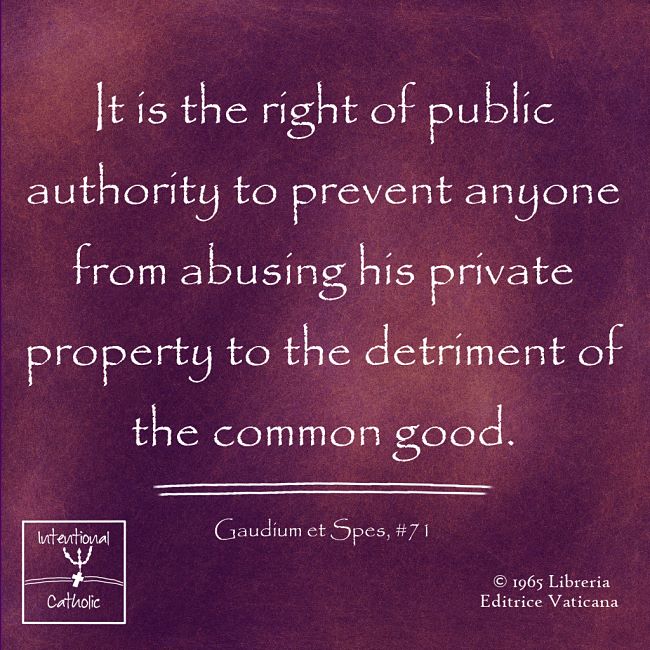
I know this is kind of a long quote to process, so let me rephrase it to clarify why it struck me so forcefully. If we forget that our personal property has a “social dimension,” we’ll end up making an idol of it, making it all about ME and what I want. Getting resentful at the suggestion that the “social dimension” exists at all.
And when that happens, it’s easy for people to say, “See? This system of private property is corrupt. It doesn’t serve the common good.”
In other words, if we are too grabby about what’s MINE, it’s going to give people ammunition to suggest that the whole system is flawed.
The writers were undoubtedly thinking of giving ammunition to communism when they wrote this, but given the unpardonable and growing disparity between rich and poor these days–underscored by who gets COVID and who doesn’t; who has to put themselves at risk to go do low-income “essential” labor while the rest of us work safely from home–it seems like a pretty spot-on reminder for our day and age, too.
A few weeks ago I decided we’d all adjusted as well as we could to COVID and I could return to Gaudium et Spes. I posted once, with the quote “…man should regard the external things that he legitimately possesses not only as his own but also as common in the sense that they should be able to benefit not only him but also others.”
Right after that, current events overtook me again. But here I am now, sharing this quote, the second in a group of three that really struck me. In our polarized political atmosphere, a point of view has developed that believes government has no right to limit personal property–that to do so is an overreach.
But it turns out that this point of view is inconsistent with Church teachings. This sequence from G&S (it’s paragraphs 69-71) makes very clear that government *does* have a right to regulate private holdings. We can debate all day the extent and the appropriate use of that right, but government does have a licit and totally morally upright role.
When I landed on #seethegood as a “word” of the year, I had no idea just how appropriate it was going to be. I thought I was just choosing it because I tend to get gripey about ordinary life and stressors. I had no idea this was God giving me a heads-up that we were headed into a year that broke every mold. Preparing me to cope with it.
All the memes about murder hornets and cats with laser eyes are funny because it really does feel like we’re standing under one of those dump buckets they put into pools now, we just didn’t know it.
I’ve been feeling pretty overwhelmed lately, bent down under the weight of the toxicity of social media and the unrelenting bad news and micro-aggressions (and macro, for that matter) against human dignity permeating the news.
This weekend, a friend reminded me of my commitment to #seethe good in 2020. Yes, there’s a lot of bad stuff going on, but there’s a lot of good too.
I needed that reminder. In the early days of the shutdown, with nothing to focus on except the present moment, I was really aware of the need to keep focused on the blessings–and I did.
But the increasing toxicity of online interactions–making wedge issues out of a pandemic, followed by the horrific response of a scattered few to the demands for racial justice, plus some things that have happened within Catholic circles in recent weeks, have really worn me down. It’s been hard to focus on anything but the feeling that we’re galloping toward a precipice, and soon it will be too late to stop.
In recent weeks, I’ve been hard-pressed to find things to post about. The echo chambers are deafening on both sides of every issue, and I had nothing of substance to add. When I did, I found myself either ignored or ripped to shreds.
What has been lacking on social media (at least on my feed) has been the small beauties, the small celebrations, and it felt incredibly tone deaf to insert those into the entirely-justified righteous anger being communicated since George Floyd’s murder.
But I realize now I have to keep looking for and acknowledging those moments of grace, those snapshots of divine beauty. And I think everyone else needs those reminders that goodness is still there, like Sam Gamgee seeing the star that shines through the break in the clouds in The Return of the King.
So I’m going to devote Mondays to that for a while. To the small beauties, the intimate graces. Here’s my first offering: the first hollyhock to bloom beside my house, a reminder of my childhood and something I’ve wanted for a long time.
The basic premise behind “Intentional Catholic” is that we should examine everything we encounter–every gut reaction, every human encounter, every decision, every news story, every moral question and political issue–through the lens of our faith.
Many of the songs we love and sing robustly at church are about justice: Canticle of the Turning; Send Down the Fire; All That Is Hidden; Anthem; Christ Be Our Light; We Are Called; City of God; We Will Serve the Lord; Lift Up Your Hearts, to name a few.
These songs stir us because they awaken in us a connection between a real, tangible world and “Thy kingdom come ON EARTH AS IT IS IN HEAVEN.”
They stir us, in other words, because they underscore that justice is *supposed* to be something to be something we work toward on earth. That’s literally what we’re praying for in every Our Father we recite.
This presupposes that we have a role to play in that, because as Teresa of Avila famously said, we are now God’s hands and feet on the earth. They stir us to desire that just, peaceful world.
But when it comes to putting in the effort to make that happen, we crash into our own idols. We start fussing about what actually constitutes “justice,” because we start to realize seeking it is going to threaten some of our own worldly priorities and political philosophies. At some level, we begin to recognize how our idols might have to give way in order to truly see the Kingdom made reality on earth as it is in Heaven. We start feeling threatened by how much we might be asked to give up.
And in the end, we’re stirred by the music, and we talk the talk, but we don’t walk the walk.
And so justice remains a far away dream. People who have experienced oppression protest. Some among us look for reasons to justify dismissing them, while others with the best of intentions react so strongly to such dismissals that they end up perpetrating a whole other kind of injustice.
I’m really struggling with the world right now, if you can’t tell. Toss some hope my direction.
A small but vocal segment of my social media circle has been spam-sharing memes that, whatever the intention, give the message “Racism isn’t a real thing, and blacks need to get over it.”
I’ve seen people do character assassination on George Floyd. Quotes from MLK urging nonviolence that are accurate, but ignore the fact that he also acknowledged “Riots are the language of the unheard.” Posts about how one of the first slaveowners was black, so clearly nothing going on now has anything to do with whites or institutional racism. How we don’t have to listen to any of the current outrage, because violence negates their moral authority. Etc., etc.
Well, yes, obviously violence is bad. But think of your kid saying, “Mom. Mom. Mom. Mom.”
And you keep saying, “Hang on, wait a minute,” because you have Important Things to do.
So then they say again, “Mom!”
And you say: “I said hang on!” Even though you’re getting sidetracked by the next thing, and the next thing.
“MOM!”
“Did I say wait? Wait!”
Eventually they’ve had enough and they throw something and break it. And now they finally have your attention. Boy, do they ever.
Were they wrong to resort to breaking things? Yup.
But you were wrong first, for ignoring them when they were asking for your attention in an appropriate way.
This is not a perfect analogy by any means. Most especially because whites are not blacks’ parents, and blacks shouldn’t ever be under the authority of whites. It drives me crazy that this is the analogy I think of, because it smacks of paternalism.
But on the other hand, I am a parent, and parenthood is the lens through which I see most of life.
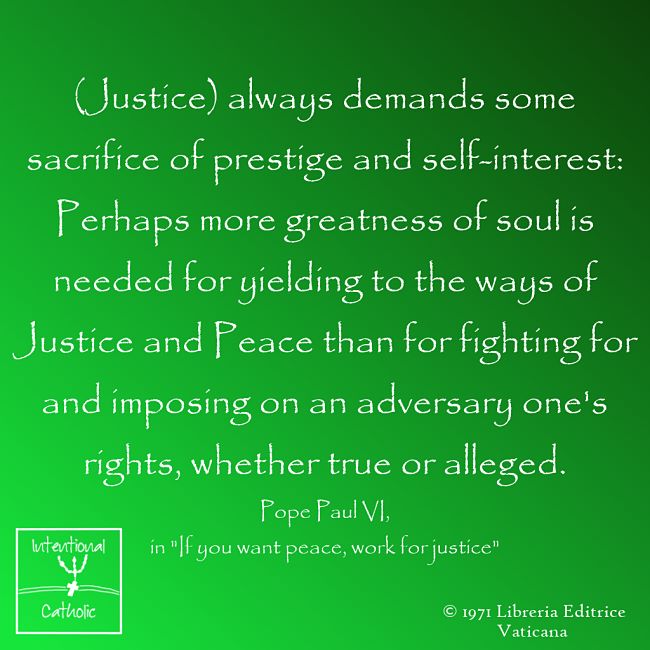
I have more thoughts about what justice is–I barely even touched the quote I shared above. But I’ll save that for another day. In the meantime, here’s the speech with the MLK quote.
I’m posting this today, not because any of us think what happened to George Floyd was okay–I’ve yet to meet the person who thinks that–but because we, as Catholics, need to be reminded that it’s not enough just to think it’s not okay.
Our bishops have talked about the realities of institutional racism through this document, “Open Wide Our Hearts: The Enduring Call To Love.” They’ve told us also that we have a responsibility to act, and that the first part is to recognize how we are complicit in the continuation of racism in our country. And that is the part too many in the Catholic community are unwilling to do. This week I’ve encountered Catholics who won’t even read this document because it calls us into that hard examination of conscience, and they refuse to believe there’s anything to examine.
This is one of those times when being Catholic requires us to be intentional. Because if we aren’t, then we aren’t really being Catholic at all. We’re letting pre-determined worldly values determine how we interact with the world, rather than doing the hard work required when our faith directs us.
I went to a park to meet a friend and her son, my godchild, to social-distance celebrate a birthday. She was upset, and I didn’t immediately realize why. She had to lead me almost all the way there.
I have rarely felt the privilege of my own skin color so keenly.
Because unlike me, she and her son are not white. And while the events of the past week, beginning in Minnesota and spreading all over the country, are a source of grief to me, for her they are inescapable realities that she has to wrestle with on a daily basis.
What is the future for her child? For all her male loved ones? Can they not go running in their neighborhoods? Do they really need to be afraid every time they see a police officer?
We rarely recognize how deeply our unconscious biases affect us. How many ways we have taken worldly values (self-reliance, personal responsibility, small government, and money, always money–it’s my money, no one has a right to it, especially a central authority, even to help lift up vulnerable populations) and tried to use our faith to justify them.
It’s not that those values are without merit. Of course they have merit. But they so easily become idols, when the Gospels make it clear that people ALWAYS come first.
As my friend and I talked, I could empathize–sort of. The cluelessness of white America is, for her, something like the cluelessness I encounter about issues surrounding disability. Whenever I share a frustration I experience with institutions that interact with my daughter–health care, schools, etc.–I get pushback from people who oversimplify the situation. People who don’t understand that the pat solutions that seem so obvious to them simply don’t work. The tangled complexities of the situation are invisible to those outside it. Even those who are closest to us generally don’t “get” it, because they haven’t experienced it themselves.
Last fall I tried to explain our family’s struggles with special ed to a group of health care workers who were studying issues surrounding special needs. I thought I could tell the story in twenty minutes. At twenty-five minutes, I realized I was only a quarter of the way through, and the audience was zoning.
Even an audience of people most poised to understand really couldn’t “get” it.
So I understood, on an intellectual level, my friend’s deep frustration and woundedness. But I don’t *understand* what it’s like to be black in America. Not at a deep, visceral level, the way the black community does.
The only solution to all this is to “hear with open hearts,” as the pastoral letter from the US Bishops on racism teaches. To accept that what we cannot “get” at a visceral level is nonetheless real, and to recognize that it calls for a response from us. Not just an express-my-outrage-on-social media, write-a-blog-post response, but a “don’t blame the victim for the way things got out of control” response. A “hold my leaders accountable for their inflammatory words and lack of positive action” response. A “quit giving them a pass because they check the box on a single issue, regardless of how poorly they reflect the rest of my faith” response.
There are basically two kinds of posts filling up my Facebook feed right now. I’m sure it’s the same for you.
On the one hand, there are the conspiracy theories and memes filled with outrage over having to mask or social distance or really, having to endure limits and inconvenience of any kind. The we-should-just-open-up-and-get-herd-immunity posts. The the-numbers-are-always-changing-and-that’s-a-sign-that-it’s-all-baloney posts. Yesterday I saw a meme that bemoaned ruining our economy for a disease with a death rate of only .1%. (FYI: I went to the CDC and did the math, because I’ve been wrong before. The death rate is 6%.)
On the other hand, there are strident posts that imply that it’s universally too soon to open up, that everyone should stay in lockdown, that no church anywhere under any circumstances should sing, because it’s dangerous. Posts that pass judgment on others’ choices, without knowing the circumstances and in some cases, exaggerating the level of the violations.
Those who share the first type of post are almost exclusively from rural areas where the case load has been low. Those who share the second are almost exclusively urban dwellers living with ongoing trauma caused by the exploding body counts in their vicinities.
The thing is, both these points of view contain nuggets of truth. Where I live, it makes no sense to deny assembly singing; we’ve only had one death and a hundred cases since the whole thing began. That would be a precaution that causes unnecessary damage to communities without any benefit.
On the other hand, there *is* real mental health suffering going on because of the shutdowns; I’ve thought since day one that we could have a whole generation in need of counseling after this is over. I have four children. I did counseling myself for the first time in my life during this pandemic. Parenting during this is a nightmare for a person who suffers scrupulousness and, by extension, anxiety. What if I’m the one who ends up passing the disease to dozens of others and causes the deaths of hundreds because I’m too cavalier? What if the hospitals get overrun and my developmentally disabled daughter is the one who has to be denied a ventilator?
But because I’m so sensitized to my children’s mental health, to my own anxieties, and to the high stakes for my own family, I’m really cognizant of the need for balance.
In some places (like where I am), the damage being done by shutdown might, in fact, be worse than the damage avoided.
But maybe not. Because maybe shutting down prevented us from becoming a hot spot. Prevented us from the unbelievable anguish of burying our loved ones without being able to say goodbye or gather to remember them and send them off to Heaven.
The trouble is, we don’t know. We won’t know until it’s over and all the data is in—and maybe not even then. In real time, the situation is always in motion; the numbers change because new information comes to light, not because of some great conspiracy.
There *are* places where the fears are totally justified. As we, out here in the low-caseload areas, start reopening, it’s tempting to assume that what is true here is true everywhere. And then, to judge others for being more cautious. And our lack of sympathy causes people in areas where the danger is real to react more strongly—which makes us lash out more strongly still—which makes them angry…
It’s American tribalism on full display, in all its ugly, unchristian glory.
The beautiful thing about being human is that we are capable—if we will choose to exercise the ability—of adapting our understanding based on new information. But when the stakes are so high, our Christian responsibility to be cautious about what information we choose to partake of is more crucial than ever.
I propose that as Christians, our responsibility—our DUTY, in fact—is to check the bias of EVERY source BEFORE we click through, and to refuse to click through to any source that leans strongly right or left. Moderately left, moderately right, these sources are balanced enough that we can properly form our consciences. Clicking through to extreme sources only encourages greater extremism. If we want our media to behave with integrity, we have to quit rewarding them for misbehaving. If we want integrity in our news reporting, we have to demand it by not supporting those who violate our trust.
Frankly, on this Memorial Day, committing to greater integrity in our information consumption seems like a good way to honor those who gave their lives to protect this country. Don’t you think?
The past two weeks have been really intense for me as it is crunch time/deadline days for preparing presentations for the NPM (National Association of Pastoral Musicians) convention, which went online this year because of COVID-19. At the same time, where I live we are opening up. From this point forward, the discernments get harder. Now we have to weigh our responsibility to uphold the life and dignity of our fellow human beings against the danger of being so overprotective of physical health that we cause lasting damage to the emotional and mental health of ourselves and those we love. To say nothing of causing unnecessary suffering from deepening poverty, as more economic damage happens.
For weeks before opening, we’d had virtually no new cases where I live, so the calculation looks quite different here than it does in many other places. In some ways, it makes it more difficult. How long can we remain isolated from those we love? Yet if we loosen up in some areas and loved ones loosen in others, then we’ve both just multiplied our exposures. My state has been open 2 1/2 weeks now, and naturally we are seeing cases again. Not a lot, but to see regular cases after weeks of almost none makes it clear that we can’t be cavalier.
Which brings us, among other things, to the “do we mask?” question that has become yet another a lightning rod, another opportunity for political division in our country. The reaction of certain quarters of our population (“I’m not wearing a mask! When I woke up this morning I was in a free country!”) is what, specifically, made this Chesterton quote jump out at me this morning. This is one of those moments in which we are challenged to recognize where a worldly value has come to be more important than Godly ones. Has become an idol.
I don’t wear a mask at all times, and in masking, in opening up, every moment requires a discernment for me to make sure I’m practicing what I preach. Or at least, to try. I don’t like it, but it is the spiritual exercise of life right now–for all of us.




 Intentional Catholic