If goodness wants to spread, why do I harden my heart to others?

EG 9 - profound liberation.jpg

One of the hardest things about harvesting quotes from Church documents is that, taken out of context, we don’t always appreciate the magnitude of what we’re reading. This quote, for instance, is in the middle of a passage on goodness. Goodness, Pope Francis says, spreads outward by its very nature. What goodness we receive wants to expand out to others.

Is this really how we receive goodness? Do we desire to take what has filled us and spill it over to others? If so, what does that mean for the way we interact with others?

Yesterday morning my son and I took a bike ride along a trail near our house. Along the way we crossed paths with two people, one of whom I think was homeless and the other I’m sure of. I said hello and waved as I do with everyone I encounter on the trails, but where most people respond with “beautiful morning!” or “good morning!” these two men appeared guarded. I got to thinking about how we, the with-homes crowd, react to homeless people. I can list off a series of things I’ve heard or thought myself, and none of them are charitable. All of them focus on the fact that the homeless are an inconvenience, they make us uncomfortable, or they got themselves into their own messes and thus they are Not Our Problem.

These people, who are not beneficiaries of the good things you and I have, have to know that this is how they’re viewed. No wonder they feel a need to be on the defensive whenever they cross paths with us. They’re probably bracing for being reported to the police and kicked out, when they have nowhere to go.

Where is the evidence, in these instances, that goodness desires to spread outward? If we are truly receiving goodness–in other words, if we are cognizant of it, if we are truly grateful for all we have been given–why do we default to judging those less fortunate based on assumptions about their situations? Are we truly free from sin? Because if we are, shouldn’t we be more willing to acknowledge and responsive to–not just individually but as a society–the needs of others?


A thousand conditions

EG 7 1000 conditions resize

I’ll be happy when…

…I get away from this job.

…I get a literary agent.

…school’s out.

…this stressful life item is over.

…I graduate.

…so-and-so gets his/her life straightened out.

(And so on, and so on.)

They’re all lies, and deep down, we all know that, but we all say them. I’ve been working on this in myself for years.

#joy #evangeliigaudium #intentionalcatholic #humandignity #realfaithrealworld #faithinaction #catholic #theologyofthebody

Whatever’s Inside Eventually Comes Out

joy painting brush
Photo by Bekka Mongeau on Pexels.com

When I was a little girl, my mother took me to visit a relative in the nursing home. I must have been pretty small, because I don’t remember much except this: we were walking down the hallway and passed an old woman in a wheelchair—a complete stranger—who looked up at my mom and cussed her out.

Mostly, I remember the shock. Seeing my reaction, my mom said, in some verbiage appropriate enough to lodge a grain of wisdom in a small child, “We have to guard our thoughts, because when we get old, whatever we think is going to come out of our mouths, even if we know it’s wrong. Even if we always controlled it before.”

In recent weeks, as I’ve been pondering joy (and whether I have it), this truth has been working its way up through my memory. Challenging me to examine my present in light of its implications for the future. What kind of person I will be in another twenty or thirty years, if I spend these hours and days and years shadowboxing real and imaginary opponents? To do so is to nurture anger and bitterness, and in my twilight years, that is what I will do: view the world through a lens of everything that irritates me about it. To skip right over the beauty and unity and look instead for opportunities to pick fights with anything (possibly important, but more likely petty) that annoys me.

This is not what I want. I want the unfiltered version of me to be one that doesn’t evoke winces, deep breaths, or gritted teeth from those around me. To be joyful.

So what have I learned about seeking joy?

Honestly? Not much, yet. My spiritual director asked me, “Have you asked God to give you joy?” I took a breath to answer and what came out was:

“Um….”

gnarled treeSo lesson #1 is, relying on myself to find joy is futile. A chase after wind. Just like every other hard thing in life, it is beyond me. It is a gift of God, and I have to ask for it.

Lesson #2 is that whether it feels like it or not, I have a choice about how I react to things. You know that cliche, “pick your battles”? In recent years, I’ve been picking them all. A few months ago, I identified one major battle in my life that I was not winning, while other people were having better success. I realized that meant it was time to let them take over the fight.

In the past few days, I discovered that where another battle is concerned, I’m simply done fighting. The wound hasn’t changed, my convictions haven’t changed, but I’ve expended all the emotional energy I’m willing to expend. It’s time to seek open doors instead of banging on the one that’s closed. Shake the dust from my feet. Move on.

Lesson #3 is that being out of sync in my closest relationships is an unnecessary stress that robs joy from all of life.

Lesson #4 is that getting stretched too thin causes me to be out of sync in my closest relationships.

Lesson #5 is the one I already knew: that equilibrium in my life comes from spending time alone with God in nature. Weather, family obligations, and my husband’s lack of freedom to do the same all complicate that seemingly simple truth, but I’m trying to work with it.

That’s what I’ve got so far. What about you, readers? What have you learned about seeking joy?

About Joy (or: Is it possible to care TOO much?)

JoyI’ve spent a lot of the last few years feeling angry and unsettled. Reading Evangelii Gaudium last fall really convicted me. I don’t mean that in the sense of “courage of my convictions.” I mean it like judge and jury.

I don’t think I am joyful, you see. I see too much in the world that is not as it should be. Things besides the sound bites that most often preoccupy Christians. Things that most Christians don’t even recognize as out of sync with the Gospel. Things that strike me with particular force because it hasn’t been that long since I didn’t recognize them, either.

I struggle with how resistant we Christians are, collectively, to acknowledge injustice and to dig into the messy, challenging work of fixing it. People can disagree about solutions to problems, but too often, the go-to response is to act as if it’s all an overreaction. That actually, there’s nothing to fix.

For example: how we deal with race. Or the way certain quarters of Christianity have vilified people traveling at great personal cost from Central America, labeling them criminals even though the vast majority are asylum seekers fleeing violence at home. Why are we so resistant to accepting the word of minorities and hopeful immigrants about what they’ve experienced? What does it say about us? How does it reflect a belief that Jesus’ presence is in each human being, and that therefore each one’s human dignity is sacred?

Ignatius-favorable interpretation

Why is it so difficult to recognize when we aren’t following this exhortation from St. Ignatius of Loyola?

I can’t help feeling that by focusing too narrowly on one issue to the exclusion of many, many other things Jesus called out by name in the Gospels, we weaken the Church. We weaken our credibility as representatives of Christ on Earth, and we weaken our ability to evangelize.

This makes me angry. Which weakens my ability to evangelize. Because how does an angry person invite others in? Why would they want anything to do with a Christianity that, on the one hand, applies the value of human dignity unevenly, and on the other, spits fire about it?

Which makes me wonder: is it possible to care too much? Am I too focused on the here and now, when I know full well that the kingdom is never going to be fully realized on earth?

I did not intend to tour two of Pope Francis’ writings in a row. I intended to look backward, to Paul VI or the Council. But this question of passion for the justice of God versus resting in the joy of salvation is really potent in my life right now. I spend far too much of my inner life shadowboxing the Bad Stuff of the world and those who support it.

Rachel Held Evans passed away this weekend. She wasn’t Catholic, but I think it’s safe to say most Catholic bloggers know her work. Stretched thin as I am, I didn’t always click through, but when I did I never failed to be inspired and challenged—even before I understood why her words resonated so deeply. If you aren’t on Facebook with Intentional Catholic, you might have missed this post of hers, which I shared yesterday. What leaps out at me in her writing is that she doesn’t pull punches, yet she doesn’t sound angry.

I long for this gift. It is a gift I intend to pursue, because I’m weary of being angry. Are you? Will you join me in pursuing joy? Might joy itself be the answer to all that ails us in this polarized, toxic time?

Assuming the best

Ignatius-favorable interpretation

Words that should skewer us all in these polarized times…they certainly made me squirm. This quote reminds me of the adage “assume the best of the other.” I believe this passionately, yet so often, I do the opposite.


Wrestling With God (or: What I do and say, and think, I Become)

grayscale photography of wrestler on field
Photo by Mike González on Pexels.com

Confession: I am an over-analyzer.

You have been warned.

I find it interesting to ponder the various influences that converge to shape us into the people we are. For me, one of those influences is the Theology of the Body.

I have to confess that I haven’t yet read the body of work–only a book-length summary, which was enough to spark the realization that TOB isn’t just about sexuality. You know that famous quote that says thoughts become words become actions become habits become destiny? TOB is structured around the reality that we have both souls and bodies, and what we do to one impacts the other, whether we intend it to or not.

So faith that is lived in real, tangible ways through our works and our words–in other words, in the body–will grow. Will bring us into closer alignment with God. Will make us clearer images of God in the world.

Likewise, works and words (and attitudes) that stand at odds with the Gospel weaken our faith and dim our ability to reflect God’s image in the world.

In other words: everything we think, say or do either builds up our faith and brings us closer into alignment with God, or it turns us away from Him. There are no neutral actions, and there is no area of our life which is exempt. Whether we are consciously examining our thoughts, words, and actions for how well they reflect the Gospel doesn’t matter. They’re going to have the impact whether we are aware of them or not. Where the body goes, the soul follows–unless the soul consciously, intentionally takes the lead.

IC Everything We think do say

This is why I started Intentional Catholic–because it’s so easy to drift through days, following trends and emotions (and political ideologies, and personal preferences, etc., etc.) without examining them in depth for their conformity to the Gospel. If we aren’t intentional about our faith, we unconsciously give power to worldly influences, and we end up farther from God without even realizing it. A perfect example is that U.S. bishops’ quote about unintended bias.

I don’t claim to have everything figured out. In fact, as I said in my very first post, delving into this process made a mess of my neat and tidy world view. I now know that I will spend the rest of my life wrestling, as Jacob wrestled with the angel (read that: God).
But that’s okay. You know how you build muscle? Micro tears. When the body repairs those tears, it does so with extra fortification. Faith muscles are the same way.

I wrote this post because going forward, lots of quotes will be tagged #theologyofthebody, even though they have nothing to do with sexuality. I hope you’ll walk with me through this process of self-examination and conversion. I believe that the more of us who do so, the stronger the Church (and the world) will be.

We Were Not Meant To Live Like This

Rush Hour
Photo by ChrisM70, via Flickr

It’s a been quite a weekend week two weeks month life lately. I’m working on a novel revision which I intended to have finished the middle of last week, but between spring break, meetings, presentations, kids’ events, and so on, I missed my self-imposed deadline.

I don’t like missing deadlines.

At the same time, I was wrestling with what to do about a very specific item that was causing me great anguish. The kind that keeps you from taking deep breaths. The kind that keeps you awake for three hours in the middle of the night.

I knew God had a solution, but I couldn’t find it. I kept asking. But I didn’t have time to be quiet and still to let him talk, and when I did have thirty seconds, I couldn’t find the quiet center that would allow me to hear anything. Whatever course of action I took, I could see potential disasters.

The good news is that when you seek sincerely, God will get through eventually, one way or another. And by the time I took off on an all-day-and-evening field trip with my daughter on Friday, I had found an course of action that eased my mental, spiritual, and emotional health. Somewhat.

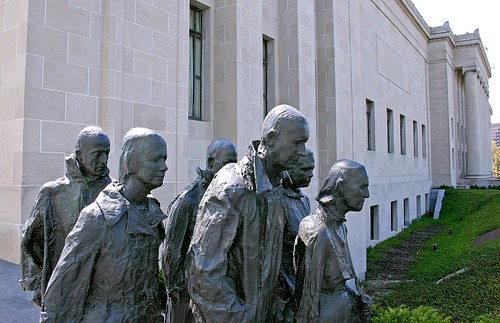
That day, as we walked around Kansas City, the sculpture pictured above stuck out at me. Often, I’ll look at art and be struck by it, but not really know why it resonates. This one made its meaning instantly clear. Look at those people–grim-faced, heads down, leaning into a maelstrom of overwhelming stress. Weighed down. Completely checked out of their own lives. They are prisoners of modern life.

It resonated because it was precisely how I’d been feeling: trapped, powerless, entirely in survival mode–and resentful about it. The weather was beautiful, the earth coming back to life, and I was struggling just to breathe. I couldn’t look up to see–really see–the birds twittering and the baby leaves on the weeping willow. I couldn’t hear the hum of the earth going through its yearly resurrection.

I think we all know that when we’re weighed down and all of life feels burdensome, we miss the goodness of God all around us. But that sculpture reminded me that what I lack most in those times is guidance. I am always, always willing to do whatever God asks of me, however difficult–I just need to know what God’s will is! But when my eyes are staring at internal blackness, my brain wrapped in thick chains of stress and busy work instead of resting in God…

Well, at those times I’m short-tempered, easily offended, easily goaded into fighting, more judgmental, and generally a dim reflection of God’s presence in the world. Worse: at those time, I can’t hear God telling me His will for this moment and this situation and this question.

We were not meant to live like this, in a constant race around a pointless hamster wheel. We were made for better things. Made to live in a peace and calm that allows us to recognize the whisper of God’s voice in our minds, telling us the answer to our quandaries, and God’s hand on our back, nudging us toward His will in all the complexities of modern life.

We were not meant to live like this. The question is, are we looking for a way out?