Are We Doing Our Job?

A few weeks ago, I read a biography of Dorothy Day. That book sparked a lot of thoughts, which I’ll go into at some point, but this quote made me think of it today, because Dorothy actually baptized her daughter before she became Catholic herself. Her struggle was the contradiction between the power of the Church’s teachings on social justice and the reality of Catholic communities whose focus was Bingo and card games. Community building is important, but so is going out and doing the work of the Kingdom, and that work is a lot more challenging and less fun.

Within the pastoral music community, periodically someone brings up a point that never fails to make me squirm: if your choir is just singing on Sundays, you’re not really doing your job. Is your music ministry reaching out? Working food banks and soup kitchens? Helping at crisis pregnancy centers? Joining in interfaith service events?

Once a year, after Christmas, my choir puts on a concert to benefit a charity. So we’ve done step one. But this Scripture is a pinprick to my conscience, reminding me that my community (whether that means my choir or my parish) is not supposed to be insular. What has been given to me is supposed to overflow to others.
The “unruly freedom of the word”

I find this quote really striking, because human nature, especially in this day and age when we face too much information at all times, is to try to boil everything down, put it in categories and boxes so we can process it and feel safe with it. And whenever something defies those artificial limitations, we feel really threatened. Threatened to the point where we reject it, even if it’s the movement of God, because it doesn’t fit where we think he’s supposed to be.

On the other hand, yesterday’s first reading, from 2 Corinthians, scolded us for how quickly we substitute artificial Jesuses for the real one. It made me squirm. Well, first it made me feel pretty righteous, because I was aiming it outward at others. (You know you all do it, too.) Then realized it could easily point at me as well. And I had a bit of disorientation, thinking about the specific instances I was considering in light of that Scripture. I wondered, “How do I tell which one is the real Jesus and which one is the artificial human one?”

I don’t have an answer for that one yet. What I am 100% convinced of is that the struggle–not the answer–is the point of the question. Life is complicated, and we want answers for everything, but when we oversimplify all the questions of the real world, we close out God when he’s inviting us to grow. This is the lesson I take from this quote.

Joy = Freedom?

Photo by Pixabay on Pexels.com

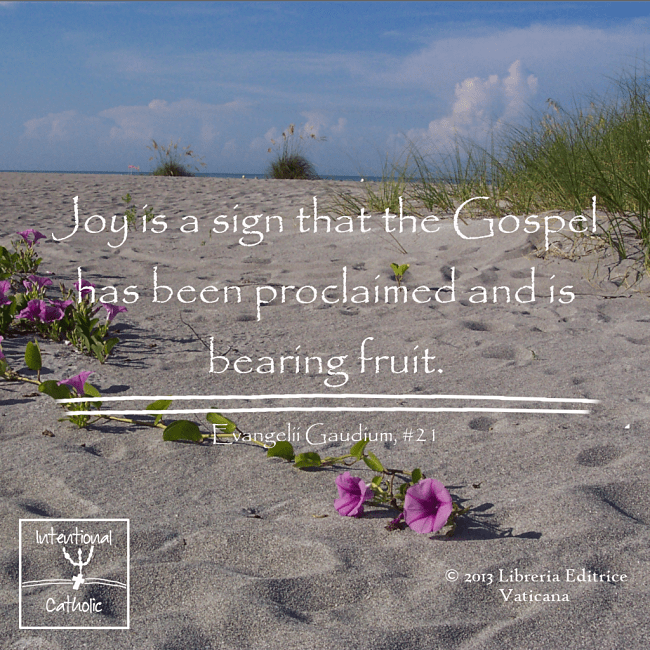
Until I started reading Evangelii Gaudium last fall, I had never thought much about the relationship between joy and faith. The very beginning of this apostolic exhortation consists of a list of very familiar Scripture quotes that I never before thought of in terms of joy.

Simple, childlike joy: if we want to evangelize, Pope Francis said, we do it by showing that our faith in Jesus Christ gives us joy.

I have to admit, “joy” is not the vibe I get off most of the people who make a big Thing out their Christian faith. Some…yes. But a precious few.

More to the point, it’s definitely not been the vibe I sensed from myself. I want to see the world as God sees it—yes, there’s beauty, but there is also so much that is not as it should be. How can I help being grieved by what grieves the heart of God?

For years, faith has reminded me of Jacob wrestling with God/the angel. What is the point of faith, after all? Isn’t it to challenge us to become better than we would be without it? If the point of faith is to pat us on the head and tell us how we’re saved and forgiven and we’re blessed in temporal terms because we’re saved—well, I would submit that what we’re actually worshiping isn’t God at all, but our own comfort.

But where does that leave “joy”?

Yesterday morning, singing James Moore’s “Taste & See,” a line leaped off the page:
“From all my troubles I was set free.”

The psalms encompass the breadth of human emotional experience. I know this. But this is Psalm 34. There are more than a hundred more psalms after this one. There is no way that David never had more troubles after writing this song.

Which means…what?

Maybe being set free from troubles just means those troubles don’t rule you. You still have to walk through the dark valleys, but you don’t have to let them define you. They don’t have to define your identity.

So maybe it’s okay to be angry with the things I see happening in the world. But I don’t have to internalize it, dwell on it, and lie awake fretting about it. (Or what people think of me for calling it out, for that matter.)

And maybe it means that I can advocate for the will of God in the world, as best I can discern it, but I don’t have to be crushed when the inevitable setbacks come. I can default to joy, even though things aren’t as they should be.

That would be freedom, indeed.

Photo by fall maple on Pexels.com

It’s not about what we say

Background Image by Soorelis from Pixabay

It seems like everyone these days is focused on “what do we say to the ‘none’s?” and “How do we talk about Jesus?”

I can’t help feeling that those are the wrong questions. Pope Francis’ contention in Evangelii Gaudium is that when we’re filled with the Gospel, it’ll overflow from us automatically.

These days, I’m becoming more and more convinced that simply living the Gospel authentically, holistically, and with joy is the simple, yet difficult part of evangelization that we have to master first. For better or for worse, the world sees an image of God in us–in our words, in our actions, and in the way we approach everyday situations and hot button issues. If the image we present is beautiful and inviting, we don’t have to say anything at all. If it’s off-putting, nothing we say will make any difference anyway.