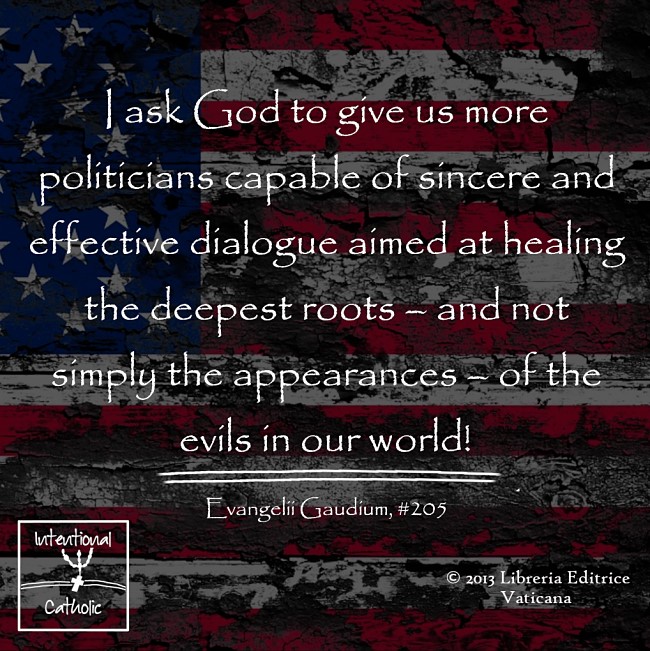
When I opened my copy of Evangelii Gaudium on Friday to find the day’s sharable, these words leaped off the screen. Almost immediately, two more quotes on the same topic followed, and I realized I needed to wait and post them in a row, as a series. That’s what we’ll be doing this week.
There’s a lot to unpack here, so I’d encourage you to take the time to ponder these words. How else can we describe what has happened in our country and in our Church in the past twenty years, besides loss of perspective and shrinking horizons resulting from being trapped in conflict?
All of us who have wanted to pull our hair out over the proliferation of conspiracy sites and “fake news”–to say nothing of the subsequent perversions of the concept (it’s not “fake news” just because you don’t like it)–surely find resonance in the idea that getting trapped in conflict leads to a sense of reality falling apart. By which I mean: when people are so committed to always being right, and the other side wrong, that they choose to ignore any and all realities that might force them to self-reflect, then yes, reality itself starts coming apart. We can’t find common ground, because we’re not even operating in the same reality.
I’m thinking of America’s political reality in the above reflections, but it largely transfers into the conflicts within the Church as well. Much food for thought here.
What I take from this excerpt is affirmation of what I’ve thought for some time now: we cannot view the world through the lens of abortion as a single issue that overrides all others, because so many other issues bring pressure to bear on it. If we truly want to be pro-life, we have to address all the issues that exert influence on abortion.
I love this passage so much. It makes me chuckle, because it’s so dead-on, and it’s not couched in airy-fairy language. “Irksome,” indeed! That’s a dead-on assessment of the reaction these concerns usually get. People are irked at having to think about them.
This whole section of Evangelii Gaudium is talking about economic systems and the need to make sure they are truly equitable and provide for the poor. It’s a procession of plain-speaking, conscience-pricking paragraphs: welfare should be considered a temporary solution, the dignity of the human person should shape all economic policy, inequality is the root of social ill, we can’t trust the market to do this work, and on and on. It’s so good. Take time to read it!
The readings this weekend were all about money. Amos was talking about the dishonesty of those with money–how they were so focused on their own profits that they didn’t really care what happened to the “have not”s of the world. And Jesus said, “Guess what? How you use your money matters.”
Listening yesterday at Mass, it really struck me how those readings should skewer America. The obvious application is the question of income inequality: how many of the huge profits made by companies are held by those at the top of the food chain, how little is actually shared with those down the ranks.
But you know, so much of what we talk about in America centers on money. Many would like to believe we’re a Christian nation, but money–capitalism–is the primary thing that preoccupies our social and political discourse, even among Christians. So many things come back to money: health care and social programs would require more taxes, and we can’t possibly suggest raising taxes. Immigrants are perceived as a threat to American jobs, so again–it comes back to money. The question of whether a president deserves re-election is always about the economy. We’re having all these discussions about China and intellectual property and trade fairness, but nowhere on anyone’s radar is the question of just wages for labor, which is–let’s face it–the only reason manufacturing went overseas in the first place. It went overseas because we, the rank and file Americans, aren’t willing to pay what it would cost to make a product while paying a just wage to the laborer who made it.
We have a lot to answer for, and I don’t pretend to have a pat solution. I personally try to take a step back from the consumer culture by starting with secondhand clothing purchases as much as possible. But those clothes, too, were made by cheap labor overseas, and I order from Amazon just like every other red-blooded American. What do I think God will say to me when it comes time for me to answer for my choices? I don’t like pondering that question any more than anyone else.
In any case, when I was looking through the possibilities for things to share today, this quote from my Beatitudes book seemed to dovetail with what we heard at church yesterday. Because what if? What if, instead of money, we made God’s will, God’s kingdom, God’s priorities, the central principle that guided every other choice?
While I was preparing a talk called “Who is my neighbor?” recently, I learned that the Jewish law was laid out as a set of concrete guidelines to explain how it looks, in real world terms, to “love the Lord your God with all your heart, with all your heart, your soul, and your mind, and your neighbor as yourself.”
Isn’t that interesting? Jesus is all over people in the Gospels for being too rigid and scrupulous about the Law, and Paul takes it to a whole new level. From that, modern Christians sort of naturally assume the Law was intrinsically flawed. But this made me realize the purpose of the Law was the same as what I’m doing here: to try to connect airy-fairy concepts of the faith to a concrete world.
The problem came when scrupulousness and rigidity about the precepts of the law caused people to judge others rather than love them.
I have two thoughts on this, and they’re kind of contradictory. On the one hand, I think the modern Church suffers from the same scrupulosity as ancient Jews. I know I have. Frankly, I think it’s more common among Catholics than we might think. What is Catholic guilt, if not an overwhelming anxiety to make sure we’re doing things RIGHT? And we judge everyone else for not doing the “right” thing. (Cough-cough-liturgy wars-cough-cough)
On the other hand, we tend not to recognize what the precepts of the faith actually mean in real life. All the big political issues of the day–abortion, guns, health care, immigration, race, etc.–looking at these through the radical call to love unconditionally should make all of us squirm, wherever we fall on the political spectrum. The love of money taking precedence over care of neighbor or creation. And so on. It’s like I said to my boys yesterday morning before school, when they were being nasty to each other: “All the religious formation in the world will do you no good if you can’t figure out what it looks like in real life!”
This is the question I leave us all with for the weekend: if showing love is how people will know I am a follower of Christ, HOW do I show love in this moment, this time, to this person I am encountering?
Every so often a meme goes around Facebook that riles up Christians about public prayer and religious freedom. It’s not always the same one, but the idea is the same: we Christians are persecuted, we should rise up and demand that America act like the Christian nation it is.
The problem is, America is not a Christian nation. Many of America’s first immigrants came here to escape religious persecution. That persecution was very much on the minds of those who set up the system of government. They structured America specifically so that nobody’s faith would get to knock down anyone else’s. Everyone gets the chance to worship as they see fit. Whether we as Godly people like it or not, that also means freedom FROM religion. Not having publicly-sanctioned prayer is not persecution. It’s simply a recognition that we are a nation built on religious liberty. No one’s prayer can be imposed on all.
We as Christians may not like that idea, but this is what makes America great. Because in fact, it’s a system that mirrors God’s own heart.
As the saying goes, God is a gentleman. He doesn’t force himself on us. When has it ever gone well for us to try to force him on others? The Crusades. The Inquisition. The suppression of native cultures. Every time we try to force God on others, we end up gravely sinning in His name.
Our job is to do as God does: invite.
Instead, I would argue that much of what we as Christians display publicly is not inviting at all. Inviting could mean different things in different situations, but surely the fundamental quality of one who invites is a joyful heart. A heart so welcoming and kind and compassionate and peaceful in spirit that others say, “Hey, I want some of that. How do I get it?”
Instead, so often we Christians display anger, resentment, bitterness, judgment, and attitudes of exclusion when faced with those in crisis situations. We focus on our own preferences and emotional comfort while turning a blind eye to inconvenient facts—like the fact that if my free expression of religion requires the suppression of someone else’s free expression of religion, then it really isn’t religious freedom at all.
When we turn a blind eye to these realities (which admittedly are hard, complicated to navigate, and resist neat and tidy solutions) and instead let ourselves be manipulated into outrage over something that’s really not a threat at all, we damage our ability to evangelize. We alienate those we are meant to invite.
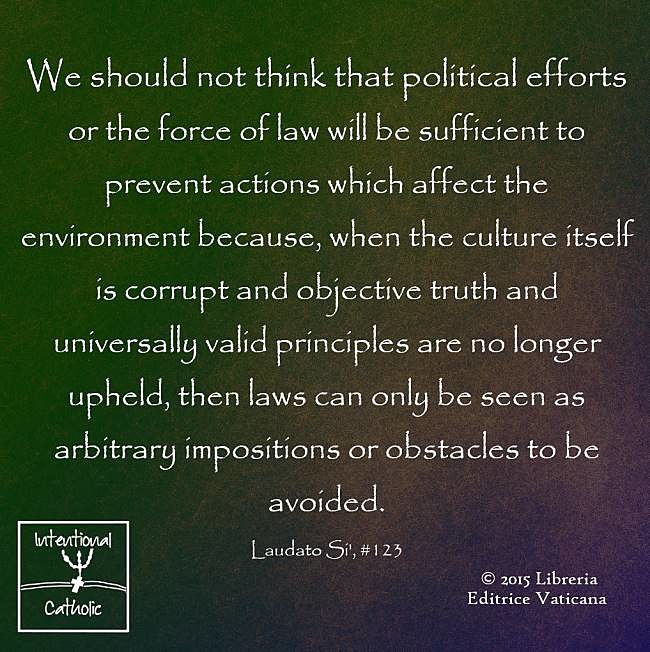
When we (and by “we” I mean American culture–media, social media, etc.) talk about climate change, environmental stewardship, etc., we focus pretty much exclusively on policy: the Paris climate accord, rollbacks of protection initiatives, opening up preserves for drilling, etc. I remember when Trump first decided to pull us out of the Paris Climate Accord, I posted my “ways to be a good steward of the environment,” suggesting that if all of us examined our lives, we could still make a big difference ourselves. Someone I know poo-poohed the idea that we as individual people could have an impact.
But this clip from Laudato Si’ points out an uncomfortable truth: that it’s human nature (especially when profit is involved) to look for loopholes, to figure out how to be the exception so as not to have to do what is difficult, costly, or uncomfortable. Law, in other words, isn’t going to fix the problem of poor stewardship of the earth by itself. We as individuals have to step up and do our part.
Which doesn’t necessarily mean big, earth-shattering things. My family is saving for solar, but in the meantime, a big part of how we form our kids is a focus on reducing waste and initial consumption. Things as simple as those stupid party bags full of useless, disposable junk that you tend to get at birthday parties. Why? Every bit of that is going to end up in the landfill sooner rather than later.
Things like (and those who know me will say “oh here she goes again”) turning off the car when you’re waiting on kids, sitting in the grocery store parking lot, or checking your phone. There’s almost always an option–sitting under a shady tree when it’s hot; going inside when it’s cold. The vast majority of the time, the only reason to leave the car running is one’s own comfort/convenience. Comfort/convenience is one of the most insidious, invisible idols of modern life.
The increasing number and severity of natural disasters hasn’t yet touched *most* of the First World (though even here, we’ve had fires and superstorms and hurricanes). Acting like our daily choices are divorced from the greater good of the earth and those who shelter on this tiny oasis of blue in a vast universe is not a mark of true discipleship. Being a Christian means examining our daily choices–in other words, our habits–and being more intentional about them.
It’s important to recognize that this applies not just to the issues we immediately recognize as evil, but to realities we resist recognizing as such.
We have a distressing tendency in America to decide that one issue or set of issues matters so much more than another issue or set of issues, we have the right to dismiss those others. It happens on both sides of the political divide. I would argue this is how we become people whose political affiliations (of whatever color), rather than our faith, end up becoming our primary identity.
I don’t think any of us intend to put politics before faith, but it’s really easy to fall into the trap. I’ve pointed that finger outward a lot in recent years, but you know what they say about pointing fingers: for every one you point at someone else, four are pointed back at you. In other words, I’ve been wrestling with this reality in myself, too.
Surely we can all acknowledge that America has been greatly weakened by the competing rigid extremisms that have been growing for the last twenty years. Extremisms that refuse to seek common ground and build from there. Extremisms so committed to the righteousness of that refusal that gradually, they cease to see there is any common ground.
But I would argue that the “either-or” mentality weakens the Church as well. Because when we dismiss an entire swath of issues as somehow less important, we look like hypocrites to a world we’re supposed to be evangelizing.
And they’re not wrong to think so.
When we decide to pick and choose what injustices matter, we thumb our nose at God. We imply that God isn’t big enough to deal with all the issues, so we have to decide for him which ones are worth fighting. We thus dismiss the suffering of everyone touched by every issue we didn’t choose. Is it any wonder that our efforts at evangelization aren’t successful?
Finally–to most people who are just along for the ride on these posts, it may not have really registered, but the breadth of topics covered in Evangelii Gaudium really underscores the spaghetti-bowl effect. This document, which is titled “the JOY” of the Gospel,” has wandered very far from the topic of joy itself. It underscores that to really spread Gospel joy, we have to embrace the whole Gospel, in all its difficult, messy glory.






 Intentional Catholic