
An Election Season Litany
Real Faith for a Real World

We’ve all heard the Gospel passage a million times: Jesus, talking about the importance and permanence of marriage.
My whole life, I have focused on the obvious teaching here: that marriage is forever, and divorce = bad.
But there’s a lot to unpack in the unspoken questions of justice that lie behind this teaching. Women didn’t get to file for divorce in ancient Israel. Only men. And when women got cast aside, they didn’t have many options–and no good ones at all.
So this teaching protects women, who were among the most powerless in society in his time. This says a lot about the sanctity of marriage, of course–but it also says a lot about what Jesus thought about the pursuit of justice in the temporal world.
Because really, that’s what the disciples were all bent out of shape about in the later part of this Gospel passage, when they protested to Jesus: the limits on their power. They’re just baffled by Jesus saying this. “If we can’t divorce a wife whenever we want,” they say, “then it’s be better not to get married at all!” Jesus just cut the legs out from under their absolute power in relationship. Of course they found it threatening.
To those who think we shouldn’t worry about working toward justice in the real world–who think none of that matters because we should only focus on the world beyond–this Gospel passage is a rebuke. Justice DOES matter.

I have been struggling the last couple weeks with #seethegood posts. It’s not that I’m lacking in goodness to see around me–it’s just that too much of it is too specific to my own situation, involving things and people that aren’t appropriate to share publicly.
But this morning, it occurs to me that I can share this pearl of wisdom from my husband. For several years, he’s wanted to use his birthday as an opportunity to serve rather than be celebrated. It doesn’t always work out, but this year he did.
He asked people on Facebook to give him a gift: to only be nice to each other–to focus on family and fun, and if they had to go political–well, you can read his words below. I share them today because of something we all know, but often forget: that whatever we look for, whatever we cultivate in the garden of our hearts, is what we get more of. If we look for things to be angry about, we’ll find things to be angry about everywhere, in everything. If we look for reasons to judge, the reasons will not only present themselves, they will multiply exponentially, until we are incapable of accepting–we have trained ourselves to judgment.
I figured this #seethegood moment could be a really beautiful leaven for the coming fall of pandemic and politics.
Enough from me. Here’s my husband:
OK folks — my birthday is TUESDAY, as in ELECTION DAY (for several states). Kate always asks what I want on my birthday, and this year, I landed on something — I’m fatigued as I’m sure we all are. So this year, if you so desire — for my birthday — I’m asking that you do one of two things (or both):
1.) Not post anything that rings of politics or seeks to judge others for a problem. Instead, focus on the kids, pets, sunsets, soft rain, flowers, awesome food, etc. in your life and give us a post about that. OR……..
2.) Look at a post that would normally evoke a visceral reaction from you and find ONE GOOD THING in the argument. You don’t have to agree with the point, but you have to acknowledge that it is a GOOD POINT. And I don’t mean some dumbass platitude. Honestly look for something that forces you to go beyond your comfort zone or your political leaning and see that someone, somewhere who thinks completely differently from you has a good point in an argument.And then, tell me about in a post. Tell me what you posted instead of a political meme or rant or judgement OR tell me about what you found in someone’s post that you initially disagreed with.And THAT, THAT folks is what I would like on my birthday.

Camillus is a new saint to me. I had to go look him up. He was a gambler with a bad leg and, it seems, a bad temper, because the hospital where he went for treatment kicked him out for being quarrelsome–all this according to Franciscan Media. But once he was converted, he managed to change, and in the end he took care of plague victims. How’s that for a turnaround?
But his “think well” and “speak well,” in particular, really stuck out at me today. We’re living in a time when we’re under stresses we recognize (hello, COVID), but whose impacts upon us we don’t necessarily recognize.
I really believe a lot of the toxicity of social media right now is a sign of people driven right to the edge of what they can handle and then having one more feather put on top of them. Us, I mean. It’s me, too.
We aren’t able to tolerate some things, and other things we might be able to think critically and rationally about, we swallow wholeheartedly, because we’re just that overwhelmed. We simply don’t have the emotional bandwidth to be everything we’re called to be and everything we’re capable of being. So we see things that are wrong, and we totally lose it. We go wild with outrage instead of stopping to think, “Wait… is this clickbait, designed to manipulate my emotions by using loaded words and ignoring context that really matters in understanding the situation?”
I’m talking of social media, but of course it’s in our homes too. I’m so over my kids telling each other to shut up. The count is now 138 days that we’ve spent with way more togetherness and way less structure than we’re built for. What little tolerance they ever had for each other has long been exhausted. It’s a constant battle, trying to call them back to their best selves. Too often the same criticism applies to me.
None of the externals are changing any time soon, but maybe just being aware of it can help us be less reactive, to stop and think instead of knee-jerk reacting to things we think are totally intolerable. Because as the old adage says, what we think and say becomes what we do and who we are.
It has not been pretty in my house, these last 125 days. Have you intuited that from my posts? It seems all I do these days is fret, gnash my teeth, and talk about the lack of peace in my house–the strain of kinda-sorta-not-exactly-quarantine, the lack of structure, the endless snipping and sometimes screaming, the teenage hormones and the childhood overreactions.
The other day I had my youngest two children working on dishes. In their resentment at being forced to work (not that they had anything else to do; they were totally bored), they instantly fell to squabbling. “You can’t use the spray hose that way,” “you’re taking too much space at the sink.” That kind of nonsense.
I turned to them and said, “That’s enough! I don’t want you two to say anything to each other you wouldn’t say to ME if you were working with ME.” Because they are kind to me, if not to each other.
It was a stroke of brilliance–the Holy Spirit’s, not mine, just to be totally clear.
They are accustomed to being horrible to each other. To be told to treat each other as they treat the person they trust the most required a hard reset. They didn’t like it, but for one of them, the tone of voice changed instantly. In the other it happened after I said, “Would you use that tone of voice talking to me?”
Yesterday’s readings struck a chord so deep, it resonated in my whole being. Our new associate’s homily tied together the various parables brilliantly. It can be much harder than we realize to judge between good and evil, he said. Which is why it’s not our job to rip out the “weeds,” but instead to be leaven–to live the faith in a way that causes the whole culture to “rise.”
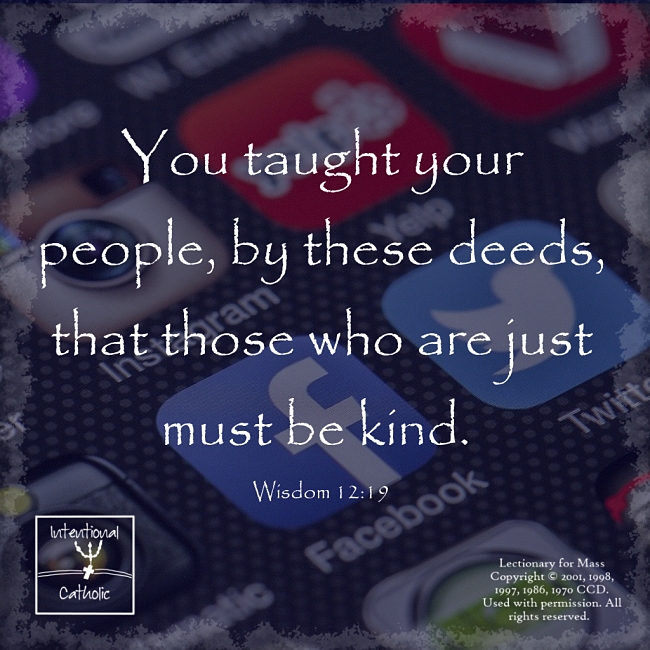
But the words that stay with me the most were those from the book of Wisdom. “You taught your people, by these deeds, that those who are just must be kind.”
In these heavy, momentous days of pandemic and communal examination of conscience, there are many of us concerned with justice. There’s a lot of righteous indignation, a lot of holy anger at the way huge sections of the Catholic faith have been lopped off, cafeteria-Catholic style, to force them into a political box.
People are speaking up for justice, but too often there’s no kindness involved. I fear that the pursuit of justice will fail, because of the way the campaign is pursued. Without kindness, calls for justice often come across as bullying. Nobody’s heart is being changed when they feel they’re being bullied.
None of which changes the fact that the world is crying out for God’s justice. I want to be clear on that, lest anyone read this post as a justification for dismissing calls for justice. Or for resisting guidelines put in place to protect the life and health of all God’s children. The right has plenty to answer for. Blistering the “mainstream media” for liberal bias makes no sense when one eagerly and uncritically gobbles up sources whose violations of journalistic integrity are far more heinous, if in the opposite direction.
For right and left alike, what we choose to do now–whether we are willing to examine our hearts and work to overcome our biases–this is truly a question of following God versus making an idol of self. Calls for justice, specific to this time and place, are necessary. In fact, they’re an imperative of discipleship. These things need to be said.
But the way we say them matters.
Maybe, in the days and weeks to come, “justice = kindness” can be our guiding principle, the standard by which we measure our online presence. We want justice. But are we actually modeling Godly justice–by our kindness?
What if we all vowed to say nothing we wouldn’t say to the person we respect and honor most in the world? How much more calm, measured, and productive might our national discourse be?
“Trample my courts no more!
To bring offerings is useless;
incense is an abomination to me.” (Is. 10:13)

Isaiah really didn’t mess around, did he? Most of the time we focus in on the feel-good prophecies about the coming of the Messiah.
But in yesterday’s first reading, Isaiah says, “Guys, seriously. God’s not interested in what you’re bringing to the altar. You’re trying to substitute ritual for meaningful action in your real life. Your worship is useless. What gives worship meaning is what you do outside these walls, and you’re not doing it.”
This reminded me powerfully of a lengthy reflection I read a few weeks ago. The context is race, but the part that struck me most profoundly was about the way we interpret various passages in Scripture. When we hear passages like today’s, we shake our heads at those poor blind, hard-hearted Israelites. But when the readings of comfort come, we think they’re meant for us.
Today I just want to share a couple of paragraphs from that article, which was an uncomfortable but eye-opening read. In fact, the article is one of many in a magazine issue devoted to forgiveness; the whole issue this came from is on my to-read list. I encourage you to click through.
Erna Kim Hackett, “Why I Stopped Talking About Racial Reconciliation and Started Talking About White Supremacy”

There’s a lot on my mind these days that speaks to how we live the faith in the real world—a world that, at the moment, is defined by crises and division. More now than ever. I didn’t think that was possible.
It seems there is no safe subject; even small talk leads to conflict. This morning on a bike ride, I encountered my kids’ former bus driver, and stopped to chat (from across the street). I asked about coming back in the fall. The answer was a hard pushback on the forthcoming citywide masking requirement—a requirement that makes a lot of sense given that during the first wave, we had practically zero cases, and now we are averaging 30+ per day. “I’m VERY strongly anti-mask,” she said. ”I think it’s a personal choice.”
How does one respond to such vehemence? I know what I WANT to say. I WANT to say that as Christians, our world view is supposed to reflect a Gospel that tells us self-emptying, treating the other’s needs as equal to our own, is the way of discipleship. A Gospel that we believe tell us life is precious, and the right to life far outweighs personal “choice.”
I WANT to say, “Can’t you see that you’re setting aside your prolife convictions? That you’re using the exact same language used by the pro-choice movement for decades?”
But how do you communicate any of that without sounding holier-than-thou, preachy, and generally self-righteous?
It didn’t matter, because all I got out was, “Oh, I’m not.” Then she was pouring out her grievances, and thirty seconds in, I thought, I’m supposed to be home in 40 minutes. I just need to politely say “good luck” and move on.
So I did.
I spent the rest of my ride pondering this exchange and others. So many things have become wedge political issues that have no business being so. A pandemic should NOT be a political wedge issue. Racial justice should NOT be a political issue. Supporting women who have experienced harassment, abuse, or assault should NOT be a political issue. These are things people of faith should be unified on. Certainly the Catholic Church, flawed as it has been in practice, has spoken clearly on them all. How on earth has politics become more important in forming our world view than our faith?
But I realize that a lot of the refusal to budge on these issues is a reaction to scrupulousness–a scrupulousness that leads to making assumptions about people. From there, it’s a short skip to judgment.
There’s a lot of judgment on social media these days.
*I’m* judging a lot. Most of the time I don’t post my judgy thoughts, but that doesn’t mean they’re not there.
I think those of us who believe we have a societal responsibility to public health, who care passionately about racial justice and victims’ rights–those of us who care about these issues are so angry, we don’t always recognize that our words and our tone can do more harm than good. That sometimes, in our passion for justice, we cross the boundaries of Christian charity.
I know, that sounds like “tone policing.” I get it. But tone DOES matter, because when we make assumptions about what people are or aren’t doing; when we pass judgment; when we belittle and dismiss and make sweeping generalizations about everyone who (fill-in-the-blank)—
When we do these things, we make everything worse. We aren’t bringing people to a greater understanding of the truth. In fact, all we’re accomplishing is hardening people in their perception of persecution. They become less open to hearing, less open to examining the conflict between their worldly perspective and the Gospel.
Below (in the comments, on Facebook), I am sharing an op-ed that really hit me hard. I don’t often share (or read, for that matter) from the New York Times, because to so many people, it epitomizes the “liberal media.” But I think people across political spectrums will be surprised by what this man has to say.

I know this is kind of a long quote to process, so let me rephrase it to clarify why it struck me so forcefully. If we forget that our personal property has a “social dimension,” we’ll end up making an idol of it, making it all about ME and what I want. Getting resentful at the suggestion that the “social dimension” exists at all.
And when that happens, it’s easy for people to say, “See? This system of private property is corrupt. It doesn’t serve the common good.”
In other words, if we are too grabby about what’s MINE, it’s going to give people ammunition to suggest that the whole system is flawed.
The writers were undoubtedly thinking of giving ammunition to communism when they wrote this, but given the unpardonable and growing disparity between rich and poor these days–underscored by who gets COVID and who doesn’t; who has to put themselves at risk to go do low-income “essential” labor while the rest of us work safely from home–it seems like a pretty spot-on reminder for our day and age, too.
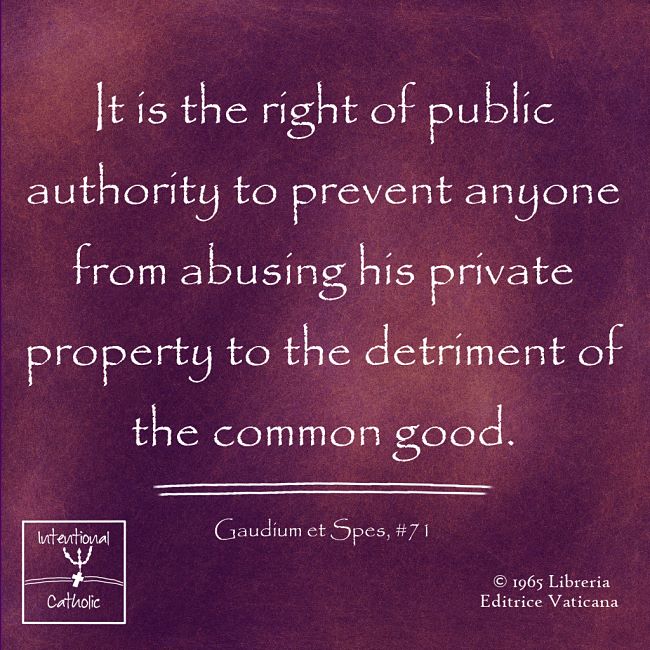
A few weeks ago I decided we’d all adjusted as well as we could to COVID and I could return to Gaudium et Spes. I posted once, with the quote “…man should regard the external things that he legitimately possesses not only as his own but also as common in the sense that they should be able to benefit not only him but also others.”
Right after that, current events overtook me again. But here I am now, sharing this quote, the second in a group of three that really struck me. In our polarized political atmosphere, a point of view has developed that believes government has no right to limit personal property–that to do so is an overreach.
But it turns out that this point of view is inconsistent with Church teachings. This sequence from G&S (it’s paragraphs 69-71) makes very clear that government *does* have a right to regulate private holdings. We can debate all day the extent and the appropriate use of that right, but government does have a licit and totally morally upright role.
Interesting, right?

 Intentional Catholic