
I certainly see the truth of this in my own life and in those of my loved ones. I can think of quite a few people I know and care about who fit both these descriptors… as for me, I resemble the second more than the first.
Real Faith for a Real World
I certainly see the truth of this in my own life and in those of my loved ones. I can think of quite a few people I know and care about who fit both these descriptors… as for me, I resemble the second more than the first.

When I opened my copy of Evangelii Gaudium on Friday to find the day’s sharable, these words leaped off the screen. Almost immediately, two more quotes on the same topic followed, and I realized I needed to wait and post them in a row, as a series. That’s what we’ll be doing this week.
There’s a lot to unpack here, so I’d encourage you to take the time to ponder these words. How else can we describe what has happened in our country and in our Church in the past twenty years, besides loss of perspective and shrinking horizons resulting from being trapped in conflict?
All of us who have wanted to pull our hair out over the proliferation of conspiracy sites and “fake news”–to say nothing of the subsequent perversions of the concept (it’s not “fake news” just because you don’t like it)–surely find resonance in the idea that getting trapped in conflict leads to a sense of reality falling apart. By which I mean: when people are so committed to always being right, and the other side wrong, that they choose to ignore any and all realities that might force them to self-reflect, then yes, reality itself starts coming apart. We can’t find common ground, because we’re not even operating in the same reality.
I’m thinking of America’s political reality in the above reflections, but it largely transfers into the conflicts within the Church as well. Much food for thought here.
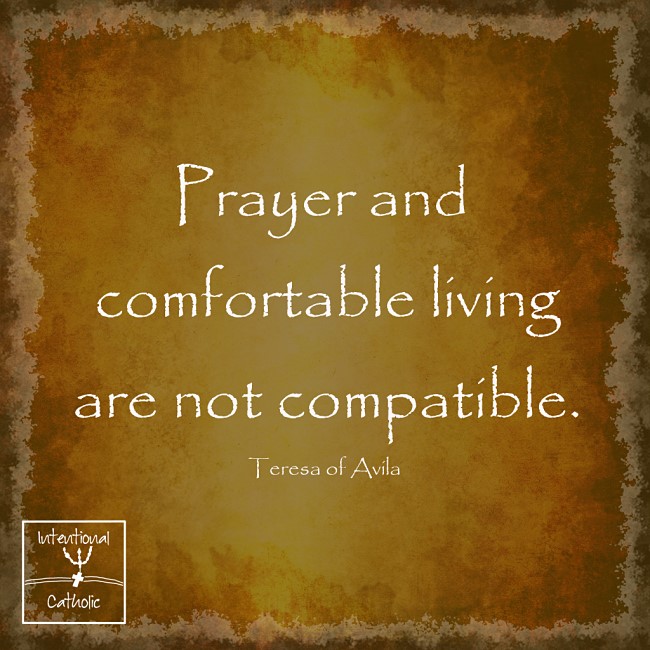
A brief and very relevant thought from St. Teresa of Avila for All Saints Day. Because whenever we pray–really pray–we get closer to the mind of God, which sensitizes us to the ways we still fall short, and how much we need to change.

Bad news is everywhere these days, and often it seems like the Church is characterized by division rather than the unity implied by our name.
We bicker over whether the Eucharist is medicine for the flawed or a reward given to those who deserve it.
We bicker over kneeling versus standing.
We bicker over whether it’s better to receive on the tongue or in the hand.
When the Pope challenges us to see the world’s issues as interconnected and inseparable, quoting the last several popes, certain extreme factions within the Church (who have a secular political agenda) launch a campaign against him that has caused confusion among many faithful people who are just trying to follow Jesus in their daily lives. (You should read that article, by the way. All of it.)
And of course, there’s the ongoing stain of the sex abuse scandal.
Given all this, it was pretty demoralizing when that Pew research survey came out a few months ago. The one suggesting that Catholics don’t even really understand the one thing that, above all others, defines us: the Eucharist.
Today I want to offer two points as words of hope. First, this article. Words matter, and the way the Pew questions were written, many of us would hesitate, caught between our faith and the way certain words are used in the modern secular world. I mentioned this at choir practice shortly after the survey came out, when people were expressing their dismay about the survey, and a recent convert, who had to navigate those waters on the way into the Church, nodded vigorously in agreement. The authors of this analysis suggest a more hopeful picture, and their argument resonates with me.
Which brings me to the second point: part of the reason for that resonance is an experience I had when I was working as a full-time liturgy director. I was jaded even then about the view and understanding of the Eucharist among the average Catholic Mass-goer. Convinced that most people really didn’t “get” it.
Then one day, when we had a no-show, I substituted as an extraordinary Eucharistic minister.
It was an amazing experience. One after another, people raised their eyes and their hands. The looks on their faces remain with me to this day: raw, naked, vulnerable, longing, hopeful, reverent, transfigured. Those people knew they were receiving Jesus. Knew it at a visceral level that tells a truth far deeper than any survey can illuminate. By the end of Communion, I was nearly in tears.
So when the division in the Church seem ready to rip us apart at the seams—when despair tries to get a hold on my heart—I choose to hope. To believe that what I was taught as a child remains true now: the Spirit is in control, that we are led at this point in time by the person the Spirit knows we need, and that nothing can destroy the Church. Not even us.

Over the years I’ve fussed a lot about religious platitudes. In liturgical composers’ circles, we’re often urged to take out all the religious clichés and see if there’s anything left. (Often, there’s not.) In my own writing I’ve talked a lot about deadly generalizations in how we talk about the faith. When you talk big picture, everybody can get on board, because it doesn’t actually challenge us. It’s when we get into the nitty-gritty specifics that we start feeling defensive, which is not a guarantee, but at least a warning sign that we might be guarding an idol.
“The dignity of the human person AND THE COMMON GOOD,” Pope Francis says, are more important than coddling the comfort of the privileged people of the world.
I doubt most of us recognize ourselves as those privileged people, but I can just about guarantee that every person reading this right now is a member of that group, just as I am. I know my audience is basically white American and middle-class or higher. We don’t see ourselves as privileged, but we are. Living with oceans to protect us from the vast bulk of outside violence is a privilege. Living in a place where we have the right to go to church is a privilege. Living in a place where we have a government willing to step in and rebuild our homes in the face of increasing climate events is a privilege. Living in a place where we trust the police to be on our side is a privilege (and that one, not even all Americans share).
Giving up “comforts” could mean any number of things. It could mean paying more in taxes so as to better support education, social security, or a host of other things our faith calls us to support. It could mean curtailing certain gun rights so as to better protect the common good. It could mean something as simple as turning off your car while waiting in grocery store parking lots and pickup lines, and thereby accepting that you may have to sit under a tree and be hot in the heat, or turning off your car and just bundling up in the winter. It could mean being willing to live in proximity to people who make us uncomfortable. (People of different races, people of different education levels, people with disabilities, people who are poor or even homeless…you get the idea. Someday I’ll do a post about solidarity.)
I’m aware that everything I listed there is a challenge to conservatives. Anyone who would like to comment and leave parallel comforts to those who lean left, please feel free. I am trying to cram a lot of things into my days right now, and I don’t always have time to do real justice to these reflections. 🙂

What I take from this excerpt is affirmation of what I’ve thought for some time now: we cannot view the world through the lens of abortion as a single issue that overrides all others, because so many other issues bring pressure to bear on it. If we truly want to be pro-life, we have to address all the issues that exert influence on abortion.
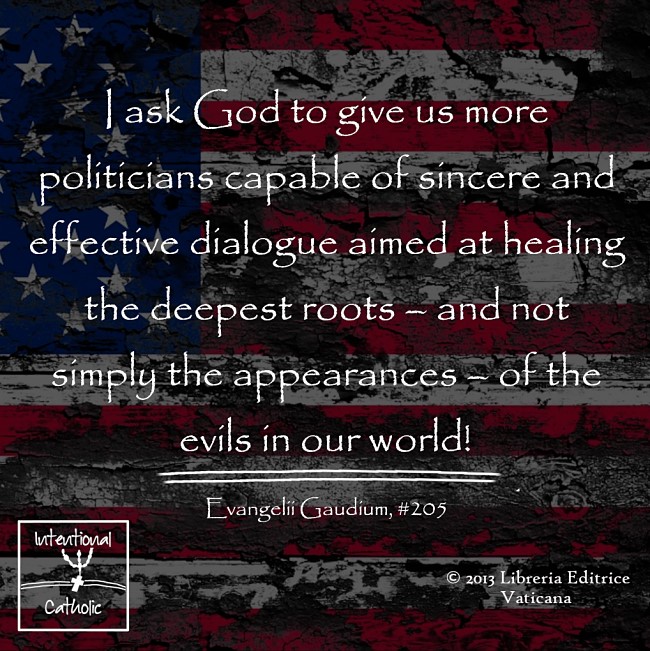

I love this passage so much. It makes me chuckle, because it’s so dead-on, and it’s not couched in airy-fairy language. “Irksome,” indeed! That’s a dead-on assessment of the reaction these concerns usually get. People are irked at having to think about them.
This whole section of Evangelii Gaudium is talking about economic systems and the need to make sure they are truly equitable and provide for the poor. It’s a procession of plain-speaking, conscience-pricking paragraphs: welfare should be considered a temporary solution, the dignity of the human person should shape all economic policy, inequality is the root of social ill, we can’t trust the market to do this work, and on and on. It’s so good. Take time to read it!

First of all, let me just say I recognize how challenging this quote is. This idea stands 100% in opposition to our American cultural values.
However, if we are citizens of Heaven first and America second–as should be the case for all who call ourselves Catholic–then we have to accept the challenge in these words.
Interestingly, they are *not* Pope Francis’ words. They are the words of Pope Paul VI (he of Humane Vitae fame) from an apostolic letter called “Octogesima Adveniens,” dating from May 1971. I haven’t read the whole letter, but this is the full paragraph Pope Francis quoted from:
Through the statement of the rights of man and the seeking for international agreements for the application of these rights, progress has been made towards inscribing these two aspirations in deeds and structures (16). Nevertheless various forms of discrimination continually reappear – ethnic cultural, religious, political and so on. In fact, human rights are still too often disregarded, if not scoffed at, or else they receive only formal recognition. In many cases legislation does not keep up with real situations. Legislation is necessary, but it is not sufficient for setting up true relationships of justice and equity. In teaching us charity, the Gospel instructs us in the preferential respect due to the poor and the special situation they have in society: the more fortunate should renounce some of their rights so as to place their goods more generously at the service of others. If, beyond legal rules, there is really no deeper feeling of respect for and service to others, then even equality before the law can serve as an alibi for flagrant discrimination, continued exploitation and actual contempt. Without a renewed education in solidarity, an overemphasis of equality can give rise to an individualism in which each one claims his own rights without wishing to be answerable for the common good.
Pope Paul VI, Octegesima Adveniens, #23
There’s so much to unpack in that. “Legislation is necessary, but it is not sufficient for setting up true relationships of justice and equity.” Legislation, in other words, needs to happen, but we have to go beyond it.
And “renouncing rights” means what? Perhaps we could read that as a call to be less tax-averse. Perhaps we could read it as a call to be less inclined to hoard, judging others as unworthy, requiring them to prove they don’t need what we have to offer before we’re willing to give it to them.
“A renewed education in solidarity…” Solidarity is a word a lot of us associate with Lech Walesa, but it’s something we’re all called to–to enter into the pain of others, to make it our own. (Read Shannon Evans’ book Embracing Weakness. She broke open solidarity for me in a way I still haven’t figured out how to incorporate into my real life.)
“individualism in which each one claims his own rights without wishing to be answerable for the common good.” That one explains itself.
A lot to think about here! Because again, we’re recognizing that evangelization is not narrowly defined as walking around talking to anything with a heartbeat about Jesus Christ. Evangelization is something that encompasses all of real life. Because who will listen to us when we talk, if our view is so narrow we can’t see the forest for the trees?

 Intentional Catholic