This reminds me of Teresa of Avila saying, “God has no hands but yours…”
There’s a tension in modern life between prayer and action. Many of us have gotten jaded about invoking prayer because so often, “thoughts and prayers” seem a pretty poor substitute for action. God doesn’t come down and magically change things; we have to do the work. God works through us. Prayer isn’t about changing God’s mind–it’s about changing us.
Yet sometimes there truly is nothing we, in our human limitations, can figure out to do, other than pray. Pray for peace of mind, for acceptance, for grace to bear what we cannot take away.
More often, though, there are things we can do–they just require effort. We have to advocate publicly, but that presupposes that we’re willing to educate ourselves on the complexities of situations. We have to be willing to look at the world through someone else’s eyes and accept that the way the world works for us–which fundamentally shapes our vision of what is and is not possible–is not the way the world works for others. (Remember this quote?)
My husband and I taught natural family planning for sixteen years. So often, during that time, people would say, “What’s natural about resisting the body’s impulses?”
I thought a lot about that, and I realized what I was hearing was frustration: a desire to have the best of sex while avoiding the related hassles.
The first time I encountered the Thomas Merton quote I shared last week, it seemed made to tackle the connections among desire, freedom, and consequence. In spinning out the implications, a blog post was born. Most of that post follows today:
******
I’ve come to a realization lately that I think all women, and frankly
all men too, need to come to terms with. For me, it was a long time in
coming, considering how obvious it is.
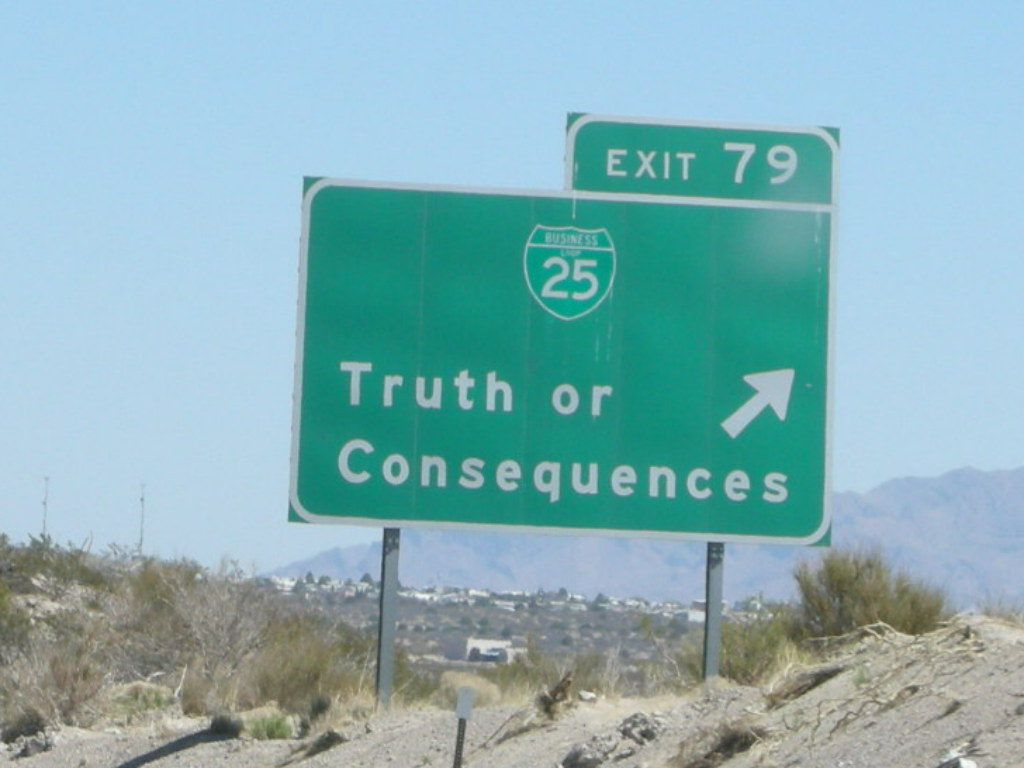
There is no such thing as sex without consequences.
Proponents of natural family planning and proponents of artificial
means of birth control both seem unable to grasp this simple truth. The
NFP community likes to harp on the side effects of birth control and its
potential to damage human relationships. Those who use birth control
deride NFP as ineffective and contrary to human nature because it
requires people to fight their instincts to come together at women’s
most fertile time.
We would all like to think there’s some magic bullet that takes away
the sacrifice and, dare I say it, suffering that is part and parcel of
reproductive life. We want to be able to enjoy the coming together
without the side effects/consequences. There are basically three courses
you can take: you can impose artificial controls on nature
(contraception); you can work with nature (NFP); or you can do whatever
you want and let the chips fall where they may.
Photo by einalem, via Flickr
But every one of those paths has consequences.
If you use natural family planning, you have to deal with occasional
(and for some people, frequent) ambiguity in the signs and the need to
abstain when the woman is most interested in sex. There’s no question
that requires sacrifice and, sometimes, suffering.
If you use chemical contraception, though–assuming it does what it’s
supposed to do, and fools your body into thinking it’s pregnant
already–you’re giving up that increased sex drive altogether. Which is
why I find it puzzling when proponents of birth control criticize NFP
for the abstaining when the sex drive is highest. I mean, it’s not like
contraception solves that issue. And besides, there’s that whole thing
about side effects, and environmental impact, and blood clots. Again: sacrifice, and sometimes, suffering.
Your third option is to let the chips fall where they may. You get
the best of both worlds: sex whenever you feel like it, without side
effects, without increased risk of blood clots. But there’s a natural
consequence to that, too, and it involves bigger cars and bigger houses
and a humongous grocery bill, to say nothing of college costs. And a lot
of time pregnant and breastfeeding and exhausted. So again: sacrifice,
and sometimes, suffering.
The reality is that sex does have consequences, no matter
what you do. You can gnash your teeth all you like, but that’s the
reality. Our job is to make the most responsible choice we can, based on
as much information as we can. And the longer I’m involved with natural family planning,
the more thoroughly convinced I become that NFP, while not without
consequences, is the best option. It’s not the easiest, but it is the
best–for women, for couples, for the world.
Bear with me, because you may think I’m posting this on the wrong blog.
Friday night, I went to an Asian grocery store to buy boba pearls. Outside stood a group of three young people, chatting in what I presume was Chinese over a grocery cart full of white plastic bags. It was a beautiful night, and I glanced over at them as I walked in. My eye caught on the gorgeous dress one of them was wearing. Red, with white and black trim, fitted without being slinky, worn over black leggings. I thought, “I want to shop where she bought that dress.”
And I had this moment of crystal clarity: I hate American fashion. Every outfit I’ve admired in the past 4-5 years has been from Asia or Africa.
For months, I’ve been searching for a handful of clothing items to serve a particular purpose. I’ve bought nothing, because I can’t find anything I like. Not in the consignment stores where I start and not in the big box stores.
A friend of mine found this train of thought troubling. If this is true, how do we live faithful life? What if we can’t even survive without participating in some way in a system that harms others? What if the system is so pervasive, we can’t escape it?
To which I add: if we could opt out, wouldn’t we actually increase the misery of the poor, because whatever income they do make is more than they’d make if we stopped buying?
The world is full of good things, and I want to enjoy them: chocolate, a good book, and my backyard patio set all give glory to God, the maker of the raw materials and the giver of the human creativity used to shape raw materials into wonderful things.
But it’s hard not to wonder if I should be diverting every penny I spend on these things to people fighting for little more than survival.
How long, O LORD? I cry for help but you do not listen! I cry out to you, “Violence!” but you do not intervene.
And God’s reply:
The vision still has its time, presses on to fulfillment, and will not disappoint; if it delays, wait for it, it will surely come, it will not be late.
Habakkuk’s pain is so familiar. The world is such a mess. We just want God to fix it already.
But how can we yell at God for not acting to alleviate the injustices at work in the world? We’re the ones who enact the injustices, not God. The only way they get un-enacted is “if today you hear God’s voice, harden not your hearts.” In other words, learn to recognize injustice and then DO something about it.
But the obstacles to doing something seem insurmountable. I’m a big believer in pebbles and ripples. I throw my pebble in the pond, you throw yours, and the guy down the street throws his, and eventually things change.
But it’s not satisfying. Waiting is hard. Waiting leaves us conscience-stung in that no-man’s land between the good things of the world and the knowledge of who’s actually paying the price for them.
And maybe, in the end, that’s the only takeaway: that while we are in the world, we have to accept that we are never going to have the answers—we’ll always be wrestling with what is versus what could or should be. We’ll always be looking for that balance between enjoying the world God gave us and recognizing the ways in which we are called to act. Even if it requires sacrifices we don’t want to make.
It’s been six years since I read Thomas Merton’s “New Seeds of Contemplation,” but the experience remains with me. It resonated so deeply with my experience of finding God in the silence of nature, beyond cell signals and wifi, beyond human noise. So many things stood out to me, but this quote in particular seemed noteworthy, because we think of “freedom” as “I get to do whatever I want to do.” We fail to recognize that self-gratification makes us prisoner within a set of chains far more inescapable than the strictures we rail against.
Here’s the larger quote:
It should be accepted as a most elementary human and moral truth that no man can live a fully sane and decent life unless he is able to say “no” on occasion to his natural bodily appetites. No man who simply eats and drinks whenever he feels like eating and drinking, who smokes whenever he feels the urge to light a cigarette, who gratifies his curiosity and sensuality whenever they are stimulated, can consider himself a free person. He has renounced his spiritual freedom and become the servant of bodily impulse. Therefore his mind and will are not fully his own. They are under the power of his appetites.
Love is one of those words we throw around a lot. I often get frustrated when homilies focus on love, not because it’s wrong to do so, but because so much of the time, it stays in the realm of the theoretical. We can all nod our heads sagely and agree that to be a disciple is to love, but it’s awfully hard to recognize the concrete ways in which we don’t love at all.
It’s easiest to spot in the kids. One kid comes home stressed by lack of time and homework. He has a veritable comic strip cloud hanging over his head, with lightning bolts coming out of it. He bites off the heads of his brothers, who aren’t actually doing anything wrong, and they react by being predictably hateful. I may or may not, recently, have shouted, “All the religious formation in the world is useless if you can’t figure out how to live it in real life!”
Every parent reading this post probably chuckled and nodded sagely just now. We’ve all dealt with it.
But it happens to us, too. We’re just a lot more sophisticated with our stresses, and far more skilled at justifying ourselves for not acting in love.
Today I will let the context of the quote above, in which Pope Francis is explaining what he means by “accompaniment,” stand on its own:
Listening, in communication, is an openness of heart which makes possible that closeness without which genuine spiritual encounter cannot occur. Listening helps us to find the right gesture and word which shows that we are more than simply bystanders. Only through such respectful and compassionate listening can we enter on the paths of true growth and awaken a yearning for the Christian ideal: the desire to respond fully to God’s love and to bring to fruition what he has sown in our lives. But this always demands the patience of one who knows full well what Saint Thomas Aquinas tells us: that anyone can have grace and charity, and yet falter in the exercise of the virtues because of persistent “contrary inclinations”.
The interesting thing is that the section of Evangelii Gaudium from which I drew both yesterday’s and today’s posts is addressed to preachers. Yet both days resonate really strongly with me as a lay person. I’m guilty of this… are you?
It’s such a relief to take these words in and let them spread out like salve on a blistered soul. The more scrupulous we are about our faith, the more we think the slightest misstep is going to doom us forever. Even our best intentions can trip us up. It’s so freeing to realize we don’t have to bear the burden of perfection–we’re just supposed to keep trying to be better than yesterday.
And it’s also a reminder that the grace given to me, to still have a place in the race even though I’m not perfect, is a grace I can offer to others as well. I can give them the benefit of the doubt and think of them in charity, assuming that they are working at holiness the same as I am.
Depending on who I apply that to, that’s the really hard part.
My passion for environmental stewardship was born because of infertility.
For three years, we tried to start our family and couldn’t.
It was excruciating. I started metformin to treat PCO; I had surgery for
endometriosis. But in the end, what allowed us to conceive was a water filter.
Yes—a water filter.
The water where we live contains alachlor, diazinon, and
atrazine—herbicides and insecticides used in lawn care and agriculture. These
three chemicals also suppress male fertility. We don’t drink much soda; water
is our staple. We installed a PUR water filter, and four or five months
later—time enough for the change to impact the male reproductive system—we were
expecting.
Were there other ways we could have overcome our
infertility? IVF? Most likely. But even if it weren’t against what we believed
as Catholics, IVF isn’t the answer to infertility caused by lawn and agricultural
chemicals in the water supply. The fix is not to have those chemicals in the water supply in the first place.
My husband and I are big believers in NFP, because we have
experienced firsthand what the use of chemicals by human beings can do to the
natural environment. To us, Church teaching on birth control simply makes
sense. Working in conjunction with the way God made us is a best practice for
living. It puts us more in harmony with God’s creation. With how God made us.
Self-knowledge, better marital communication—all these are real benefits, but
the basic truth is that planning our family through NFP allows us to live as
God made us, without harming ourselves or the world around us.
For me, it’s no leap to generalize the lesson to a million other questions of environmental stewardship. Nothing exists in a vacuum. Ecosystems work because all the pieces are in place. God designed them to work in a particular way. If one species goes extinct, it upsets the balance; the ripples go out from there. I was mocked a few months ago by a supporter of the border wall for sharing a link outlining the negative impact on migrating species. It was a reminder that we have an unfortunate tendency as human beings to compartmentalize rather than recognize how all things exert a push and pull on each other.
Here’s my favorite example of this ripple effect:
Just one species, long absent because humans had tried to
eliminate them, made all that difference.
How can anyone cling to the belief that human beings couldn’t
possibly be causing climate change?
We often try to separate issues into “these issues are faith
issues, and the rest are not.” It simplifies life, for sure—makes it easier to
process a complex world. But it’s not accurate.
What I find so beautiful about Laudato Si’ is that it makes the connections. In fact, if we live in a world created by God in a certain way–with intention, in other words–then all issues are faith issues.







 Intentional Catholic