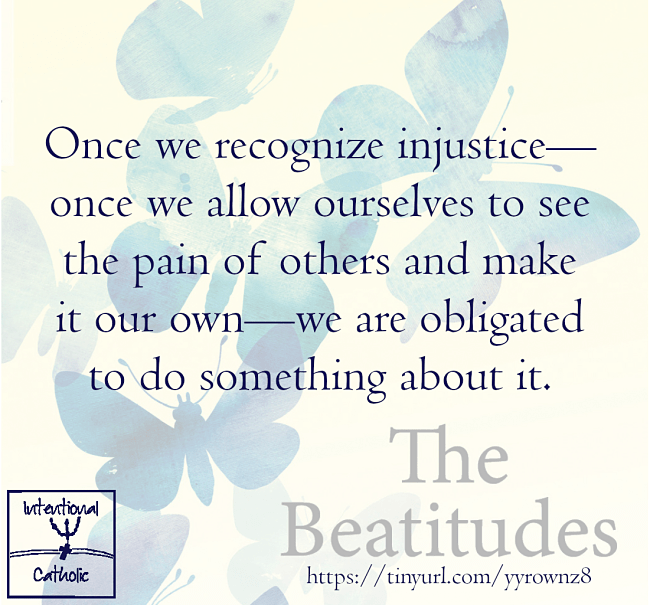
This insight was a really monumental shift for me in my faith. I knew the truth of it, at least as it related to particular issues of importance, of course. But it was a big deal to realize that whatever ignites my righteous anger, makes me squirm, or breaks my heart in the news–those things are, in fact, a call to action from God, speaking through my conscience.
I recognize them now, though I’m far from perfect about the “doing something” part. Writing “The Beatitudes” reminded me of that every time I sat down to work on it.
For years, I’ve maintained that *living* the faith is the truest form of evangelization. I still believe that, and it’s tempting–because I really have zero comfort level with talking about the faith to people who don’t already share it–to gloss right over this snippet of Evangelii Gaudium.
The trouble is, I put it in bold face in my notes, which means I thought it was important. Probably because it makes me uncomfortable.
But here’s what I appreciate about it: it’s very authentic. It doesn’t say “go out and stand on a street corner and thump on a Bible.” It’s asking me to examine my life and recognize where God has touched it–and that is my witness. I have no problem saying, “Hey, everybody, I went to this great restaurant and the staff was friendly and the food was great and we had a great time!” I just have to learn to do that with my faith, too.
My book, “The Beatitudes,” is now available from Our Sunday Visitor’s Companions in Faith series. If you’re not familiar with this series, they’re small books meant to be compact–to get right to the point, because we all know nobody has time to waste. “The Beatitudes” looks at the nitty-gritty issues of real life through the lens of these statements, which encapsulate the Christian faith.
I loved this idea from the moment OSV approached me about it. We hear the Beatitudes so often, it’s easy for them to lose their punch. They sort of roll over our heads without really impacting. This book uses them as a way to examine our attitudes and actions and discern where God might be calling us to grow. You can read a section in about three minutes and spend the next several days mulling over and praying about it. Sounds about perfect for modern life! (Where are the emojis when you need them?)
In any case, I’m very excited about this book. It is perhaps the most compact, focused way I’ve been able to lay out what I mean by the words “intentional Catholic.” So over the next week or two, I’ll share a few quotes from the book off and on. I hope you’ll check it out!
The subject of unity has been on my mind a lot lately.
A well-formed, 100% orthodox Catholic friend shared an editorial addressing the danger of the organized dissidence against Pope Francis. It’s from NCR, which conservative Catholics often don’t trust, so I didn’t share. But I’ve been troubled for a long time by this as well as other signs of division in the Church. How can I make a difference? How can I foster unity in the Church–and, for that matter, in the world?
Wrestling with those questions brings me back to this:
Dang it.
This is hard to swallow. I mean, I know I am flawed and weak. The rush to judgment I excoriate others for is my greatest sin, too. But I’m trying so hard to think around the issues that divide us. To form myself, educate myself, and discern whether the good in one side outweighs the good in the other. And to share whatever good there is with others. My hope is that taking a measured approach can help bridge the gaps between us. Am I really powerless?
I was contemplating this question with great angst when my laptop unexpectedly switched documents. There’s nothing particularly remarkable about that (unfortunately); being an old computer with a first-generation touch screen, it does random things like that pretty regularly. What was remarkable was the document it flipped over to—a nugget carved off another post that wandered too far from its original topic:
For years, I’ve wanted to pull my hair out as our society—both within the Church and outside it—makes a run for the all-or-nothing extremes. If one dares challenge trickle down economic theory, one must, by definition, be against capitalism. If one says “America should be better than this,” one must, by definition, hate America.
Of course, it happens the other direction, too. Words like “racist” are getting thrown around pretty freely these days. Now, I’m a big believer that white privilege and unexamined bias are real problems. I see them manifest in myself daily, and the struggle to conquer them is part of my spiritual journey. But it also seems perfectly self-evident that well-intentioned people suffering from white privilege and unexamined bias are not going to be convinced to confront said privilege by being called racists for it. How we talk about things matters.
I had to stop and chuckle at the Holy Spirit’s timing. It was like a little Divine nudge saying, “Yeah, unity is my problem–but I have a job for you, don’t worry.”
As for the division in the Church: I’ve now read two of Pope Francis’ documents in full, and I am baffled by the voices raised so loudly against him. Everything I see is so clearly, authentically Catholic. He’s called out people for getting too focused on a sliver of the Kingdom to the exclusion of the rest; he’s called out legalism and extremism; he’s called out the misidentification of things of the world as things of God. But there’s nothing threatening to the faith in any of that. So my best (most charitable) guess is that people get defensive when challenged to grow beyond the comfortable and familiar.
There’s a lot of demonizing going on within the Church, and it’s got to stop. There’s got to be room in the Church both for people who are passionately committed to annihilating abortion and people who believe we can’t sacrifice every other Gospel command in pursuit of that worthy goal.
I can’t help feeling that a lot of the negative chatter about Pope Francis is a reaction to him being outspoken on social justice rather than abortion. I have to keep reminding myself of this:
Both in our Church and in the larger world, our habit is to do exactly the opposite—and to cling so tightly to our assumptions that we end up not even seeing there could be another interpretation.
When we do that, the Devil is the only winner. When we do that, we’re giving the Church and the world to Satan.
I am often guilty of trying to control everything, to take charge and fix what I see needs fixing on the strength of my own convictions and abilities. Since I’ve been quite opinionated the last two days on matters of liturgical music, I put this out as a reminder to all of us who feel passionately about liturgy–myself above all–that God is in charge, not me. That if I try to lean on my own understanding, I’m going to make things worse, not better.
Come, Holy Spirit. Sweep us along with you, and get us where You meant us to be all along.
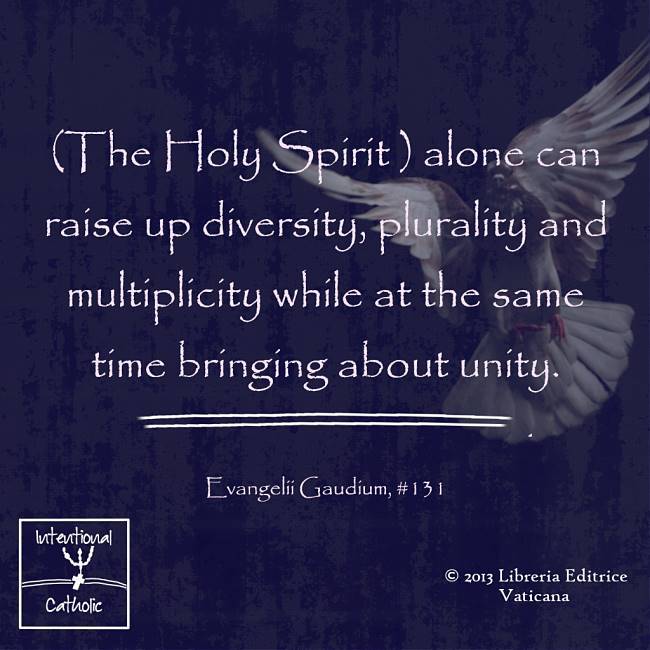
This whole section of Evangelii Gaudium is talking about unity (as distinct from uniformity) and diversity. Bear with me, or better yet just go read it yourself, because it may seem strange that I’m zeroing in on liturgy.
Evangelii Gaudium says the message of the Gospel has been “closely associated with” some cultures, but that doesn’t mean the culture is essential to the message (117). “We cannot demand that peoples of every continent, in expressing their Christian faith, imitate modes of expression which European nations developed at a particular moment of their history, because the faith cannot be constricted to the limits of understanding and expression of any one culture.” (118)
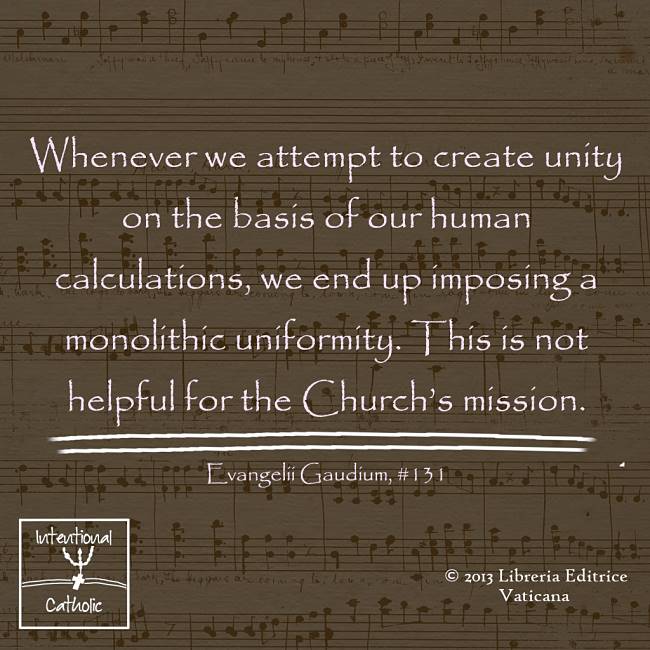
127-8 talk about how for most of us, opportunities for evangelization come one on one in personal settings, and suggests how that might look–but then 129 warns against being slavish to a particular formulation. This opens up a discussion of the many and varied charisms within the Church, which brings us to this quote and the one I will share tomorrow.
So it’s not specifically about liturgy, but the liturgy wars demonstrate clearly the confusion between unity and uniformity–specifically as regards music. That final sentence: “This is not helpful for the Church’s mission,” is what ties it all back to evangelization. Liturgy is the source of our strength to go out and accomplish the Church’s mission of bringing people to Christ and unfolding the Kingdom on Earth, but if the summit of our faith is corrupted by bickering over guitar vs. organ and whether drums are actually part of the culture and whether pop styles are intrinsically inappropriate for liturgy–etc., etc.–if we’re pouring all our emotional energy into fighting over these issues, how are we supposed to evangelize anyone? More to the point, why would anyone want to join that Church?
In other words: “Not helpful for the Church’s mission.”
I want to spend a few days pondering liturgy. The Eucharistic celebration is the “source and summit” of our faith, which to me means it is the spiritual food that strengthens us for discipleship in the real world, and it’s also the purest expression of our faith, uncomplicated by the messiness we experience outside the walls.
In theory.
Because we waste a lot of energy fighting about liturgy. My higher ed degrees are both in music performance, so I’m well steeped in classical music. But it’s contemporary music that lit me on fire and has shaped my Catholic identity as an adult.
So I react pretty strongly when people try to dismiss entire styles or instruments as “less worthy” or even “unworthy.” We all have things that speak to us more authentically and deeply than others. They’re not the same from person to person, because we are fearfully and wonderfully made, in diversity as wide as the creativity of God. We have no business trying to box in the Holy Spirit, Who inSpires across all eras, all cultures, and all artistic styles.
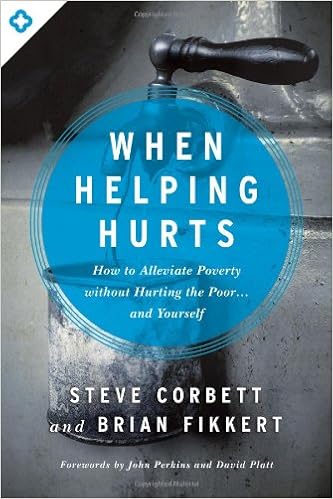
I can’t say enough good things about this book. Written by two Christians (not Catholic) who have been involved for decades in mission work, they share wisdom on how to be helpful, rather than going in with great intentions and making everything worse. In a nutshell, it boils down to this: we can’t come in and be saviors. Our job is to facilitate others helping themselves. There are three types of help: relief, recovery, and development. Most of the time, what’s needed is development, but the vast majority of the time what we offer is relief–because it’s easier. It’s easy to measure, its results make good reports to the investors.
The authors take a “both/and” approach. Many Christians look at the poor and assume they got that way by their own bad choices/sins; therefore their problems are theirs, not ours, to deal with.
Sin is an issue, the authors stress, but so are unjust societal institutions. As an example, they point to civil rights work in the south in the 1960s, and a particular pastor who didn’t speak out on racism.
“Both Reverend Marsh and the civil rights workers were wrong, but in different ways,” the authors wrote. “Reverend Marsh sought the King without the kingdom. The civil rights workers sought the kingdom without the King.”
The authors address overseas missions as well as efforts undertaken within the U.S. When Helping Hurts suggests that successful solutions are not either/or; they have to acknowledge both the effects of personal sin and the effects of institutional oppression, because those two things exert an influence over each other:
“What happens when society crams historically oppressed, uneducated, unemployed, and relatively young human beings into high-rise buildings, takes away their leaders, provides them with inferior education, health care, and employment systems, and then pays them not to work? Is it really that surprising that we see out-of-wedlock pregnancies, broken families, violent crimes, and drug trafficking? Worse yet, we end up with nihilism, because these broken systems do serious damage to people’s worldviews. Worldviews affect the systems, and the systems affect the worldviews.”
(p. 92)
When Helping Hurts offers the concept of “poverty alleviation” as a solution to the complexities of institutional injustice and personal sin. It is a “ministry of reconciliation” in which we use our money in such a way as to empower those in desperate circumstances to begin to help themselves. It acknowledges that they do, in fact, need help from outside, but that as much as possible we should honor the God-given human dignity of the poor by allowing them to be the leaders and the experts in their own lives. That our job is to empower them, not rescue them.
I’ve long believed that in most issues we bicker about, God is in the middle. This book shows us a Godly middle to issues of poverty. Both conservatives and liberals will find things that resonate and things that challenge in this book–which is, to me, the strongest argument that they are on target.
I spent some time yesterday morning–the first full day of school for all my kids–thinking about faith formation for my oldest child, who has now transitioned to public schools. Not all forms of religious formation are going to serve every kid.
And what does good formation look like? One of the things I talked about in my books for families with young kids is that it’s not just about knowing the what. Is it more important to be able to name the commandments in order, or to know what they are and how they apply in real life?
I don’t know what we’ll end up deciding, but I love the idea set forth in this quote: critical thinking formed by mature moral values. What a fabulous vision to set at the center of one’s educational goals! Critical thinking, to inoculate them from the worst of the manipulation practiced by modern life; mature moral values–not oversimplified ones that can’t stand up to the complexities of real life. I love it.





 Intentional Catholic