
Something we aren’t really talking about in terms of immigration or race (or, for that matter, quite a few other hot-button topics these days).
Real Faith for a Real World
Something we aren’t really talking about in terms of immigration or race (or, for that matter, quite a few other hot-button topics these days).

Returning to Open Wide Our Hearts for a day or two, as the subject of immigration comes back up in the national news. This quote really stuck out at me when I first read it, because so much of our national discourse these days involves firing shots over opponents’ shoulders, without ever actually pausing to listen “with open hearts,” as the US Bishops said. The obvious application of this quote is to black-white race relations. How often do we dismiss the experiences of our African American brothers and sisters, thinking, whether we admit it out loud or not, that they’re overreacting, or reading into situations things that aren’t there? Open hearts, indeed.
But black-white relations aren’t the only instance where this quote applies. How much of the immigration debate these days is framed around the belief that people coming from south of the border are out to get us? Whole swaths of the country have bought, hook, line, and sinker, the idea that most of those seeking entry to the U.S. are criminals, even though research shows the opposite to be true.
The other thing we aren’t talking about, nationally, is the fact that the violence that is causing the mass migration that has created a crisis at the border came from the U.S. in the first place. MS-13 originated in Los Angeles. (Given the above paragraph, I take a moment to acknowledge this example of crime within the immigrant community, but also–it has to be seen within the larger context; the gang came into being to protect the immigrant community from gang violence from American-born criminals. So hey, Americans taught immigrants to be criminals.) This 2005 article from the L.A. Times illustrates that the seeds of the current crisis were sown by our own failures decades earlier.
And yet now, we choose to ignore our own role in this crisis, and try to blame others?
Open hearts, indeed.
The problems at the border are real. The questions are real–the ones posed by people on both sides of the debate. But the hysteria and demonizing done on both sides does not reflect the heart of Christ. How are we supposed to bring people to Christ if we’re not even reflecting him?
For further reflection, here’s a homily Archbishop Chaput gave on the topic.

The wrestling match between anger and joy remains much on my mind, and this morning I read Ephesians 4: 25-32, which says, “Be angry but do not sin.” And also, “bitterness, fury, anger, shouting, and reviling must be removed from you,” and “be kind to one another.” I believe there is a great deal of meditation to do on these verses, in light of my pursuit of joy.

When I was a little girl, my mother took me to visit a relative in the nursing home. I must have been pretty small, because I don’t remember much except this: we were walking down the hallway and passed an old woman in a wheelchair—a complete stranger—who looked up at my mom and cussed her out.
Mostly, I remember the shock. Seeing my reaction, my mom said, in some verbiage appropriate enough to lodge a grain of wisdom in a small child, “We have to guard our thoughts, because when we get old, whatever we think is going to come out of our mouths, even if we know it’s wrong. Even if we always controlled it before.”
In recent weeks, as I’ve been pondering joy (and whether I have it), this truth has been working its way up through my memory. Challenging me to examine my present in light of its implications for the future. What kind of person I will be in another twenty or thirty years, if I spend these hours and days and years shadowboxing real and imaginary opponents? To do so is to nurture anger and bitterness, and in my twilight years, that is what I will do: view the world through a lens of everything that irritates me about it. To skip right over the beauty and unity and look instead for opportunities to pick fights with anything (possibly important, but more likely petty) that annoys me.
This is not what I want. I want the unfiltered version of me to be one that doesn’t evoke winces, deep breaths, or gritted teeth from those around me. To be joyful.
So what have I learned about seeking joy?
Honestly? Not much, yet. My spiritual director asked me, “Have you asked God to give you joy?” I took a breath to answer and what came out was:
“Um….”
 So lesson #1 is, relying on myself to find joy is futile. A chase after wind. Just like every other hard thing in life, it is beyond me. It is a gift of God, and I have to ask for it.
Lesson #2 is that whether it feels like it or not, I have a choice about how I react to things. You know that cliche, “pick your battles”? In recent years, I’ve been picking them all. A few months ago, I identified one major battle in my life that I was not winning, while other people were having better success. I realized that meant it was time to let them take over the fight.
In the past few days, I discovered that where another battle is concerned, I’m simply done fighting. The wound hasn’t changed, my convictions haven’t changed, but I’ve expended all the emotional energy I’m willing to expend. It’s time to seek open doors instead of banging on the one that’s closed. Shake the dust from my feet. Move on.
Lesson #3 is that being out of sync in my closest relationships is an unnecessary stress that robs joy from all of life.
Lesson #4 is that getting stretched too thin causes me to be out of sync in my closest relationships.
Lesson #5 is the one I already knew: that equilibrium in my life comes from spending time alone with God in nature. Weather, family obligations, and my husband’s lack of freedom to do the same all complicate that seemingly simple truth, but I’m trying to work with it.
That’s what I’ve got so far. What about you, readers? What have you learned about seeking joy?
#joy #evangeliigaudium #intentionalcatholic #realfaithrealworld #faithinaction #catholic

#joy #evangeliigaudium #intentionalcatholic #realfaithrealworld #faithinaction #catholic
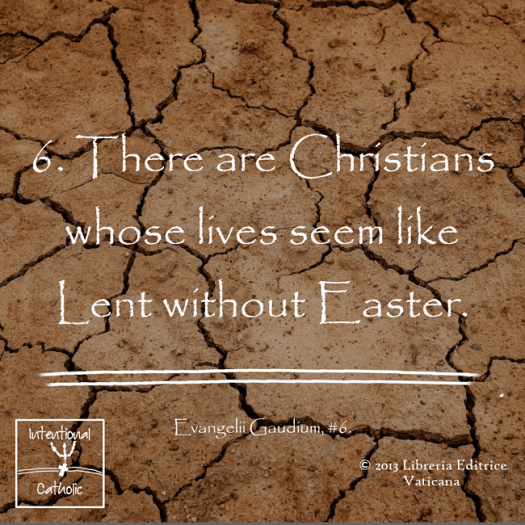
 I’ve spent a lot of the last few years feeling angry and unsettled. Reading Evangelii Gaudium last fall really convicted me. I don’t mean that in the sense of “courage of my convictions.” I mean it like judge and jury.
I don’t think I am joyful, you see. I see too much in the world that is not as it should be. Things besides the sound bites that most often preoccupy Christians. Things that most Christians don’t even recognize as out of sync with the Gospel. Things that strike me with particular force because it hasn’t been that long since I didn’t recognize them, either.
I struggle with how resistant we Christians are, collectively, to acknowledge injustice and to dig into the messy, challenging work of fixing it. People can disagree about solutions to problems, but too often, the go-to response is to act as if it’s all an overreaction. That actually, there’s nothing to fix.
For example: how we deal with race. Or the way certain quarters of Christianity have vilified people traveling at great personal cost from Central America, labeling them criminals even though the vast majority are asylum seekers fleeing violence at home. Why are we so resistant to accepting the word of minorities and hopeful immigrants about what they’ve experienced? What does it say about us? How does it reflect a belief that Jesus’ presence is in each human being, and that therefore each one’s human dignity is sacred?

Why is it so difficult to recognize when we aren’t following this exhortation from St. Ignatius of Loyola?
I can’t help feeling that by focusing too narrowly on one issue to the exclusion of many, many other things Jesus called out by name in the Gospels, we weaken the Church. We weaken our credibility as representatives of Christ on Earth, and we weaken our ability to evangelize.
This makes me angry. Which weakens my ability to evangelize. Because how does an angry person invite others in? Why would they want anything to do with a Christianity that, on the one hand, applies the value of human dignity unevenly, and on the other, spits fire about it?
Which makes me wonder: is it possible to care too much? Am I too focused on the here and now, when I know full well that the kingdom is never going to be fully realized on earth?
I did not intend to tour two of Pope Francis’ writings in a row. I intended to look backward, to Paul VI or the Council. But this question of passion for the justice of God versus resting in the joy of salvation is really potent in my life right now. I spend far too much of my inner life shadowboxing the Bad Stuff of the world and those who support it.
Rachel Held Evans passed away this weekend. She wasn’t Catholic, but I think it’s safe to say most Catholic bloggers know her work. Stretched thin as I am, I didn’t always click through, but when I did I never failed to be inspired and challenged—even before I understood why her words resonated so deeply. If you aren’t on Facebook with Intentional Catholic, you might have missed this post of hers, which I shared yesterday. What leaps out at me in her writing is that she doesn’t pull punches, yet she doesn’t sound angry.
I long for this gift. It is a gift I intend to pursue, because I’m weary of being angry. Are you? Will you join me in pursuing joy? Might joy itself be the answer to all that ails us in this polarized, toxic time?
Words that should skewer us all in these polarized times…they certainly made me squirm. This quote reminds me of the adage “assume the best of the other.” I believe this passionately, yet so often, I do the opposite.

Another thought from Pope Francis about the underlying mindset that allows us to be better stewards of God’s creation (not to mention everything else).
#intentionalcatholic #realfaithrealworld #faithinaction #theologyofthebody #creation #environmentalstewardship #steward #green #greenliving #gogreen #climatechange #laudatosi #laudatosii #catholic #socialjustice #humandignity #goldenrule #theologyofthebody
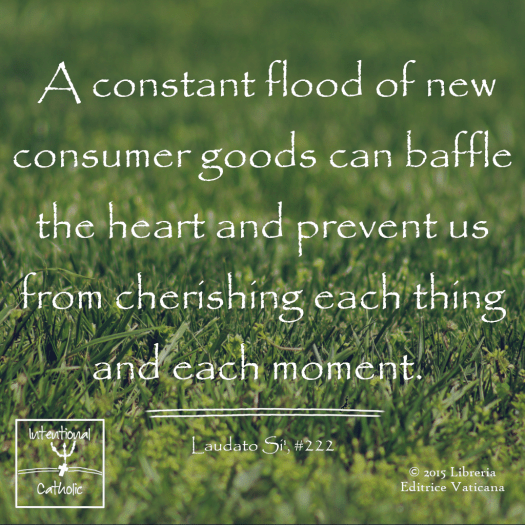
The context of this quote is about the global approach to life. What drives damage to the earth, as much as anything, is an underlying craving for more, new, better, in an unending stream. But does any of that make us happy? No. This is Pope Francis pointing out that we need much less than we think we do. And that the constant craving for more leads to many imbalances, the environment being only one of them.
#intentionalcatholic #realfaithrealworld #faithinaction #theologyofthebody #creation #environmentalstewardship #steward #green #greenliving #gogreen #climatechange #laudatosi #laudatosii #catholic #socialjustice #humandignity #goldenrule #theologyofthebody
 Intentional Catholic