Happy Memorial Day to my U.S. readership! It’s been a crazy May for me, so if I take a hiatus next week, bear with me. I have a lot of catchup to do, and now the kids are out of school–time to get some healthy summer habits set up!
On that topic…Yesterday, some friends and I were chatting about what it takes to get our children to really connect the faith with the real world. There was discussion about whether working at the soup kitchen might be just as effective as formal religious education. Perhaps not a substitute, but definitely food for thought as summer break begins and parents have a little time to breathe, to live intentionally with our families…
Returning to Open Wide Our Hearts for a day or two, as the subject of immigration comes back up in the national news. This quote really stuck out at me when I first read it, because so much of our national discourse these days involves firing shots over opponents’ shoulders, without ever actually pausing to listen “with open hearts,” as the US Bishops said. The obvious application of this quote is to black-white race relations. How often do we dismiss the experiences of our African American brothers and sisters, thinking, whether we admit it out loud or not, that they’re overreacting, or reading into situations things that aren’t there? Open hearts, indeed.
But black-white relations aren’t the only instance where this quote applies. How much of the immigration debate these days is framed around the belief that people coming from south of the border are out to get us? Whole swaths of the country have bought, hook, line, and sinker, the idea that most of those seeking entry to the U.S. are criminals, even though research shows the opposite to be true.
The other thing we aren’t talking about, nationally, is the fact that the violence that is causing the mass migration that has created a crisis at the border came from the U.S. in the first place. MS-13 originated in Los Angeles. (Given the above paragraph, I take a moment to acknowledge this example of crime within the immigrant community, but also–it has to be seen within the larger context; the gang came into being to protect the immigrant community from gang violence from American-born criminals. So hey, Americans taught immigrants to be criminals.) This 2005 article from the L.A. Times illustrates that the seeds of the current crisis were sown by our own failures decades earlier.
And yet now, we choose to ignore our own role in this crisis, and try to blame others?
Open hearts, indeed.
The problems at the border are real. The questions are real–the ones posed by people on both sides of the debate. But the hysteria and demonizing done on both sides does not reflect the heart of Christ. How are we supposed to bring people to Christ if we’re not even reflecting him?
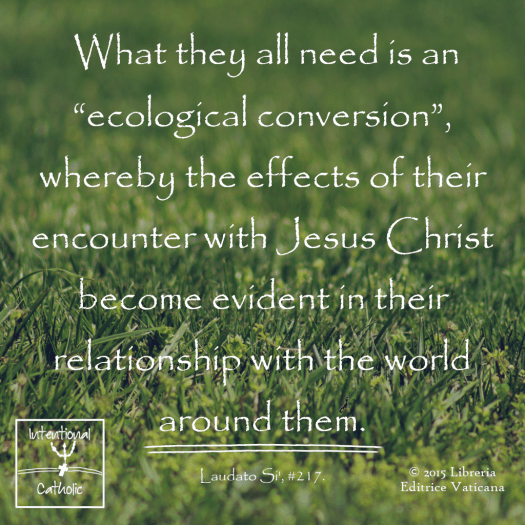
This is a key quote in this document, because it underscores the fact that belief is evidenced by action. Pope Francis is stressing that when we have a living and vibrant faith, it is going to manifest itself in the way we interact with everything. In this case, valuing creation as a gift of God — seeing in it the “caress of God“– should change the way we interact with that gift. We should not be cavalier in the way we use the earth. And here’s where we delve into turning off the vehicles instead of idling for ten or twenty or thirty minutes; to not using plastic straws and plastic bottles; to all the everyday ways we can be better stewards of creation.
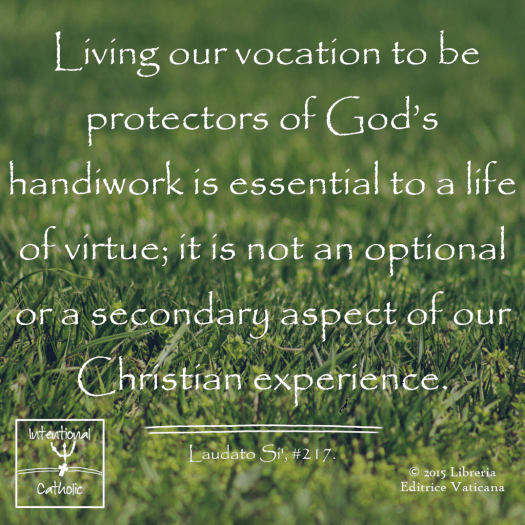
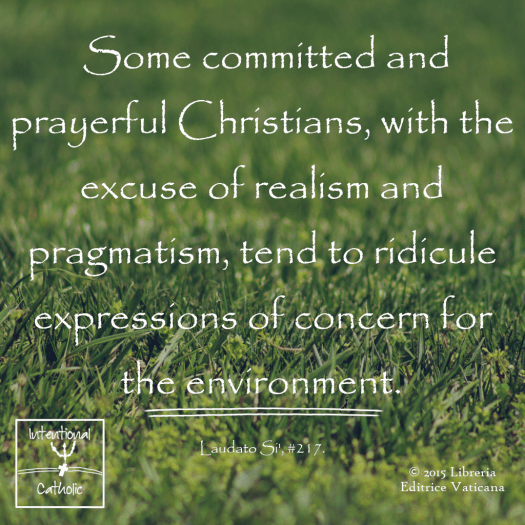
This is the first of two hard-hitting quotes that should cause us to examine our consciences and our biases. It’s easy to make fun of “tree huggers,” isn’t it? To view concerns about environment as secondary (at best) or pagan (at worst). Tune in tomorrow for the second half.
When I read this, all I could think was: wow! How much food goes to waste in the United States, again? A third of what’s available? Even today, years after first reading this quote and making changes to make sure we waste as little as possible, there is a bag of lettuce going bad in my refrigerator. Stolen from the poor, indeed.
This is the first of many places where this encyclical challenges us to examine our habits and make changes, because stewardship of creation goes hand in hand with care for “the least of these.”
My parish sits near the intersection of a major interchange along a major cross-country interstate. My husband and I lead a music ensemble at church, and every so often at practice on Wednesday nights, we find ourselves facing people coming in off the interstate asking for help: out of gas, out of work, broken down…
It happened last night, and it underscored how unprepared we are, both as individuals and as a parish, for such situations. We tried to find someone from St. Vincent de Paul but weren’t successful, and this gentleman eventually left, apologizing for bothering us because we clearly couldn’t help him. And though he was polite, it felt like he was pointing out the disconnect between our self-satisfied perception of ourselves as people of faith and the reality of how unprepared (unwilling?) we were to help a person in need.
Situations like this always disturb me. I find myself caught between a desire to help and a gut-level suspicion that said seeker is preying on the hearts (and guilt) of those of faith. And of course, the answering twinge of conscience, because how is that attitude compatible with a Christian world view?
For forty-plus years, every time I’ve confronted this situation, good and faithful people have responded with something like, “Hey, it’s the way of the world. This is reality. You have to be suspicious or you’ll get taken advantage of by scammers.”
But is it really okay for suspicion and world-weary jadedness to be our first, let alone our final, reaction? I mean, how are we ever actually to know whether a person is genuinely in need or being lazy/irresponsible/reaping the harvest s/he has sown? We are never actually going to know that. More importantly, is it really our business? Isn’t our call to give, and let God sort out the recipients? And if the answer to those questions has anything to do with the words “it’s my money,” then aren’t we intrinsically putting mammon ahead of God? How does it damage me in the slightest to give the benefit of the doubt to those asking for aid, even if I do end up supporting the occasional scammer?
This morning, Bishop Barron’s Gospel reflection zeroed right in on this same issue: “God is not pleased with this kind of economic inequality, and he burns with a passion to set things right. …Even though it makes us uncomfortable—and God knows it does, especially those of us who live in the most affluent society in the world—we can’t avoid it because it’s everywhere in the Bible.”
It’s hard for me to imagine why anyone would come into a church at night, put themselves in the face of such humiliation, if they didn’t actually need help.
So today, this is the puzzle I’m wrestling: What is the right and proper balance of prudence with Christian charity? How do I keep from twisting the faith, in situations like these, to make it more comfortably align with worldly values—like, for instance, the attachment to the idea of “my money, my way”? Isn’t it just as likely that we react with suspicion because it absolves us of the responsibility to respond to the face of Christ in people who come to us for help?




 Intentional Catholic