Context is important…Gaudium et Spes was published in 1965, during the cold war, and no doubt the bishops who wrote it, as well as Pope Paul VI, were thinking about the threat of nuclear war. But it’s interesting how much these words resonate today, isn’t it?
Bear with me, because you may think I’m posting this on the wrong blog.
Friday night, I went to an Asian grocery store to buy boba pearls. Outside stood a group of three young people, chatting in what I presume was Chinese over a grocery cart full of white plastic bags. It was a beautiful night, and I glanced over at them as I walked in. My eye caught on the gorgeous dress one of them was wearing. Red, with white and black trim, fitted without being slinky, worn over black leggings. I thought, “I want to shop where she bought that dress.”
And I had this moment of crystal clarity: I hate American fashion. Every outfit I’ve admired in the past 4-5 years has been from Asia or Africa.
For months, I’ve been searching for a handful of clothing items to serve a particular purpose. I’ve bought nothing, because I can’t find anything I like. Not in the consignment stores where I start and not in the big box stores.
A friend of mine found this train of thought troubling. If this is true, how do we live faithful life? What if we can’t even survive without participating in some way in a system that harms others? What if the system is so pervasive, we can’t escape it?
To which I add: if we could opt out, wouldn’t we actually increase the misery of the poor, because whatever income they do make is more than they’d make if we stopped buying?
The world is full of good things, and I want to enjoy them: chocolate, a good book, and my backyard patio set all give glory to God, the maker of the raw materials and the giver of the human creativity used to shape raw materials into wonderful things.
But it’s hard not to wonder if I should be diverting every penny I spend on these things to people fighting for little more than survival.
How long, O LORD? I cry for help but you do not listen! I cry out to you, “Violence!” but you do not intervene.
And God’s reply:
The vision still has its time, presses on to fulfillment, and will not disappoint; if it delays, wait for it, it will surely come, it will not be late.
Habakkuk’s pain is so familiar. The world is such a mess. We just want God to fix it already.
But how can we yell at God for not acting to alleviate the injustices at work in the world? We’re the ones who enact the injustices, not God. The only way they get un-enacted is “if today you hear God’s voice, harden not your hearts.” In other words, learn to recognize injustice and then DO something about it.
But the obstacles to doing something seem insurmountable. I’m a big believer in pebbles and ripples. I throw my pebble in the pond, you throw yours, and the guy down the street throws his, and eventually things change.
But it’s not satisfying. Waiting is hard. Waiting leaves us conscience-stung in that no-man’s land between the good things of the world and the knowledge of who’s actually paying the price for them.
And maybe, in the end, that’s the only takeaway: that while we are in the world, we have to accept that we are never going to have the answers—we’ll always be wrestling with what is versus what could or should be. We’ll always be looking for that balance between enjoying the world God gave us and recognizing the ways in which we are called to act. Even if it requires sacrifices we don’t want to make.
The readings this weekend were all about money. Amos was talking about the dishonesty of those with money–how they were so focused on their own profits that they didn’t really care what happened to the “have not”s of the world. And Jesus said, “Guess what? How you use your money matters.”
Listening yesterday at Mass, it really struck me how those readings should skewer America. The obvious application is the question of income inequality: how many of the huge profits made by companies are held by those at the top of the food chain, how little is actually shared with those down the ranks.
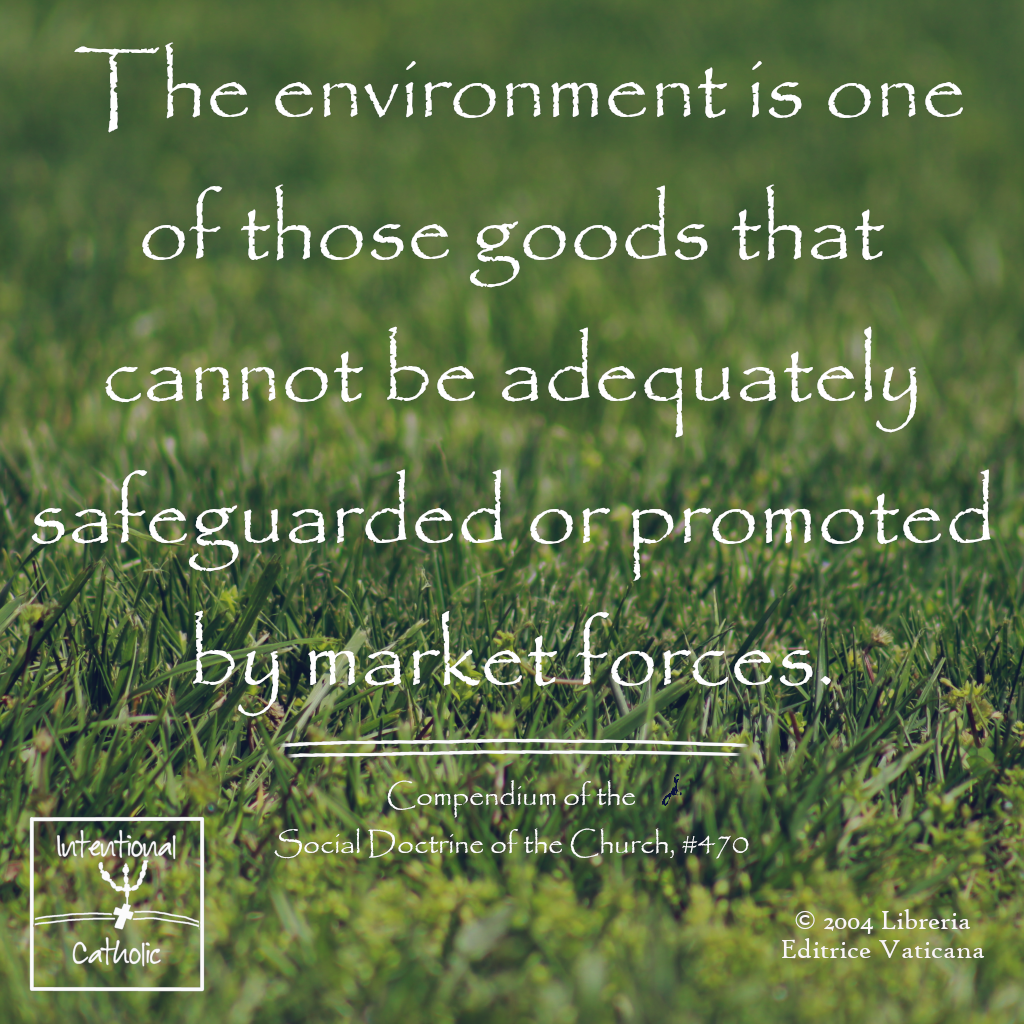
But you know, so much of what we talk about in America centers on money. Many would like to believe we’re a Christian nation, but money–capitalism–is the primary thing that preoccupies our social and political discourse, even among Christians. So many things come back to money: health care and social programs would require more taxes, and we can’t possibly suggest raising taxes. Immigrants are perceived as a threat to American jobs, so again–it comes back to money. The question of whether a president deserves re-election is always about the economy. We’re having all these discussions about China and intellectual property and trade fairness, but nowhere on anyone’s radar is the question of just wages for labor, which is–let’s face it–the only reason manufacturing went overseas in the first place. It went overseas because we, the rank and file Americans, aren’t willing to pay what it would cost to make a product while paying a just wage to the laborer who made it.
We have a lot to answer for, and I don’t pretend to have a pat solution. I personally try to take a step back from the consumer culture by starting with secondhand clothing purchases as much as possible. But those clothes, too, were made by cheap labor overseas, and I order from Amazon just like every other red-blooded American. What do I think God will say to me when it comes time for me to answer for my choices? I don’t like pondering that question any more than anyone else.
In any case, when I was looking through the possibilities for things to share today, this quote from my Beatitudes book seemed to dovetail with what we heard at church yesterday. Because what if? What if, instead of money, we made God’s will, God’s kingdom, God’s priorities, the central principle that guided every other choice?
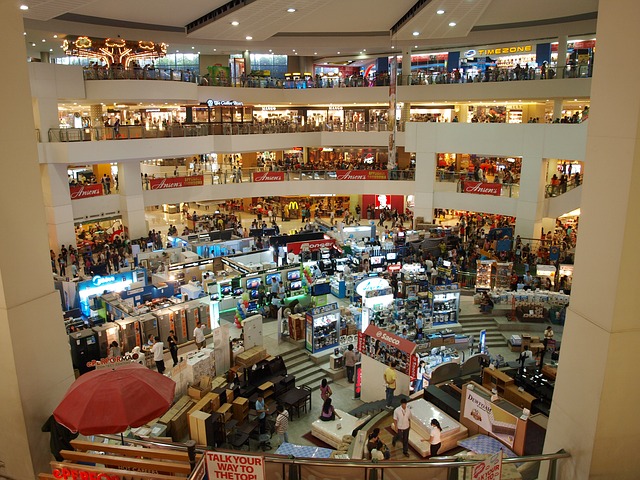
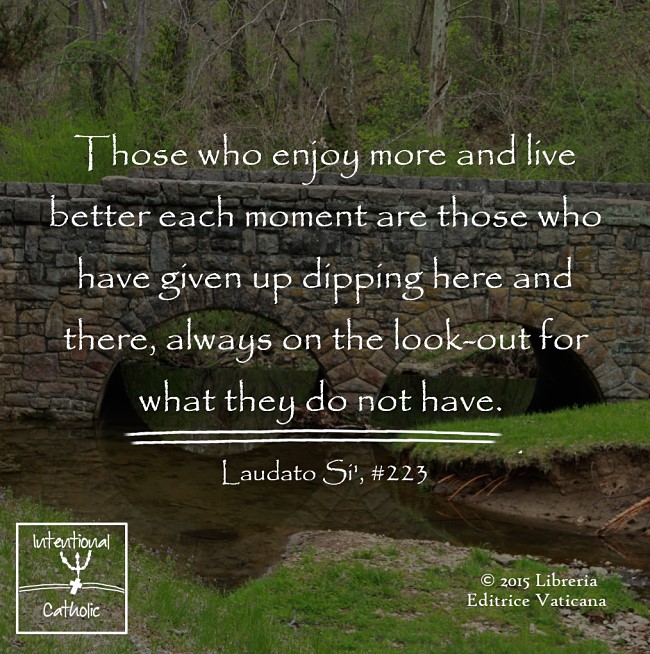
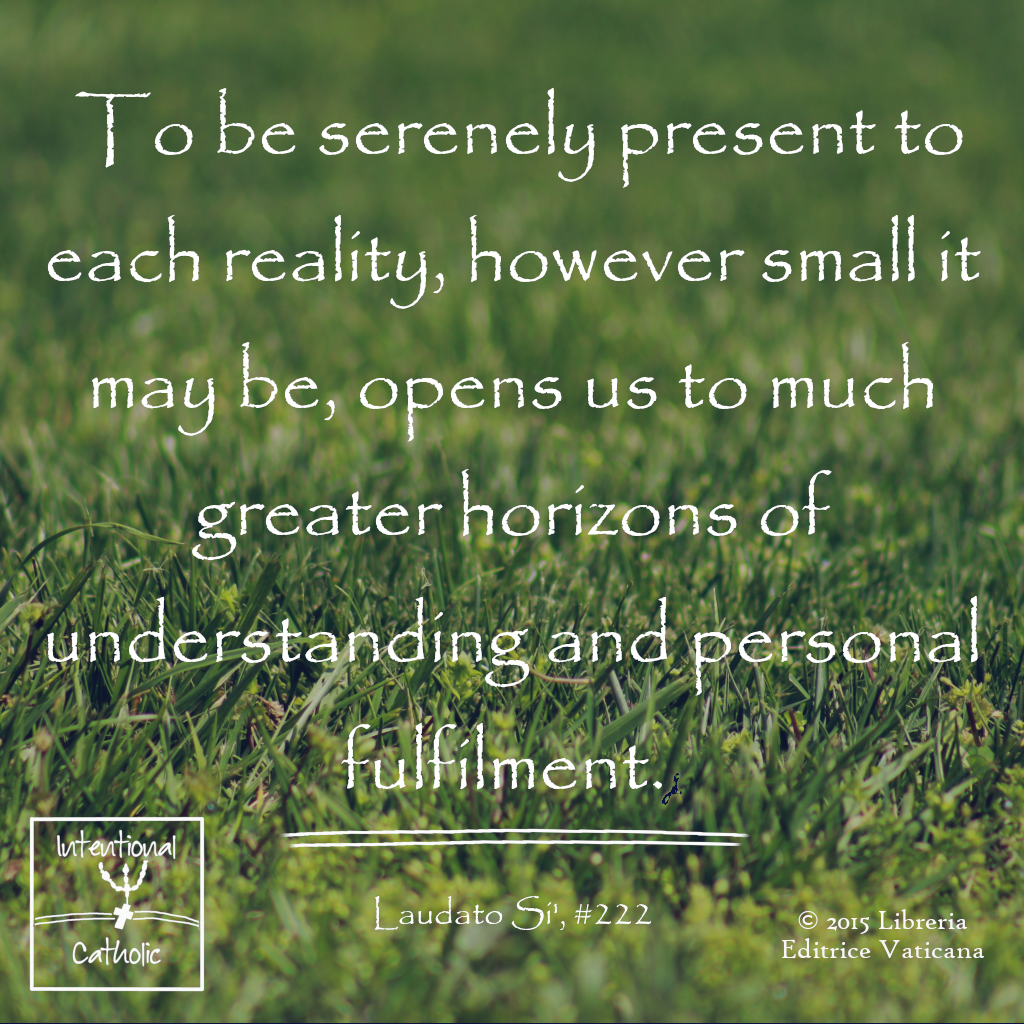
One of the things I love about Laudato Si’–and all the documents I am mining, in fact–is how lessons about the primary topic apply in so many other, seemingly unrelated, areas of life. Take this one. It’s about living more sustainably, but his point is that the chasing after the wind that is the consumption culture (new phone! Better streaming service! New clothes!) leads to being unsatisfied with life–skipping along the surface without ever really sinking into the moment. This resonates with me so deeply. It applies to the pursuit of physical goods as well as one’s reach and influence. You can imagine how much that topic preoccupies someone with an online ministry. Stats! Followers! Shares! Engagements! SEO!
But it also applies to being too busy, trying to gorge on everything on the buffet table of life instead of choosing and savoring. We all recognize this as a perennial problem we face in modern life.
The news about the Amazon has had me very troubled lately; perhaps that’s why Laudato Si’ has been on my mind again lately. I went back to see what quotes I hadn’t used, and this seemed so universal, not just in relation to stewardship of the earth, it practically leaped off the screen.
Another thought from Pope Francis about the underlying mindset that allows us to be better stewards of God’s creation (not to mention everything else).
The context of this quote is about the global approach to life. What drives damage to the earth, as much as anything, is an underlying craving for more, new, better, in an unending stream. But does any of that make us happy? No. This is Pope Francis pointing out that we need much less than we think we do. And that the constant craving for more leads to many imbalances, the environment being only one of them.
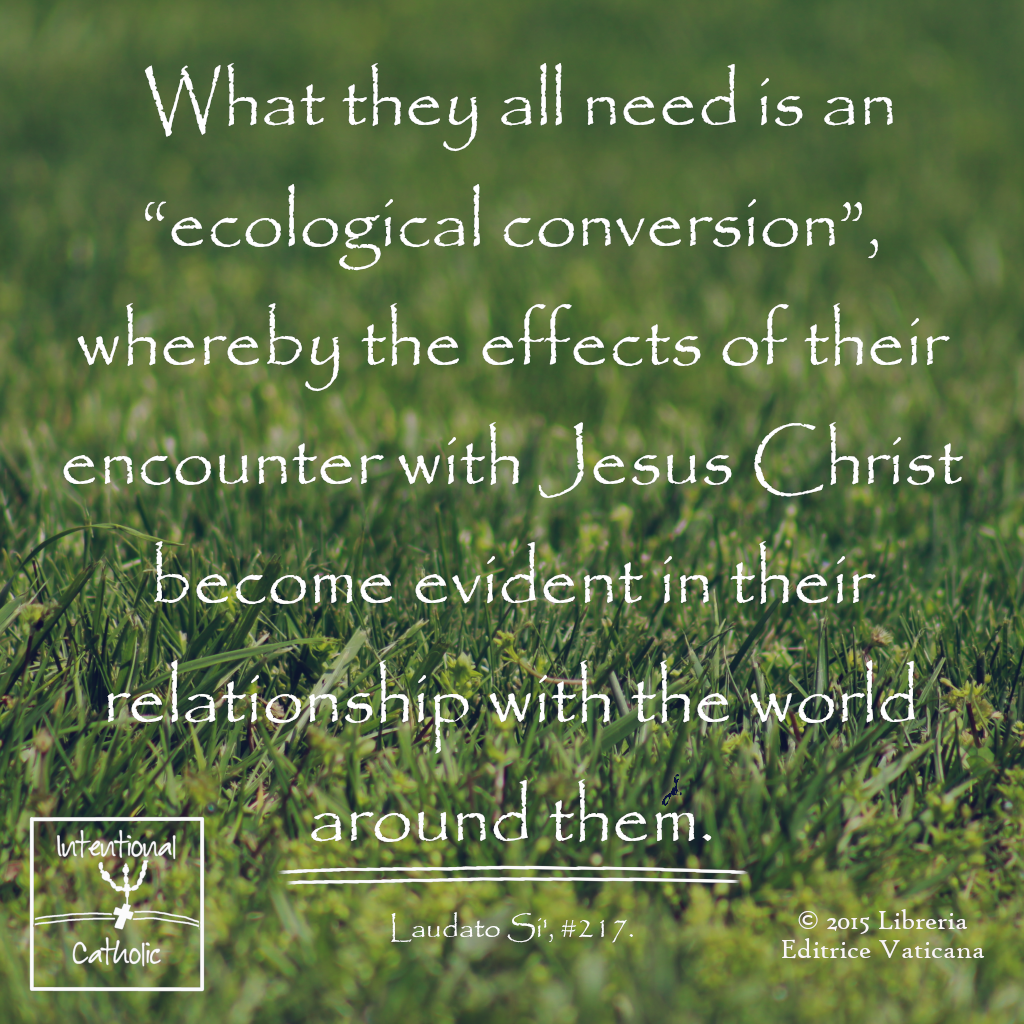
This is a key quote in this document, because it underscores the fact that belief is evidenced by action. Pope Francis is stressing that when we have a living and vibrant faith, it is going to manifest itself in the way we interact with everything. In this case, valuing creation as a gift of God — seeing in it the “caress of God“– should change the way we interact with that gift. We should not be cavalier in the way we use the earth. And here’s where we delve into turning off the vehicles instead of idling for ten or twenty or thirty minutes; to not using plastic straws and plastic bottles; to all the everyday ways we can be better stewards of creation.
This is the first of two hard-hitting quotes that should cause us to examine our consciences and our biases. It’s easy to make fun of “tree huggers,” isn’t it? To view concerns about environment as secondary (at best) or pagan (at worst). Tune in tomorrow for the second half.





 Intentional Catholic