Right Words, Wrong Message

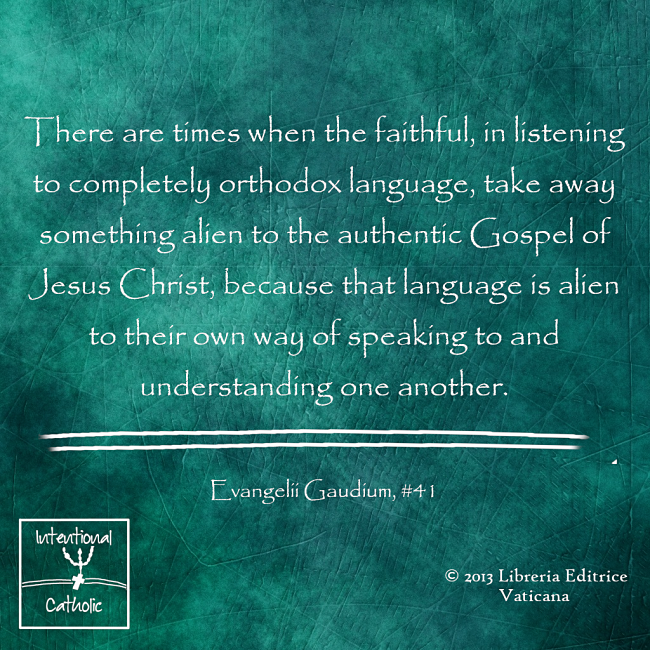
I had to go back to the source myself on this one. There’s a lot to think about here, and Pope Francis doesn’t dig in and tell us exactly what he’s referring to. He just says sometimes we set up “false gods or a human ideal which is not really Christian.” He goes on to say that sometimes things we treasure, or which have been very helpful in the past, no longer are helpful because the culture, and thus the people we’re speaking to, have changed around them. I’d encourage you to read all of #41-43 (and beyond).

I see this dynamic play out when praiseworthy commitment to the teachings laid out by the Church leads us to judge and exclude people because they don’t measure up–even though none of us, in fact, measure up. I point back to the posts on imperfect practice of the faith and whether we view sin as a stumbling block on the way to something better, or a pit of mud we can’t escape.

As hard as we are on ourselves, most of us recognize that we can be loved by God despite our sins. But someone else’s sin, which takes a different form than ours, we often can’t or won’t overlook. We’re inconsistent about our approach to sexual sins, for one thing. And other sins–greed and dishonesty come to mind–we accept with a shrug…if we acknowledge them at all.

To me, this is an example of how we take a true message–what we are called to as Christians–and as we bring it down through the filter of our worldly biases, we corrupt it into something different. Something that achieves the opposite of what Jesus intended; namely, division and exclusion.

That’s my take. What’s yours?

Imperfect, but Okay? Really?

ย†

Background image by vargazs from Pixabay

This quote first struck me because it doesn’t make sense. I have a garden. And a lawn I’ve recently reseeded. If I see a weed, I grumble a LOT. In fact, I’ve been going outside lately and pulling crabgrass out of my lawn, in a nod to complete futility. I do not see the swath of green, I see the weed. I see the imperfection.

In this one area, at least, we’re consistent in how we handle the physical and the spiritual world. We are not willing to tolerate imperfections in expressions of faith, either. It’s got to be all or nothing, and the problem is that the more we cling to that, the more people choose “nothing.”

A few years ago, someone asked me for advice on convincing a reluctant spouse to embrace Natural Family Planning. I, in turn, asked advice from a friend, who said, “Tell them to practice NFP. It’s about practicing. You do the best you can. You’re going to screw up. Just keep practicing.

This was a real brain-stretching thought for me. To me, NFP was an all or nothing prospect. You do it or you don’t. It had never before occurred to me that maybe something so challenging and outside the cultural norm is, by definition, going to be done badly (and here I don’t mean mistakes in applying the method, I mean spiritual choices) and with lots of spiritual mistakes on the way to doing it well. Like practicing the piano, or the violin. You’re bad before you’re good, but that doesn’t make the effort any less laudable or worth undertaking.

Why have we never thought about the spiritual life this way?

My brain is exploding with thoughts on this, but I’ll leave it there for today and take up the question again after the weekend.

To Love Is…

Since the Church considers this quote important enough to be underscored in the Catechism, I thought it deserved a graphic of its own, even if I did already write a whole post on the topic. Sometimes a picture is worth a thousand words, right?

Love Is A Concrete Thing

Photo by Ylanite Koppens on Pexels.com

Tell me if this sounds familiar: you tell a kid to put away a piece of clothing, and ten minutes later you look and discover it hasnโ€™t been done. You tell them to do it again, and this time it makes it up the stairs and gets dumped on the floor. By the third time, youโ€™ve pretty well lost your temper, and itโ€™s all downhill from there.

This is my life right now: dishonesty, serial disobedience, and difficulty discerning how much is developmental and how much is spacey personality versus testing behavior. My husband reminds me weโ€™ve been through it before and weโ€™ll get through it this time, but itโ€™s wearying.

Why does this warrant a blog post on a site about living the faith?

Because Iโ€™m starting to recognize that this parenting issue has a lot to teach us about loveโ€”real, self-giving, sacrificial love. How can we teach such a big concept to our children without starting with small, intimate relationships and smallโ€”maybe even pettyโ€”examples?

Little kids experience the world in concrete ways, after all. I need my child to learn that love doesnโ€™t just mean cuddles and kisses and being tucked into bed at night and giving me a hug on the way out the door. Thatโ€™s a tiny childโ€™s version of love, but as they grow, they need to learn that a bare minimum, love means you donโ€™t do things that harm the other.

And since Jesus Christ was never in the business of bare minimum, Iโ€™d go a step further and say, as the Catechism says: love means willing the good of the other.

So your actions show your loveโ€”or the lack of it.

To wit: if you cause your favorite parent to LOSE HER EVER LOVING MIND because you just donโ€™t feel like doing what she asked you to do, then youโ€™re causing harm and youโ€™re definitely not willing the good of said parent.

In other words: NOT. LOVE.

Okay, itโ€™s petty, I know. But really, if you start spinning out the implications, this is a big deal, and not just for the kiddos, but for us as adult Catholics.

Because if:

a) everyone is our neighbor (Luke 10:29-37), and

b) loving God means loving our neighbor (Luke 10:27-28; Galatians 5:14), and

c) love means willing the good of others (Catechism of the Catholic Church 1766)โ€ฆ

โ€ฆthen weโ€™d darned well better be thinking about willing the good of asylum seekers at the southern border.

And about how to alleviate the strain on of living on women who see abortion as their only option.

And how to erase discrimination (which might mean, for a start, acknowledging that it still exists).

And what it means to steward the earth God gave us for future generations.

And how to create policies that put the good of workers and society before personal or corporate profit.

And how to protect victims of abuse and assault, rather than shame them and blame them and assume they’re lying for underhanded political reasons.

Because with every word we speak about those issues and every policy solution we advocate (or fight against), we show our love for Jesus Christ.

Or the lack of it.

Get Involved

“But I’m too busy…” It’s always about busy-ness, isn’t it? Which means, actually, it’s about my priorities. Am I so caught up in “things of the world” that I haven’t carved out time to serve God? God gave me these hands, these feet, this voice. How am I using them for him?

It’s a balancing act I know I’ll never get 100% right…but I have to keep working at it.

On Sarcasm, Mercy, and having your conscience walking around in the body of a six-year-old

In 2016, I wrote a series of posts called โ€œMercy on a Mondayโ€ for my personal blog. Many of them are just as applicable today as they were then, so Iโ€™m mining my archives to share here.

Photo by Pixabay on Pexels.com

It didnโ€™t take long for this list of ways to live out the year of mercy to nail me between the eyes:

1) Resist sarcasm; it is the antithesis of mercy: โ€œโ€Set, O Lord, a guard over my mouth; keep watch, O Lord, at the door of my lips!โ€ (Psalm 141:3).

Umโ€ฆouch.

Sarcasm is the cloak I wear at certain times of the month. It is my instant response to being asked a) stupid questions, b) questions Iโ€™ve already answered, and c) stupid questions Iโ€™ve already answered.

Itโ€™s also my instant response when a political candidate gets on my nerves (daily, at a minimum), when a driver does something I donโ€™t like, or a piece of technology causes me inconvenience. And itโ€™s always aimed at the people behind those irritants, who should have been smarter and more polite than to bother Almighty Me.

Iโ€™m a word pictures kind of girl, and in the past month, mercy has come to be associated with something soft and cool, pliable, able to bridge the gap between square pegs and round holes. Sarcasm, on the other hand, is a hard, hot slap in the face. It raises hackles and solidifies them into brick walls. It makes both parties hard and unforgiving (in every sense).

Sarcasm is demeaning to others. It excoriates the soul and causes sensitive people to retreat into themselves. It shuts down communication. It might be funny, but the laughter only makes the belittling and the soul scouring feel even more belittling and soul scouring. It feeds bad feelings on both sides: self-hatred on the part of the victim and self-righteousness on the part of the one who doles it out.

It can be death on a marriage, in particular, and cause real pain to children, who only want to be loved, even when theyโ€™re completely clueless how to express that need appropriately.

Resist sarcasm; it is the antithesis of mercy.

I read those words and instantly vowed to change. And just in case there was any doubt that this was what I was called to do, the Holy Spirit gave me a big wakeup call the next day. It was in the van on the way home from school, and my mini-me responded to his little brother with blistering sarcasm, his tone dripping with contempt. It cut me to the soul, instantly and so profoundly that I even remember where we were on the route.

Because this is my fault. Iโ€™ve taught them this.

I donโ€™t remember what I said. I do know it was not a scolding; it was heartfelt and involved confessing my own fault in the matter. I told them part of what I was doing for the year of mercy was to quit being sarcastic.

The car was quiet for a few moments, which, if youโ€™ve ever had three, four, five, or six kids in the car (as I do on a regular basisโ€“am I not lucky?), youโ€™ll know is no small thing.

You know that old saying about how parenthood means having your heart walking around outside your body?

Well, I think God gives you children in order to make sure you have a conscience walking around in someone elseโ€™s body, commenting out loud on your foibles. In this case, the body of my six-year-old.

โ€œMom, are you being sarcastic?โ€ my child will ask me.

โ€œUmโ€ฆyes, I was. Iโ€™m so sorry, honey. Youโ€™re right.โ€

โ€œMom, I think that was sarcastic!โ€

โ€œWe-ell, that was sort on the edge. It was more like a joke.โ€

Itโ€™s been good for me. Itโ€™s making me stop and think before I share the effervescence of my own wit.

I donโ€™t like it. But I can feel the difference. Iโ€™m not so angry, so volatile, like a pump primed and ready to react to the slightest provocation. The inside of my chest feels a little cooler and settled, more relaxed, more open. It feels like growth. And that is, after all, what Iโ€™m going for, in this year of mercy.

The “unruly freedom of the word”

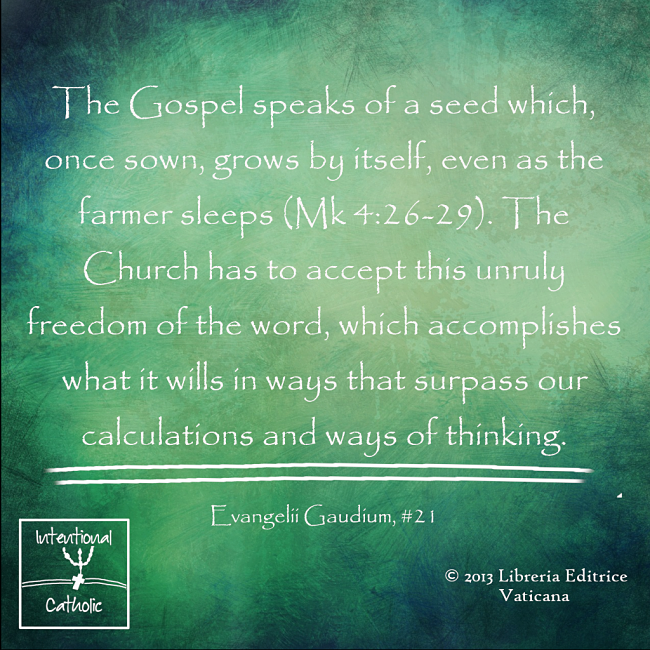
I find this quote really striking, because human nature, especially in this day and age when we face too much information at all times, is to try to boil everything down, put it in categories and boxes so we can process it and feel safe with it. And whenever something defies those artificial limitations, we feel really threatened. Threatened to the point where we reject it, even if it’s the movement of God, because it doesn’t fit where we think he’s supposed to be.

On the other hand, yesterday’s first reading, from 2 Corinthians, scolded us for how quickly we substitute artificial Jesuses for the real one. It made me squirm. Well, first it made me feel pretty righteous, because I was aiming it outward at others. (You know you all do it, too.) Then realized it could easily point at me as well. And I had a bit of disorientation, thinking about the specific instances I was considering in light of that Scripture. I wondered, “How do I tell which one is the real Jesus and which one is the artificial human one?”

I don’t have an answer for that one yet. What I am 100% convinced of is that the struggle–not the answer–is the point of the question. Life is complicated, and we want answers for everything, but when we oversimplify all the questions of the real world, we close out God when he’s inviting us to grow. This is the lesson I take from this quote.

Joy = Freedom?

Photo by Pixabay on Pexels.com

Until I started reading Evangelii Gaudium last fall, I had never thought much about the relationship between joy and faith. The very beginning of this apostolic exhortation consists of a list of very familiar Scripture quotes that I never before thought of in terms of joy.

Simple, childlike joy: if we want to evangelize, Pope Francis said, we do it by showing that our faith in Jesus Christ gives us joy.

I have to admit, โ€œjoyโ€ is not the vibe I get off most of the people who make a big Thing out their Christian faith. Someโ€ฆyes. But a precious few.

More to the point, itโ€™s definitely not been the vibe I sensed from myself. I want to see the world as God sees itโ€”yes, thereโ€™s beauty, but there is also so much that is not as it should be. How can I help being grieved by what grieves the heart of God?

For years, faith has reminded me of Jacob wrestling with God/the angel. What is the point of faith, after all? Isnโ€™t it to challenge us to become better than we would be without it? If the point of faith is to pat us on the head and tell us how weโ€™re saved and forgiven and weโ€™re blessed in temporal terms because weโ€™re savedโ€”well, I would submit that what weโ€™re actually worshiping isnโ€™t God at all, but our own comfort.

But where does that leave โ€œjoyโ€?

Yesterday morning, singing James Mooreโ€™s โ€œTaste & See,โ€ a line leaped off the page:
“From all my troubles I was set free.”

The psalms encompass the breadth of human emotional experience. I know this. But this is Psalm 34. There are more than a hundred more psalms after this one. There is no way that David never had more troubles after writing this song.

Which meansโ€ฆwhat?

Maybe being set free from troubles just means those troubles donโ€™t rule you. You still have to walk through the dark valleys, but you donโ€™t have to let them define you. They donโ€™t have to define your identity.

So maybe itโ€™s okay to be angry with the things I see happening in the world. But I donโ€™t have to internalize it, dwell on it, and lie awake fretting about it. (Or what people think of me for calling it out, for that matter.)

And maybe it means that I can advocate for the will of God in the world, as best I can discern it, but I donโ€™t have to be crushed when the inevitable setbacks come. I can default to joy, even though things arenโ€™t as they should be.

That would be freedom, indeed.

Photo by fall maple on Pexels.com

It’s not about what we say

Background Image by Soorelis from Pixabay

It seems like everyone these days is focused on “what do we say to the ‘none’s?” and “How do we talk about Jesus?”

I can’t help feeling that those are the wrong questions. Pope Francis’ contention in Evangelii Gaudium is that when we’re filled with the Gospel, it’ll overflow from us automatically.

These days, I’m becoming more and more convinced that simply living the Gospel authentically, holistically, and with joy is the simple, yet difficult part of evangelization that we have to master first. For better or for worse, the world sees an image of God in us–in our words, in our actions, and in the way we approach everyday situations and hot button issues. If the image we present is beautiful and inviting, we don’t have to say anything at all. If it’s off-putting, nothing we say will make any difference anyway.