Respect, Honor, Believe: Abuse and Assault in the Church

Iโ€™ve been involved in liturgical music since junior high, when my 7th grade teacher invited me to join the parish โ€œfolk group.โ€ I also played flute with my parents, who were song leaders, and with the parish choir on holidays.

That involvement deepened as I studied music in college and grad school, and of course, now I write and publish music for the Church.

So this past springโ€™s news about David Haas was particularly horrifying to me. I had idolized David for years and I knew (know?) him, though not as well as some in my community of liturgical composers.

We spent time this fall coming together for webinars, trying to form our understanding and see how we, as composers for the Church, can make a difference.

The presentation that stayed with me most was given by Dr. Hilary Scarsella, who works with Into Account and the Colgate Rochester Crozer Divinity School. She talked about approaching discussions of abuse with an attitude of โ€œsurvivor-centered response.โ€ Too often, the response to allegations of assault, harassment and abuse is to alienate the accuser and make her experience secondary to preserving the manโ€™s reputation.

For instance:

  • What if sheโ€™s making it up? Innocent until proven guilty!
  • How dare we ruin this manโ€™s life?
  • What about forgiveness? Second chances? Weโ€™re Christians!
  • Lots of guys through history have done bad things, and we still listen to their music. Why canโ€™t we separate the man from his music?

All of these arguments, highlighted in the presentation, are reactions Iโ€™ve heard within my own communities. In fact, letโ€™s be honest. Theyโ€™re all things I thought or expressed myself in earlier accusations of abuse and assault that didnโ€™t hit quite so close to home.

When you recognize yourself in something you now recognize as morally problematic, it also makes you recognize your responsibility to speak up.

The thing is, what do all those arguments tell survivors of abuse? When we say, โ€œWhat if it isnโ€™t true?โ€ we call them liars. And THAT is how weโ€™ve managed to have generations of dysfunction around this subject. Why would women come forward if they know theyโ€™re only going to be shamed, disbelieved, and silenced?

And then, if theyโ€™ve remained silent for years *because* they know theyโ€™ll be shamed, disbelieved, and silenced, but then they finally decide to do so because, say, someone is about to be put into a position of great influence? Well, then theyโ€™re shamed, disbelieved, and silenced *again*, because if they really had this experience, why didnโ€™t they come forward years ago?

Women always bear the burden. The culture and the system are rigged in favor of the abusers.

But as for truth versus lies: in the case of David Haas, more than forty women have come forward at this point. To cling to the “what if it’s not true?” argument is to defy our God-given reason.

All of the argument listed above tell the victims, โ€œMy comfort is more important than your trauma.โ€ Because that, after all, is why we donโ€™t want to confront the hard questions. If we have to give up singing David Haasโ€™ music, it will be uncomfortable. We’ll be sad.

But if we DO keep singing them, what does that do to the victims? It means their own churches and liturgies are minefields of trauma, week in, week out. The community that should support them, the liturgy that should help heal and sustain them, is instead re-traumatizing them. EVERY. WEEK.

Is our comfort really more important than that?

As for forgiveness–sure, forgiveness is critical to Christian living. But what does that mean? Does that mean the perpetrator gets a pass and the victims–once again–have to bear the burden? There’s no way that’s what God means by “forgiveness.” It’s got to be our understanding of forgiveness that has to grow. Maybe it’s time we do the hard work of figuring THAT out.

Finally: yes, there is a loss of a beloved repertoire. But whoโ€™s to blame for that? Not the victims. We need to put the responsibility where it belongs–on the perpetrator–and stop asking the victims to bear it instead.

These are the questions Dr. Scarsella posed (and which now are filtered through my own experiences). I share them now because thereโ€™s no doubt in my mind that some of those who read this are wrestling with some of the same questions and the same resistance.

Itโ€™s really hard to overcome a lifetime of cultural conditioning, but we as a Church have lost so much moral credibility since the sex abuse scandal came to light. The Haas situation is yet another black eye in the same area. We, as Church, have GOT to learn to confront these hard, uncomfortable issues so that we can fix them. First, because victims of abuse are God’s beloved, and they deserve to be treated as such. And second, because our dysfunction is getting in the way of our credibility to spread the Gospel.
Human Dignity Depending On Our Own Convenience. (Ouch.)

The problem with being the center of world culture is that we tend to be really myopic–so focused on ourselves, we tune out the rest of the world. Every time Iโ€™m out and about at 2p.m., I butt up against this reality in myself. While I really enjoy listening to NPR news programs, to dig deeper into big questions, itโ€™s excruciating to listen to the BBC News Hour. Unless, of course, theyโ€™re talking about the USA.

Three quarters of what is talked about on that program is talking about situations that are so off my radar, I canโ€™t summon any desire to pay attention.

This is what comes to mind while reading todayโ€™s section of Fratelli Tutti (#22-28). Pope Francis points out in reality, all human rights are NOT given equal time. Some of us live in opulence and othersโ€™ rights are totally discarded. We pay lip service to women having equal dignity to men, but reality paints a different picture. Human trafficking, organ harvesting, etc. further illustrate the divide.

Where he really hits his stride, though, is in #25, where he skewers the habit of defending or dismissing assaults on human dignity, โ€œdepending on how convenient it proves.โ€

This feels very, very familiar. The difference in how we perceive the dignity of the unborn versus that of the refugee fleeing Central America (with or without going through โ€œproper channelsโ€) springs instantly to mind. If it doesnโ€™t cost ME anything, of course Iโ€™m going to uphold human dignity. But if it has the potential, however remote, to inconvenience ME, well, then I can find all kinds of reasons why itโ€™s not my problem, itโ€™s theirs.

Next, he points out the tendency to build walls, both figurative and literal, separating humanity into โ€œusโ€ and โ€œthem.โ€ Itโ€™s so beautiful, itโ€™s nearly poetry. Just go read #27. And he rounds out this section by pointing out that the disenfranchisement caused by these sinful behaviors is precisely what leads to โ€œmafias,โ€ which I would suggest is a blanket term that includes terrorism.

So many Christian teachings have an incredibly practical element. Yes, we should treat each other as โ€œbrothersโ€ (in the non-gender-specific meaning of the word) just because thatโ€™s Godโ€™s will. But the reality is that the failure to follow that teaching has all kinds of real-world ripple effects.

The way those ripple effects bang into each other and intensify is what made me start Intentional Catholic in the first place. Because I think an awful lot of us spend our lives totally unaware of them. That certainly was true of me until the arrival of my daughter set me on a small boat in the middle of all those ripples, and I had no choice but to recognize them because of the bumpiness of the ride.

Until then, I had compartmentalized life, thinking, โ€œSure, THESE issues are connected to my faith, but all THESE have nothing to do with it.โ€ I was totally wrong. All issues are connected to faith.

Honesty, Integrity, and Politics

Reflecting the other day on Pope Francisโ€™ blistering critique of American politics got me pretty riled up. I keep thinking about the lack of honesty and integrity in the political process. We seem to have different standards for politics than we do in real life, and thatโ€™s just bizarre. Especially for Christians.

Judging by the way we conduct our politics, truth and integrity no longer matter. We can stretch the truth of any narrative so much, itโ€™s no longer recognizable as truth–and as long as we think it will help us achieve our end goal, thatโ€™s A-OK.

I avoid the air waves as much as possible in the pre-election weeks, but you canโ€™t escape it all. A political ad comes up, and I think, โ€œWhat the actual heck? You have a family. You put your tiny kids on all your direct mail pieces to show what a great, upstanding, moral Christian you are. And then you say things like THAT? You take your opponentโ€™s words out of context so you can change what they mean. You exaggerate their beliefs so profoundly that thereโ€™s more falsehood than truth in your statement! How in the world do you do this and then expect your kids to grow up valuing honesty and integrity and respect for others? What example are you giving them?โ€

How did we reach the point where we think it’s OK to pick and choose what facts to share so that we can pretend the more inconvenient truths don’t exist at all? (โ€La la la, I canโ€™t hear you!โ€ How childish. How unworthy of Christ.)

I think the problem is, weโ€™ve allowed politics to get so extreme that people actually think the hyperbole is reality. They have stopped seeing the difference. Stopped recognizing that context matters. Stopped recognizing nuance. Why paint with a detail brush when we can use a fire hose?

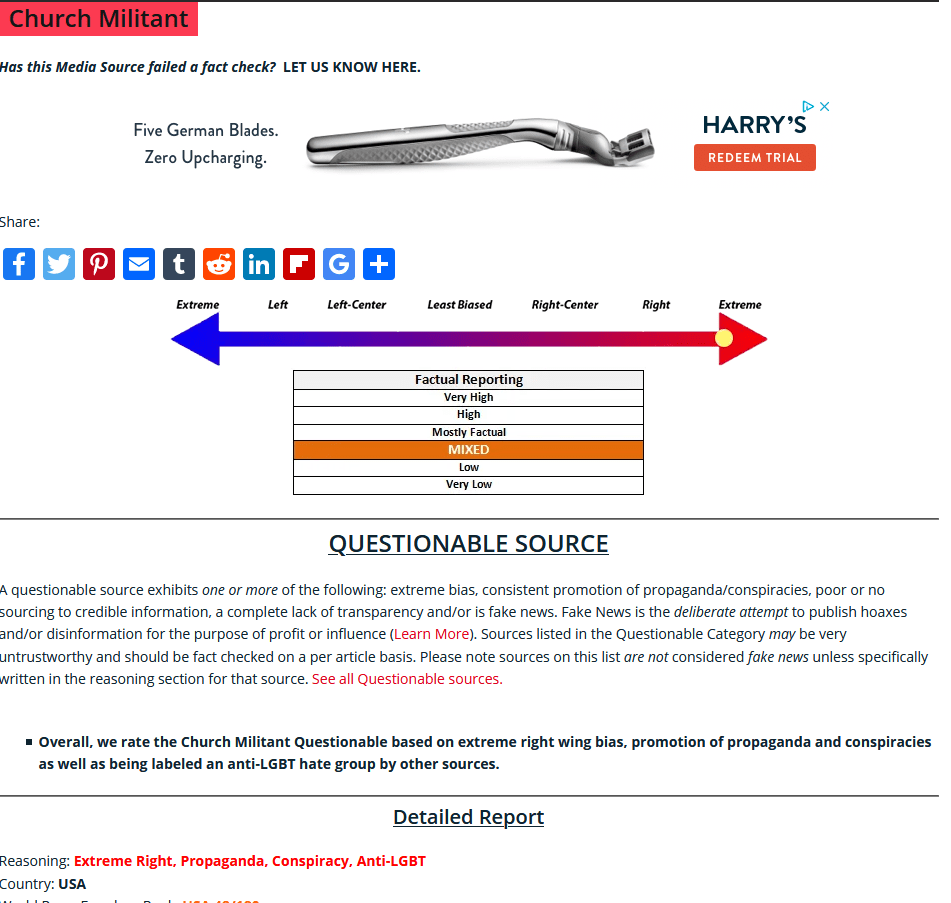
Once we do that, itโ€™s inevitable that weโ€™ll start swallowing extreme narratives whole, without even bothering to think critically, without bothering to do a 30-second bias check on a place like mediabiasfactcheck.com. (I mean, itโ€™s such a low bar. It takes no time at all.)

For instance, here are a couple sites that conservative Catholics like to share.

And lest you think I only bias-check the right, here’s a site that gets shared a lot by social justice Catholics:

The unintended consequence of all this is that no one trusts anyone to tell the truth anymore. Leaders (unless theyโ€™re MY political color), media (unless itโ€™s MY media). People are picking and choosing their own facts, their own realities. Which gives them blanket permission to ignore and dismiss anything that would cause them to question said facts and realities. If you donโ€™t like it, call it fake news.

(All those years we spent bemoaning relativism, and now the entire culture, including the right, has not only embraced it but is rabidly, passionately devoted to it!)

Whatโ€™s become excruciatingly clear, in all this, is that religious teachingsโ€”like, oh, letโ€™s say honesty & integrity–are not given just to slap us with strictures to chafe and annoy us. They are necessary for the functioning of society. If no one can trust anyone else to tell the truth, well, youโ€™ve got a problem, folks. Your society is going to be a mess.

If we would just take a deep breath and turn back to honesty and integrity, and condemn hyperbole, America would be a much better place. We all know it. We all believe it. Why donโ€™t we demand it? Why wonโ€™t we do whatโ€™s necessary to make it happen?

How would politics be different if we really did believe we are all family?

So there’s an election next week. Let’s talk politics? (Yippee!)

Because I feel pretty certain that the timing of the release of the encyclical “Fratelli Tutti” was not accidental. Pope Francis released it right before the US elections for a reason.

Background Image by Alexas_Fotos from Pixabay

Over the course of my life, papal documents have generally been pointed at someone else. At least, thatโ€™s how it felt. Like America was the good guy–not that we were perfect, but generally we were on the right side of the Gospel–and all those other countries were the ones getting their body parts handed to them by popes.

Fratelli Tutti doesnโ€™t feel that way. In fact, it feels the opposite.

#15 begins a section subtitled “lacking a plan for everyone,” and ouch! does it ever capture modern American life. He calls out politics that make use of hyperbole, extremism and polarization. He talks about strategies of ridicule, suspicion and criticism. About political life being focused on marketing techniques rather than long-term efforts to better the plight of humanity. I mean, thatโ€™s a mirror for all of us, whatever our political persuasion, if I ever saw one!

In #18-21 he returns to a familiar topic of the โ€œthrowaway culture,โ€ naming the unborn and elderly, and expanding the circle to recognize that wastefulness (like food waste) is also a symptom of the throwaway culture, one that harms the most vulnerable. Discarding people also comes in forms like corporate cost-cutting and racism, and even the declining birth rate.


This is the part where I pivot from “Here’s what the pope says” to “here’s my reflection on it.”

This list of modern problems echoes the questions that preoccupy me, the ones I gnaw over, day in and day out. Trying to understand how good people can fail to recognize bad things, and end up embracing them instead. The frustration that people will always point these kinds of examens at others, refusing to examine our own consciences for times when we, too, participate in or enable evil.

This concept of universal brotherhood is the central problem of our time. Well. Of all human history, but it seems particularly apt in this day and age.

We deal with problems in our families in a far different way than we do in matters of policy. In a family, we have our own concerns, but we also recognize the rights and needs of others, and we know we must look for solutions that serve everyone’s interest.

If we truly regarded everyone in America as members of our family, how would that change the way we look for national solutions? I think weโ€™d have to move beyond โ€œhow does this affect ME and MY rightsโ€ and add, โ€œHow can I balance my needs against the valid needs of this other person with a conflicting interest?โ€

We need both right and left in order to keep us in balance. What we don’t need is the villifying, the mocking, the “contrast ads” and editorials and memes whose “truths” are stretched so far, they’re actually falsehoods. We wouldn’t treat our families this way. How can we, as Christians, think it’s justified in politics?

Wedge Issues, Tone Policing, and the Christian call

Photo by Pixabay on Pexels.com

Thereโ€™s a lot on my mind these days that speaks to how we live the faith in the real worldโ€”a world that, at the moment, is defined by crises and division. More now than ever. I didnโ€™t think that was possible.

It seems there is no safe subject; even small talk leads to conflict. This morning on a bike ride, I encountered my kidsโ€™ former bus driver, and stopped to chat (from across the street). I asked about coming back in the fall. The answer was a hard pushback on the forthcoming citywide masking requirementโ€”a requirement that makes a lot of sense given that during the first wave, we had practically zero cases, and now we are averaging 30+ per day. โ€œIโ€™m VERY strongly anti-mask,โ€ she said. โ€I think itโ€™s a personal choice.โ€

How does one respond to such vehemence? I know what I WANT to say. I WANT to say that as Christians, our world view is supposed to reflect a Gospel that tells us self-emptying, treating the otherโ€™s needs as equal to our own, is the way of discipleship. A Gospel that we believe tell us life is precious, and the right to life far outweighs personal โ€œchoice.โ€

I WANT to say, โ€œCanโ€™t you see that youโ€™re setting aside your prolife convictions? That youโ€™re using the exact same language used by the pro-choice movement for decades?โ€

But how do you communicate any of that without sounding holier-than-thou, preachy, and generally self-righteous?

It didnโ€™t matter, because all I got out was, โ€œOh, Iโ€™m not.โ€ Then she was pouring out her grievances, and thirty seconds in, I thought, Iโ€™m supposed to be home in 40 minutes. I just need to politely say โ€œgood luckโ€ and move on.

So I did.

I spent the rest of my ride pondering this exchange and others. So many things have become wedge political issues that have no business being so. A pandemic should NOT be a political wedge issue. Racial justice should NOT be a political issue. Supporting women who have experienced harassment, abuse, or assault should NOT be a political issue. These are things people of faith should be unified on. Certainly the Catholic Church, flawed as it has been in practice, has spoken clearly on them all. How on earth has politics become more important in forming our world view than our faith?

But I realize that a lot of the refusal to budge on these issues is a reaction to scrupulousness–a scrupulousness that leads to making assumptions about people. From there, itโ€™s a short skip to judgment.

Thereโ€™s a lot of judgment on social media these days.

*Iโ€™m* judging a lot. Most of the time I donโ€™t post my judgy thoughts, but that doesnโ€™t mean theyโ€™re not there.

I think those of us who believe we have a societal responsibility to public health, who care passionately about racial justice and victimsโ€™ rights–those of us who care about these issues are so angry, we donโ€™t always recognize that our words and our tone can do more harm than good. That sometimes, in our passion for justice, we cross the boundaries of Christian charity.

I know, that sounds like โ€œtone policing.โ€ I get it. But tone DOES matter, because when we make assumptions about what people are or arenโ€™t doing; when we pass judgment; when we belittle and dismiss and make sweeping generalizations about everyone who (fill-in-the-blank)โ€”

When we do these things, we make everything worse. We arenโ€™t bringing people to a greater understanding of the truth. In fact, all weโ€™re accomplishing is hardening people in their perception of persecution. They become less open to hearing, less open to examining the conflict between their worldly perspective and the Gospel.

Below (in the comments, on Facebook), I am sharing an op-ed that really hit me hard. I donโ€™t often share (or read, for that matter) from the New York Times, because to so many people, it epitomizes the โ€œliberal media.โ€ But I think people across political spectrums will be surprised by what this man has to say.

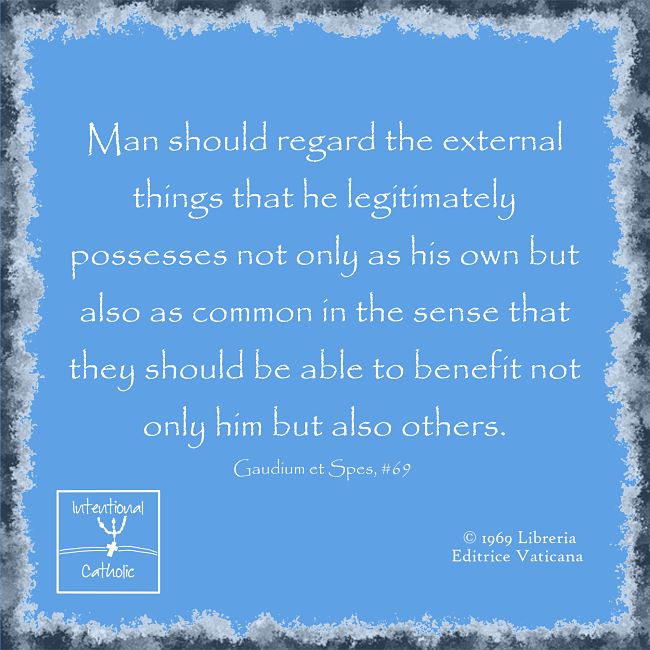
The social quality of personal property

I know this is kind of a long quote to process, so let me rephrase it to clarify why it struck me so forcefully. If we forget that our personal property has a “social dimension,” we’ll end up making an idol of it, making it all about ME and what I want. Getting resentful at the suggestion that the “social dimension” exists at all.

And when that happens, it’s easy for people to say, “See? This system of private property is corrupt. It doesn’t serve the common good.”

In other words, if we are too grabby about what’s MINE, it’s going to give people ammunition to suggest that the whole system is flawed.

The writers were undoubtedly thinking of giving ammunition to communism when they wrote this, but given the unpardonable and growing disparity between rich and poor these days–underscored by who gets COVID and who doesn’t; who has to put themselves at risk to go do low-income “essential” labor while the rest of us work safely from home–it seems like a pretty spot-on reminder for our day and age, too.

More from the U.S. Bishops

I’m posting this today, not because any of us think what happened to George Floyd was okay–I’ve yet to meet the person who thinks that–but because we, as Catholics, need to be reminded that it’s not enough just to think it’s not okay.

Our bishops have talked about the realities of institutional racism through this document, “Open Wide Our Hearts: The Enduring Call To Love.” They’ve told us also that we have a responsibility to act, and that the first part is to recognize how we are complicit in the continuation of racism in our country. And that is the part too many in the Catholic community are unwilling to do. This week I’ve encountered Catholics who won’t even read this document because it calls us into that hard examination of conscience, and they refuse to believe there’s anything to examine.

This is one of those times when being Catholic requires us to be intentional. Because if we aren’t, then we aren’t really being Catholic at all. We’re letting pre-determined worldly values determine how we interact with the world, rather than doing the hard work required when our faith directs us.