
Tell me if this sounds familiar: you tell a kid to put away a piece of clothing, and ten minutes later you look and discover it hasn’t been done. You tell them to do it again, and this time it makes it up the stairs and gets dumped on the floor. By the third time, you’ve pretty well lost your temper, and it’s all downhill from there.
This is my life right now: dishonesty, serial disobedience, and difficulty discerning how much is developmental and how much is spacey personality versus testing behavior. My husband reminds me we’ve been through it before and we’ll get through it this time, but it’s wearying.
Why does this warrant a blog post on a site about living the faith?
Because I’m starting to recognize that this parenting issue has a lot to teach us about love—real, self-giving, sacrificial love. How can we teach such a big concept to our children without starting with small, intimate relationships and small—maybe even petty—examples?
Little kids experience the world in concrete ways, after all. I need my child to learn that love doesn’t just mean cuddles and kisses and being tucked into bed at night and giving me a hug on the way out the door. That’s a tiny child’s version of love, but as they grow, they need to learn that a bare minimum, love means you don’t do things that harm the other.
And since Jesus Christ was never in the business of bare minimum, I’d go a step further and say, as the Catechism says: love means willing the good of the other.

So your actions show your love—or the lack of it.
To wit: if you cause your favorite parent to LOSE HER EVER LOVING MIND because you just don’t feel like doing what she asked you to do, then you’re causing harm and you’re definitely not willing the good of said parent.
In other words: NOT. LOVE.
Okay, it’s petty, I know. But really, if you start spinning out the implications, this is a big deal, and not just for the kiddos, but for us as adult Catholics.
Because if:
a) everyone is our neighbor (Luke 10:29-37), and
b) loving God means loving our neighbor (Luke 10:27-28; Galatians 5:14), and
c) love means willing the good of others (Catechism of the Catholic Church 1766)…
…then we’d darned well better be thinking about willing the good of asylum seekers at the southern border.
And about how to alleviate the strain on of living on women who see abortion as their only option.
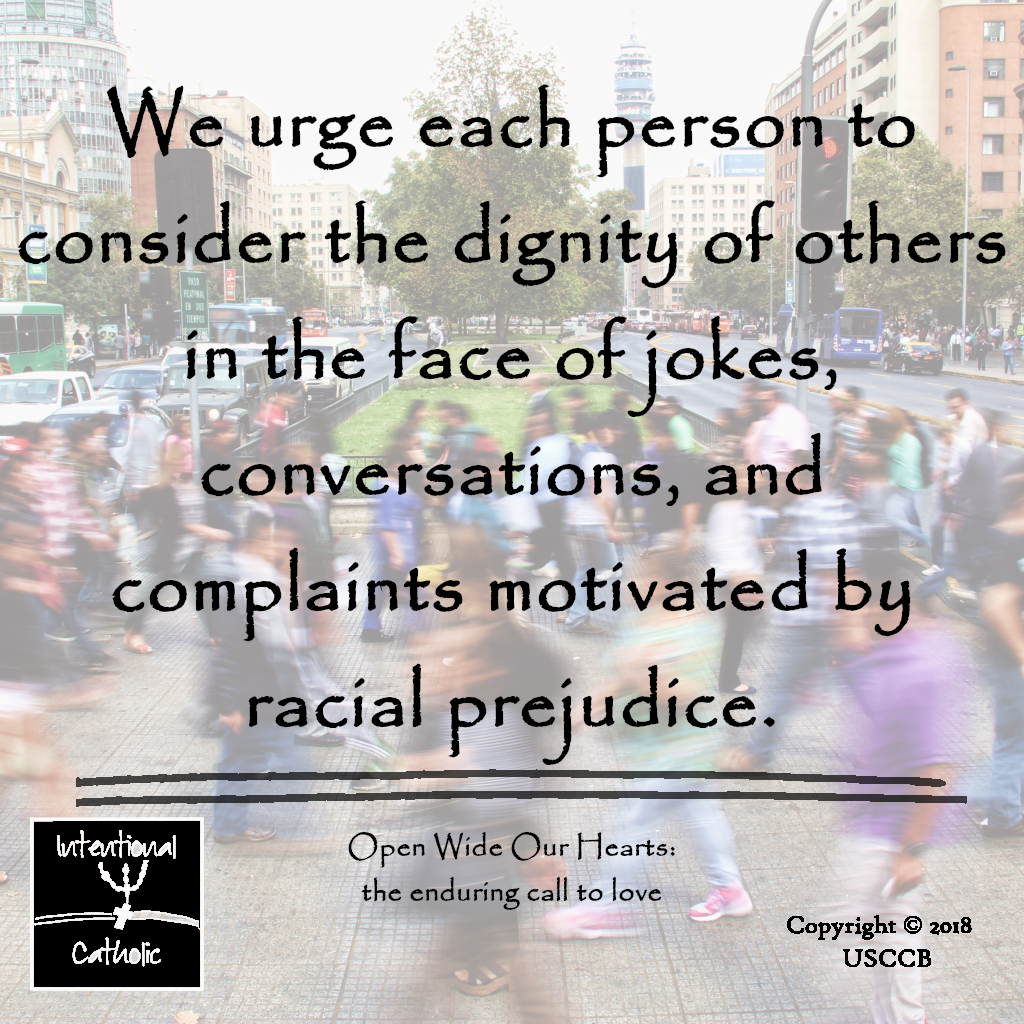
And how to erase discrimination (which might mean, for a start, acknowledging that it still exists).
And what it means to steward the earth God gave us for future generations.
And how to create policies that put the good of workers and society before personal or corporate profit.
And how to protect victims of abuse and assault, rather than shame them and blame them and assume they’re lying for underhanded political reasons.
Because with every word we speak about those issues and every policy solution we advocate (or fight against), we show our love for Jesus Christ.
Or the lack of it.






 Intentional Catholic