“Renounce some of their rights”

Background image by Gerd Altmann from Pixabay

First of all, let me just say I recognize how challenging this quote is. This idea stands 100% in opposition to our American cultural values.

However, if we are citizens of Heaven first and America second–as should be the case for all who call ourselves Catholic–then we have to accept the challenge in these words.

Interestingly, they are *not* Pope Francis’ words. They are the words of Pope Paul VI (he of Humane Vitae fame) from an apostolic letter called “Octogesima Adveniens,” dating from May 1971. I haven’t read the whole letter, but this is the full paragraph Pope Francis quoted from:

Through the statement of the rights of man and the seeking for international agreements for the application of these rights, progress has been made towards inscribing these two aspirations in deeds and structures (16). Nevertheless various forms of discrimination continually reappear – ethnic cultural, religious, political and so on. In fact, human rights are still too often disregarded, if not scoffed at, or else they receive only formal recognition. In many cases legislation does not keep up with real situations. Legislation is necessary, but it is not sufficient for setting up true relationships of justice and equity. In teaching us charity, the Gospel instructs us in the preferential respect due to the poor and the special situation they have in society: the more fortunate should renounce some of their rights so as to place their goods more generously at the service of others. If, beyond legal rules, there is really no deeper feeling of respect for and service to others, then even equality before the law can serve as an alibi for flagrant discrimination, continued exploitation and actual contempt. Without a renewed education in solidarity, an overemphasis of equality can give rise to an individualism in which each one claims his own rights without wishing to be answerable for the common good.

Pope Paul VI, Octegesima Adveniens, #23

There’s so much to unpack in that. “Legislation is necessary, but it is not sufficient for setting up true relationships of justice and equity.” Legislation, in other words, needs to happen, but we have to go beyond it.

And “renouncing rights” means what? Perhaps we could read that as a call to be less tax-averse. Perhaps we could read it as a call to be less inclined to hoard, judging others as unworthy, requiring them to prove they don’t need what we have to offer before we’re willing to give it to them.

“A renewed education in solidarity…” Solidarity is a word a lot of us associate with Lech Walesa, but it’s something we’re all called to–to enter into the pain of others, to make it our own. (Read Shannon Evans’ book Embracing Weakness. She broke open solidarity for me in a way I still haven’t figured out how to incorporate into my real life.)

“individualism in which each one claims his own rights without wishing to be answerable for the common good.” That one explains itself.

A lot to think about here! Because again, we’re recognizing that evangelization is not narrowly defined as walking around talking to anything with a heartbeat about Jesus Christ. Evangelization is something that encompasses all of real life. Because who will listen to us when we talk, if our view is so narrow we can’t see the forest for the trees?


God’s means of hearing the poor

This reminds me of Teresa of Avila saying, “God has no hands but yours…”

There’s a tension in modern life between prayer and action. Many of us have gotten jaded about invoking prayer because so often, “thoughts and prayers” seem a pretty poor substitute for action. God doesn’t come down and magically change things; we have to do the work. God works through us. Prayer isn’t about changing God’s mind–it’s about changing us.

Yet sometimes there truly is nothing we, in our human limitations, can figure out to do, other than pray. Pray for peace of mind, for acceptance, for grace to bear what we cannot take away.

More often, though, there are things we can do–they just require effort. We have to advocate publicly, but that presupposes that we’re willing to educate ourselves on the complexities of situations. We have to be willing to look at the world through someone else’s eyes and accept that the way the world works for us–which fundamentally shapes our vision of what is and is not possible–is not the way the world works for others. (Remember this quote?)

Consumer culture: Is it possible to opt out?

Image by Eduardo Davad from Pixabay

Bear with me, because you may think I’m posting this on the wrong blog.

Friday night, I went to an Asian grocery store to buy boba pearls. Outside stood a group of three young people, chatting in what I presume was Chinese over a grocery cart full of white plastic bags. It was a beautiful night, and I glanced over at them as I walked in. My eye caught on the gorgeous dress one of them was wearing. Red, with white and black trim, fitted without being slinky, worn over black leggings. I thought, “I want to shop where she bought that dress.”

And I had this moment of crystal clarity: I hate American fashion. Every outfit I’ve admired in the past 4-5 years has been from Asia or Africa.

For months, I’ve been searching for a handful of clothing items to serve a particular purpose. I’ve bought nothing, because I can’t find anything I like. Not in the consignment stores where I start and not in the big box stores.

I have a handful of things sitting in my Amazon cart, but you know what? They all ship from China. Which brings me back to the post I wrote a couple weeks ago: how we ignore unpleasant realities about the way our food and goods are produced, because acknowledging those realities would mean admitting that many, maybe even most, of the things we enjoy are made cheap on the backs of people in poor working conditions with extremely low wages.

A friend of mine found this train of thought troubling. If this is true, how do we live faithful life? What if we can’t even survive without participating in some way in a system that harms others? What if the system is so pervasive, we can’t escape it?

To which I add: if we could opt out, wouldn’t we actually increase the misery of the poor, because whatever income they do make is more than they’d make if we stopped buying?

The world is full of good things, and I want to enjoy them: chocolate, a good book, and my backyard patio set all give glory to God, the maker of the raw materials and the giver of the human creativity used to shape raw materials into wonderful things.

But it’s hard not to wonder if I should be diverting every penny I spend on these things to people fighting for little more than survival.

Into this mix dropped the weekend readings:

How long, O LORD? I cry for help
but you do not listen!
I cry out to you, “Violence!”
but you do not intervene
.

And God’s reply:

The vision still has its time,
presses on to fulfillment, and will not disappoint;
if it delays, wait for it,
it will surely come, it will not be late.

Habakkuk’s pain is so familiar. The world is such a mess. We just want God to fix it already.

But how can we yell at God for not acting to alleviate the injustices at work in the world? We’re the ones who enact the injustices, not God. The only way they get un-enacted is “if today you hear God’s voice, harden not your hearts.” In other words, learn to recognize injustice and then DO something about it.

But the obstacles to doing something seem insurmountable. I’m a big believer in pebbles and ripples. I throw my pebble in the pond, you throw yours, and the guy down the street throws his, and eventually things change.

But it’s not satisfying. Waiting is hard. Waiting leaves us conscience-stung in that no-man’s land between the good things of the world and the knowledge of who’s actually paying the price for them.

And maybe, in the end, that’s the only takeaway: that while we are in the world, we have to accept that we are never going to have the answers—we’ll always be wrestling with what is versus what could or should be. We’ll always be looking for that balance between enjoying the world God gave us and recognizing the ways in which we are called to act. Even if it requires sacrifices we don’t want to make.

Discipleship = Love

Love is one of those words we throw around a lot. I often get frustrated when homilies focus on love, not because it’s wrong to do so, but because so much of the time, it stays in the realm of the theoretical. We can all nod our heads sagely and agree that to be a disciple is to love, but it’s awfully hard to recognize the concrete ways in which we don’t love at all.

It’s easiest to spot in the kids. One kid comes home stressed by lack of time and homework. He has a veritable comic strip cloud hanging over his head, with lightning bolts coming out of it. He bites off the heads of his brothers, who aren’t actually doing anything wrong, and they react by being predictably hateful. I may or may not, recently, have shouted, “All the religious formation in the world is useless if you can’t figure out how to live it in real life!”

Every parent reading this post probably chuckled and nodded sagely just now. We’ve all dealt with it.

But it happens to us, too. We’re just a lot more sophisticated with our stresses, and far more skilled at justifying ourselves for not acting in love.

The Art of Listening

Today I will let the context of the quote above, in which Pope Francis is explaining what he means by “accompaniment,” stand on its own:

Listening, in communication, is an openness of heart which makes possible that closeness without which genuine spiritual encounter cannot occur. Listening helps us to find the right gesture and word which shows that we are more than simply bystanders. Only through such respectful and compassionate listening can we enter on the paths of true growth and awaken a yearning for the Christian ideal: the desire to respond fully to God’s love and to bring to fruition what he has sown in our lives. But this always demands the patience of one who knows full well what Saint Thomas Aquinas tells us: that anyone can have grace and charity, and yet falter in the exercise of the virtues because of persistent “contrary inclinations”.

Evangelii Gaudium, #171

Primary Motivator

The readings this weekend were all about money. Amos was talking about the dishonesty of those with money–how they were so focused on their own profits that they didn’t really care what happened to the “have not”s of the world. And Jesus said, “Guess what? How you use your money matters.”

Listening yesterday at Mass, it really struck me how those readings should skewer America. The obvious application is the question of income inequality: how many of the huge profits made by companies are held by those at the top of the food chain, how little is actually shared with those down the ranks.

But you know, so much of what we talk about in America centers on money. Many would like to believe we’re a Christian nation, but money–capitalism–is the primary thing that preoccupies our social and political discourse, even among Christians. So many things come back to money: health care and social programs would require more taxes, and we can’t possibly suggest raising taxes. Immigrants are perceived as a threat to American jobs, so again–it comes back to money. The question of whether a president deserves re-election is always about the economy. We’re having all these discussions about China and intellectual property and trade fairness, but nowhere on anyone’s radar is the question of just wages for labor, which is–let’s face it–the only reason manufacturing went overseas in the first place. It went overseas because we, the rank and file Americans, aren’t willing to pay what it would cost to make a product while paying a just wage to the laborer who made it.

We have a lot to answer for, and I don’t pretend to have a pat solution. I personally try to take a step back from the consumer culture by starting with secondhand clothing purchases as much as possible. But those clothes, too, were made by cheap labor overseas, and I order from Amazon just like every other red-blooded American. What do I think God will say to me when it comes time for me to answer for my choices? I don’t like pondering that question any more than anyone else.

In any case, when I was looking through the possibilities for things to share today, this quote from my Beatitudes book seemed to dovetail with what we heard at church yesterday. Because what if? What if, instead of money, we made God’s will, God’s kingdom, God’s priorities, the central principle that guided every other choice?

But what does that MEAN?

While I was preparing a talk called “Who is my neighbor?” recently, I learned that the Jewish law was laid out as a set of concrete guidelines to explain how it looks, in real world terms, to “love the Lord your God with all your heart, with all your heart, your soul, and your mind, and your neighbor as yourself.”

Isn’t that interesting? Jesus is all over people in the Gospels for being too rigid and scrupulous about the Law, and Paul takes it to a whole new level. From that, modern Christians sort of naturally assume the Law was intrinsically flawed. But this made me realize the purpose of the Law was the same as what I’m doing here: to try to connect airy-fairy concepts of the faith to a concrete world.

The problem came when scrupulousness and rigidity about the precepts of the law caused people to judge others rather than love them.

I have two thoughts on this, and they’re kind of contradictory. On the one hand, I think the modern Church suffers from the same scrupulosity as ancient Jews. I know I have. Frankly, I think it’s more common among Catholics than we might think. What is Catholic guilt, if not an overwhelming anxiety to make sure we’re doing things RIGHT? And we judge everyone else for not doing the “right” thing. (Cough-cough-liturgy wars-cough-cough)

On the other hand, we tend not to recognize what the precepts of the faith actually mean in real life. All the big political issues of the day–abortion, guns, health care, immigration, race, etc.–looking at these through the radical call to love unconditionally should make all of us squirm, wherever we fall on the political spectrum. The love of money taking precedence over care of neighbor or creation. And so on. It’s like I said to my boys yesterday morning before school, when they were being nasty to each other: “All the religious formation in the world will do you no good if you can’t figure out what it looks like in real life!”

This is the question I leave us all with for the weekend: if showing love is how people will know I am a follower of Christ, HOW do I show love in this moment, this time, to this person I am encountering?

Do something

This insight was a really monumental shift for me in my faith. I knew the truth of it, at least as it related to particular issues of importance, of course. But it was a big deal to realize that whatever ignites my righteous anger, makes me squirm, or breaks my heart in the news–those things are, in fact, a call to action from God, speaking through my conscience.

I recognize them now, though I’m far from perfect about the “doing something” part. Writing “The Beatitudes” reminded me of that every time I sat down to work on it.

Book Recommendation: When Helping Hurts

How about a chance of pace for a Monday morning? I have a book recommendation to share:

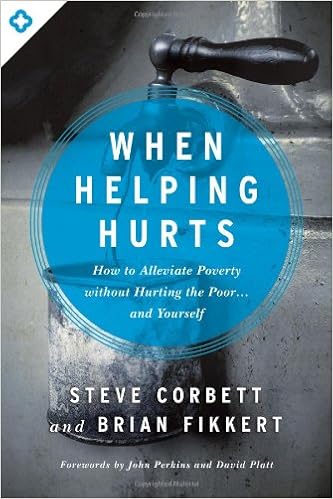
When Helping Hurts:
How to Alleviate Poverty Without Hurting the Poor…And Yourself

I can’t say enough good things about this book. Written by two Christians (not Catholic) who have been involved for decades in mission work, they share wisdom on how to be helpful, rather than going in with great intentions and making everything worse. In a nutshell, it boils down to this: we can’t come in and be saviors. Our job is to facilitate others helping themselves. There are three types of help: relief, recovery, and development. Most of the time, what’s needed is development, but the vast majority of the time what we offer is relief–because it’s easier. It’s easy to measure, its results make good reports to the investors.

The authors take a “both/and” approach. Many Christians look at the poor and assume they got that way by their own bad choices/sins; therefore their problems are theirs, not ours, to deal with.

Sin is an issue, the authors stress, but so are unjust societal institutions. As an example, they point to civil rights work in the south in the 1960s, and a particular pastor who didn’t speak out on racism.

“Both Reverend Marsh and the civil rights workers were wrong, but in different ways,” the authors wrote. “Reverend Marsh sought the King without the kingdom. The civil rights workers sought the kingdom without the King.”

The authors address overseas missions as well as efforts undertaken within the U.S. When Helping Hurts suggests that successful solutions are not either/or; they have to acknowledge both the effects of personal sin and the effects of institutional oppression, because those two things exert an influence over each other:

“What happens when society crams historically oppressed, uneducated, unemployed, and relatively young human beings into high-rise buildings, takes away their leaders, provides them with inferior education, health care, and employment systems, and then pays them not to work? Is it really that surprising that we see out-of-wedlock pregnancies, broken families, violent crimes, and drug trafficking? Worse yet, we end up with nihilism, because these broken systems do serious damage to people’s worldviews. Worldviews affect the systems, and the systems affect the worldviews.”

(p. 92)

When Helping Hurts offers the concept of “poverty alleviation” as a solution to the complexities of institutional injustice and personal sin. It is a “ministry of reconciliation” in which we use our money in such a way as to empower those in desperate circumstances to begin to help themselves. It acknowledges that they do, in fact, need help from outside, but that as much as possible we should honor the God-given human dignity of the poor by allowing them to be the leaders and the experts in their own lives. That our job is to empower them, not rescue them.

I’ve long believed that in most issues we bicker about, God is in the middle. This book shows us a Godly middle to issues of poverty. Both conservatives and liberals will find things that resonate and things that challenge in this book–which is, to me, the strongest argument that they are on target.

Evil Spreads

It’s important to recognize that this applies not just to the issues we immediately recognize as evil, but to realities we resist recognizing as such.

We have a distressing tendency in America to decide that one issue or set of issues matters so much more than another issue or set of issues, we have the right to dismiss those others. It happens on both sides of the political divide. I would argue this is how we become people whose political affiliations (of whatever color), rather than our faith, end up becoming our primary identity.

I don’t think any of us intend to put politics before faith, but it’s really easy to fall into the trap. I’ve pointed that finger outward a lot in recent years, but you know what they say about pointing fingers: for every one you point at someone else, four are pointed back at you. In other words, I’ve been wrestling with this reality in myself, too.

Surely we can all acknowledge that America has been greatly weakened by the competing rigid extremisms that have been growing for the last twenty years. Extremisms that refuse to seek common ground and build from there. Extremisms so committed to the righteousness of that refusal that gradually, they cease to see there is any common ground.

But I would argue that the “either-or” mentality weakens the Church as well. Because when we dismiss an entire swath of issues as somehow less important, we look like hypocrites to a world we’re supposed to be evangelizing.

And they’re not wrong to think so.

When we decide to pick and choose what injustices matter, we thumb our nose at God. We imply that God isn’t big enough to deal with all the issues, so we have to decide for him which ones are worth fighting. We thus dismiss the suffering of everyone touched by every issue we didn’t choose. Is it any wonder that our efforts at evangelization aren’t successful?

Finally–to most people who are just along for the ride on these posts, it may not have really registered, but the breadth of topics covered in Evangelii Gaudium really underscores the spaghetti-bowl effect. This document, which is titled “the JOY” of the Gospel,” has wandered very far from the topic of joy itself. It underscores that to really spread Gospel joy, we have to embrace the whole Gospel, in all its difficult, messy glory.