We Were Not Meant To Live Like This

Rush Hour
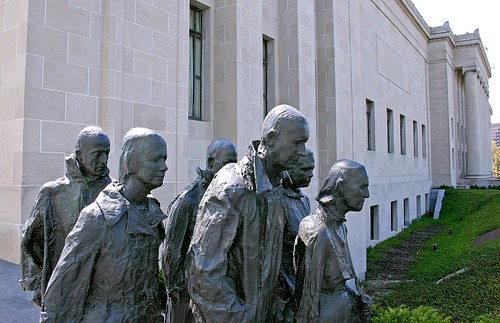
Photo by ChrisM70, via Flickr

It’s a been quite a weekend week two weeks month life lately. I’m working on a novel revision which I intended to have finished the middle of last week, but between spring break, meetings, presentations, kids’ events, and so on, I missed my self-imposed deadline.

I don’t like missing deadlines.

At the same time, I was wrestling with what to do about a very specific item that was causing me great anguish. The kind that keeps you from taking deep breaths. The kind that keeps you awake for three hours in the middle of the night.

I knew God had a solution, but I couldn’t find it. I kept asking. But I didn’t have time to be quiet and still to let him talk, and when I did have thirty seconds, I couldn’t find the quiet center that would allow me to hear anything. Whatever course of action I took, I could see potential disasters.

The good news is that when you seek sincerely, God will get through eventually, one way or another. And by the time I took off on an all-day-and-evening field trip with my daughter on Friday, I had found an course of action that eased my mental, spiritual, and emotional health. Somewhat.

That day, as we walked around Kansas City, the sculpture pictured above stuck out at me. Often, I’ll look at art and be struck by it, but not really know why it resonates. This one made its meaning instantly clear. Look at those people–grim-faced, heads down, leaning into a maelstrom of overwhelming stress. Weighed down. Completely checked out of their own lives. They are prisoners of modern life.

It resonated because it was precisely how I’d been feeling: trapped, powerless, entirely in survival mode–and resentful about it. The weather was beautiful, the earth coming back to life, and I was struggling just to breathe. I couldn’t look up to see–really see–the birds twittering and the baby leaves on the weeping willow. I couldn’t hear the hum of the earth going through its yearly resurrection.

I think we all know that when we’re weighed down and all of life feels burdensome, we miss the goodness of God all around us. But that sculpture reminded me that what I lack most in those times is guidance. I am always, always willing to do whatever God asks of me, however difficult–I just need to know what God’s will is! But when my eyes are staring at internal blackness, my brain wrapped in thick chains of stress and busy work instead of resting in God…

Well, at those times I’m short-tempered, easily offended, easily goaded into fighting, more judgmental, and generally a dim reflection of God’s presence in the world. Worse: at those time, I can’t hear God telling me His will for this moment and this situation and this question.

We were not meant to live like this, in a constant race around a pointless hamster wheel. We were made for better things. Made to live in a peace and calm that allows us to recognize the whisper of God’s voice in our minds, telling us the answer to our quandaries, and God’s hand on our back, nudging us toward His will in all the complexities of modern life.

We were not meant to live like this. The question is, are we looking for a way out?
 

Population Control Isn’t The Answer

LS population control

This is where society sometimes gets it wrong: assuming that simply cutting the number of children will fix the problem. The “issues” Pope Francis lays out in Laudato Si’ should make us all squirm. Our entire culture is built on convenience (which is to say, disposability) and consumption–the more, the better.

In my neighborhood every week, the amount of trash and recycling that goes out in households with 2-3 people is often three to four times larger than what we, as a family of 6, put out. Sustainable living is a value that parents have to prioritize in our own lives and intentionally pass on to our children–just like respect for life and the centrality of the Eucharist. Two kids raised in an atmosphere that is cavalier or thoughtless about consumption will do as much or more damage to God’s creation as six kids raised with a heart of environmental stewardship.

Read the whole encyclical here.


Making It Our Problem

LS personal suffering

At the heart of all the issues that lie at the messy intersection of faith & the real world is this reality: If it doesn’t impact us directly, we generally don’t think much about it–let alone prioritize it. In the case of care for the earth, we don’t even think about the choices we make and what impact they can have over time.

Read the full encyclical here.

Caress of God

A beautiful thought from Pope Francis for this spring day.

LS caress

#intentionalcatholic #realfaithrealworld #faithinaction #creation #Laudatosi #environmentalstewardship #steward #green #greenliving #gogreen #climatechange

25 Ways To Be A Better Steward of Creation

golden-hour-peony Lent is a funny time of year. We turn one eye inward, to the spiritual desert, while with the other we watch the physical desert of winter explode into the resurrection that is spring. Of course we celebrate Easter in the spring. At what other time does the physical world so perfectly parallel the spiritual journey we are undertaking?

At this time of year, environmental stewardship is always foremost in my mind, too–as a civic duty, yes, but more importantly, as a Godly one. As the catechism reminds us in #2415, our authority over creation doesn’t give us the right to run roughshod over it. We have a responsibility to honor the integrity of God’s creation and think about the needs of future generations.

With that in mind, I’d like to share a list of everyday ways we, as Catholic Christians, can be more intentional about how we interact with creation. To be more intentional about our consumption and purchasing habits, rather than adopting, without even recognizing it, a culture of “convenience” that almost always involves tremendous waste.

25 ways to be a better steward of creation

In the Kitchen

  1. Take your own bags to the grocery store. Cloth is even better than paper or plastic.
    2. Buy fresh, not prepackaged.
    3. Buy local–less transport = less environmental impact.
    4. Grow your own vegetables.
    5. Compost.
    6. Recycle.Yes, even so far as bringing home the plastic ware from the fast food restaurants which don’t offer recycling. This is a biggie! Wash them.
    7. Wash and reuse Ziploc bags.
    8. Wait to run the dishwasher till it’s full.
    9. Look for ways to use less plastic overall. Stop buying water bottles–pack your own!

Vehicles and driving

10. Turn off the car. (Another biggie.) Do you get in the car, turn it on, and then check your phone? Why run your vehicle while you check your phone, wait for kids at their lessons/practices, or for your spouse at the grocery store? Every bit of that is unnecessary pollution. Turn it off.
11. Slow down! The faster you drive, the more gas you burn, and it really doesn’t make a significant difference in time, anyway.
12. Combine trips & walk from errand to errand when possible. Not when convenient–when possible.
13. Carpool.

Around the house

14. Buy bulk refills on cleaners instead of a new squeeze bottle every time.
15. Buy used, and don’t buy things you don’t need. (Another big one!)
16. Turn the lights off.
17. Turn the computer off, or at least put it to sleep. Why have it running while you’re sleeping? And in the summer it’s adding to the heat that the air conditioner has to fight.
18. Use Recycled Paper.
19. Print on the back sides of used paper for rough drafts.
20. Turn the thermostat up a degree in the summer and down a degree in the winter.
21. Plant a tree.
22. Replace parts of your lawn with native plants–wildflowers, low-maintenance ground cover, and so on–so the mowing takes less time and gasoline.

For the Family

23. Use cloth diapers. There are diaper services that can do the cleaning for you.
24. Toilet train early. In my experience, the success or failure toilet training has much more to do with parental commitment than a child’s “readiness.” (Since I’ve toilet trained four kids, and the only one who was over 2 was the one with a disability, I stand by that statement.)
25. Practice Natural Family Planning. No plastic, no chemicals going into the water supply, no waste. And despite what you may have heard…it works.

(This list is adapted from one originally published on my personal blog.)

My Money, My Way?

person woman sitting old
Photo by Skitterphoto on Pexels.com

My parish sits near the intersection of a major interchange along a major cross-country interstate. My husband and I lead a music ensemble at church, and every so often at practice on Wednesday nights, we find ourselves facing people coming in off the interstate asking for help: out of gas, out of work, broken down…

It happened last night, and it underscored how unprepared we are, both as individuals and as a parish, for such situations. We tried to find someone from St. Vincent de Paul but weren’t successful, and this gentleman eventually left, apologizing for bothering us because we clearly couldn’t help him. And though he was polite, it felt like he was pointing out the disconnect between our self-satisfied perception of ourselves as people of faith and the reality of how unprepared (unwilling?) we were to help a person in need.

Situations like this always disturb me. I find myself caught between a desire to help and a gut-level suspicion that said seeker is preying on the hearts (and guilt) of those of faith. And of course, the answering twinge of conscience, because how is that attitude compatible with a Christian world view?

For forty-plus years, every time I’ve confronted this situation, good and faithful people have responded with something like, “Hey, it’s the way of the world. This is reality. You have to be suspicious or you’ll get taken advantage of by scammers.”

But is it really okay for suspicion and world-weary jadedness to be our first, let alone our final, reaction? I mean, how are we ever actually to know whether a person is genuinely in need or being lazy/irresponsible/reaping the harvest s/he has sown? We are never actually going to know that. More importantly, is it really our business? Isn’t our call to give, and let God sort out the recipients? And if the answer to those questions has anything to do with the words “it’s my money,” then aren’t we intrinsically putting mammon ahead of God? How does it damage me in the slightest to give the benefit of the doubt to those asking for aid, even if I do end up supporting the occasional scammer?

This morning, Bishop Barron’s Gospel reflection zeroed right in on this same issue: “God is not pleased with this kind of economic inequality, and he burns with a passion to set things right. …Even though it makes us uncomfortable—and God knows it does, especially those of us who live in the most affluent society in the world—we can’t avoid it because it’s everywhere in the Bible.”

It’s hard for me to imagine why anyone would come into a church at night, put themselves in the face of such humiliation, if they didn’t actually need help.

So today, this is the puzzle I’m wrestling: What is the right and proper balance of prudence with Christian charity? How do I keep from twisting the faith, in situations like these, to make it more comfortably align with worldly values—like, for instance, the attachment to the idea of “my money, my way”? Isn’t it just as likely that we react with suspicion because it absolves us of the responsibility to respond to the face of Christ in people who come to us for help?

Xenophobia

Open Wide - Extreme nationalist-xenophobia

Read the entire pastoral letter here.

#intentionalcatholic #realfaithrealworld #faithinaction #socialjustice #humandignity #goldenrule #racism #OpenWideOurHearts

Soul Corruption

It’s easy to see the effect of racism on the victims, but it damages the oppressor spiritually too.

Open Wide - Racism causes harm, corrupts

#intentionalcatholic #realfaithrealworld #faithinaction #socialjustice #humandignity #goldenrule #racism #OpenWideOurHearts