I love this passage so much. It makes me chuckle, because it’s so dead-on, and it’s not couched in airy-fairy language. “Irksome,” indeed! That’s a dead-on assessment of the reaction these concerns usually get. People are irked at having to think about them.
This whole section of Evangelii Gaudium is talking about economic systems and the need to make sure they are truly equitable and provide for the poor. It’s a procession of plain-speaking, conscience-pricking paragraphs: welfare should be considered a temporary solution, the dignity of the human person should shape all economic policy, inequality is the root of social ill, we can’t trust the market to do this work, and on and on. It’s so good. Take time to read it!
First of all, let me just say I recognize how challenging this quote is. This idea stands 100% in opposition to our American cultural values.
However, if we are citizens of Heaven first and America second–as should be the case for all who call ourselves Catholic–then we have to accept the challenge in these words.
Interestingly, they are *not* Pope Francis’ words. They are the words of Pope Paul VI (he of Humane Vitae fame) from an apostolic letter called “Octogesima Adveniens,” dating from May 1971. I haven’t read the whole letter, but this is the full paragraph Pope Francis quoted from:
Through the statement of the rights of man and the seeking for international agreements for the application of these rights, progress has been made towards inscribing these two aspirations in deeds and structures (16). Nevertheless various forms of discrimination continually reappear – ethnic cultural, religious, political and so on. In fact, human rights are still too often disregarded, if not scoffed at, or else they receive only formal recognition. In many cases legislation does not keep up with real situations. Legislation is necessary, but it is not sufficient for setting up true relationships of justice and equity. In teaching us charity, the Gospel instructs us in the preferential respect due to the poor and the special situation they have in society: the more fortunate should renounce some of their rights so as to place their goods more generously at the service of others. If, beyond legal rules, there is really no deeper feeling of respect for and service to others, then even equality before the law can serve as an alibi for flagrant discrimination, continued exploitation and actual contempt. Without a renewed education in solidarity, an overemphasis of equality can give rise to an individualism in which each one claims his own rights without wishing to be answerable for the common good.
Pope Paul VI, Octegesima Adveniens, #23
There’s so much to unpack in that. “Legislation is necessary, but it is not sufficient for setting up true relationships of justice and equity.” Legislation, in other words, needs to happen, but we have to go beyond it.
And “renouncing rights” means what? Perhaps we could read that as a call to be less tax-averse. Perhaps we could read it as a call to be less inclined to hoard, judging others as unworthy, requiring them to prove they don’t need what we have to offer before we’re willing to give it to them.
“A renewed education in solidarity…” Solidarity is a word a lot of us associate with Lech Walesa, but it’s something we’re all called to–to enter into the pain of others, to make it our own. (Read Shannon Evans’ book Embracing Weakness. She broke open solidarity for me in a way I still haven’t figured out how to incorporate into my real life.)
“individualism in which each one claims his own rights without wishing to be answerable for the common good.” That one explains itself.
A lot to think about here! Because again, we’re recognizing that evangelization is not narrowly defined as walking around talking to anything with a heartbeat about Jesus Christ. Evangelization is something that encompasses all of real life. Because who will listen to us when we talk, if our view is so narrow we can’t see the forest for the trees?
This reminds me of Teresa of Avila saying, “God has no hands but yours…”
There’s a tension in modern life between prayer and action. Many of us have gotten jaded about invoking prayer because so often, “thoughts and prayers” seem a pretty poor substitute for action. God doesn’t come down and magically change things; we have to do the work. God works through us. Prayer isn’t about changing God’s mind–it’s about changing us.
Yet sometimes there truly is nothing we, in our human limitations, can figure out to do, other than pray. Pray for peace of mind, for acceptance, for grace to bear what we cannot take away.
More often, though, there are things we can do–they just require effort. We have to advocate publicly, but that presupposes that we’re willing to educate ourselves on the complexities of situations. We have to be willing to look at the world through someone else’s eyes and accept that the way the world works for us–which fundamentally shapes our vision of what is and is not possible–is not the way the world works for others. (Remember this quote?)
Bear with me, because you may think I’m posting this on the wrong blog.
Friday night, I went to an Asian grocery store to buy boba pearls. Outside stood a group of three young people, chatting in what I presume was Chinese over a grocery cart full of white plastic bags. It was a beautiful night, and I glanced over at them as I walked in. My eye caught on the gorgeous dress one of them was wearing. Red, with white and black trim, fitted without being slinky, worn over black leggings. I thought, “I want to shop where she bought that dress.”
And I had this moment of crystal clarity: I hate American fashion. Every outfit I’ve admired in the past 4-5 years has been from Asia or Africa.
For months, I’ve been searching for a handful of clothing items to serve a particular purpose. I’ve bought nothing, because I can’t find anything I like. Not in the consignment stores where I start and not in the big box stores.
A friend of mine found this train of thought troubling. If this is true, how do we live faithful life? What if we can’t even survive without participating in some way in a system that harms others? What if the system is so pervasive, we can’t escape it?
To which I add: if we could opt out, wouldn’t we actually increase the misery of the poor, because whatever income they do make is more than they’d make if we stopped buying?
The world is full of good things, and I want to enjoy them: chocolate, a good book, and my backyard patio set all give glory to God, the maker of the raw materials and the giver of the human creativity used to shape raw materials into wonderful things.
But it’s hard not to wonder if I should be diverting every penny I spend on these things to people fighting for little more than survival.
How long, O LORD? I cry for help but you do not listen! I cry out to you, “Violence!” but you do not intervene.
And God’s reply:
The vision still has its time, presses on to fulfillment, and will not disappoint; if it delays, wait for it, it will surely come, it will not be late.
Habakkuk’s pain is so familiar. The world is such a mess. We just want God to fix it already.
But how can we yell at God for not acting to alleviate the injustices at work in the world? We’re the ones who enact the injustices, not God. The only way they get un-enacted is “if today you hear God’s voice, harden not your hearts.” In other words, learn to recognize injustice and then DO something about it.
But the obstacles to doing something seem insurmountable. I’m a big believer in pebbles and ripples. I throw my pebble in the pond, you throw yours, and the guy down the street throws his, and eventually things change.
But it’s not satisfying. Waiting is hard. Waiting leaves us conscience-stung in that no-man’s land between the good things of the world and the knowledge of who’s actually paying the price for them.
And maybe, in the end, that’s the only takeaway: that while we are in the world, we have to accept that we are never going to have the answers—we’ll always be wrestling with what is versus what could or should be. We’ll always be looking for that balance between enjoying the world God gave us and recognizing the ways in which we are called to act. Even if it requires sacrifices we don’t want to make.
My passion for environmental stewardship was born because of infertility.
For three years, we tried to start our family and couldn’t.
It was excruciating. I started metformin to treat PCO; I had surgery for
endometriosis. But in the end, what allowed us to conceive was a water filter.
Yes—a water filter.
The water where we live contains alachlor, diazinon, and
atrazine—herbicides and insecticides used in lawn care and agriculture. These
three chemicals also suppress male fertility. We don’t drink much soda; water
is our staple. We installed a PUR water filter, and four or five months
later—time enough for the change to impact the male reproductive system—we were
expecting.
Were there other ways we could have overcome our
infertility? IVF? Most likely. But even if it weren’t against what we believed
as Catholics, IVF isn’t the answer to infertility caused by lawn and agricultural
chemicals in the water supply. The fix is not to have those chemicals in the water supply in the first place.
My husband and I are big believers in NFP, because we have
experienced firsthand what the use of chemicals by human beings can do to the
natural environment. To us, Church teaching on birth control simply makes
sense. Working in conjunction with the way God made us is a best practice for
living. It puts us more in harmony with God’s creation. With how God made us.
Self-knowledge, better marital communication—all these are real benefits, but
the basic truth is that planning our family through NFP allows us to live as
God made us, without harming ourselves or the world around us.
For me, it’s no leap to generalize the lesson to a million other questions of environmental stewardship. Nothing exists in a vacuum. Ecosystems work because all the pieces are in place. God designed them to work in a particular way. If one species goes extinct, it upsets the balance; the ripples go out from there. I was mocked a few months ago by a supporter of the border wall for sharing a link outlining the negative impact on migrating species. It was a reminder that we have an unfortunate tendency as human beings to compartmentalize rather than recognize how all things exert a push and pull on each other.
Here’s my favorite example of this ripple effect:
Just one species, long absent because humans had tried to
eliminate them, made all that difference.
How can anyone cling to the belief that human beings couldn’t
possibly be causing climate change?
We often try to separate issues into “these issues are faith
issues, and the rest are not.” It simplifies life, for sure—makes it easier to
process a complex world. But it’s not accurate.
What I find so beautiful about Laudato Si’ is that it makes the connections. In fact, if we live in a world created by God in a certain way–with intention, in other words–then all issues are faith issues.
The readings this weekend were all about money. Amos was talking about the dishonesty of those with money–how they were so focused on their own profits that they didn’t really care what happened to the “have not”s of the world. And Jesus said, “Guess what? How you use your money matters.”
Listening yesterday at Mass, it really struck me how those readings should skewer America. The obvious application is the question of income inequality: how many of the huge profits made by companies are held by those at the top of the food chain, how little is actually shared with those down the ranks.
But you know, so much of what we talk about in America centers on money. Many would like to believe we’re a Christian nation, but money–capitalism–is the primary thing that preoccupies our social and political discourse, even among Christians. So many things come back to money: health care and social programs would require more taxes, and we can’t possibly suggest raising taxes. Immigrants are perceived as a threat to American jobs, so again–it comes back to money. The question of whether a president deserves re-election is always about the economy. We’re having all these discussions about China and intellectual property and trade fairness, but nowhere on anyone’s radar is the question of just wages for labor, which is–let’s face it–the only reason manufacturing went overseas in the first place. It went overseas because we, the rank and file Americans, aren’t willing to pay what it would cost to make a product while paying a just wage to the laborer who made it.
We have a lot to answer for, and I don’t pretend to have a pat solution. I personally try to take a step back from the consumer culture by starting with secondhand clothing purchases as much as possible. But those clothes, too, were made by cheap labor overseas, and I order from Amazon just like every other red-blooded American. What do I think God will say to me when it comes time for me to answer for my choices? I don’t like pondering that question any more than anyone else.
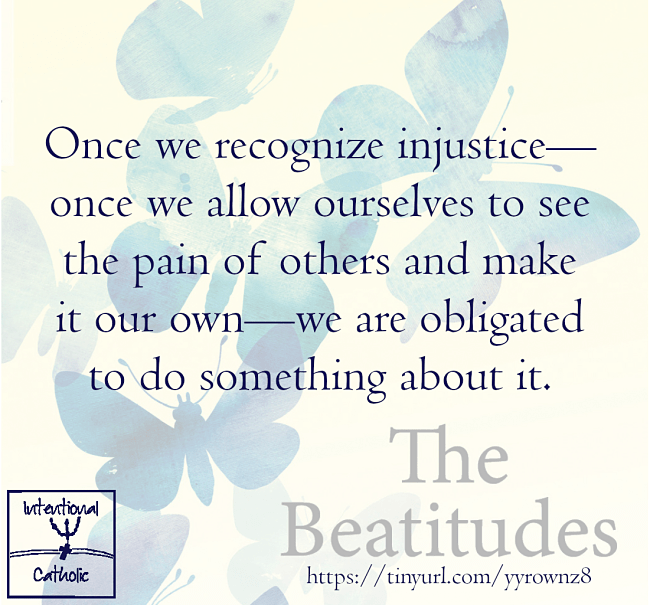
In any case, when I was looking through the possibilities for things to share today, this quote from my Beatitudes book seemed to dovetail with what we heard at church yesterday. Because what if? What if, instead of money, we made God’s will, God’s kingdom, God’s priorities, the central principle that guided every other choice?
When we (and by “we” I mean American culture–media, social media, etc.) talk about climate change, environmental stewardship, etc., we focus pretty much exclusively on policy: the Paris climate accord, rollbacks of protection initiatives, opening up preserves for drilling, etc. I remember when Trump first decided to pull us out of the Paris Climate Accord, I posted my “ways to be a good steward of the environment,” suggesting that if all of us examined our lives, we could still make a big difference ourselves. Someone I know poo-poohed the idea that we as individual people could have an impact.
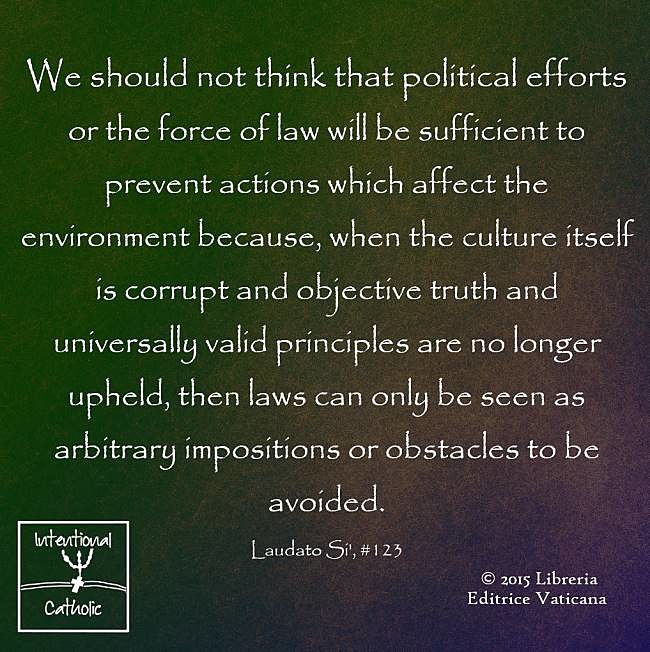
But this clip from Laudato Si’ points out an uncomfortable truth: that it’s human nature (especially when profit is involved) to look for loopholes, to figure out how to be the exception so as not to have to do what is difficult, costly, or uncomfortable. Law, in other words, isn’t going to fix the problem of poor stewardship of the earth by itself. We as individuals have to step up and do our part.
Which doesn’t necessarily mean big, earth-shattering things. My family is saving for solar, but in the meantime, a big part of how we form our kids is a focus on reducing waste and initial consumption. Things as simple as those stupid party bags full of useless, disposable junk that you tend to get at birthday parties. Why? Every bit of that is going to end up in the landfill sooner rather than later.
Things like (and those who know me will say “oh here she goes again”) turning off the car when you’re waiting on kids, sitting in the grocery store parking lot, or checking your phone. There’s almost always an option–sitting under a shady tree when it’s hot; going inside when it’s cold. The vast majority of the time, the only reason to leave the car running is one’s own comfort/convenience. Comfort/convenience is one of the most insidious, invisible idols of modern life.
The increasing number and severity of natural disasters hasn’t yet touched *most* of the First World (though even here, we’ve had fires and superstorms and hurricanes). Acting like our daily choices are divorced from the greater good of the earth and those who shelter on this tiny oasis of blue in a vast universe is not a mark of true discipleship. Being a Christian means examining our daily choices–in other words, our habits–and being more intentional about them.
This insight was a really monumental shift for me in my faith. I knew the truth of it, at least as it related to particular issues of importance, of course. But it was a big deal to realize that whatever ignites my righteous anger, makes me squirm, or breaks my heart in the news–those things are, in fact, a call to action from God, speaking through my conscience.
I recognize them now, though I’m far from perfect about the “doing something” part. Writing “The Beatitudes” reminded me of that every time I sat down to work on it.
The subject of unity has been on my mind a lot lately.
A well-formed, 100% orthodox Catholic friend shared an editorial addressing the danger of the organized dissidence against Pope Francis. It’s from NCR, which conservative Catholics often don’t trust, so I didn’t share. But I’ve been troubled for a long time by this as well as other signs of division in the Church. How can I make a difference? How can I foster unity in the Church–and, for that matter, in the world?
Wrestling with those questions brings me back to this:
Dang it.
This is hard to swallow. I mean, I know I am flawed and weak. The rush to judgment I excoriate others for is my greatest sin, too. But I’m trying so hard to think around the issues that divide us. To form myself, educate myself, and discern whether the good in one side outweighs the good in the other. And to share whatever good there is with others. My hope is that taking a measured approach can help bridge the gaps between us. Am I really powerless?
I was contemplating this question with great angst when my laptop unexpectedly switched documents. There’s nothing particularly remarkable about that (unfortunately); being an old computer with a first-generation touch screen, it does random things like that pretty regularly. What was remarkable was the document it flipped over to—a nugget carved off another post that wandered too far from its original topic:
For years, I’ve wanted to pull my hair out as our society—both within the Church and outside it—makes a run for the all-or-nothing extremes. If one dares challenge trickle down economic theory, one must, by definition, be against capitalism. If one says “America should be better than this,” one must, by definition, hate America.
Of course, it happens the other direction, too. Words like “racist” are getting thrown around pretty freely these days. Now, I’m a big believer that white privilege and unexamined bias are real problems. I see them manifest in myself daily, and the struggle to conquer them is part of my spiritual journey. But it also seems perfectly self-evident that well-intentioned people suffering from white privilege and unexamined bias are not going to be convinced to confront said privilege by being called racists for it. How we talk about things matters.
I had to stop and chuckle at the Holy Spirit’s timing. It was like a little Divine nudge saying, “Yeah, unity is my problem–but I have a job for you, don’t worry.”
As for the division in the Church: I’ve now read two of Pope Francis’ documents in full, and I am baffled by the voices raised so loudly against him. Everything I see is so clearly, authentically Catholic. He’s called out people for getting too focused on a sliver of the Kingdom to the exclusion of the rest; he’s called out legalism and extremism; he’s called out the misidentification of things of the world as things of God. But there’s nothing threatening to the faith in any of that. So my best (most charitable) guess is that people get defensive when challenged to grow beyond the comfortable and familiar.
There’s a lot of demonizing going on within the Church, and it’s got to stop. There’s got to be room in the Church both for people who are passionately committed to annihilating abortion and people who believe we can’t sacrifice every other Gospel command in pursuit of that worthy goal.
I can’t help feeling that a lot of the negative chatter about Pope Francis is a reaction to him being outspoken on social justice rather than abortion. I have to keep reminding myself of this:
Both in our Church and in the larger world, our habit is to do exactly the opposite—and to cling so tightly to our assumptions that we end up not even seeing there could be another interpretation.
When we do that, the Devil is the only winner. When we do that, we’re giving the Church and the world to Satan.
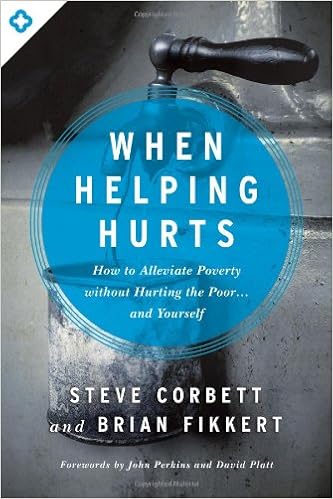
I can’t say enough good things about this book. Written by two Christians (not Catholic) who have been involved for decades in mission work, they share wisdom on how to be helpful, rather than going in with great intentions and making everything worse. In a nutshell, it boils down to this: we can’t come in and be saviors. Our job is to facilitate others helping themselves. There are three types of help: relief, recovery, and development. Most of the time, what’s needed is development, but the vast majority of the time what we offer is relief–because it’s easier. It’s easy to measure, its results make good reports to the investors.
The authors take a “both/and” approach. Many Christians look at the poor and assume they got that way by their own bad choices/sins; therefore their problems are theirs, not ours, to deal with.
Sin is an issue, the authors stress, but so are unjust societal institutions. As an example, they point to civil rights work in the south in the 1960s, and a particular pastor who didn’t speak out on racism.
“Both Reverend Marsh and the civil rights workers were wrong, but in different ways,” the authors wrote. “Reverend Marsh sought the King without the kingdom. The civil rights workers sought the kingdom without the King.”
The authors address overseas missions as well as efforts undertaken within the U.S. When Helping Hurts suggests that successful solutions are not either/or; they have to acknowledge both the effects of personal sin and the effects of institutional oppression, because those two things exert an influence over each other:
“What happens when society crams historically oppressed, uneducated, unemployed, and relatively young human beings into high-rise buildings, takes away their leaders, provides them with inferior education, health care, and employment systems, and then pays them not to work? Is it really that surprising that we see out-of-wedlock pregnancies, broken families, violent crimes, and drug trafficking? Worse yet, we end up with nihilism, because these broken systems do serious damage to people’s worldviews. Worldviews affect the systems, and the systems affect the worldviews.”
(p. 92)
When Helping Hurts offers the concept of “poverty alleviation” as a solution to the complexities of institutional injustice and personal sin. It is a “ministry of reconciliation” in which we use our money in such a way as to empower those in desperate circumstances to begin to help themselves. It acknowledges that they do, in fact, need help from outside, but that as much as possible we should honor the God-given human dignity of the poor by allowing them to be the leaders and the experts in their own lives. That our job is to empower them, not rescue them.
I’ve long believed that in most issues we bicker about, God is in the middle. This book shows us a Godly middle to issues of poverty. Both conservatives and liberals will find things that resonate and things that challenge in this book–which is, to me, the strongest argument that they are on target.







 Intentional Catholic