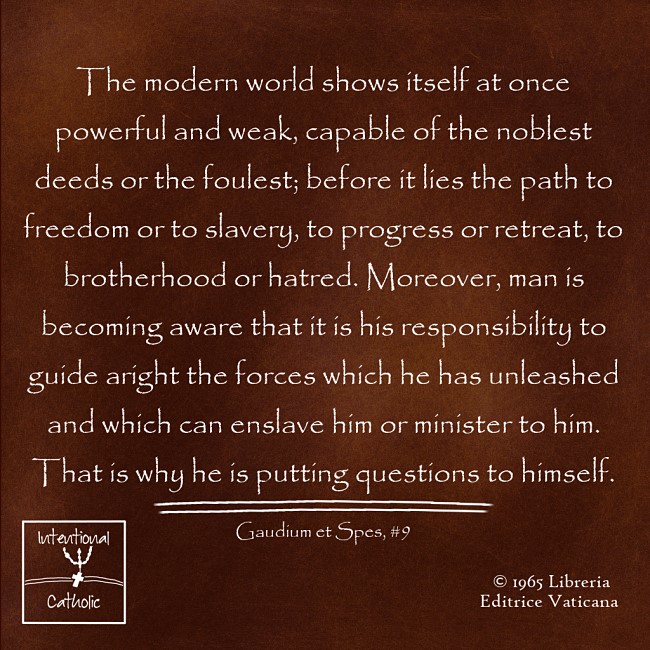
This is such a striking and beautiful statement, I want to let the document stand on its own today–a good reflection as we launch into this second week of Advent. Here is some of the context surrounding it.
In the depths of his conscience, man detects a law which he does not impose upon himself, but which holds him to obedience. … Conscience is the most secret core and sanctuary of a man. There he is alone with God…
Conscience frequently errs from invincible ignorance without losing its dignity. The same cannot be said for a man who cares but little for truth and goodness, or for a conscience which by degrees grows practically sightless as a result of habitual sin.
I spend most of my time here reflecting on things I’ve already discerned, words of wisdom shared by popes and bishops and saints. Sometimes I worry that I look like I think I have it all figured out (read that: holier than thou).
I don’t.
I’ve been in a bad frame of mind lately. Aware of it, pondering it, praying about it, but not seeing any improvement. Yesterday morning, I was driving across town when I saw a minivan owned by a taxi company. It had a Scripture reference plastered on the side. I didn’t even see what the Scripture was. I just had an immediate negative reaction.
I was sort of shocked by how strong it was. It should be a good thing for a person to witness to his/her faith publicly. This should spark warmth, joy, affirmation. Not negativity. What does it say about me, as a person of faith, that my first reaction to expressions of faith in business owners is such a negative one?
How terribly jaded I have become.
Not without reason.
There are an awful lot of people walking around wearing Christianity on their sleeve and saying terrible things, shredding the human dignity of others through memes and tweets and nasty social media comments, sharing clickbait headlines that don’t even reflect the article content accurately, let alone reality, from websites that demonstrate by their publication choices that they consider taking things out of context, twisting the truth, or deleting inconvenient facts as justifiable in pursuit of their agenda. (Agenda outranks Ten Commandments.) Christians who say “thoughts and prayers” after every natural disaster and mass shooting while turning a blind eye to the scientific consensus on climate change and insisting that “it’s mental health, not guns,” while simultaneously advocating cuts to mental health funding because cutting taxes is more important than taking care of the earth God gave us or being our brothers’ keeper.
That’s the sin I see in too many people who share my faith.
Now here’s mine.
It’s a sinful judgment to assume that one who puts Scripture verses on the side of his or her business car is also sharing inflammatory memes and tweets and making nasty social media comments and sharing clickbait and substituting “thoughts and prayers” for action.
But God forgive me, that’s where my mind goes.
I don’t like this about myself. I want my faith to be a source of joy, for me and for others. I want to assume the best of others, as I so often admonish others to do. (Doing religious writing really is a round-the-clock examination of conscience.)
I don’t want to feel reluctant to talk about praying for others–but I do, because too many people have been on the receiving end of “prayers” that are really judgments. “Prayers” that are holier-than-thou rather than expressions of solidarity.
I don’t want to be judgy of others (“Stop judging, that you may not be judged,” Mt. 7:1). I know the upheaval it took to pry my mind open and force me to recognize the things I see now. I should offer grace, not judgment.
I want Christianity to be all it was meant to be by Jesus, and I want to be able to talk about it without sounding holier-than-thou (read that: off-putting).
I have no idea how to fix any of this. In myself or in the larger world, either one.
I came face to face with my own brokenness yesterday, and it wasn’t pretty. I don’t have it figured out, and I won’t pretend I do. The one thing I know is that without such honest self-reflection, there is no moving forward.
I love this passage so much. It makes me chuckle, because it’s so dead-on, and it’s not couched in airy-fairy language. “Irksome,” indeed! That’s a dead-on assessment of the reaction these concerns usually get. People are irked at having to think about them.
This whole section of Evangelii Gaudium is talking about economic systems and the need to make sure they are truly equitable and provide for the poor. It’s a procession of plain-speaking, conscience-pricking paragraphs: welfare should be considered a temporary solution, the dignity of the human person should shape all economic policy, inequality is the root of social ill, we can’t trust the market to do this work, and on and on. It’s so good. Take time to read it!
Bear with me, because you may think I’m posting this on the wrong blog.
Friday night, I went to an Asian grocery store to buy boba pearls. Outside stood a group of three young people, chatting in what I presume was Chinese over a grocery cart full of white plastic bags. It was a beautiful night, and I glanced over at them as I walked in. My eye caught on the gorgeous dress one of them was wearing. Red, with white and black trim, fitted without being slinky, worn over black leggings. I thought, “I want to shop where she bought that dress.”
And I had this moment of crystal clarity: I hate American fashion. Every outfit I’ve admired in the past 4-5 years has been from Asia or Africa.
For months, I’ve been searching for a handful of clothing items to serve a particular purpose. I’ve bought nothing, because I can’t find anything I like. Not in the consignment stores where I start and not in the big box stores.
A friend of mine found this train of thought troubling. If this is true, how do we live faithful life? What if we can’t even survive without participating in some way in a system that harms others? What if the system is so pervasive, we can’t escape it?
To which I add: if we could opt out, wouldn’t we actually increase the misery of the poor, because whatever income they do make is more than they’d make if we stopped buying?
The world is full of good things, and I want to enjoy them: chocolate, a good book, and my backyard patio set all give glory to God, the maker of the raw materials and the giver of the human creativity used to shape raw materials into wonderful things.
But it’s hard not to wonder if I should be diverting every penny I spend on these things to people fighting for little more than survival.
How long, O LORD? I cry for help but you do not listen! I cry out to you, “Violence!” but you do not intervene.
And God’s reply:
The vision still has its time, presses on to fulfillment, and will not disappoint; if it delays, wait for it, it will surely come, it will not be late.
Habakkuk’s pain is so familiar. The world is such a mess. We just want God to fix it already.
But how can we yell at God for not acting to alleviate the injustices at work in the world? We’re the ones who enact the injustices, not God. The only way they get un-enacted is “if today you hear God’s voice, harden not your hearts.” In other words, learn to recognize injustice and then DO something about it.
But the obstacles to doing something seem insurmountable. I’m a big believer in pebbles and ripples. I throw my pebble in the pond, you throw yours, and the guy down the street throws his, and eventually things change.
But it’s not satisfying. Waiting is hard. Waiting leaves us conscience-stung in that no-man’s land between the good things of the world and the knowledge of who’s actually paying the price for them.
And maybe, in the end, that’s the only takeaway: that while we are in the world, we have to accept that we are never going to have the answers—we’ll always be wrestling with what is versus what could or should be. We’ll always be looking for that balance between enjoying the world God gave us and recognizing the ways in which we are called to act. Even if it requires sacrifices we don’t want to make.
Love is one of those words we throw around a lot. I often get frustrated when homilies focus on love, not because it’s wrong to do so, but because so much of the time, it stays in the realm of the theoretical. We can all nod our heads sagely and agree that to be a disciple is to love, but it’s awfully hard to recognize the concrete ways in which we don’t love at all.
It’s easiest to spot in the kids. One kid comes home stressed by lack of time and homework. He has a veritable comic strip cloud hanging over his head, with lightning bolts coming out of it. He bites off the heads of his brothers, who aren’t actually doing anything wrong, and they react by being predictably hateful. I may or may not, recently, have shouted, “All the religious formation in the world is useless if you can’t figure out how to live it in real life!”
Every parent reading this post probably chuckled and nodded sagely just now. We’ve all dealt with it.
But it happens to us, too. We’re just a lot more sophisticated with our stresses, and far more skilled at justifying ourselves for not acting in love.
The readings this weekend were all about money. Amos was talking about the dishonesty of those with money–how they were so focused on their own profits that they didn’t really care what happened to the “have not”s of the world. And Jesus said, “Guess what? How you use your money matters.”
Listening yesterday at Mass, it really struck me how those readings should skewer America. The obvious application is the question of income inequality: how many of the huge profits made by companies are held by those at the top of the food chain, how little is actually shared with those down the ranks.
But you know, so much of what we talk about in America centers on money. Many would like to believe we’re a Christian nation, but money–capitalism–is the primary thing that preoccupies our social and political discourse, even among Christians. So many things come back to money: health care and social programs would require more taxes, and we can’t possibly suggest raising taxes. Immigrants are perceived as a threat to American jobs, so again–it comes back to money. The question of whether a president deserves re-election is always about the economy. We’re having all these discussions about China and intellectual property and trade fairness, but nowhere on anyone’s radar is the question of just wages for labor, which is–let’s face it–the only reason manufacturing went overseas in the first place. It went overseas because we, the rank and file Americans, aren’t willing to pay what it would cost to make a product while paying a just wage to the laborer who made it.
We have a lot to answer for, and I don’t pretend to have a pat solution. I personally try to take a step back from the consumer culture by starting with secondhand clothing purchases as much as possible. But those clothes, too, were made by cheap labor overseas, and I order from Amazon just like every other red-blooded American. What do I think God will say to me when it comes time for me to answer for my choices? I don’t like pondering that question any more than anyone else.
In any case, when I was looking through the possibilities for things to share today, this quote from my Beatitudes book seemed to dovetail with what we heard at church yesterday. Because what if? What if, instead of money, we made God’s will, God’s kingdom, God’s priorities, the central principle that guided every other choice?
While I was preparing a talk called “Who is my neighbor?” recently, I learned that the Jewish law was laid out as a set of concrete guidelines to explain how it looks, in real world terms, to “love the Lord your God with all your heart, with all your heart, your soul, and your mind, and your neighbor as yourself.”
Isn’t that interesting? Jesus is all over people in the Gospels for being too rigid and scrupulous about the Law, and Paul takes it to a whole new level. From that, modern Christians sort of naturally assume the Law was intrinsically flawed. But this made me realize the purpose of the Law was the same as what I’m doing here: to try to connect airy-fairy concepts of the faith to a concrete world.
The problem came when scrupulousness and rigidity about the precepts of the law caused people to judge others rather than love them.
I have two thoughts on this, and they’re kind of contradictory. On the one hand, I think the modern Church suffers from the same scrupulosity as ancient Jews. I know I have. Frankly, I think it’s more common among Catholics than we might think. What is Catholic guilt, if not an overwhelming anxiety to make sure we’re doing things RIGHT? And we judge everyone else for not doing the “right” thing. (Cough-cough-liturgy wars-cough-cough)
On the other hand, we tend not to recognize what the precepts of the faith actually mean in real life. All the big political issues of the day–abortion, guns, health care, immigration, race, etc.–looking at these through the radical call to love unconditionally should make all of us squirm, wherever we fall on the political spectrum. The love of money taking precedence over care of neighbor or creation. And so on. It’s like I said to my boys yesterday morning before school, when they were being nasty to each other: “All the religious formation in the world will do you no good if you can’t figure out what it looks like in real life!”
This is the question I leave us all with for the weekend: if showing love is how people will know I am a follower of Christ, HOW do I show love in this moment, this time, to this person I am encountering?
I can’t stand conflict. But there’s something I loathe even more: when people who are upset with each other talk past each other instead of to each other. I’ve been harping on this for years in politics, but recently it’s come home to me that it happens an awful lot in places much closer to home.
There’s a relationship in my family’s life that is riddled with this dysfunction: you see a problem, you ask for an answer, and there’s either a complete lack of response, or the entity on the other side of the line issues its “message points” instead of answering the question. Is it any wonder that a person who approaches communication in good faith and gets message points in return ends up feeling, well, enraged?
Unfortunately, it’s a common dysfunction. I’ve come to believe it is the source of tremendous unnecessary angst and lack of peace in the modern world. As I ponder this, weighed down by the frustration and bewilderment that comes from beating your head on a brick wall you can’t avoid, I realize something else: we live in a world defined by fear and lack of trust. People use their message points because they’re afraid if they address the questions on the other side of a conflict openly and honestly, it’ll come back to bite them. They’ll get sued, they’ll get in trouble with their superiors, or whatever.
My whole life, I’ve been conditioned to look at the big picture, and so for years, when I ponder questions like this, I’ve gone straight to its impact on issues of global or at least national import. But everything big starts small. If protectionist passive-aggressiveness is what we as individuals face in interacting with individuals or local entities (and how often are we the guilty party?), then of course the larger world looks this way, too. It’s like those mosaics made up of hundreds of tiny thumbnails. One individual incident doesn’t change the world—but all together, they form a global pattern.
“Let your yes mean yes and your no mean no,” Jesus says. His context is different, but it applies all the same: Just lay it out straight. Don’t dance around. Be authentic and communicate in good faith.
What if changing the world could really be that simple?
**(Note: I did not say “easy.” I said “simple.”)**







 Intentional Catholic